semi合集-English.pdf - 第2285页
SEMI E81-0600 © 1999, 2 000 22 NamedEnti ty (from Reso urce AIG) Material TrackingLocatio n (fro m Machi ne Gr oup) Mate rial Group 0..* contains 0..* Material Container (from Dura ble Mgt Co mp) Inventory RegionSystem (…

SEMI E81-0600 © 1999, 200021
• Capture, record, interpret and respond to
equipment events and fault detection.
• Generate MES-level job status events and
material location change events.
• Record and report on material locations and
material movement histories for material in the
system.
• Interact with Production Machine component and
loadport for material hand-off handshake protocols.
7.2.20 Responsibilities of Factory Labor Component
7.2.20.1 The Factory Labor component (defined in
SEMI E86) implements the generic Factory Resource
architecture (see Section 7.3.3) applied to factory
personnel resources. It represents personnel, their
capabilities (skills) and skill maintenance (training), and
their assignment to other factory resources (to machines
and areas) and jobs. The Factory Labor component
integrates with access security services (in the Factory
Services group) to associate personnel with roles,
identity authentication (e.g. system login passwords)
and access authorization.
7.2.20.2 Build-time Responsibilities of Factory Labor
Component
• Configure the Person resource model.
• Each Person’s name, identification, department,
role, etc.
• Each Person’s initial skills and authorization to
perform jobs and access data.
• Each Person’s initial assignment to other
factory resources (such as specific machines or
factory areas).
• Each Person’s medical qualifications.
• Define skill maintenance tasks and what triggers
them.
7.2.20.3 Run-time Responsibilities of Factory Labor
Component
• Track and report the Person skills, authorization
and assignments and record these in Person
histories.
• Support assignment of Persons to factory jobs and
monitor and record job progress (from the
perspective of the Person’s role).
• Monitor skill maintenance triggers (such as expired
skill certification) and recommend skill
maintenance jobs.
• Execute triggered skill maintenance jobs.
• Change Person capabilities (before and after
training).
• Execute and monitor skill maintenance jobs
(training, certification testing) and report job
progress.
• Record skill maintenance triggers and job
results in person skill maintenance histories.
• Collect and report person and skill performance
(utilization and effectiveness).
• Maintain relationships between persons and system
security for identity authentication and
authorization.
7.3 Common Architectural Patterns
7.3.1 This section documents architecture patterns that
serve to functionally integrate CIM Framework
components. The material architecture defines
functionality common to Product Management,
Durables Management and Consumables Management
components. The factory resource architecture defines
relationships and common functionality of factory
resources. The job architecture defines a factory-wide
model of controlling factory operations.
7.3.2 Material Architecture
7.3.2.1 The Product Management, Durables
Management and Consumables Management
components all share a common architecture for
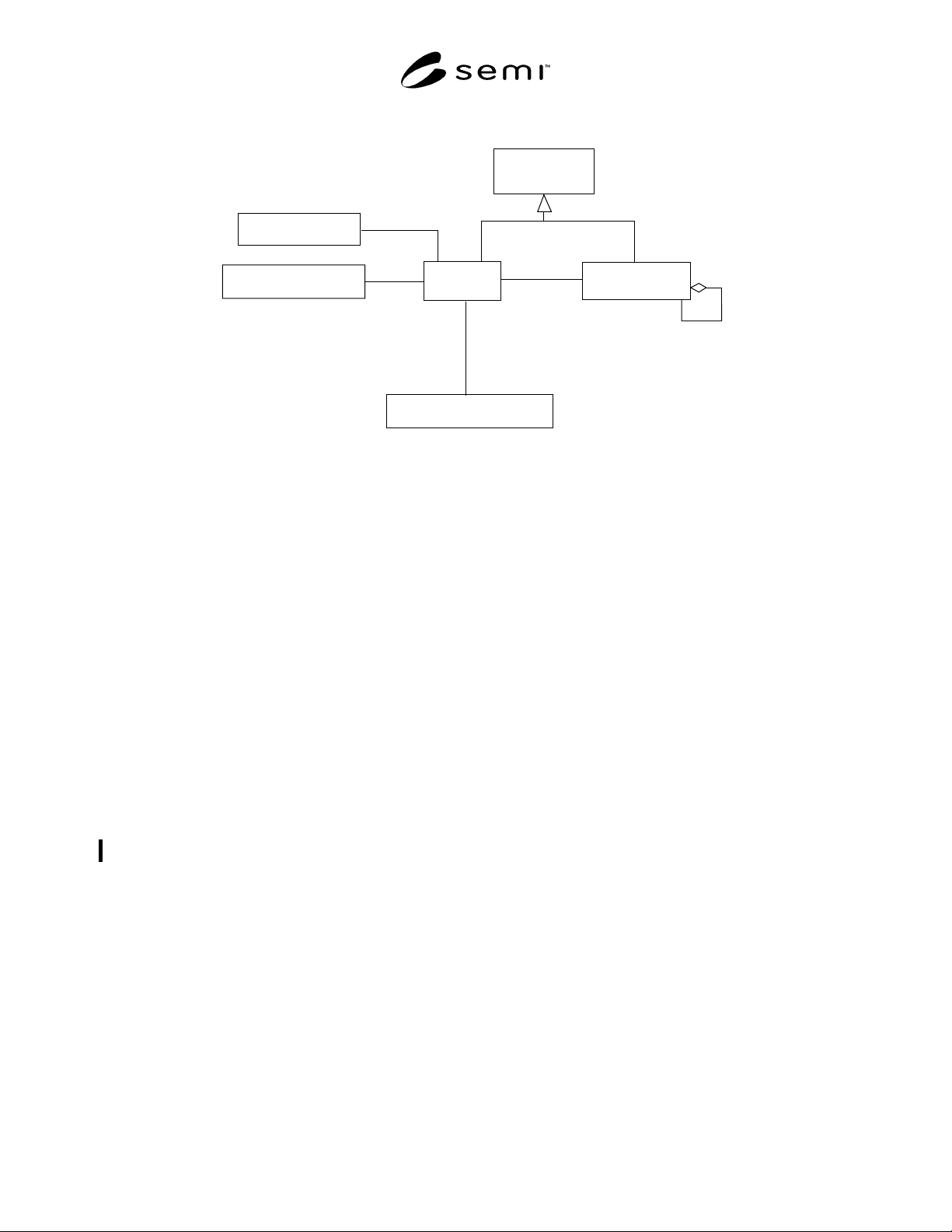
identifying, grouping and locating materials. Figure 6
illustrates the common material interface architecture.
7.3.2.2 Material has an identification, history, location,
inventory region and associations to material containers
that may contain it. Material can also be in multiple
material groups that physically (same location or
carrier) or logically (same lot, same process batch, same
product family, etc.) associate material. Specializations
of material include products, durables and consumables.
Specializations of material groups include product
groups, lots, process groups and transport groups.
SEMI E81-0600 © 1999, 2000 22
NamedEntity
(from Resource AIG)
MaterialTrackingLocation
(from Machine Group)
MaterialGroup
0..*
contains
0..*
MaterialContainer
(from Durable Mgt Comp)
InventoryRegionSystem
(from Inventory Region Mgt Comp)
Material
0..*
0..1
0..*
0..1
holds
0..*
0..*
0..*
0..*
is grouped in
0..*0..*
0..1
0..*
0..1
0..*
holds
in
0..*
0..*
0..*
0..*
is
associated
with
Figure 6
Material Interface Architecture
7.3.3 Factory Resource Architecture
7.3.3.1 Factory resources, such as machines, people
and reticles, are the entities that participate in
transforming material into products. The CIM
Framework defines an overall domain architecture for
factory resources that supports
• resource tracking and maintenance (resource usage
counters, maintenance procedures, etc.),
• hierarchical organization (e.g., a factory is
organized into areas which group machines and
people),
• composition of resources (e.g., a machine is
composed of chambers, load ports and sensors),
and
• an object-oriented type structure (transport
machines and production machines are types of
machines; machines, ports, durables and people are
support resources, etc.).
7.3.3.2 This section defines the CIM Framework
resource architecture.
7.3.3.3 Factory Resource Hierarchy
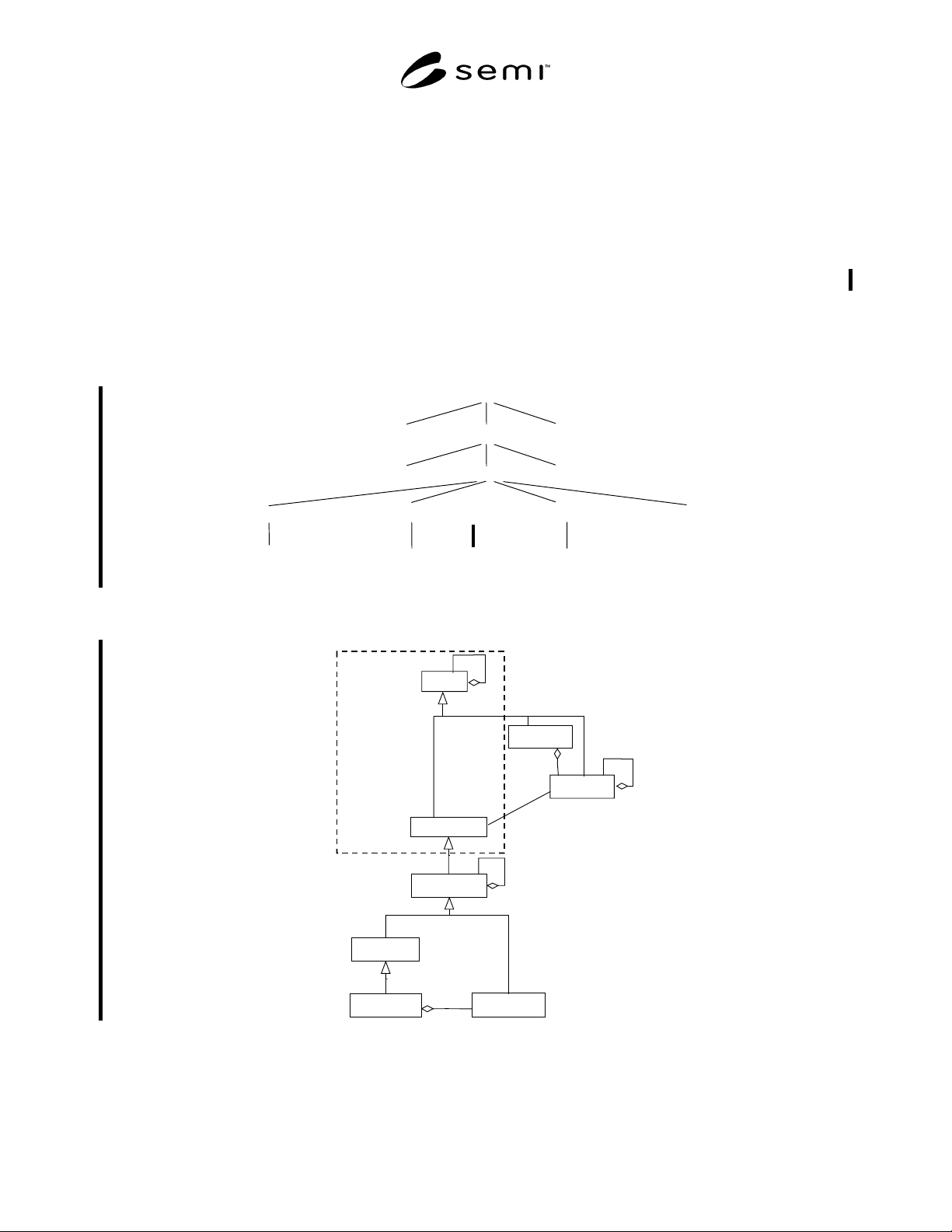
7.3.3.3.1 A factory is usually viewed as a hierarchy of
resources organized in groups, as in Figure 7. Each
level or portion of the hierarchy has an associated task
scope.
• An enterprise often includes multiple factories. The
task of the enterprise is to deliver products to
customers.
• A factory is made up of areas and bays with
interbay material handling systems. The task of the
factory is to manufacture product in response to
product requests.
• Areas or bays are made up of processing and
metrology equipment with intrabay material
handling systems. The task of the areas or bays is
to perform a group of process operations on groups
of materials, move material to the processing
equipment, and perform maintenance and other
supporting tasks. For a simple factory, the area
level is optional. For a complex factory, there may
be multiple area levels, with areas made up of sub-
areas.
• Complex processing equipment (such as a cluster
tool) is made up of processing chambers and
internal material handling and storage resources.
The task of the processing equipment is to perform
a process or metrology step or a closely related
group of steps on a material lot or process group.
The task of the processing resource in the
processing equipment (such as a chamber in a
cluster tool) is to perform a single process step on a
single wafer or on a collection of wafers in a
process resource group.
• Material handling and transport systems are made
up of interconnected stockers, tracks, conveyers,
robotic handlers and other material storage and
movement equipment. The task of the material
handling systems is to store and move materials in
transport groups.
SEMI E81-0600 © 1999, 200023
• Manufacturing operators and other factory
personnel are important resources to facilitate and
supervise material processing and handling,
preventive maintenance, and in some cases,
perform manufacturing steps such as moving
material or performing a visual inspection.
• Other factory resources include durables (reticles,
cassettes, pods, etc.) and consumables (gases,
utilities, etc.).
• The information model in Figure 8 shows the CIM
Framework Resource Composition Architecture.
The interfaces in the box labeled Resource Abstract
Interface Group define the generic resource
architecture. In general, resources can be composed
of other resources. In particular, at the factory and
area levels, Factory can be composed of Areas and
an Area can be composed of other Areas. Areas
group Support Resources, such as machines and
persons. This is not a strict composition so that
support resources can be in more than one Area
grouping. At the machine level, Machine
Resources are composed of other Machine
Resources, in general. In particular, Production
Machines are composed of Process Resources.
Production Machine
Transport Machine Storage Machine
Transport Resource Storage Resource
Enterprise
A
rea
Factory
Process Resource
Person
... ...
... ...
Figure 7
Factory Resource Hierarchy Model
Resource
MachineResource
Machine
ProductionMachine
ProcessResource
0..*0..*
0..*0..*
MESFactory
SupportResource
Area
0..*0..*
0..*0..*
groups
0..*
0..*
0..*0..*
Generic
Resource
Architecture
(part)
Figure 8
Resource Composition Architecture