semi合集-English.pdf - 第1997页
SEMI E54.6-0997 © SEMI 1997, 2004 3 4 Referenced Documents 4.1 SEMI Documents SEMI E30 — Generic Model for C ommunicati ons and Control of SEMI E quipm ent (GEM) SEMI E39 — Object Se rvices Standard: Concepts, Behavior, …
SEMI E54.6-0997 © SEMI 1997, 2004 2
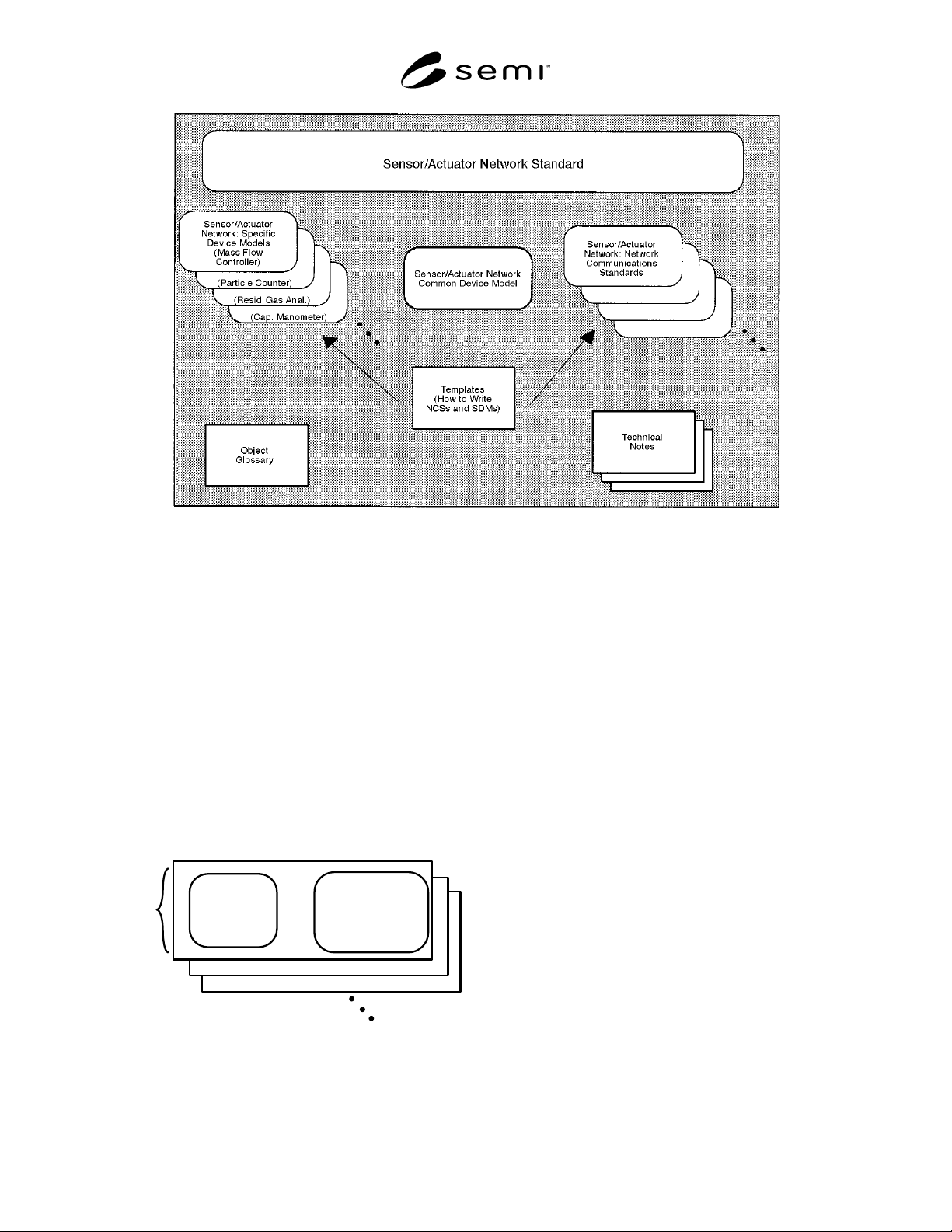
Figure 1
Sensor/Actuator Network Related Documents
2.5 Document Structure — The LonWorks network
communications standard complies with the SEMI SAN
NCS template document structure; this structure is
shown in Figure 2. The standard document is composed
of two main parts. The first part (Sections 1 through 8)
specifies the SAN-enabling protocol as well as the
presentation (i.e., mapping) of CDM object structure
and behavior onto the network (referred to as the
“CDM mapping”). The second part (Section 9)
specifies the presentation (i.e., mapping) of SDM object
structure and behavior onto the network for each SEMI-
specified SDM (referred to as the “SDM mapping”).
Device-type-specific items, such as connector devia-
tions (see Section 6.1), may also be noted in Section 9.
This
Document
SDS NCS
Device Net NCS
Common
Device Model
Mapping
Specific Device Model
Mappings
Mass Flow Controller
Particle Counter
Residual Gas Analyzer
LonWorks NCS
Other NCS
Standards
Figure 2
LonWorks Network Communications Standard
Document Structure
3 Limitations
3.1 This document specifies a semiconductor
equipment SAN based solely on LonWorks and is a
companion document to the LonWorks protocol
specification; thus, a complete specification of this
standard necessarily includes the LonWorks
specifications. There are other semiconductor
equipment SAN communications options. The
specifications for these options are not included here.
3.2 This standard specifies enhancements that provide
additional capabilities over and above those currently
required by the LonMark Interoperability Guidelines.
In order to avoid document consistency problems,
information in the LonWorks technology standard that
relates to this standard is not repeated in this document.
This document is limited to describing enhancements or
limitations of LonWorks technology and the LonMark
interoperability guidelines that are imposed by this
standard.
3.3 A complete specification of the conformance
testing procedure shall include the applicable LonMark
interoperability conformance testing specification.
Conformance testing shall include enhancements to the
LonMark guidelines required by this standard.
SEMI E54.6-0997 © SEMI 1997, 2004 3
4 Referenced Documents
4.1 SEMI Documents
SEMI E30 — Generic Model for Communications and
Control of SEMI Equipment (GEM)
SEMI E39 — Object Services Standard: Concepts,
Behavior, and Services
SEMI E54.1 — Standard for Sensor/Actuator Network
Common Device Model
4.2 ISO Standard
1
ISO 7498 — Basic Reference Model for Open Systems
Interconnection
4.3 Other Documents
LonTalk Protocol Specification, Echelon Corporation,
4015 Miranda Avenue, Palo Alto, CA 94304 USA
LonMark Layers 1–6 Interoperability Guidelines,
Echelon Corporation
LonMark Application Layer Interoperability
Guidelines, Echelon Corporation
Neuron Chip Data Book, Echelon Corporation
Neuron C Programmer’s Guide, Echelon Corporation
Standard Network Variable Type Master List and
Programmer’s Guide, Echelon Corporation
Standard Configuration Parameter Type Master List
and Programmer’s Guide, Echelon Corporation
5 Terminology
Terminology that is common to all of the documents in
this SAN series may also be defined in the Sensor
Actuator Network Standard. Terminology may be
reproduced here which is defined in other SEMI
documents.
5.1 Acronyms
5.1.1 CDM — Common device model
5.1.2 DM — DeviceManager
5.1.3 DS — Device status
5.1.4 NCS — Network communications standard
5.1.5 NV — Network variable
5.1.6 OSI — Open systems interconnect
5.1.7 OSS — Object services standard
5.1.8 SAC — Sensor, actuator, controller object
1 International Organization for Standardization, 1 rue de Varembe, Case
postale 56, CH-1211, Geneva 20, Switzerland
5.1.9 SAN — Sensor/actuator network
5.1.10 SCPT — Standard configuration parameter type
5.1.11 SDM — Specific device model
5.1.12 SNVT — Standard network variable type
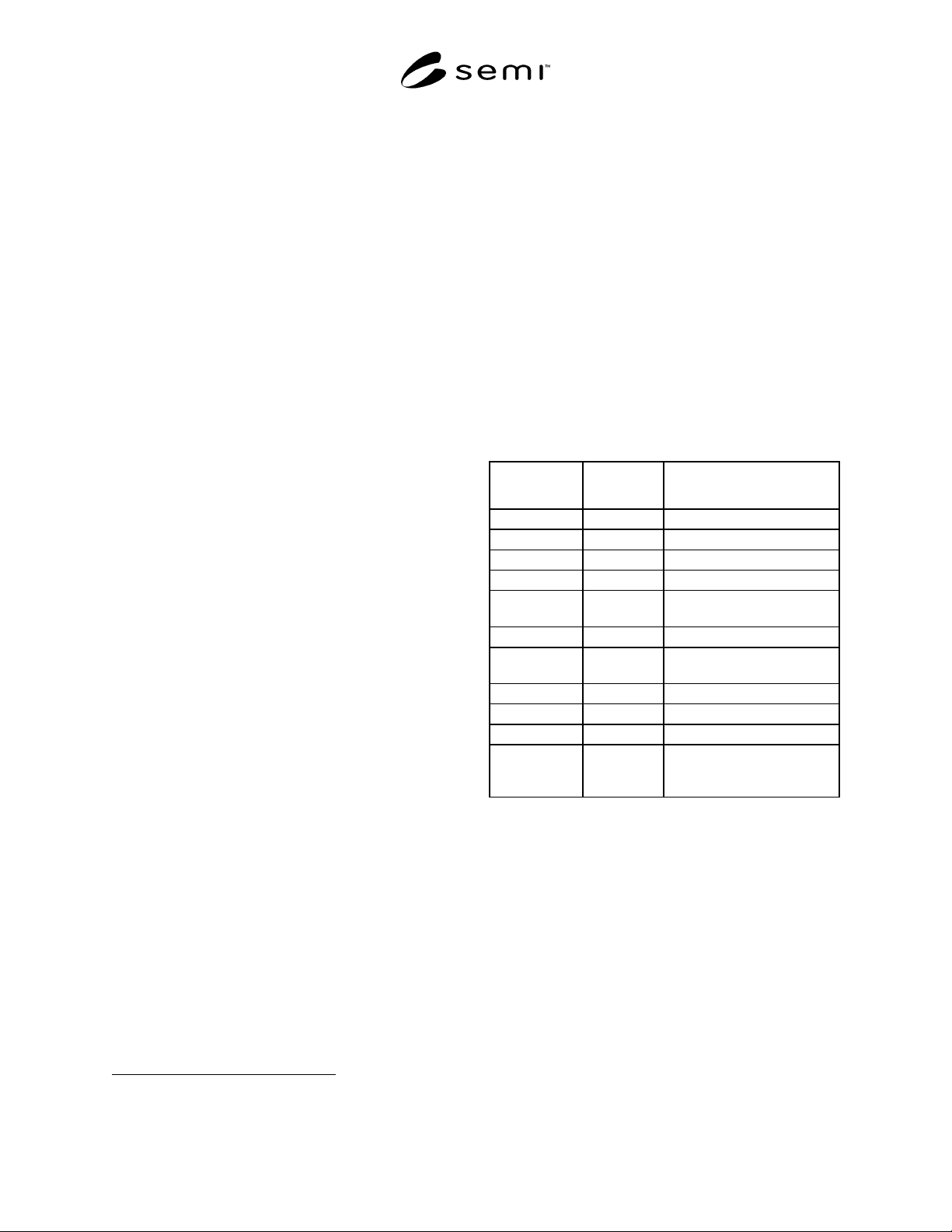
5.2 Device Component Definitions — As this standard
defines the presentation or mapping of CDM data
structure and behavior over a network, it makes use of
many of the terms in the CDM document. Table 1
provides a mapping of fundamental terminology of the
CDM document into this document and the LonWorks
definitions. The symbol “=” indicates that the definition
is used exactly as specified on the CDM specification.
In the following sections, additional clarification of
some of these terms is provided in the context of the
LonWorks protocol.
Table 1 Mapping of CDM to NCS Terminology
CDM Term
NCS
Equivalent
LonWorks Equivalent
Device = Device or node
Device Model = Functional profile
Object = LonMark object type
Instance = LonMark object instance
Attribute = Network variable or
configuration property
Behavior = =
Service = Network variable function or
application message
State Diagram = =
Byte = =
Nibble = =
Character
String
= String of ASCII characters or
string of international
characters
5.2.1 attribute — Attributes are either input network
variables, output network variables, or configuration
properties. Input and output network variables may be
read and/or written by the device itself, and all
attributes may be polled over the network. Additionally,
input network variables and configuration properties
may be updated over the network, and the receipt of
such an update causes an event to be propagated to the
device' s application layer. This corresponds to a RW
(Read and Write) attribute of the object owning the
network variable. Output network variables may not be
updated over the network. This corresponds to a RO
(Read Only) attribute of the object owning the network
variable. When the device itself updates one of its
output network variables, the value of that variable may
be propagated over the network to destination
SEMI E54.6-0997 © SEMI 1997, 2004 4
address(es) determined at installation time. Finally,
configuration properties are attributes typically stored
in non-volatile memory and preserved across device
resets and power cycles.
5.2.2 behavior — Generic object behavior is specified
by the LonMark Application Layer Interoperability
Guidelines. Additional object-specific behavior is
specified by means of functional profiles.
5.2.3 device — A device (or node) consists of one
network transceiver which implements the physical
layer of the LonTalk Protocol, one Neuron Chip with
associated firmware which implements the other layers
of the LonTalk Protocol, and input/output hardware
implementing the physical interface of the device to
external sensor and/or actuator hardware. A LonWorks
device may optionally contain a host processor and
associated software or firmware which implements the
application layer of the LonTalk Protocol.
5.2.4 device model — The device model comprises
several elements which fully describe the external
interface of the device for an interoperable network.
The interface is made of the following pieces: a Device
Manager (DM) object; a Sensor/Actuator/Controller
(SAC) object; LonMark objects such as sensors,
actuators, and controllers; individual network variables;
and configuration properties.
5.2.5 instance — Real devices may have zero or more
instances of each of the defined LonMark objects and
functional profiles. Object instances are identified by
means of an instance number within the device.
5.2.6 object — LonMark objects are defined as a set of
one or more network variable inputs and/or outputs,
implemented as Standard Network Variable Types, and
a set of configuration properties, implemented as
Standard Configuration Property Types. LonMark
objects form the basis of interoperability at the
application layer. The LonMark objects describe
standard formats for how information is input to, and
output from, a device, and shared with other devices on
the network.
5.2.7 service — Request services are represented by
LonTalk messages delivered to the device application.
Notification services are represented by LonTalk
messages originated by the device application.
5.2.8 state diagram — In a LonWorks device, state is
represented by the collection of values of local and
network variables of the application program.
Transitions between states are the result of external
events (such as the receipt of a network variable update,
or other I/O event), or internal events (such as the
expiration of a timer).
5.3 LonWorks-Specific Definitions — In addition to the
standard data type definitions for bit, nibble, byte, and
character, the LonTalk Protocol defines a set of
standard data representations for use as attribute values.
5.3.1 binding — Network variables on the same or
different devices may be associated together by means
of a network management service known as binding.
Binding is permitted only if all the network variables in
the set are of the same data type. The values of network
variables that are bound together are propagated over
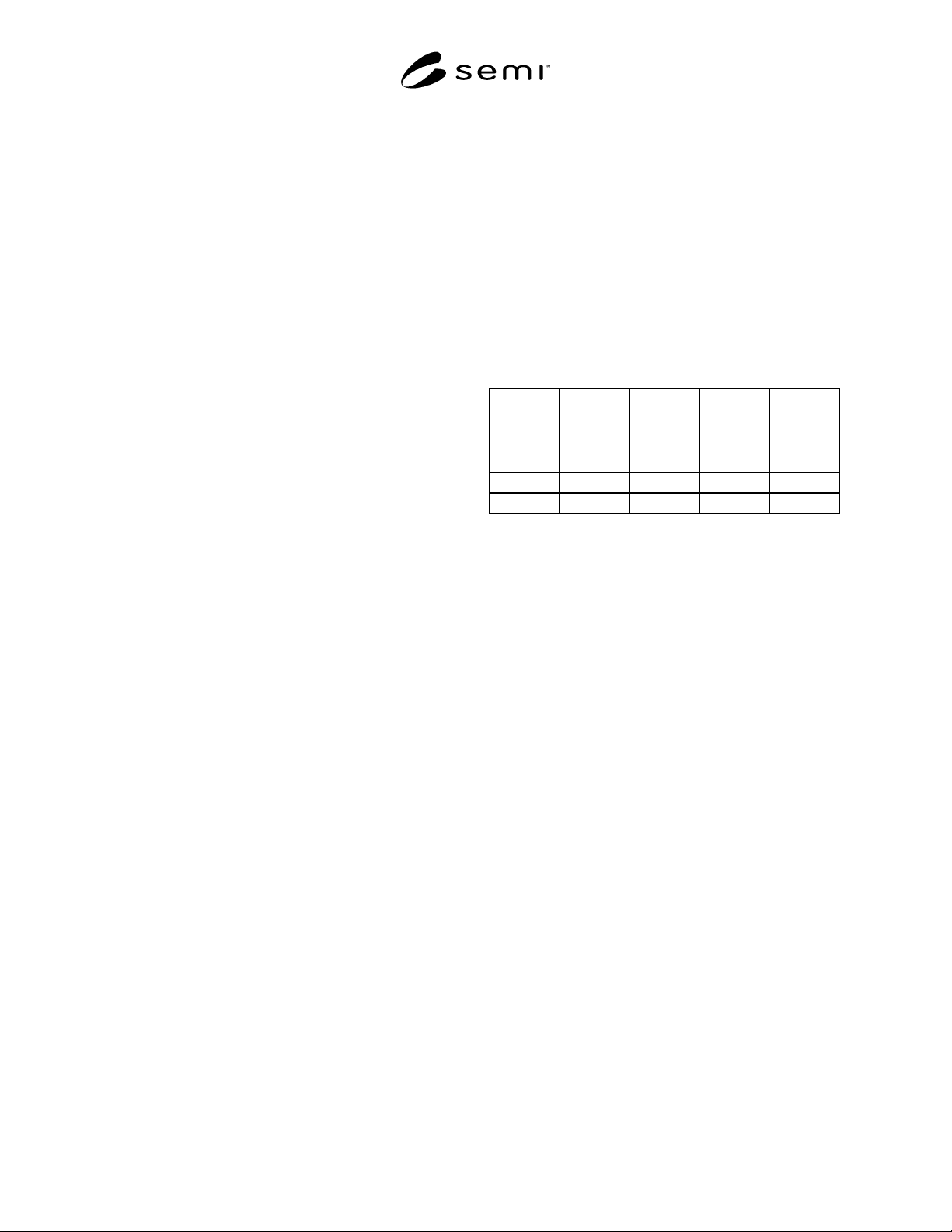
the network by the LonTalk protocol. Table 2 shows the
permitted combinations for updating and polling of
network variables.
Table 2 Updating and Polling of Network Variables
Network
Variable
Class
Update
from
Network
Update
f
rom Device
Poll from
Network
Poll from
Device
Input
Yes Yes Yes Yes
2
Output
No Yes
1
Yes No
Config’n
Yes No Yes Yes
2
NOTES:
1. When the device updates one of its own output network variables,
input network variables that are bound to this output network variable
receive an update from the network.
2. When the device polls one of its own input or configuration
network variables, output network variables that are bound to this
input or configuration network variable receive a poll from the
network.
5.3.2 configuration properties — These are attributes
of a LonMark object that are used to configure the
application-specific behavior of the object, such as
sensor gain and offset, linearization table, and sample
rate. These attributes are typically updated when the
device is installed, configured, or calibrated, and are
stored in non-volatile memory.
5.3.3 functional profile — A functional profile is a set
of one or more LonMark objects, together with
semantic definitions relating the behavior of the
object(s) to the network variable values. The collection
of functional profiles and LonMark objects in a device
corresponds to the device-specific model for that
device. Each type of functional profile is identified by a
type number which is allocated when the profile is
standardized.
5.3.4 network variable — This is a network-visible
data attribute of a device, with a well-defined data type.
Network variables are either input variables, output
variables, or configuration variables. The value of a
network variable may be updated either by the device
itself, or over the network by some other device. This
corresponds to a SetAttribute operation. The value of a
network variable may be polled over the network by