semi合集-English.pdf - 第7462页
SEMI MF1569-0705 © SEMI 2003, 2005 4 6.1.1.3 Draft test method. 6.1.1.4 Obtain con sensus within a represen tative task group or subco mmittee. 6.2 Desig n and ini tiate the Interl aboratory Study ( ILS) . 6.2.1 Design t…
SEMI MF1569-0705 © SEMI 2003, 2005 3
ISO 10012-1, the term “measuring equipment” is extended to include both measuring instruments and measurement
standards (including reference wafers).
4.2 Terminology related to the conduct and analysis of the ILS may be found in ASTM Terminology E 456 and
ASTM Practice E 691.
5 Summary of Guide
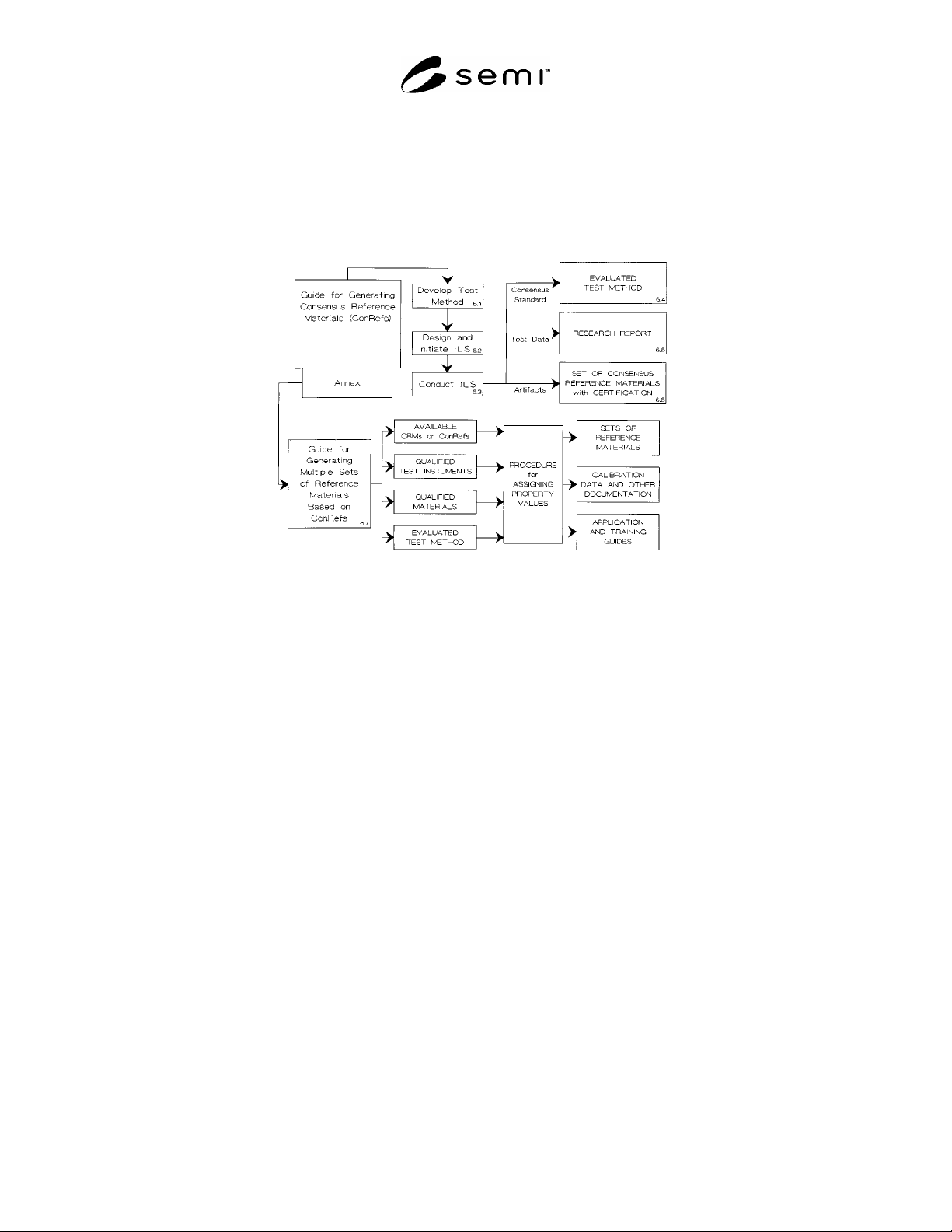
NOTE 2: See Figure 2 for a flow chart of the steps covered.
Figure 2
Flow Chart for Generation of Consensus Reference Materials and Derived Sets of Reference Materials
5.1 The test method to be used is selected or developed, and acceptable levels of repeatability and reproducibility
are defined.
5.2 An ILS test protocol for use with the selected consensus test method is developed in accordance with ASTM
Practice E 691 and the proper materials and instrumentation are assembled.
5.3 The ILS is executed and analyzed.
5.4 The results are evaluated against the criteria selected in ¶5.1. If the results are acceptable, a precision statement
is developed and balloted for inclusion in the test method. If the results are not acceptable, the test method validity
and the usefulness of the materials tested are assessed.
5.5 The results are incorporated into a research report.
5.6 If the results are acceptable, the materials used in the test are now qualified as ConRefs. They have values of
the desired property (or properties) that represent the consensus of the industry; the uncertainty in these values can
be estimated from the repeatability and reproducibility obtained in the test, as documented in the research report.
These materials are stored in a location accessible for future use in preparing replicate sets of reference materials.
6 Procedure
6.1 Select or establish the test method to be used and define acceptable levels of repeatability and reproducibility
for the proposed test method.
6.1.1 If the test method has already been evaluated by an interlaboratory study (ILS) and contains repeatability and
reproducibility results documented in a research report or in the method itself, proceed directly to ¶6.4. Otherwise
develop the test method as follows:
6.1.1.1 Determine feasibility of proposed test method.
6.1.1.2 Conduct screening experiments (ruggedness tests) of the proposed test method in a single laboratory.

SEMI MF1569-0705 © SEMI 2003, 2005 4
6.1.1.3 Draft test method.
6.1.1.4 Obtain consensus within a representative task group or subcommittee.
6.2 Design and initiate the Interlaboratory Study (ILS).
6.2.1 Design the experiment in accordance with the principles of ASTM Practice E 691, taking into account
whether the test is destructive or nondestructive.
6.2.2 Prepare an interlaboratory test protocol that specializes the test method to this design and also includes a
provision for reporting deviations from the method if participants in the interlaboratory test are unable to follow the
test method exactly.
6.2.3 Select, qualify, and prepare materials for the interlaboratory test, paying particular attention to issues of
uniformity, stability, storage, transportation, and handling.
6.2.4 Qualify instrumentation in accordance with test method and applicable quality control practices.
6.2.5 Select and qualify participating laboratories.
6.3 Execute the interlaboratory experiment.
6.3.1 Collect the data in a round-robin or hub-and-spoke mode.
6.3.2 Analyze the data collected in accordance with Practice E 691 to establish the repeatability and reproducibility
of the test.
6.3.3 Derive an appropriate “uncertainty” from the results of the analysis and incorporate the repeatability and
reproducibility into “Precision” and “Bias” sections for the test method.
6.4 Evaluate test results against the preselected criteria (see ¶6.1).
6.4.1 If the result is acceptable, proceed to ¶6.5.
6.4.2 If the result is not acceptable, assess the validity of the test method and the usefulness of the generated
materials. Consider whether the test method may need to be revised or the ILS repeated with improved controls on
the procedures used.
6.5 Prepare a Research Report.
6.5.1 Include the following information in the research report:
6.5.1.1 Description of the nature, purpose, and application of the ILS.
6.5.1.2 Identification of the test method evaluated.
6.5.1.3 Detailed instructions for carrying out the test method including any special conditions or requirements for
the test and any special requirements regarding the nature, transmission, and storage of the test materials.
6.5.1.4 List of participating laboratories.
6.5.1.5 Data report forms.
6.5.1.6 Statistical data summary.
6.5.1.7 Summary of results and conclusions.
6.5.2 Reference the research report in the appropriate test method.
6.5.3 Consider preparing a technical paper to report the results of the ILS.
6.6 Determine disposition of materials.
6.6.1 If the results of the ILS are considered acceptable, establish an appropriate repository for the ConRefs
generated.
6.6.2 Establish the protocol for storage and handling of the ConRefs and the ground rules for future use in
developing other reference materials.

SEMI MF1569-0705 © SEMI 2003, 2005 5
6.7 Prepare guide for generation of multiple sets of reference materials traceable to the ConRefs generated by the
ILS (see Appendix 1).
7 Keywords
7.1 certified reference material; consensus reference material; flat panel display; interlaboratory experiment;
reference material; semiconductor; silicon; sputtering target; working reference material