semi合集-English.pdf - 第874页
SEMI E116-0705 © SEMI 2002, 2005 6 EPT module i dle. 9.2.2 The equipm ent shall maintain an EPT state model for eac h major m o dule (e. g., process stations and c hambers, wafer handling systems, etc.) through which a…

SEMI E116-0705 © SEMI 2002, 2005 5
8 Overview
8.1 This section defines the concepts that enable EPT to provide information required for determining equipment
performance.
8.2 Equipment processing times, including throughput and cycle times, are determined by two factors: (1) the
sequence of tasks performed by the equipment’s EPT modules, including the number of each task performed, as well
as the series and parallel relationships between tasks, and (2) the execution time of each individual task. By tracking
equipment systems in terms of modules that perform tasks, it will be possible to precisely identify the affect of both
factors toward overall system performance.
8.3 EPT enables tracking to this level of detail by introducing the concept of an EPT module and the concept of a
task. EPT-compliant equipment are required to report events according to a breakdown of equipment operations
into tasks and EPT modules. An EPT module is an equipment component that affects processing or throughput, and
is capable of executing only one task at a time. Examples of EPT modules include process stations, process
chambers, wafer handling systems, etc. A task is a planned and repeatable activity with an expected duration and a
definite beginning and end. Examples of tasks include the following:
Move wafer from cassette to stage
Pre-align wafer
Align reticle
Preheat chamber
Increase vacuum etc.
8.4 EPT-compliant equipment consist of EPT modules that perform tasks. Thus, the state of the equipment can be
effectively modeled as a composition of the states of the EPT modules. In addition, EPT provides detailed
information required for performance tracking by providing the task-level details for each EPT module.
8.5 EPT modules and tasks are to be defined such that each EPT module executes only one task at a time. An
example is given in Related Information §R1-7. Each equipment system must have defined at least as many EPT
modules as tasks that may be performed simultaneously by that system.
8.6 Each task should be defined such that the units involved (e.g., wafers, substrates, reticles), the EPT modules
involved (e.g., process station, robot, etc.), and the task type (e.g., “process”, “support”, etc.) are constant throughout
the duration of the task. A change in any of the following items should result in the start of a new task or completion
of current task:
Change in material involved (e.g., arrival of wafer, removal of wafer)
Change of EPT modules involved (e.g., robot moves wafer, chamber processes wafer)
Change in task type (e.g., purge recipe followed by production recipe)
NOTE 1: It is not practical for equipment to define tasks or modules at an indefinite level of detail. It is therefore recommended
that in each instance for which the material involved, the EPT modules involved, and the task types are all constant, events for
only one task should be reported. Any further breakdown is not required for EPT compliance. EPT places no limitations on
supplemental event reporting within any task. However, these supplemental events should not be reported as EPT events.
9 EPT State Model
9.1 This section defines the basic Equipment Performance Tracking State Model, which is applied to the equipment
and its EPT modules.
9.2 EPT State Model Requirements
9.2.1 The EPT state model is intended to capture the different states of the equipment and its EPT modules from an
operational point of view:
EPT module busy executing a task.
EPT module blocked from executing a task.
SEMI E116-0705 © SEMI 2002, 2005 6
EPT module idle.
9.2.2 The equipment shall maintain an EPT state model for each major module (e.g., process stations and chambers,
wafer handling systems, etc.) through which a unit passes throughout the entire equipment from removal of units
from the carrier to the return of units to the carrier.
9.2.3 The equipment shall maintain an EPT state model for any major component of the equipment that impacts
processing and throughput.
9.2.4 The equipment shall maintain its own EPT state model for the overall equipment.
9.2.5 The equipment is responsible for communicating all EPT state transitions.
9.2.6 The EPT state model can be applied to the Equipment Front-End Module (EFEM).
9.2.7 There are two types of EPT Modules: (1) Production EPT modules, and (2) EFEM/LoadPort EPT modules.
Both types have a module-level EPT State Machine.
9.3 EPT State Model Diagram
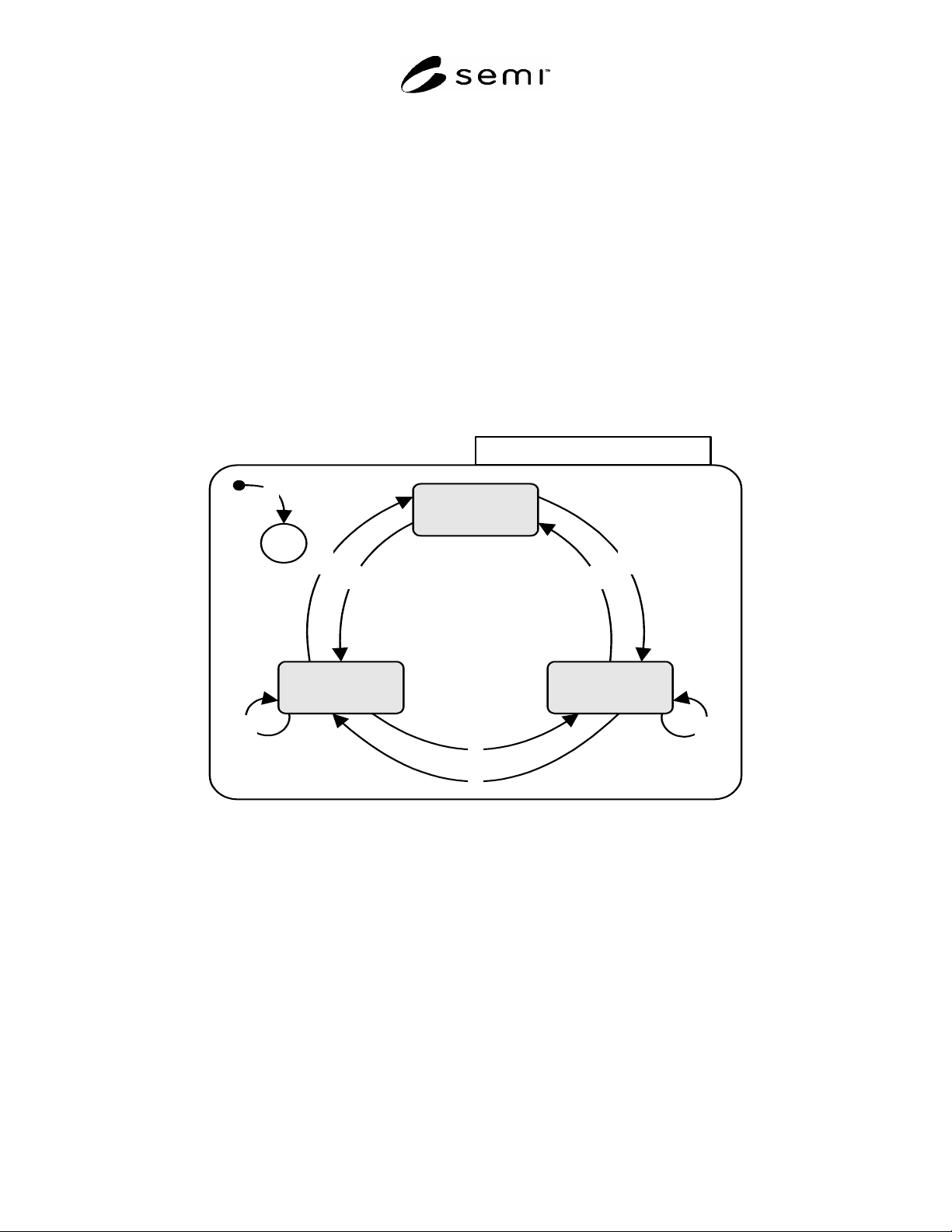
9.3.1 Figure 1 shows the EPT state module diagram.
1
9
4
2
3
7
8
5
6
IDLE
BLOCKED BUSY
EPT State Model
C
Figure 1
Equipment Performance Tracking State Model
9.4 EPT State Definitions
This section describes the EPT states.
9.4.1 IDLE
9.4.1.1 EPT Module — The following conditions are required for the module to be in the IDLE state:
No material is present in the module and
The module is not executing a task and
No fault condition exists in the module that prevents it from starting a new task.
9.4.1.2 Equipment — The following conditions are required for the equipment to be in the IDLE state:

SEMI E116-0705 © SEMI 2002, 2005 7
No BLOCKED EPT modules prevent an EPT module from starting a new task, and
There is no EPT module in the BUSY state with a task type of 1, 2, 3, 4 or 5.
9.4.1.3 For both the equipment and modules the following conditions may
exist in the IDLE State:
The equipment or module is maintaining and monitoring environmental requirements (e.g., background
temperature, particle monitoring, etc).
9.4.2 BUSY
9.4.2.1 EPT Module — The following conditions are required for the module to be in the BUSY state:
The module is executing a task and
No fault condition exists in the module that prevents the execution of a task.
9.4.2.2 Equipment — The following condition is required for the equipment to be in the BUSY state:
At least one EPT module is BUSY with a task type of 1, 2, 3, 4, or 5.
9.4.2.3 For both the equipment and modules the following conditions may
exist in the BUSY State:
Material is present.
9.4.3 BLOCKED
9.4.3.1 EPT Module — One or more of the following conditions are required for the module to be in the
BLOCKED state:
Conditions exist that do not allow the EPT module to continue or start execution of a task:
A fault condition(s) exists that prevents the EPT module from completing its task.
A fault condition(s) exists that prevents the EPT module from starting a new task.
The EPT module is pausing (or aborting) as the result of a pause (or abort) directive.
The EPT module has paused its task and is awaiting a resume directive.
The EPT module fails to initialize upon start-up.
9.4.3.2 Equipment — The following condition is required for the EPT equipment to be in the BLOCKED state:
No EPT module is BUSY with task type of 1, 2, 3, 4 or 5, and
At least one BLOCKED EPT module prevents any EPT module from starting a new task or completing a
current task.
9.4.3.3 For both the EPT equipment and modules the following conditions may
exist in the BLOCKED State:
Material is present.
9.5 EPT State Transition Table – Module Level
9.5.1 This section defines the state transitions for the EPT modules within the equipment.
9.5.2 For each status variable updated with the event change, the corresponding event variable shall also be updated
(see Table 4).