semi合集-English.pdf - 第7875页
SEMI T13-1104 © SEMI 2004 35 RELATED INFORMATION 4 USE CASE OF DEVI CE TRACKING NOTICE : This related information is not an official pa rt of SEMI T13 and was derived from the Japanese Traceability Committee. This relate…
SEMI T13-1104 © SEMI 2004 34
Tracer
Ta
Tracer
Tb
Tracer
T
j
Tracer
T
k
Client
Cx
Manager
Mn
/ Tracer
T
i
Manager
M
f
/ Tracer
T
c
Machine
E
11
Machine
E
12
Machine
E
21
Machine
E
22
Machine
E
31
Machine
E
32
Machine
E
11 1
Machine
E
11 2
Machine
E
121
Machine
E
122
Machine
E
13 1
Machine
E
132
Die Trace
Data (DTD)
[takeDTD]
DTD
DTD
DTD
DTD
DTD
DTD
DTD
DTD
DTD
DTD
DTD
data data
no data
Ask Data (AD)
[
showDTD
]
A
D
A
D
A
D
A
D
A
D
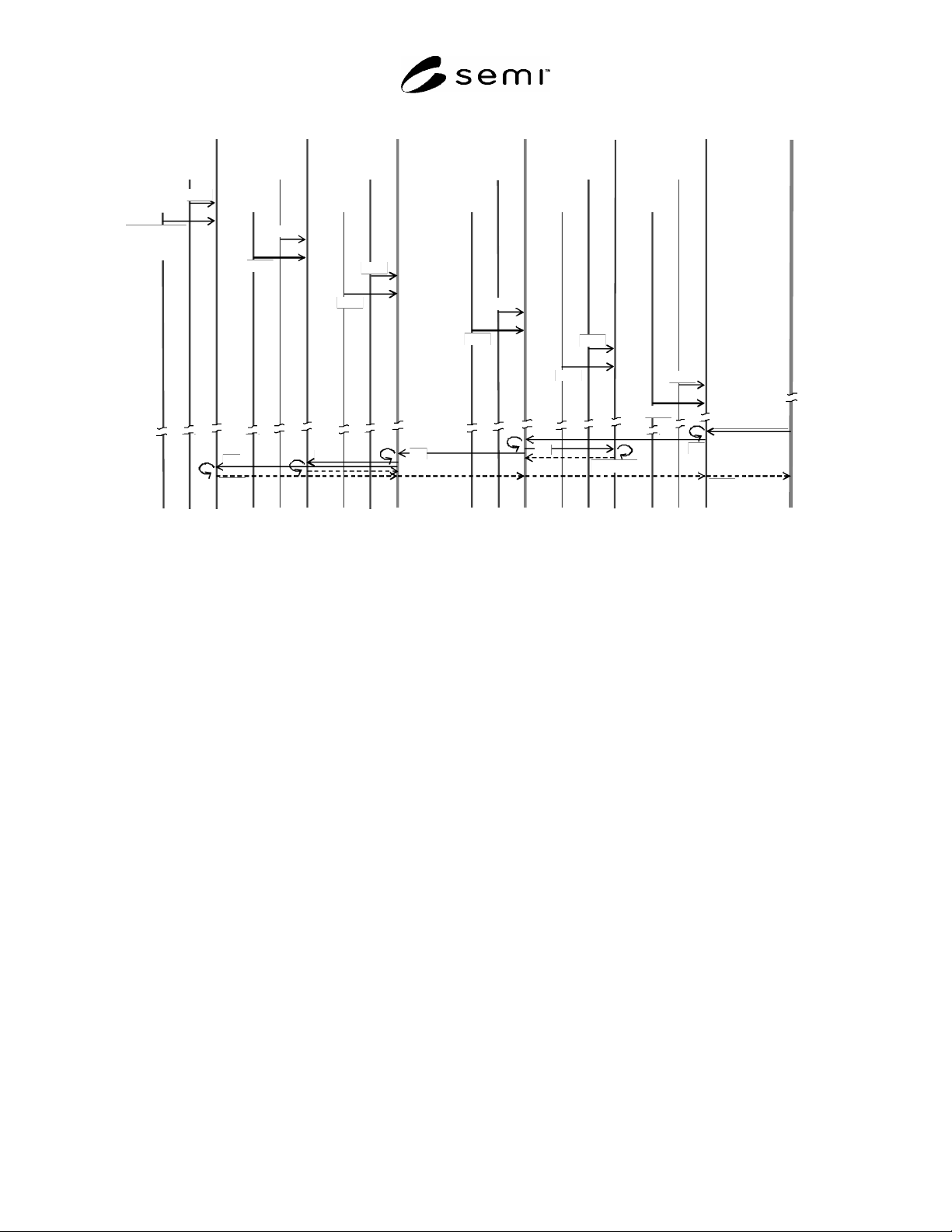
Figure R3-1
An Example Transaction

SEMI T13-1104 © SEMI 2004 35
RELATED INFORMATION 4
USE CASE OF DEVICE TRACKING
NOTICE: This related information is not an official part of SEMI T13 and was derived from the Japanese
Traceability Committee. This related information was approved for publication by full letter ballot on April 30,
2004.
R4-1 Use Case Diagram
R4-1.1 Use Case diagram is one of well-known means for understanding and analysis of problem domain to start
with. It is often used before modeling a system or bringing a good solution.
R4-1.2 Use Case diagram consists of Actors and Use Cases. A use case defines something expected to a system
related to an actor or between actors. All use cases build up whole system.
R4-2 Use Case Diagram of Device Tracking
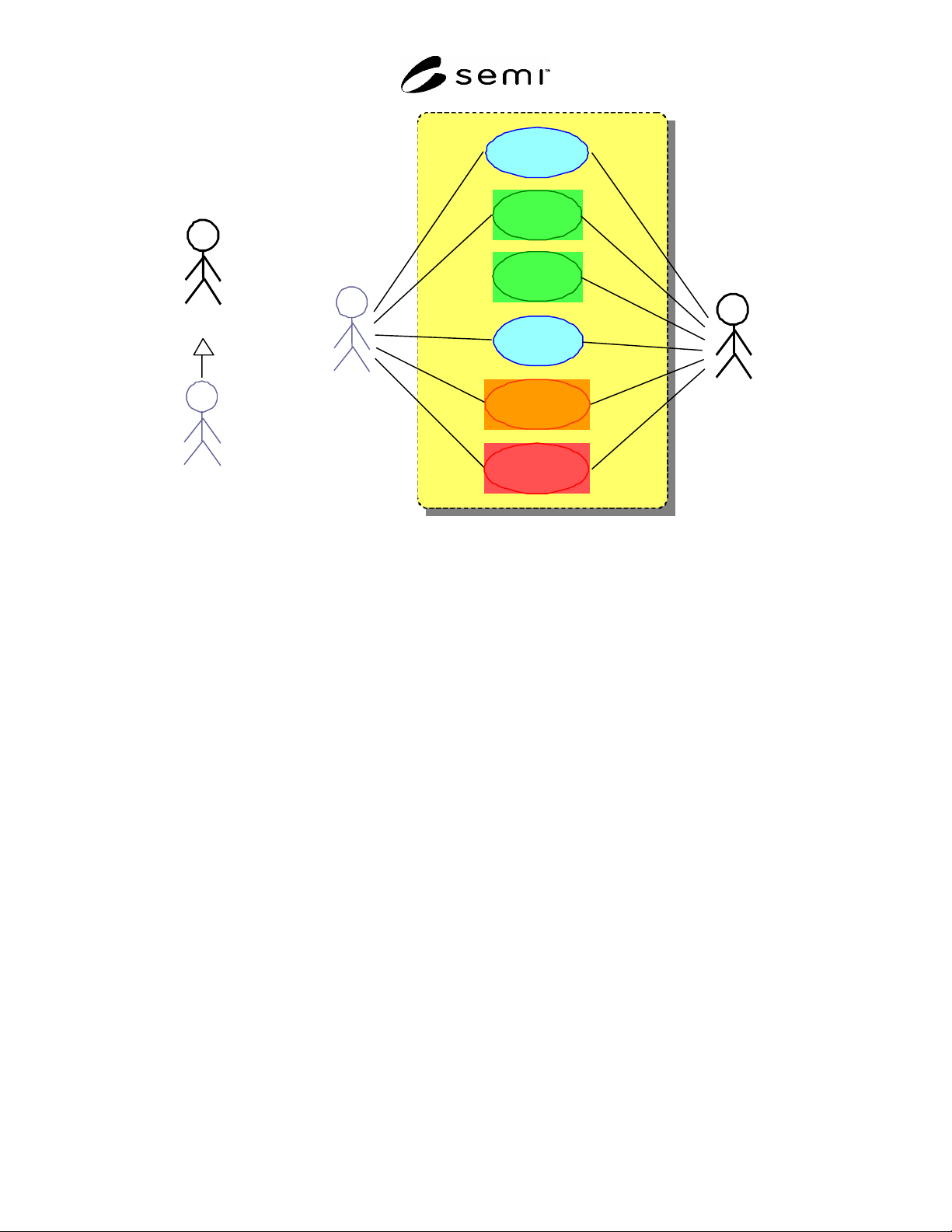
R4-2.1 The following diagram shows use case for Device Tracking.
R4-2.2 Trace — Consumer asks listing all or a part of stages of Production History and Information for tracking.
Examples may be picking up five latest history items or histories for changing substrates. Product Information may
include original production country, test house identification, assembly subcontractor and so on.
R4-2.3 Back Track — Consumer traces Production History from the latest one and checks also Problem Histories of
the state. If no specific essential problems is not found on the stage, information for previous stage is provided
interactively. If something is unclear, further information or data is requested to Producer.
R4-2.4 Update History — Producer append / updates Production History describing what has done on the product
including changing location or substrate. Information attached to the history may be dependent to the stage,
equipment and/or product. Producer may also append / update Problem History describing briefly what the problem
was and how it was fixed.
R4-2.5 Check History — Consumer asks detail history of a stage. System replies all or expected categories of
Production History and Information. Because sometimes Consumer's curiosity may beyond what system knows, the
system may ask further information to responsible producer in such case.
R4-2.6 Notify — Consumer notifies phenomena on a product to system when some problem happens on the
product. The system looks for resemble phenomena registered on the system. If it identified, the system let the
consumer know all information about the phenomena and update registry. Otherwise the system registers the
phenomena and asks all producers or most possible ones to fix it. When a responsible producer responds about the
problem, the system update registry and let the consumer know.
R4-2.7 Alert — Producer issues potential problems for a product. This information is registered on system and
distributed to all possible consumers. This capability can be used even if the product is still in process on some
stage.
SEMI T13-1104 © SEMI 2004 36
Update
History
Consumer
Producer
(
Fab, Eqp.
)
Check
History
Back
Track
Notify
Trace
Consumer
Producer
(
Fab, Eqp.
)
A
lert
Figure R4-1
Use Case Diagram for Device Tracking
NOTICE: SEMI makes no warranties or representations as to the suitability of the standards set forth herein for any
particular application. The determination of the suitability of the standard is solely the responsibility of the user.
Users are cautioned to refer to manufacturer's instructions, product labels, product data sheets, and other relevant
literature, respecting any materials or equipment mentioned herein. These standards are subject to change without
notice.
By publication of this standard, Semiconductor Equipment and Materials International (SEMI) takes no position
respecting the validity of any patent rights or copyrights asserted in connection with any items mentioned in this
standard. Users of this standard are expressly advised that determination of any such patent rights or copyrights, and
the risk of infringement of such rights are entirely their own responsibility.
Copyright by SEMI® (Semiconductor Equipment and Materials
International), 3081 Zanker Road, San Jose, CA 95134. Reproduction of
the contents in whole or in part is forbidden without express written
consent of SEMI.