semi合集-English.pdf - 第4729页
SEMI C3.55-02 00 © SEMI 2000 5 questiona ble connecti ons or leak s, report this to the su pervis or immediat ely and d o not proceed with the anal ysis. NOT E 2: Introd uce the calibrati on standard as many times as nec…
SEMI C3.55-0200 © SEMI 2000 4
5.5.2.5 Calibration Standards — 1–5 ppm (mole/
mole)
5.5.3 Operating Procedure — (see SEMI C3, Section
6, Gas Chromatography for standard procedures).
5.5.3.1 Inject the calibration standard and sample as
described in Section 6.6 of SEMI C3. The order of
elution is silane matrix, methyl silane, siloxane (for
information only) and disilane. (See NOTE 2.)
5.5.3.2 Compare the average peak area of the
components being measured in the calibration standard
to that of the same analytes found in the silane sample
being tested. Calculate the concentrations of the
analytes as described in Section 6.8 of SEMI C3. The
result shall be reported in the unit of concentration
needed and to the number of significant digits of the
variable with the least number of significant digits.
This value may not exceed that specified in Section 2.
5.6
Water — This procedure is for the determination
of trace moisture (water) in silane using a vibrating
quartz hygrometer.
5.6.1 Detection Limit — 0.1 ppm (vol/vol)
5.6.2 Instrument Parameters
5.6.2.1 Flow Requirements — Set the sample pressure
and flow rate in accordance with the instrument
manufacturer’s instructions.
5.6.3 Calibration Standards — Check the hygrometer
calibration with silane using an external permeation
device. Construct a calibration curve which contains at
least three points covering the range of interest. The
standards employed will have been verified
independently on a condensation dewpoint/frostpoint
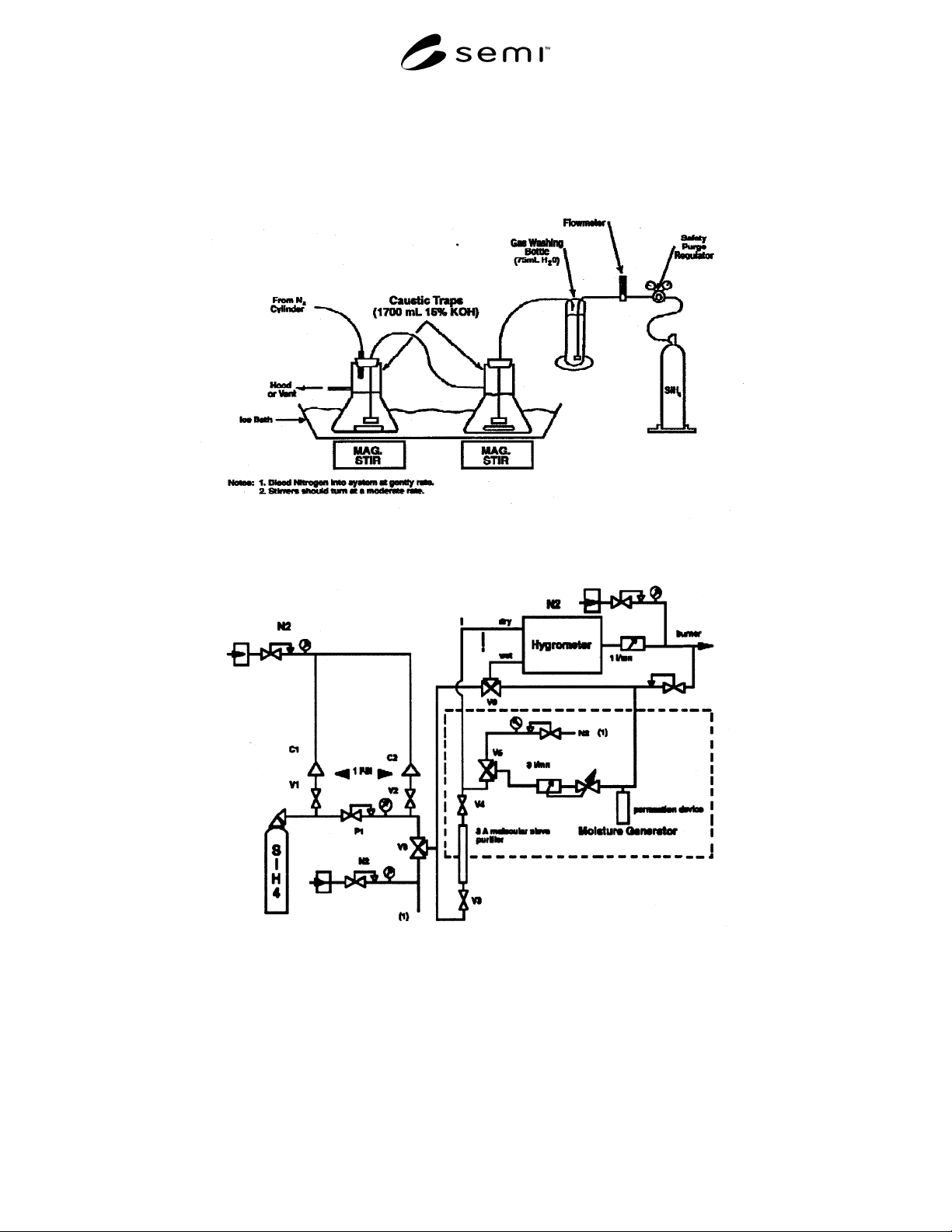
hygrometer. (See Figure 2.)
5.6.4
Operating Procedure — At the first start-up of
the hygrometer, calibrate it with moisture standards in
silane. Then check the calibration once a month and
modify the hygrometer if necessary. Direct standard to
unit with stainless lines which have been purged. Note
that silane is spontaneously flammable. Thus the
experimental set-up should be leak-free and thoroughly
purged before the introduction of silane. Obtain
representative sample of the gas to be analyzed and
direct to the unit. Wait until the equilibrium and read
the moisture content. The result may not exceed the
specification.
5.6.4.1
Construct a calibration curve with previously
verified standards. Direct standard to unit with
stainless steel lines which have been purged.
5.6.4.2 Obtain representative sample of gas to be
analyzed and direct to unit as with the standards. (See
NOTE 1.)
5.6.4.3
Construct a calibration curve and determine the
ppm moisture content in sample gas. The result may
not exceed the specification in Section 2 of this
standard.
5.7 Elemental Analysis in Deposited Layer —
Procedures for the analysis of elemental impurities in
deposited layers of polysilicon should be designated
and should be referenced from a recognized industry
standard (including but not limited to ISO, ASTM,
etc.).
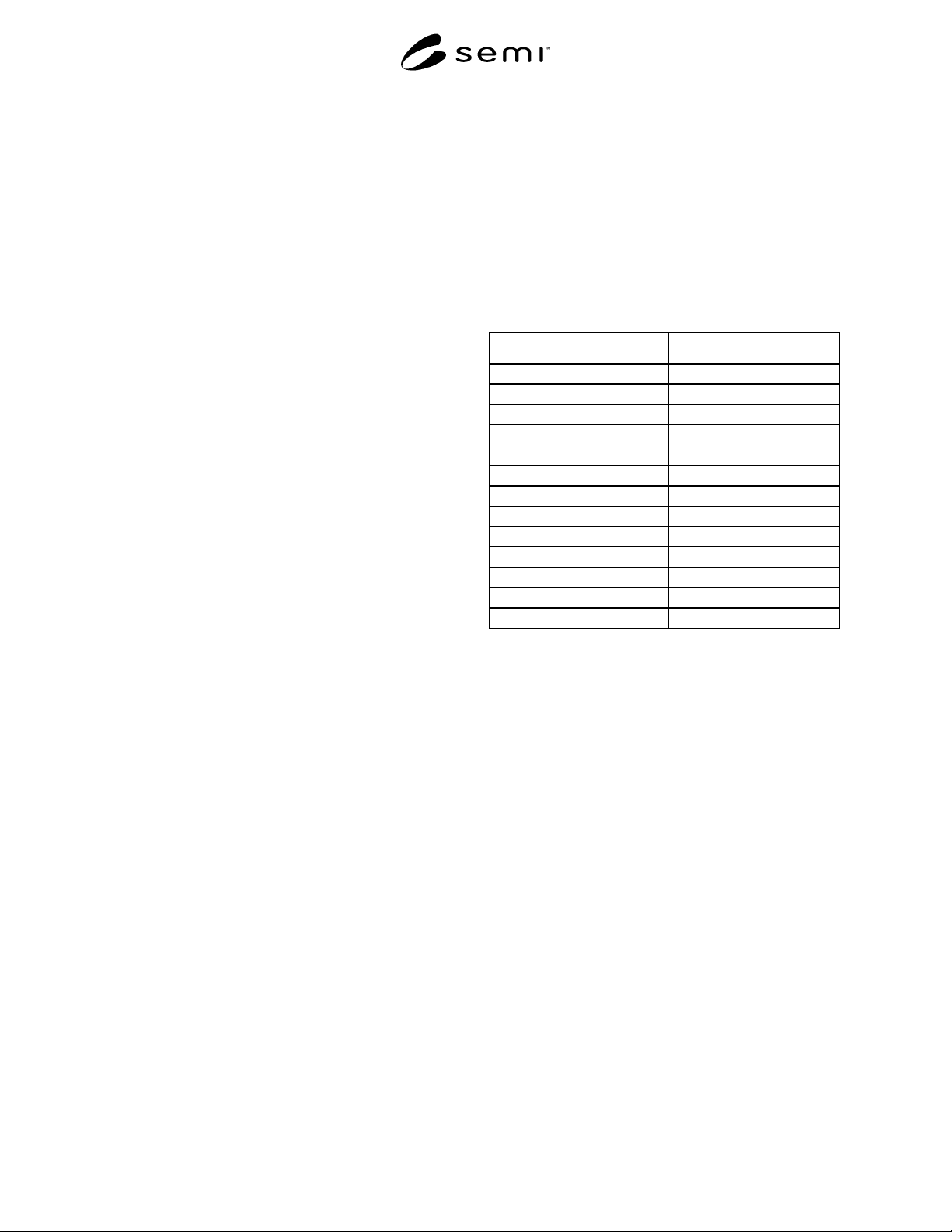
5.7.1 Typical Detection Limits
Compound Detection Limit
Carbon (C) 0.2 ppma
Oxygen (O) 0.2 ppma
Boron (B) 0.02 ppba
Aluminum (Al) 0.02 ppba
Gallium (Ga) 0.02 ppba
Phosphorus (P) 0.02 ppba
Arsenic (As) 0.02 ppba
Antimony (Sb) 0.02 ppba
Iron (Fe) 0.3 ppba
Chromium (Cr) 0.01 ppba
Nickel (Ni) 0.2 ppba
Copper (Cu) 0.02 ppba
Zinc (Zn) 0.03 ppba
5.8 Resistivity — Procedures for the measurement of
resistivity in deposited layers of polysilicon should be
designated and should be referenced from a recognized
industry standard (including but not limited to ISO,
ASTM, etc.).
NOTE 1: Before performing this or any other analytical
operation it is necessary to perform the following:
• Familiarize yourself with the products involved and the
potential hazards by consulting the MSDS's for all
hazardous substances involved and by consulting the
CGA’s “Handbook of Compressed Gases” for all gases
involved.
• Know how to safely handle and store each hazardous gas
by consulting the applicable CGA pamphlets.
• Use all necessary and applicable personal protective
equipment.
• Follow all instructions relative to the safe operation of
the equipment by consulting the LAC Safety Manual and
applicable equipment manufacturers manual(s).
It must be noted that silane is a pyrophoric gas and all sample
plumbing must be purged of air completely before introducing
silane. Extra special attention must be paid to leak checking
all connections and checking the vent plumbing to be certain
that effluents are vented properly. If there are any
SEMI C3.55-0200 © SEMI 20005
questionable connections or leaks, report this to the supervisor
immediately and do not proceed with the analysis.
NOTE 2: Introduce the calibration standard as many times as
necessary to achieve the desired precision. Detection limit
calculated on these calibrations should achieve at least that
listed for this procedure.
Figure 1
Chloride Scrubbing Apparatus
Figure 2
Moisture Analysis in Silane

SEMI C3.55-0200 © SEMI 2000 6
NOTICE: These standards do not purport to address safety issues, if any, associated with their use. It is the
responsibility of the user of these standards to establish appropriate safety and health practices and determine the
applicability of regulatory limitations prior to use. SEMI makes no warranties or representations as to the suitability
of the standards set forth herein for any particular application. The determination of the suitability of the standard is
solely the responsibility of the user. Users are cautioned to refer to manufacturer's instructions, product labels,
product data sheets, and other relevant literature respecting any materials mentioned herein. These standards are
subject to change without notice.
The user’s attention is called to the possibility that compliance with this standard may require use of copyrighted
material or of an invention covered by patent rights. By publication of this standard, SEMI takes no position
respecting the validity of any patent rights or copyrights asserted in connection with any item mentioned in this
standard. Users of this standard are expressly advised that determination of any such patent rights or copyrights, and
the risk of infringement of such rights, are entirely their own responsibility.
Copyright by SEMI® (Semiconductor Equipment and Materials
International), 3081 Zanker Road, San Jose, CA 95134. Reproduction o
f
the contents in whole or in part is forbidden without express written
consent of SEMI.