semi合集-English.pdf - 第1924页
SEMI E54.1-1000 © SEMI 1996, 2000 30 GetAttr ibute Service Mess age Definition Table* Parameter Req/Ind Rsp /Conf Form Description AttributeID M C ** , = Network- Specific Attribute Ide n tifie r of attrib ute whose valu…

SEMI E54.1-1000 © SEMI 1996, 200029
7.4.1.1.1 Name — A label used to identify the active element associated with the object instance.
7.4.1.1.2 Status — An indication of the state of the active element associated with the object instance. The form
and interpretation of the value of this attribute is context-specific.
7.4.1.1.3 AlarmEnable — An attribute which specifies whether alarm exception conditions of the active element
associated with the object instance are to be reported. Reporting is enabled if this variable is set to TRUE. The
method of reporting is beyond the scope of this document.
7.4.1.1.4 WarningEnable — An attribute which specifies whether warning exception conditions of the active
element associated with the object instance are to be reported. Reporting is enabled if this variable is set to TRUE.
The method of reporting is beyond the scope of this document.
7.4.1.2 Active Element Class Services — All Active Element common services are listed in Table 31 (the specific
AE object is the “service provider” of these services). Note that all of these services are Request services. Service
parameters that are specified in this standard are summarized in Table 32.
Table 31 AE Class Service Resource Definition
Service Service ID Type Description
Reset nS1* R Used to place object in INITIALIZED state.
Abort nS2 R Used to place object in ABORT state.
Recover nS3 R Used to move object from ABORT state to RECOVERED state.
Operate nS4 R Used to move object to the operating state from INITIALIZING,
or RECOVERING state.
GetAttribute nS5 R Used to read object attribute.
SetAttribute nS6 R Used to modify object attribute.
RestoreDefault nS7** R Used to restore object attributes to their default values.
* Where ‘n’ is the type of the object instance to which the particular service is associated (e.g., Sai, Sbi, Aao, Ado, or C), see Sections 7.4.4
through 7.4.8.
** ID’s nS8 through nS15 are reserved for future AE class service definition.
Table 32 AE Class Service Parameter Dictionary
Parameter Form Description
AttributeID Positive Integer Object instance Attribute Identifier.
AttributeValue Context-specific Value of object instance attribute.
RestoreConditions Byte enumerated Level of restore requested.
A detailed description of these services follows:
7.4.1.2.1 Reset — Used to place the object instance in its INITIALIZED state. There are no parameters specified
for this service.
7.4.1.2.2 Abort — Used to place the object instance in its ABORT state. There are no parameters specified for this
service.
7.4.1.2.3 Recover — Used to move the object instance from its ABORT state to a RECOVERED state. There are
no parameters specified for this service.
7.4.1.2.4 Operate — Used to move the object instance to the OPERATING state from the INITIALIZING or
RECOVERING state. There are no parameters specified for this service.
7.4.1.2.5 GetAttribute — Used to read a value of an object instance attribute over the network. The following table
describes the parameters specified for this service.

SEMI E54.1-1000 © SEMI 1996, 2000 30
GetAttribute Service Message Definition Table*
Parameter Req/Ind Rsp/Conf Form Description
AttributeID M C**, = Network-
Specific
Attribute Identifier of attribute whose value is being requested.
Inclusion of attribute in Rsp/Conf. is optional.
AttributeValue - M Context-
Specific
Value of attribute requested.
* See Section 6.4.3 for further description of terminology used in this table.
** The determination of whether Attribute ID is supplied in the service response/confirm is outside the scope of this document.
7.4.1.2.6 SetAttribute — Used to modify the value of an object instance attribute over the network which has been
identified as modifiable. The following table describes the parameters specified for this service.
SetAttribute Service Message Definition Table*
Parameter Req/Ind Rsp/Conf Form Description
AttributeID M C, = Network-
Specific
Attribute Identifier of attribute whose value is to be modified.
Inclusion of Attribute in Rsp/Conf. is optional.
AttributeValue M C Context-
Specific
Value to which the attribute is to be modified. Inclusion of
Attribute in Rsp/Conf. is optional. Conditions under which the
value may differ from that supplied in the associated Req/Ind.
message (e.g., negative response) are not defined in this document.
* See Section 6.4.3 for further description of terminology used in this table.
7.4.1.2.7 RestoreDefault — Used to restore attributes of this object instance to their default values. The following
table describes the parameters specified for this service.
RestoreDefault Service Message Definition Table*
Parameter Req/Ind Rsp/Conf Form Description
Restore
Conditions
MCbyte,
enumerated
0 = Restore specific attribute of this object
1 = Restore all attributes of this object
2 – 63 = Reserved
64 – 255 = Application-Defined
AttributeID C C Network-
Specific
Attribute ID of the attribute whose value is being restored.
* See Section 6.4.3 for further description of terminology used in this table.
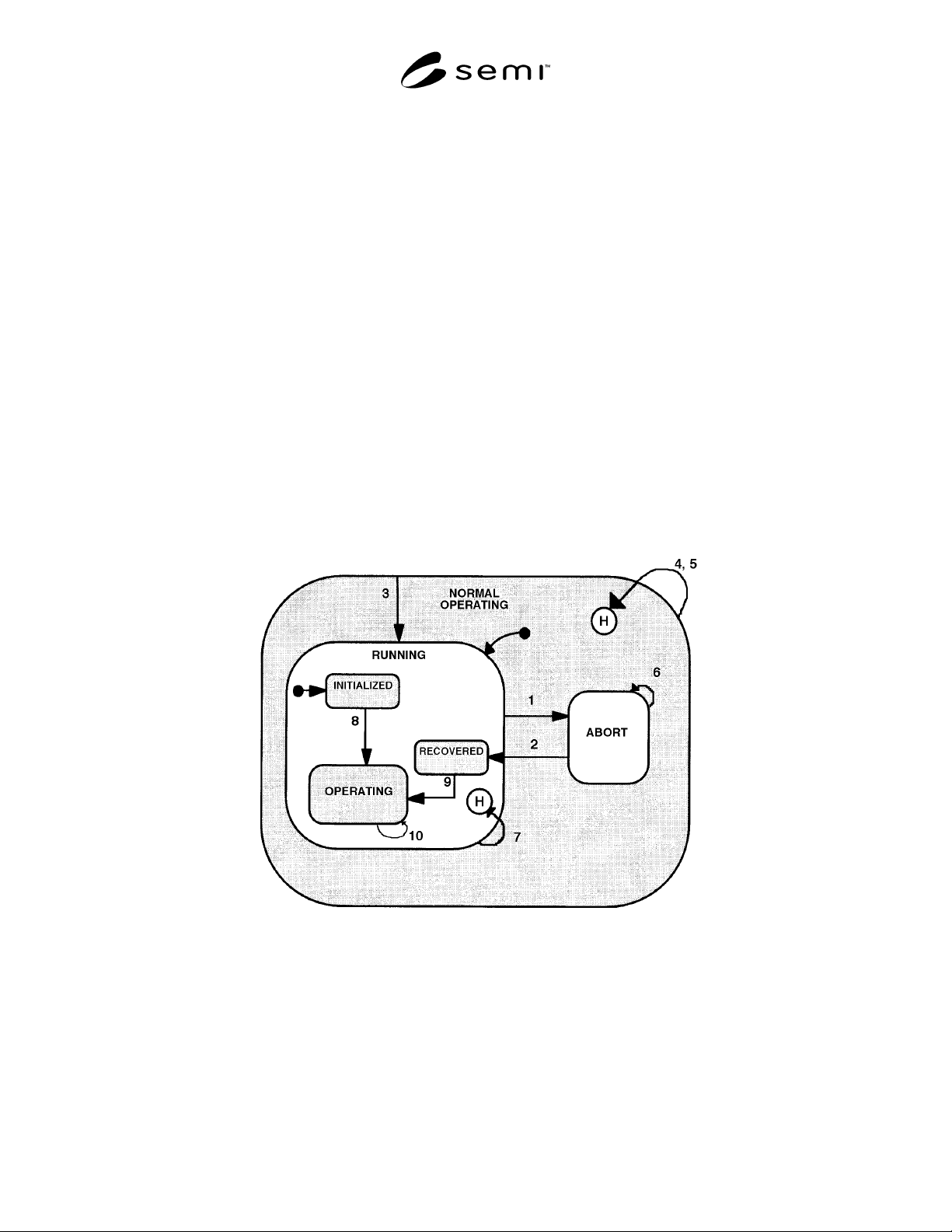
7.4.1.3 Active Element Class Behavior — The AE class behavior is illustrated in Figure 8. Associated states and
state transitions are described in Tables 33 and 34. The following also applies to AE class behavior:
An AE class service may be requested internally by the AE object instance.
Note that the behavior associated with the Reset, Abort, Recover, Operate, and Restore Default services differs from
the SAC object instance behavior in that no service requests are necessarily issued to any other object instances.
Upon instantiation or upon receipt of a reset request, an AE object instance responds by entering or staying in its
INITIALIZED state.
The object INITIALIZING application process is described as follows: When a request to initialize is received (e.g.,
through a Reset service request), all object instance attributes are restored to their initial value; the interpretation of
these values and how they are stored/retrieved is beyond the scope of this document. The object performs any
manufacturer-specified self tests and diagnostics to determine if it is qualified to enter the OPERATING state. Upon
completion of these tests, the appropriate Pass or Fail service response is reported to the requesting object instance.
The content, format, and protocol of this service response are specified by the network for requests made over the
network.
Upon receipt of an abort request, an AE object instance responds by entering or staying in its ABORT state.
SEMI E54.1-1000 © SEMI 1996, 200031
Upon receipt of a recover request, an AE object instance responds by transitioning to its RECOVERED state if, and
only if, it is currently in its ABORT state. Otherwise, it responds with an error indication.
The object RECOVERING application process is described as follows: Upon receipt of a Recover service request,
the object performs any manufacturer-specified self tests and diagnostics to determine if it is qualified to enter the
OPERATING state.
Upon completion, the appropriate Pass or Fail service response is reported to the requesting object instance. The
content, format, and protocol of this service response are specified by the network for requests made over the
network.
The AlarmEnable attribute determines whether or not alarms are reported through the ExceptionStatus and
ExceptionDetail attributes of the DM object (see Section 7.3). If the AlarmEnable attribute is set to the enabled state,
then any alarm is reported to the DM object instance upon its occurrence. The WarningEnable attribute works
analogously with respect to reporting a warning.
Additional behavior may be exhibited by an AE object instance that is defined elsewhere in its class generalization
hierarchy, or is device-specific. A complete definition of AE object type instance behavior includes the appropriate
sensor/actuator network specific device model specification.
Behavior associated with receipt of an invalid service request identified in this document applies to all services
required for this class. Unless otherwise specified (e.g., in an appropriate sensor/actuator network specific device
model specification), behavior associated with the receipt of an invalid service request for additional services
defined (elsewhere) for this class shall be the same as that for required services.
Figure 8
AE Class Behavior
NOTE: Only generic behavior is indicated in this chart. A complete state chart necessarily requires the inclusion of device-
specific behavior.