semi合集-English.pdf - 第4060页
SEMI F54-1000 © SEMI 2000 5 g. counting efficiency of the CNC as a function of particle size; and h. the lo wer size sensitivit y of the CNC. Appen dix 1 contains an example report form . 15 Precisio n and Accurac y 15.1…
SEMI F54-1000 © SEMI 2000 4
11 Calibration and Standardization
11.1 All flow meters and voltage indicators used in the
apparatus, including instruments incorporated into the
EC and particle counters, must have been checked for
proper calibration against calibrated standards within
the past 12 months. Record all calibration data.
12 Procedure
12.1 Fill the atomizer reservoir with a solution of NaCl
in water. The required NaCl concentration depends
upon the range of particle sizes to be tested, and must
be determined from the atomizer manufacturer’s
specifications. Record the concentration of NaCl in the
solution.
12.2 Determine the required aerosol, sheath air and
excess air flow rates for the EC. The flow rates depend
upon the range of particle sizes to be tested and the
required mobility bandwidth, and must be determined
from the EC manufacturer’s specifications.
12.3 Close the bypass filter valve. Adjust the flow
rates of the atomizer, CNC, and reference instrument to
their manufacturer’s specified values. Adjust the flow
rates of the
EC to their required values as described in
Section 12.2. Adjust the flow rate of the make-up air or
aerosol vent to the required value as described in
Section 10.
12.4 Set the EC voltage to obtain the selected particle
size for testing. Record the voltage setting and the
selected particle size.
12.5 Observe the particle concentration indicated by
the reference instrument. If the particle concentration
exceeds the concentration limit of the reference
instrument or the CNC, adjust the flow rate through the
bypass filter to lower the aerosol particle concentration.
After adjusting the bypass flow rate, check all flow
rates to ensure that they remain at the required values.
Record all flow rates.
12.6 Wait for the particle concentrations indicated by
the CNC and reference instrument to become steady;
the concentrations indicated by each instrument must
not change by more than 5% over a five minute
interval. In order to minimize the error in the recorded
particle concentrations, a minimum of 500 particles
must be counted in a sample. Record the steady
particle concentrations indicated by the CNC and
reference instrument.
12.7 If another particle size is to be tested, return to
Section 12.4.
NOTE 5: At least eight different particle sizes must be tested.
The particle sizes must be selected such that the measured
CNC counting efficiency at least spans the range 50% to 95%
(0.50 to 0.95). In order to eliminate systematic error, the
particles sizes must be tested in random order.
13 Calculation and Interpretation of Results
13.1 When an aerosol electrometer is used as the
reference instrument, correct the measured particle
concentrations for multiple charging, as described in
Section 7.5.
13.2 For each particle size tested, calculate the ratio of
the concentration of particles reported by the CNC to
that reported by the reference instrument. This ratio
represents the counting efficiency of the CNC.
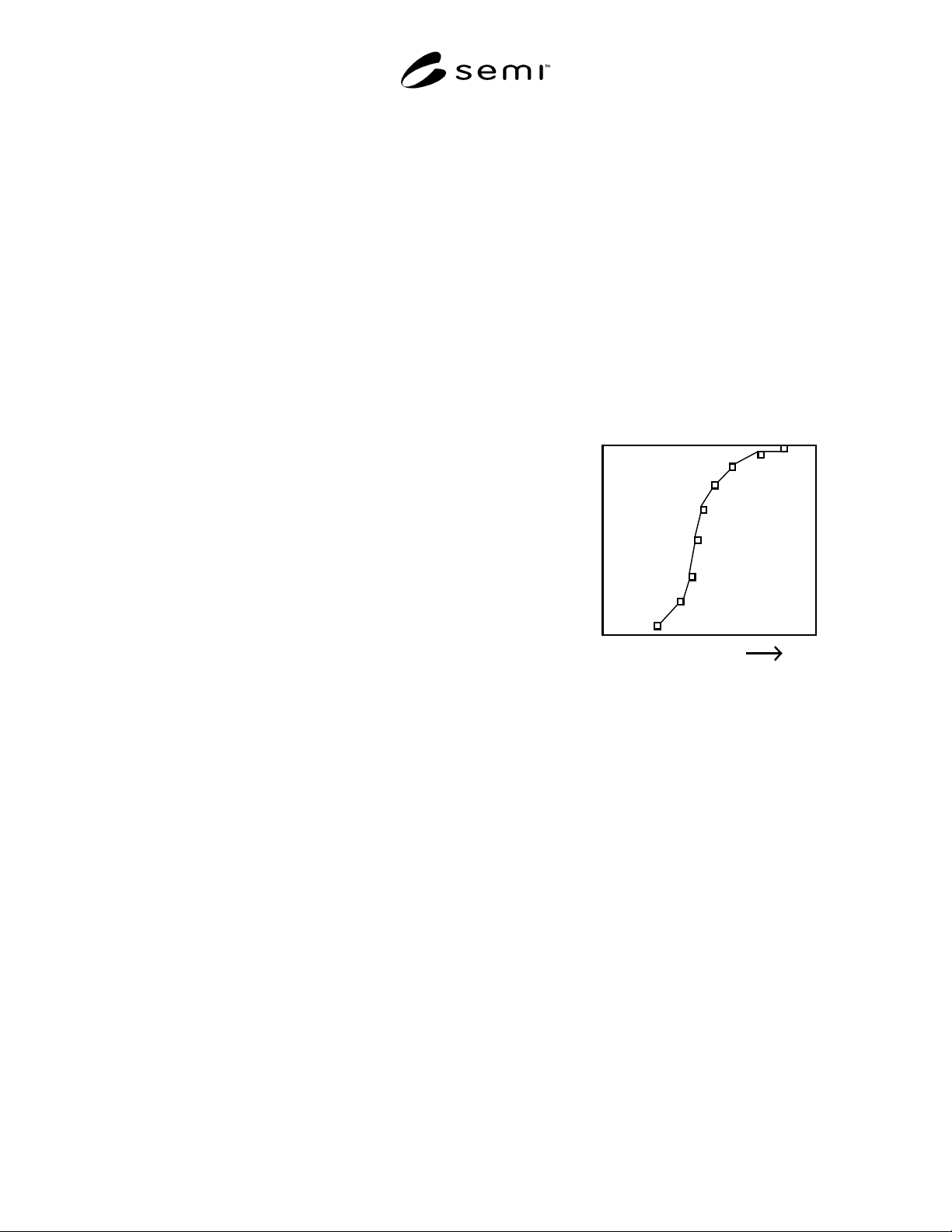
13.3 Plot the calculated counting efficiency against the
particle size as shown in Figure 2. This plot shows the
measured counting efficiency curve of the CNC.
Particle Size
Counting Efficienc
y
0
1
Figure 2
Schematic Plot of Measured Counting Efficiency
13.4 Determine the lower size sensitivity of the CNC,
as defined in Section 5. (The counting efficiency at any
particle size can be estimated using linear interpolation
between the data points.)
14 Reporting Results
14.1 The test record must include the following items:
a. test date;
b. test operator;
c. serial numbers of the reference instrument, CNC
and EC;
d. all particle transport loss calculations as described
in Section 7.4;
e. all flow meter and voltage indicator calibration
data as described in Section 11;
f. all raw data and calculations utilized in the test
method as listed in Sections 12 and 13;

SEMI F54-1000 © SEMI 20005
g. counting efficiency of the CNC as a function of
particle size; and
h. the lower size sensitivity of the CNC.
Appendix 1 contains an example report form.
15 Precision and Accuracy
15.1 This method requires a minimum of 500 particles
counted in a sample. For Poisson distributed data, the
relative standard deviation of the measured particle
concentration is less than 5% when at least 500
particles are counted in a sample.
SEMI F54-1000 © SEMI 2000 6
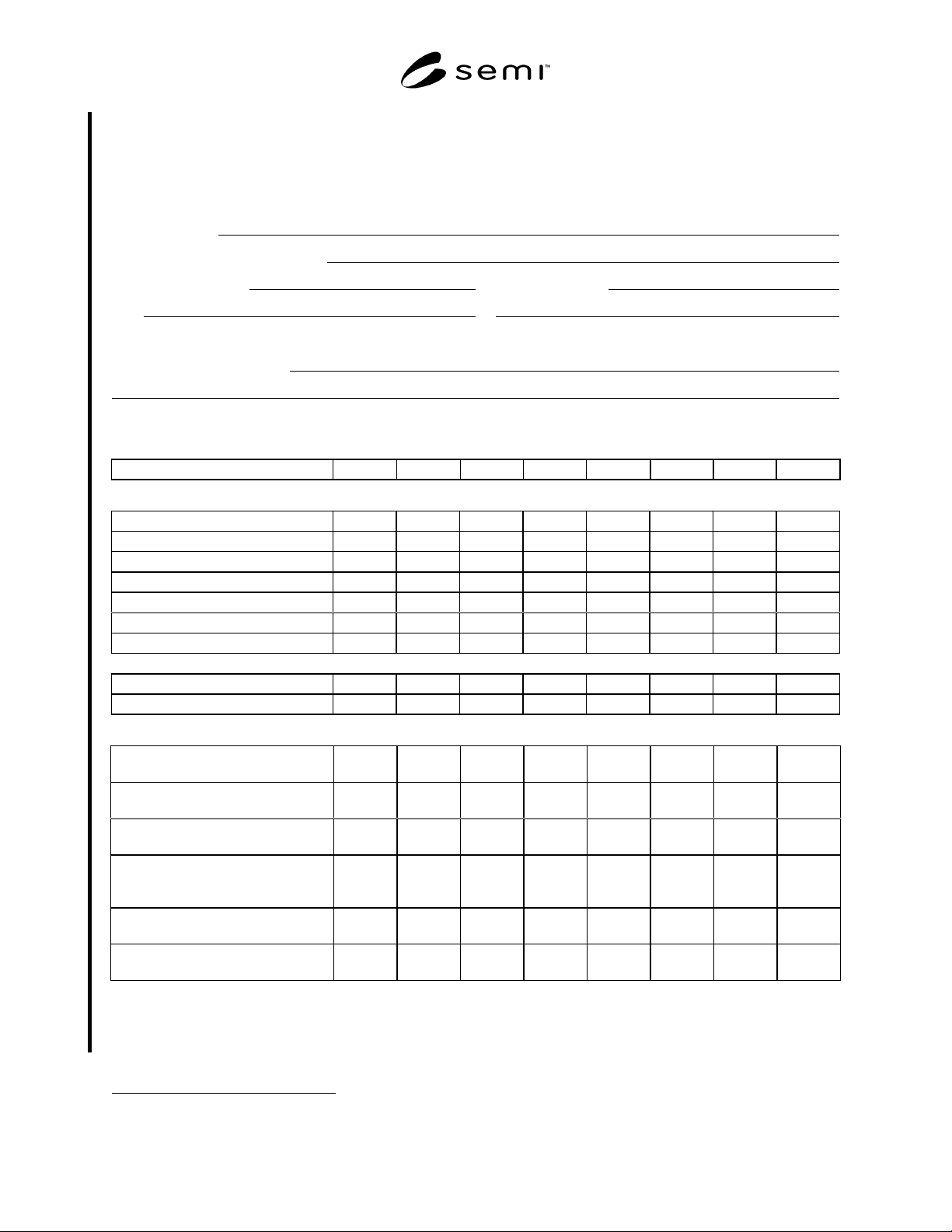
APPENDIX 1
EXAMPLE REPORT FORM
NOTE: The material in this appendix is an official part of SEMI F54 and was approved by full letter ballot procedures on July 13,
2000 by the North American Regional Standards Committee.
A1-1 Test dates:
A1-2 Operator(s) performing test:
A1-3 Serial numbers: Reference instrument
CNC EC
A1-4 Attach flow meter and voltage indicator calibration data as described in Section 11.
A1-5 Data and calculations:
Data Point (Use Additional Sheets as Necessary)
12345678
NaCl Concentration (gm/l)
Flow Rates (cm
3
/s)
EC Aerosol
EC Sheath
EC Excess Air
CNC
Reference Instrument
Make-up Air or
Excess Aerosol Vent
EC Voltage (V)
Particle Size (micrometer)
Measured Particle Concentrations (Particles/cm
3
)
CNC
(1)
(1) Corrected for Transport Loss
(2)*
Reference Instrument
(3)
(3) Corrected for Multiple Charging
(Electrometers Only)
(4)*
(4) Corrected for Transport Loss
(5)*
Counting Efficiency
= (2)/(5)
A1-6 Attach plot of counting efficiency as a function of particle size
A1-7 Lower size sensitivity (micrometer)
∗
___________
∗ Attach calculations.