semi合集-English.pdf - 第7635页
SEMI T4-0301 © SEMI 1995 , 2001 1 SEMI T4-0301 SPECIFICA TION FOR 150 mm AND 200 mm POD IDENTIFICATION DIM ENSIONS This specific ation was techn ically appr oved by the Glob al Physical Interfaces & Carri ers Committ…

SEMI T3-0302 © SEMI 1995, 2002 16
RELATED INFORMATION 1
MODIFIED DATE FORMAT
NOTE: This related information is not an official part of SEMI T3 and was derived from information developed by the T3
Revision task force of the N.A. Traceability committee during revision of the standard. This related information was approved
for publication in June 1997 after full letter ballot and approval by the NA Regional Standards Committee.
R1-1 Alternative Labeling Date Format
R1-1.1 By agreement between supplier and customer, the labeling date may be in the format of YYYYMMDD.
The data identifier “6D” should be used when the year is indicated by four characters. This adds three characters to
the information printed on the label, two additional date characters and the second character in the data identifier.
There is space available on the minimum size label when using the two-dimensional data matrix symbol or the
optional Code 128 bar code. Three additional characters added to the Code 39 bar code will not fit on the minimum
size label unless the Lot Number is reduced to 13 characters.
NOTICE: SEMI makes no warranties or representations as to the suitability of the standards set forth herein for any
particular application. The determination of the suitability of the standard is solely the responsibility of the user.
Users are cautioned to refer to manufacturer' s instructions, product labels, product data sheets, and other relevant
literature, respecting any materials or equipment mentioned herein. These standards are subject to change without
notice.
By publication of this standard, Semiconductor Equipment and Materials International (SEMI) takes no position
respecting the validity of any patent rights or copyrights asserted in connection with any items mentioned in this
standard. Users of this standard are expressly advised that determination of any such patent rights or copyrights, and
the risk of infringement of such rights are entirely their own responsibility.
Copyright by SEMI ® (Semiconductor Equipment and Materials
International), 3081 Zanker Road, San Jose, CA 95134. Reproduction o
f
the contents in whole or in part is forbidden, without express writte
n
consent of SEMI.
SEMI T4-0301 © SEMI 1995, 20011
SEMI T4-0301
SPECIFICATION FOR 150 mm AND 200 mm POD IDENTIFICATION
DIMENSIONS
This specification was technically approved by the Global Physical Interfaces & Carriers Committee and is
the direct responsibility of the European Equipment Automation Committee. Current edition approved by the
European Regional Standards Committee on December 20, 2000. Initially available at www.semi.org
February 2001; to be published March 2001. Originally published in 1995.
1 Purpose
1.1 The purpose of this specification is to ensure
dimensional compatibility when mounting pod
identification tags and tag identification devices.
2 Scope
2.1 The scope of this specification is to define:
• free space at a pod to allow the mounting of a pod
identification tag, and
• free space to allow data transmission.
2.2 This specification is applicable to 150 mm and 200
mm Standard Mechanical Interfaces (SEMI E19). The
space required for pod handling per SEMI E47 is
considered.
2.3 This standard does not purport to address safety
issues, if any, associated with its use. It is the
responsibility of the users of this standard to establish
appropriate safety and health practices and determine
the applicability of regulatory limitations prior to use.
3 Limitations
3.1 This specification applies to pod identification
only.
4 Referenced Standards
4.1 SEMI Standards
SEMI E15 — Specification for Tool Load Port
SEMI E19 — Standard Mechanical Interface (SMIF)
SEMI E47 — Specification for 150 mm/200 mm Pod
Handles
NOTE 1: As listed or revised, all documents cited shall be the
latest publications of adopted standards.
5 Terminology
5.1 pod — a box having a Standard Mechanical
Interface (SMIF) per SEMI E19.
5.2 Pod Identification Tag — information carrier
mounted to a pod.
5.3 Standard Mechanical Interface (SMIF) —
interface plane between pod and another
minienvironment per SEMI E19.
5.4 Tag Identification Device — device for
transferring information from/to a pod identification
tag.
6 Requirements
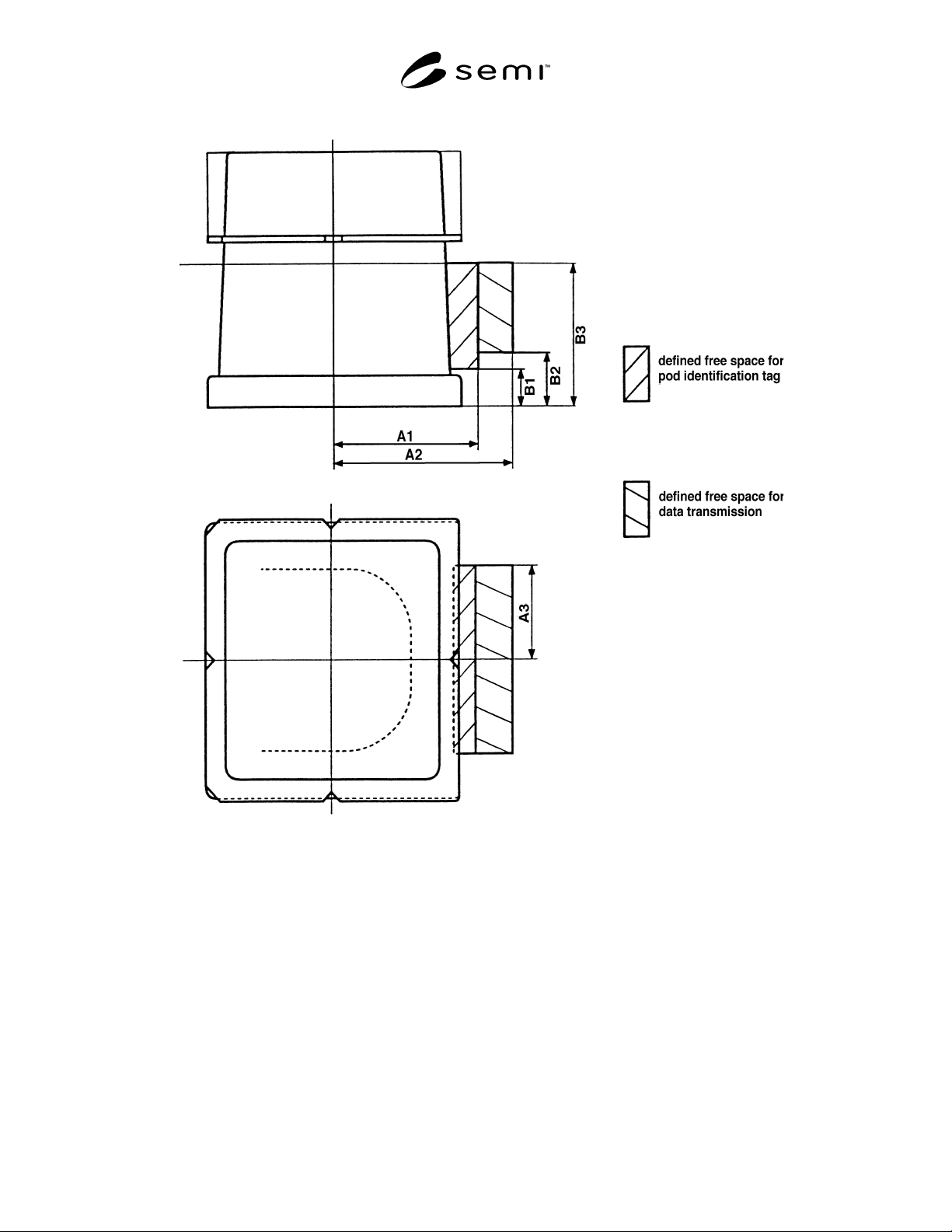
6.1 The defined free space for a pod identification tag
(see Figure 1) may not be used by any other device than
the pod identification tag and its supports.
6.1.1 The pod identification tag and its supports may
not exceed the outline of the defined free space for a
pod identification tag (see Related Information Section
R1-1).
6.2 The defined free space for data transmission (see
Figure 1) may only be used by the tag identification
device if necessary (see Related Information Section
R1-2).
Table 1 Dimensions of Defined Free Space
Dimension 150 mm SMIF 200 mm SMIF
A1 130 mm 167.5 mm
A2 160 mm min.
180 mm recommended
207.5 mm min.
227.5 mm recommended
A3 70 mm 70 mm
B1 36 mm 36 mm
B2 43 mm 43 mm
B3 120 mm 120 mm
SEMI T4-0301 © SEMI 1995, 2001 2
Figure 1
NOTICE: SEMI makes no warranties or representations as to the suitability of the standards set forth herein for any
particular application. The determination of the suitability of the standard is solely the responsibility of the user.
Users are cautioned to refer to manufacturer’s instructions, product labels, product data sheets, and other relevant
literature respecting any materials or equipment mentioned herein. These standards are subject to change without
notice.
The user’s attention is called to the possibility that compliance with this standard may require use of copyrighted
material or of an invention covered by patent rights. By publication of this standard, SEMI takes no position
respecting the validity of any patent rights or copyrights asserted in connection with any item mentioned in this
standard. Users of this standard are expressly advised that determination of any such patent rights or copyrights, and
the risk of infringement of such rights, are entirely their own responsibility.