semi合集-English.pdf - 第2916页
SEMI E109-0305 © SEMI 2001, 2005 26 # Previous State Trigger Ne w State Actions Comments 2 NOT ASSOCIATED Service: If assoc iated by service, the host sends a Bind or ReticleTransferJob service to the production equipmen…
SEMI E109-0305 © SEMI 2001, 2005 25
13 Reticle Pod Load Port/Pod Association State Model
13.1 The purpose of the Reticle Pod Association State Model is to define the host view of pod to reticle load port
association of the production equipment, as well as the host interactions with the production equipment necessary to
associate a reticle pod to a reticle load port, and to perform equipment based pod verification. Each reticle load port
shall maintain an independent instance of the Pod Association State Model. Each instance of this state model must
not influence the state of the same state model for a different reticle load port.
13.1.1 This state model provides the ability to perform PodID verification with two different methods. If the PodID
is provided before the equipment reads the PodID, the PodID that becomes associated with the reticle load port can
be used later for equipment based pod verification. If the association happens by PodID read (not by a service
execution), then the production equipment shall report the PodID information in a data collection event.
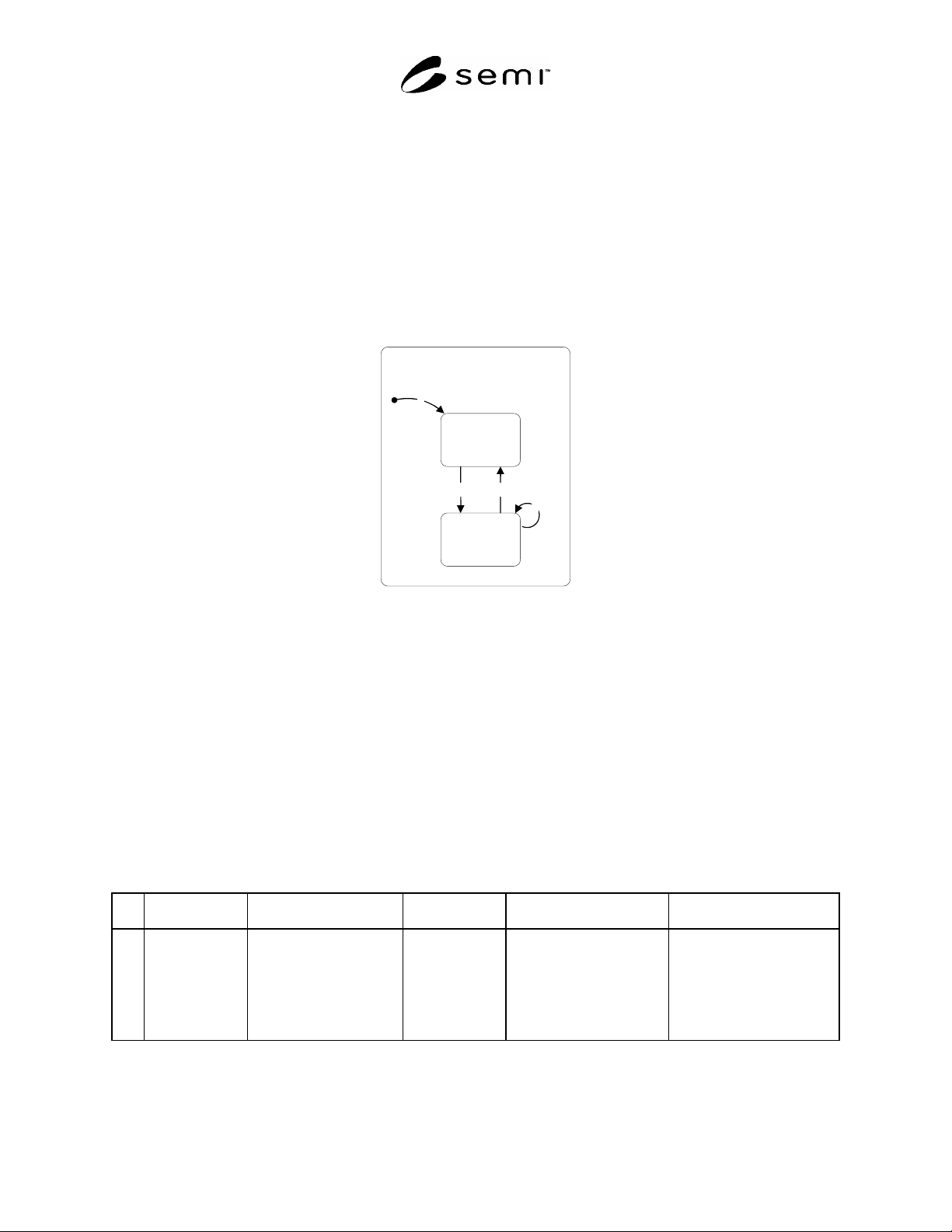
13.2 Reticle Pod Load Port/Pod Association State Model Diagram
NOT
ASSOCIATED
ASSOCIATED
2
3
1
RETICLE POD LOAD PORT
/ POD
A
SSOCIATION
4
Figure 6
Reticle Pod Load Port/Pod Association State Model Diagram
13.2.1 Reticle Pod Load Port/Pod Association State Definitions
13.2.1.1 RETICLE POD LOAD PORT/POD ASSOCIATION — The parent state of the NOT ASSOCIATED and
ASSOCIATED sub-states.
13.2.1.2 NOT ASSOCIATED — A sub-state of RETICLE POD LOAD PORT/POD ASSOCIATION. There is no
pod association present for this load port.
13.2.1.3 ASSOCIATED — A sub-state of RETICLE POD LOAD PORT/POD ASSOCIATION. A PodID has been
associated with this reticle load port. The reticle pod load port is not available for a new pod association.
13.2.2 Reticle Pod Load Port/Pod Association State Transition Table
13.2.2.1 Table 11 defines the transitions of the Reticle Pod Load Port/Pod Association State Model.
Table 11 Reticle Pod Load Port/Pod Association State Transition Definitions
# Previous State Trigger New State Actions Comments
1 (no state) System reset. NOT
ASSOCIATED
No pod associations exist for
reset/re-initialized
equipment.
Data required to be available
for this event report:
PortID.
SEMI E109-0305 © SEMI 2001, 2005 26
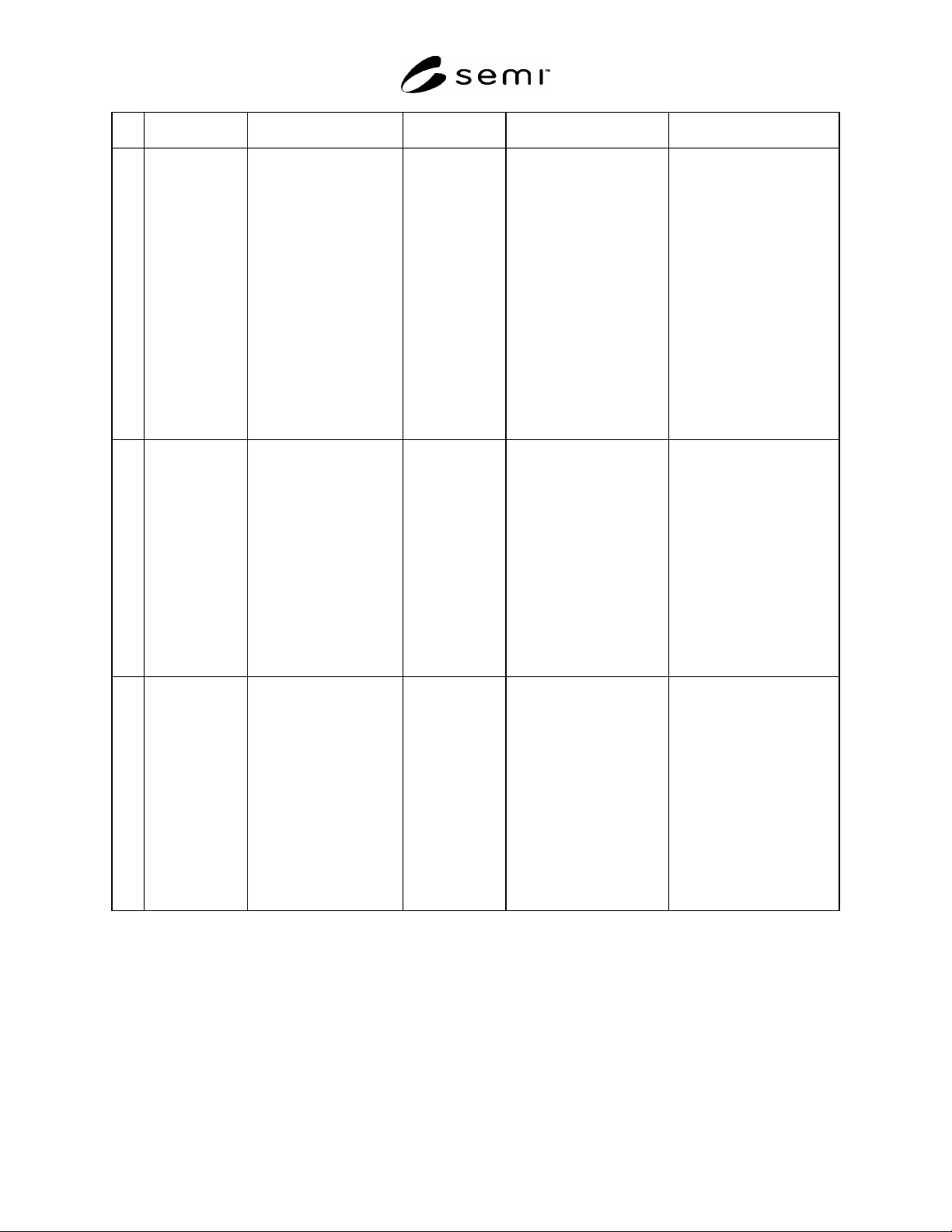
# Previous State Trigger New State Actions Comments
2 NOT
ASSOCIATED
Service: If associated by
service, the host sends a
Bind or
ReticleTransferJob
service to the production
equipment.
PodID Read: If associated
by a PodID read, the
production equipment
creates the association at
the time the PodID read is
performed.
ASSOCIATED If the Bind or
ReticleTransferJob service is
performed before the PodID
is read by the production
equipment, the production
equipment can perform the
PodID verification. Once
the PodID to reticle pod load
port association is complete,
the reticle pod load port is
not available for association
until the state returns to
NOT ASSOCIATED again.
Data required to be available
for this event report:
PortID
PodID
3 ASSOCIATED Service: If an association
cancellation is desired,
this can be done by the
host sending a
CancelBind or
CancelReticleTransferJob
service to the production
equipment.
Reticle Pod Unload: An
association cancellation
may also be performed by
removing the reticle pod
from the reticle pod load
port.
NOT
ASSOCIATED
. A reticle pod unload may
happen before or after
processing occurs. The
reticle pod load port is
available for another
association.
Data required to be available
for this event report:
PortID
4 ASSOCIATED Production equipment
based pod verification
fails, and the pod assumes
the ID value from the
reticle pod that is on the
reticle pod load port.
ASSOCIATED The existing PodID that
was associated by a Bind or
ReticleTransferJob service
is unassociated by the
production equipment and
the new PodID is now
associated to the Reticle
Pod Load Port. The
production equipment shall
delay further action until
receiving either a
CancelPod or a
ProceedWithPod command
from the host.
This transition only occurs
when the Bind or
ReticleTransferJob
command has been used.
Data required to be available
for this event report:
PortID
PodID
14 Reticle Object
14.1 Information about a reticle is encapsulated as an object. This allows the host to exchange information with the
equipment about one or more specific reticle using services defined in SEMI E39, Object Services Standard. A
reticle has properties (attributes) that are defined in Table 12, Reticle Attribute Definition.
14.2 Object Instantiation
14.2.1 The reticle object is a software representation of the reticle in the equipment. Under normal circumstances
this object is instantiated by the equipment when the host uses the Bind, ReticleTransferJob, PodNotification,
ProceedWithPod service (when it included the content map attribute), MoveReticle service, when the equipment

SEMI E109-0305 © SEMI 2001, 2005 27
successfully reads the ReticleID from the reticle pod tag, or when the equipment successfully reads the ReticleID
from the reticle itself. A reticle is instantiated by reticle pod tag read or ReticleID read only if there are no currently
existing objects with the ReticleID just read. A reticle object can also be instantiated by either the ProceedWithPod
or CancelPod Services when these services contain the content map. A Reticle can be instantiated by the
MoveReticle Service if the ReticleID(s) provided by the service have not been previously instantiated.
14.2.2 From the host point of view, an object is instantiated if the host is able to query the equipment about that
object, it's current state, and other attributes. Once instantiated, the object is considered destroyed (no longer
instantiated) if the response to such queries is “unknown object”.
14.2.3 Summary of possible reticle object instantiation methods:
1. Bind, ReticleTransferJob, or PodNotification Service that contains the content map attribute;
2. PodID tag read containing the content map with no currently existing reticle objects having the ReticleID just
read from the pod tag;
3. ReticleID read with no currently existing reticle objects having the ReticleID just read from the ReticleID read;
4. ProceedWithPod or CancelPod Service containing the content map attribute; and
5. MoveReticle
Service when the reticle is not previously instantiated.
14.2.4 Reticle Object Identifier (ObjID)
14.2.4.1 The purpose of an Object Identifier is to allow references to an object within the system. The object
identifier is created when an object is instantiated and should be unchanged or persistent until the end of the object
lifecycle. The Object Identifier shall be unique at the equipment during lifecycle of the object. The ReticleID is the
Reticle Object Identifier. The equipment is responsible for ensuring uniqueness of the ReticleID prior to
instantiation by the bind, PodNotification, ReticleTransferJob, or MoveReticle
service.
14.2.5 Reticle Object Destruction
14.2.5.1 Normally, the Reticle Object reaches the end of its lifecycle when the reticle pod containing the reticle is
unloaded from the equipment. Abnormally, the Reticle Object reaches the end of its lifecycle when a CancelBind,
CancelReticleTransferJob, or
CancelPodNotification service (if the original Bind, ReticleTransferJob, or
PodNotification service contained the contentmap) is executed prior to the reticle
pod being loaded, when a
CancelMoveReticle service is executed prior to reticle removal from the reticle pod (if the reticle was instantiated
using the MoveReticle command), when an equipment based pod verification fails following reticle pod and reticle
instantiation by the bind service, ReticleTransferJob, or reticle pod tag read.
14.2.5.2 Summary of reticle object destruction:
1. A reticle pod is unloaded from the equipment;
2. A CancelBind, CancelReticleTransferJob, or CancelPodNotification service that contained the content map is
received;
3. An equipment based verification fails (after the object has been instantiated via the bind, ReticleTransferJob
service, or reticle pod tag read);
4. A CancelMoveReticle service is executed prior to reticle removal from the reticle pod (when the content map
has not been provided by other service or reticle pod tag read); and
5.
Manual removal of the physical reticle.
14.3 Reticle Attribute Definitions
14.3.1 The following table contains the attributes that are of importance to the host and/or the equipment in order to
manage the history and the reports about the reticle object.
14.3.2 REQD Column
14.3.2.1 All attributes in the following table are required to be associated with the reticle object. However only the
attributes marked with a “Y” in the REQD column are always required to be maintained and updated by the
equipment. The attributes marked with an “N” in the REQD column are only required to be maintained if they are