semi合集-English.pdf - 第3013页
SEMI E121-0305 © SEMI 2003, 2005 9 Where: <Standard Na me>::= Short name of t he standard or SEMI assigned “E” number ( Ex. E125-1 o r E132-1 or E128 or Comm onCo mpone nt) <Version> ::= V0305 (Release or pub…
SEMI E121-0305 © SEMI 2003, 2005 8
<xs:simpleType name="ProcessType2">
<xs:restriction base="xs:string">
<xs:enumeration value="R2R"/>
<xs:enumeration value="FDC"/>
<xs:enumeration value="SPC"/>
</xs:restriction>
</xs:simpleType>
<xs:simpleType name="extProcessType">
<xs:union memberTypes="ProcessType2 otherNameType"/>
</xs:simpleType>
8.9.4.4 This method allows the writer to use ‘R2R’, ‘FDC’, ‘SPC’ or ‘Other: XXX’. While it does not define the
meaning of the ‘XXX’ it does allow an extension of the values at XML write time. When meanings of the extended
values has been agreed upon this offers a method for incorporating these extended values without requiring schema
changes..
<?xml version="1.0" encoding="UTF-8"?>
<root xmlns:xsi=http://www.w3.org/2001/XMLSchema-instance
xsi:NamespaceSchemaLocation="C:\standards\XML\E121\ExtensionSample.xsd">
<xyz>FDC</xyz>
<abc>Other:WTW</abc>
</root>
8.9.4.5 Another advantage using this approach is that the ‘Other: WTW’ portion offers a flag to the reading
application. If the reading application recognizes this string then it is aware that an extension is present and is able to
take appropriate action. If this pattern is used consistently in SEMI it will become a standard pattern for the reader.
Since this is a simple type it can be used as either an element value or an attribute value.
8.10 Schema File Naming Convention
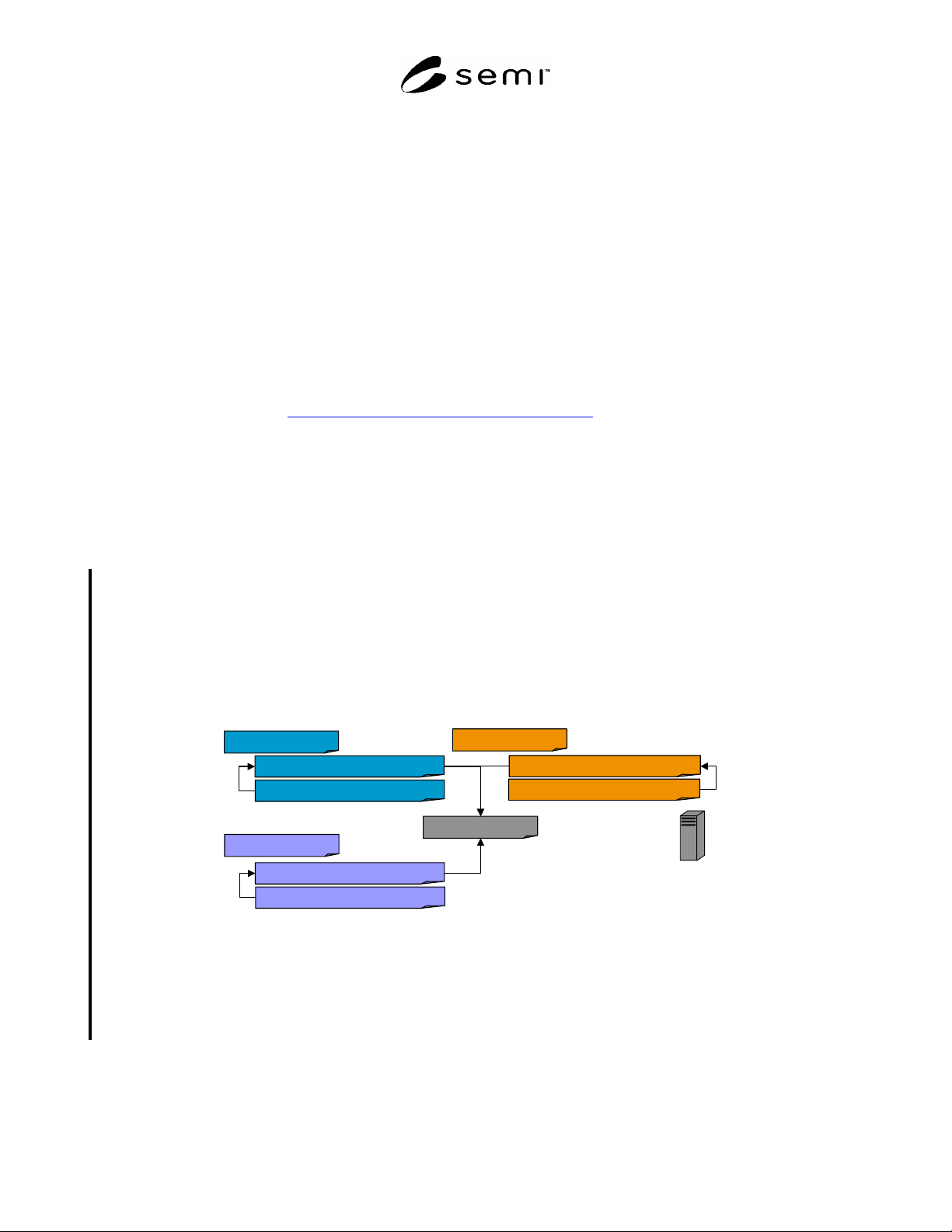
8.10.1 Three schema files have been identified for at least each interface that a standard defines. In the case of a
client interface services the three files are: DataTypes.xsd, Client-Binding.wsdl and Client-PortTypes.wsdl. Those
standards that define services for multiple clients as well as for the equipment, several schema files will be defined.
8.10.2 Each defined standard that requires multiple interfaces to communicate shall provide a set of properly named
schema files depending whether those services are intended for the equipment or for a particular client. Figure 1
shows an example of these schema files.
E132 SecurityAdmin
E132-SecurityAdmin-PortType.wsdl
E132-SessionClient-PortType.wsdl
E132-SecurityAdmin-Binding.wsdl
E132 SessionManager
E132-SessionManager-PortType.wsdl
E132-SessionManager-Binding.wsdl
E132-Schema.xsd
E132-SessionClient-Binding.wsdl
E132 SessionClient
Figure 1
Example of Schema File Organization
8.10.3 The following convention will be used with SEMI standards:
<Standard Name>-<Version>[-<Service Role>]-<Schema Classification>.<Schema Type>
SEMI E121-0305 © SEMI 2003, 2005 9
Where:
<Standard Name>::= Short name of the standard or SEMI assigned “E” number ( Ex. E125-1 or E132-1 or E128 or
CommonComponent)
<Version> ::= V0305 (Release or publication date of the standard)
<Service Role> ::= Only applies to web services or wsdl files . (Ex. SessionClient, SessionManager,
SecurityAdmin)
<Schema Classification> ::= “Schema”, “Binding” or ”PortType”.
<Schema Type> ::= xsd or wsdl
For data type definition schema files the following are acceptable names:
Unit-V0305-Schema.xsd
E125-V1104-Schema.xsd
CommonComponents-V0705-Schema.xsd
For Web Service files the following are acceptable names:
E125-1-V0305-MetadataClient-Binding.wsdl
E132-1-V1104-SessionClient-PortType.wsdl
E132-1-V1104-SessionManager-PortType.wsdl
NOTICE: SEMI makes no warranties or representations as to the suitability of the standards set forth herein for any
particular application. The determination of the suitability of the standard is solely the responsibility of the user.
Users are cautioned to refer to manufacturer’s instructions, product labels, product data sheets, and other relevant
literature, respecting any materials or equipment mentioned herein. These standards are subject to change without
notice.
By publication of this standard, Semiconductor Equipment and Materials International (SEMI) takes no position
respecting the validity of any patent rights or copyrights asserted in connection with any items mentioned in this
standard. Users of this standard are expressly advised that determination of any such patent rights or copyrights, and
the risk of infringement of such rights are entirely their own responsibility.

SEMI E121-0305 © SEMI 2003, 2005 10
RELATED INFORMATION 1
NOTICE: This related information is not an official part of SEMI E121 and was derived from the work of the
North American Information and Control Committee. This related information was approved for publication by full
letter ballot on November 4, 2004.
R1-1 Overview of XML Resources, Organizations and Standards
R1-1.1 There are an extensive number of resources in the area of XML. Most of the information is readily
available from organizations such as OMG, W3C, RosettaNet, ebXML, OASIS, Sun Micro Systems, IBM and
others through their web sites. There has been a lot of work standardizing dictionaries and vocabularies for several
industries and these documents can be used until further work is generated in this industry. Books are also widely
available from several editorial companies like O’Reily, Wrox, SAMS, Addison Wesley and other to mention some.
Titles vary from publisher to publisher but the information is in general the same. Next, is a list of these
organizations and their role in the development of standards for XML.
R1-1.2 OMG
R1-1.2.1 The Object Management Group (OMG)
is an open membership, not-for-profit consortium that produces
and maintains computer industry specifications for interoperable enterprise applications
. The membership roster,
comprises of about 800 scientists from the industry, includes virtually every large company in the computer
industry, and hundreds of smaller ones. Their flagship specification is the multi-platform Model Driven
Architecture (MDA), recently underway but already well known in the industry. It is based on the modeling
specifications the MOF, the UML, XMI, and CWM. OMG’s own middleware platform is CORBA, which includes
the Interface Definition Language OMG IDL, and protocol IIOP. The Object Management Architecture (OMA)
defines standard services that will carry over into MDA work shortly. OMG Task Forces standardize Domain
Facilities in industries such as healthcare, manufacturing, telecommunications, and others. This organization is of
interest because of the work made in the areas of UML, XMI and MOF. Link information: www.OMG.org
R1-1.3 W3C
R1-1.3.1 The World Wide Web Consortium was created in October 1994 to lead the World Wide Web to its full
potential by developing common protocols that promote its evolution and ensure its interoperability. W3C has more
than 500 Member organizations from around the world and has earned international recognition for its contributions
to the growth of the Web. By promoting interoperability and encouraging an open forum for discussion, W3C
commits to leading the technical evolution of the Web. In just over seven years, W3C has developed more than 35
technical specifications for the Web’s infrastructure. Some examples of those technical specifications are: The XML
1.0 Recommendation (published in February 1998). This was the first step towards the next generation Web,
allowing each community to design languages that suit their particular needs and integrate them harmoniously into a
general infrastructure based on XML. Since XML 1.0, a number of Recommendations have added to the XML
infrastructure: XML Namespaces was published in January 1999, Associating Style Sheets with XML documents
were published in June 1999, and XSLT, for XML transformations, was published in November 1999. Web services
and SOAP (Simple Object Application Protocol) recommendations are being voted and will be published in a near
date. Link information: www.w3.org
R1-1.4 ebXML
R1-1.4.1 ebXML (Electronic Business using eXtensible Markup Language), sponsored by UN/CEFACT and
OASIS, is a modular suite of specifications that enables enterprises of any size and in any geographical location to
conduct business over the Internet. Using ebXML, companies now have a standard method to exchange business
messages, conduct trading relationships, communicate data in common terms and define and register business
processes. Technical work on ebXML moves forward as a coordinated activity between members of UN/CEFACT
and OASIS. Some of the standards driven by this consortia are: ebXML Messaging Services, Registries and
Repositories, Collaborative Protocol Profile and Implementation, Interoperability and Conformance work is
conducted within the OASIS technical process, because of the Consortium’s expertise in XML standards
development. ebXML Core Components and Business Process Models is advanced within UN/CEFACT, because of
its vast experience in EDI standards. Link information: www.ebXML.org