semi合集-English.pdf - 第2269页
SEMI E81-0600 © 1999, 2 000 6 • process d efinitions and routings, • equipment data sampling sch emes and st orage sche ma, • personnel qualificatio ns, • and m a ny others. 6.3 CIM Framew ork Foundationa l Co ncepts 6.3…

SEMI E81-0600 © 1999, 20005
They determine the processing environment seen by a
manufactured product (e.g., wafer). Processing recipes
may be subject to change between product runs or
processing cycles.
5.2.46 sub-component — a component that is fully
contained within a larger component. The interfaces of
the sub-component may be exposed or hidden by the
encapsulating component.
5.2.47 substitutability — the ability to replace a given
component from one supplier with a functionally
equivalent component from another supplier without
impacting the other components or its clients in the
system.
5.2.48 type — a declaration that describes the common
properties and behavior for a collection of objects.
Types classify objects according to a common interface;
classes classify objects according to a common
implementation.
6 Overview
6.1 This section provides background information that
will help readers get the most from the content of this
specification.
6.2 Intended Audience
6.2.1 The framework specification is intended to
address the needs of the following CIM technologists:
• Technical CIM managers.
• System architects and engineers.
• Application developers and integrators.
• Standards developers.
6.2.2 These groups may be found in a variety of
organizations, including semiconductor manufacturers,
software product suppliers, system integrators,
equipment suppliers, standards organizations,
universities, national laboratories, and other research
organizations.
6.2.3 Technical CIM Managers
6.2.3.1 Technical CIM managers are responsible for
managing the development, delivery, and integration of
complex manufacturing software applications. They can
use the CIM Framework specification to plan and
organize the development activities and guide
component testing and validation. Moreover, those who
buy some of their software from external sources can
use it as a purchasing guide when discussing system
architecture and integration requirements with potential
suppliers.
6.2.4 System Architects and Engineers
6.2.4.1 System architects and engineers are
responsible for overall system design, including
selection of industry standards for computing and
communications infrastructure, software development
processes, product roadmaps, and related topics. They
can make extensive use of the CIM Framework as a
starting point for many of their activities, including the
• partitioning and allocation of application functions
to specific modules,
• definition of the boundary between the distributed
system infrastructure and the rest of the system,
and
• specification of open interfaces between the
portions of the system they are designing and the
external environment.
6.2.4.2 They can also use the CIM Framework
specifications to define a strategic system roadmap for
migration to an open, distributed system environment.
6.2.5 Application Developers and Integrators
6.2.5.1 Application developers and integrators must
produce, install, and support software applications for
semiconductor manufacturing. The CIM Framework
specification, in conjunction with a specific framework
“binding” (i.e., target computer system hardware and
software technologies), represents a set of detailed
design requirements for the application developer. At a
minimum, the CIM Framework defines the scope and
boundaries of the essential standard components of a
manufacturing execution system, and can be used
principally as an interface specification. The object
models can also be used in the internal design of new
applications and/or legacy integration “wrappers,”
accelerating the development process even further.
Finally, the specification can form the basis for creating
an independent set of tests necessary to verify
conformance.
6.2.6 Standards Developers
6.2.6.1 Developers of CIM software standards are
responsible for specifying the public interfaces and
shared information models that allow the many
software products found in a modern semiconductor
factory to work together. They can use the CIM
Framework as an open source of information for
establishing precise definitions for the many items in a
factory that must be represented in multiple suppliers’
products, including
• standards for partitioning and communicating with
complex equipment,
• product and raw material attributes and
relationships,
SEMI E81-0600 © 1999, 2000 6
• process definitions and routings,
• equipment data sampling schemes and storage
schema,
• personnel qualifications,
• and many others.
6.3 CIM Framework Foundational Concepts
6.3.1 This section provides an explanation of the basic
concepts of framework, component, and sub-component
as used in the CIM Framework Domain Architecture.
6.3.2 Framework
6.3.2.1 A framework is a software infrastructure that
provides a common environment for the development
and integration of applications and sharing of
information in a given problem domain. The CIM
Framework is a particular type of framework based on
an object-oriented model of semiconductor wafer
manufacturing. It specifies manufacturing objects and
object interaction protocols that enable building
semiconductor CIM applications from a framework of
compatible, substitutable application components.
6.3.2.2 The heart of the framework is a set of
semiconductor manufacturing abstractions (e.g., Wafer,
Specification, Machine) and services (e.g., get wafer
location, set specification parameter, get machine
utilization) that are typically embodied in applications
(e.g., material management, specification management,
machine control). The implementations of these
abstractions are delivered on distributed computer
platforms (e.g., workstations, servers) which use
standard software system technologies (e.g.,
communications, database, and user interface). The
current CIM Framework is specifically targeted at
manufacturing information management and control for
both the planning and operational phases of
semiconductor wafer fabrication.
6.3.3 Component Architecture
6.3.3.1 The CIM Framework specifies software
functions that are common across MES applications and
serve to integrate those MES applications into a
coherent system. The CIM Framework software
architecture is based on components. Components are
software building blocks—“chunks” of functionality
that make up software applications. By specifying
standard interfaces and behavior of common MES
components, manufacturers can assemble systems from
components from multiple suppliers and they can
evolve those systems by extending the common
components and by substituting old components with
improved components that implement the same
interfaces and behavior in improved and extended
ways. The CIM Framework defines a manufacturing
execution system architecture whose components can
be assembled in many ways and driven by many
business processes and operational policies.
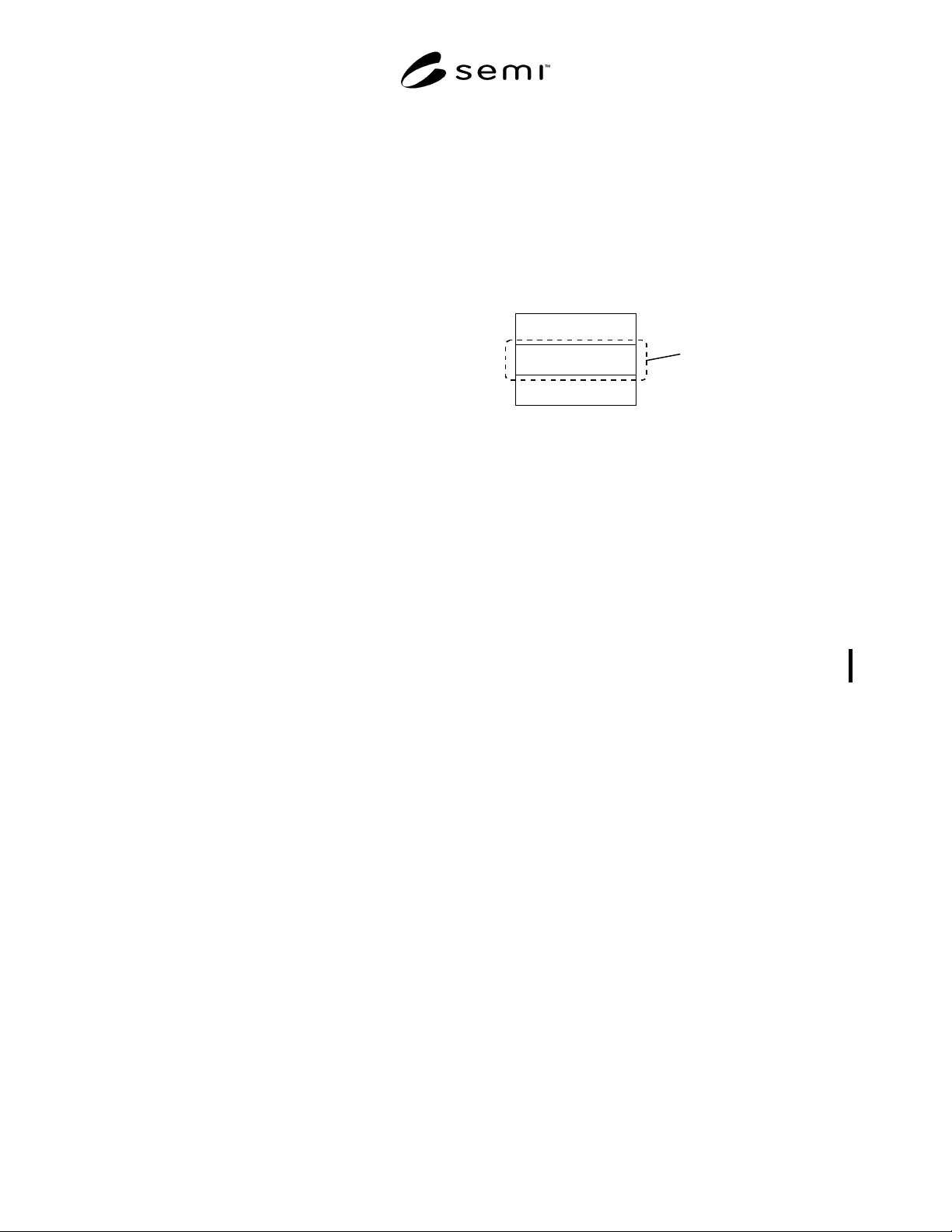
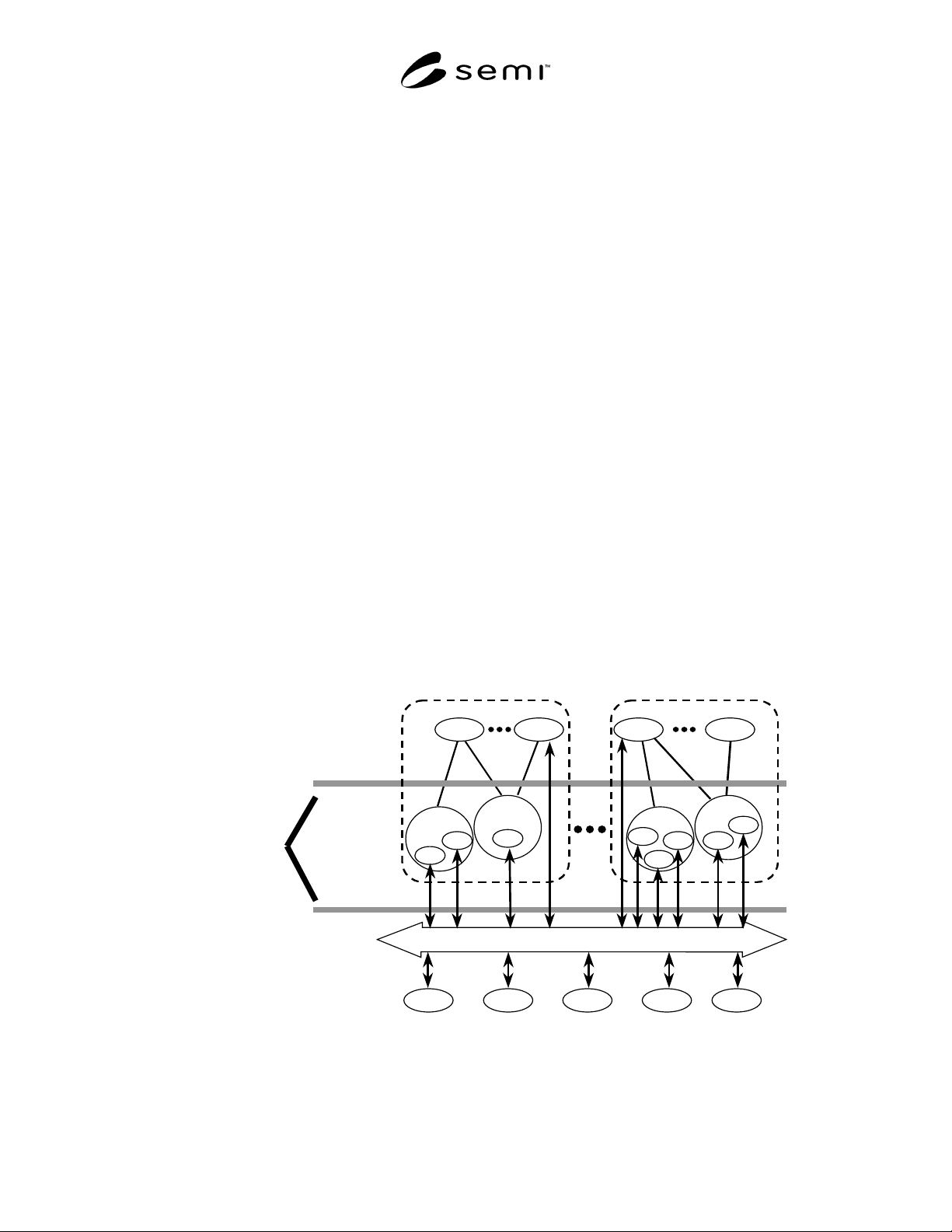
6.3.3.2 Figure 1 shows the CIM Framework architec-
ture as a layered system, with the CIM Framework cov-
ering the middle layer of that system. Figure 2 details
the layers, showing the components and their interact-
ion and extension. The following subsections provide
an introduction to the CIM Framework architecture.
Infrastructure
Common
Components
Application
Objects
CIM Framework
Domain Specifications
Figure 1
CIM Framework Layering
6.3.3.3 Infrastructure
6.3.3.3.1 The infrastructure provides the distributed
computing environment for the application. These
services include operating system, communications,
data storage, user interface, event distribution,
exception management, etc. The CIM Framework
assumes infrastructure services and facilities defined by
the Object Management Group®’s (OMG) Object
Management Architecture (OMA) or by the Microsoft®
DCOM and COM+ architecture and it can be mapped to
other infrastructures such as those for Java™. SEMI
E96 addresses the infrastructure layer.
6.3.3.4 Common Components
6.3.3.4.1 Common components are the functional
entities common across MES applications. For
example, material tracking, machine management, and
scheduling applications all need a common, shareable
concept of wafer groups (lots), machines, and process
recipes. The common components provide a shared
model for these entities, enabling quicker development
and integration of material tracking, machine
management, scheduling and other applications. They
specify the data and behavior of these components
required for interoperability between the applications.
6.3.3.5 Application Objects
6.3.3.5.1 The application objects provide the applica-
tion functionality beyond the common components.
These application objects provide application-specific
data and behavior (such as the specific scheduling
algorithms or the specific recipe management
functions), building on the common component data
and behavior that allows the application to interoperate
with other applications. The application objects also
SEMI E81-0600 © 1999, 20007
define the business process workflows, business logic
and user interfaces for the applications. They provide
functionality that is often product- or site-specific. This
functionality should not be included in an industry-wide
standard for common components. Rather, it should be
accommodated through the extendibility and reuse
mechanisms of the common components.
6.3.3.6 Component Granularity and Incremental
Standard Conformance
6.3.3.6.1 The CIM Framework components are the
smallest elements of standardization of functional
interface and behavior. The CIM Framework specifies
relatively fine-grained components (in terms of their
functional scope) as in the SEMATECH CIM
Framework Specification Version 2.0 [CIMFW]. These
components are larger than objects (their specification
is in terms of an object model with typically three to
five objects) but more fine-grained than traditional
MES applications. However, the initial SEMI CIM
Framework standards also identify components that are
more coarse-grained, aligning with current MES
product boundaries. These coarse-grained components
contain fine-grained sub-components in their
specifications, as in Figure 3 (typically two to four sub-
components per coarse-grained component).
6.3.3.6.2 The coarse-grained components encapsulate
the detail of the internal objects, relationships and sub-
components by selectively exposing, hiding or
abstracting some object methods and relationships. The
coarse-grained components are specified with the detail
of the sub-component and object interfaces and
behavior, but standard conformance is in two levels;
first-level conformance is to the interfaces of the
coarse-grained components (not requiring exposure of
the encapsulated detail), and second-level conformance
is to the detail of the sub-components.
6.4 CIM Framework Functional Scope
6.4.1 The term Manufacturing Execution System
(MES) represents an abstraction for a collection of
software implementations. While there are examples of
implementations that provide significant coverage of
MES functionality, the industry trend is toward supplier
focus on areas of core competency. In many cases this
will result in a supplier offering for a subset of the MES
domain, or a partitioned offering of separable products
by a single source. Large, more monolithic
implementations are gradually evolving toward this
model of component packaging for smaller
implementations. Ideally, MES scoping should
correspond to natural boundaries that have emerged in
representative products that border the “In
MES”/“Outside MES” dividing line. It is that capability
within MES scope that will be provided by the CIM
Framework.
6.4.2 The following list identifies so me criteria that
may be used to help scope MES within the larger
context of manufacturing enterprise systems often
called Computer Integrated Manufacturing.
Object Communications (CORBA, DCOM, etc.)
Object
Object
Events
Common Services and Facilities
(CORBAservices and CORBAfacilities or COM+ or other)
Names Persist
Transact
Distributed
Computing
Infrastructure
Common
Components
Object
Component
Component
Object
Object
Object
Object
Component
Component
Object Object Object Object
Standard Component Interfaces
Standard Component Interfaces
Application
Objects
Conformant Extensions
Conformant Extensions
Object
Application 1 Application N
CIM
Framework
Components
. . .
• Interoperable
• Substitutable
• Extendible
•Flexible
• Reusable
Figure 2
CIM Framework Component Architecture