semi合集-English.pdf - 第2102页
SEMI E54.13-0303 © SEMI 2003 3 5.3.1 As this standard defi nes the presentation or mapping of CDM data structure and behavi or over a network, it m a kes use of ma ny of the term s in the CDM document . Table 1 provides …

SEMI E54.13-0303 © SEMI 2003 2
structure and behavior onto the network for each SEMI
specified SDM (referred to as the “SDM mapping”).
2.4 Adding SDM Mappings SDM mappings added
to part two of this document are considered document
additions and are balloted as such. An SDM mapping
may only be balloted for addition to this document if
the corresponding SEMI SDM has been standardized.
NOTICE: This standard does not purport to address
safety issues, if any, associated with its use. It is the
responsibility of the users of this standard to establish
appropriate safety and health practices and determine
the applicability of regulatory or other limitations prior
to use.
3 Limitations
3.1 This document specifies a semiconductor
equipment SAN based solely on EtherNet/IP and is a
companion document to the EtherNet/IP specification;
thus a complete specification of this standard
necessarily includes the EtherNet/IP specifications.
There are other semiconductor equipment SAN
communications options. The specifications for these
options are not included here.
3.2 This standard specifies enhancements that provide
additional capabilities over and above those currently
required by EtherNet/IP. In order to avoid document
consistency problems, information in the EtherNet/IP
specification that relates to this standard is not repeated
in this document. This document is limited to
describing enhancements or limitations to the
EtherNet/IP specification that are imposed by this
standard.
3.3 A complete specification of the conformance
testing procedure shall include the EtherNet/IP
conformance testing specification. Conformance
testing shall also include enhancements and limitations
to the EtherNet/IP specification required by this
standard.
4 Referenced Standards
4.1 SEMI Standards
SEMI E30 — Generic Model for Communications and
Control of Manufacturing Equipment (GEM)
SEMI E39 — Object Services Standard: Concepts,
Behavior, and Services (OSS)
SEMI E54 — Sensor/Actuator Network Standard
SEMI E54.1 — Standard for Sensor/Actuator Network
Common Device Model
SEMI E54.2 — Guide for Writing Sensor/Actuator
Network (SAN) Standard Ballots
4.2 ISO Standards
2
ISO 7498 Basic Reference Model for Open Systems
Interconnection.
ISO/IEC 8802-3 Carrier Sense Multiple Access with
Collision Detection (CSMA/CD) Access Method and
Physical Layer Specifications (Ethernet IEEE 802.3).
4.3 Other Documents
ODVA
3
EtherNet/IP Specification Volume I and
Volume II, Release 1.0.
NOTICE: Unless otherwise indicated, all documents
cited shall be the latest published versions.
5 Terminology
5.1 Terminology that is common to all of the
documents in this SAN standard may also be defined in
SEMI E54. Terminology may be reproduced here
which is defined in other SEMI documents.
5.2 Abbreviations and Acronyms
5.2.1 CDM — Common Device Model
5.2.2 CIP — Control and Information Protocol
5.2.3 CM — Connection Manager object
5.2.4 DM — Device Management object
5.2.5 EIP — EtherNet/IP
5.2.6 EL — Ethernet Link object
5.2.7 IP — Internet Protocol
5.2.8 MR — Message Router object
5.2.9 NCS — Network Communication Standard
5.2.10 OSI — Open Systems Interconnect
5.2.11 OSS — Object Services Standard
5.2.12 PDU — Protocol Data Unit
5.2.13 SAC — Sensor, Actuator, Controller object
5.2.14 SAN — Sensor/Actuator Network
5.2.15 SDM — Specific Device Model
5.2.16 S-DS — S-Device Supervisor object
5.2.17 TCP — Transport Control Protocol
5.3 Device Component Definitions
2 International Organization for Standardization. ISO Central
Secretariat, 1, rue de Varembé, Case postale 56, CH-1211 Geneva 20,
Switzerland. Telephone: 41.22.749.01.11; Fax: 41.22.733.34.30.
Website: /www.iso.ch
3 Open DeviceNet Vendor Association, 20423 State Road 7 #F6,
Boca Raton, FL 33498-6797; Phone: (1) 561-477-7966; Website:
www.odva.org.
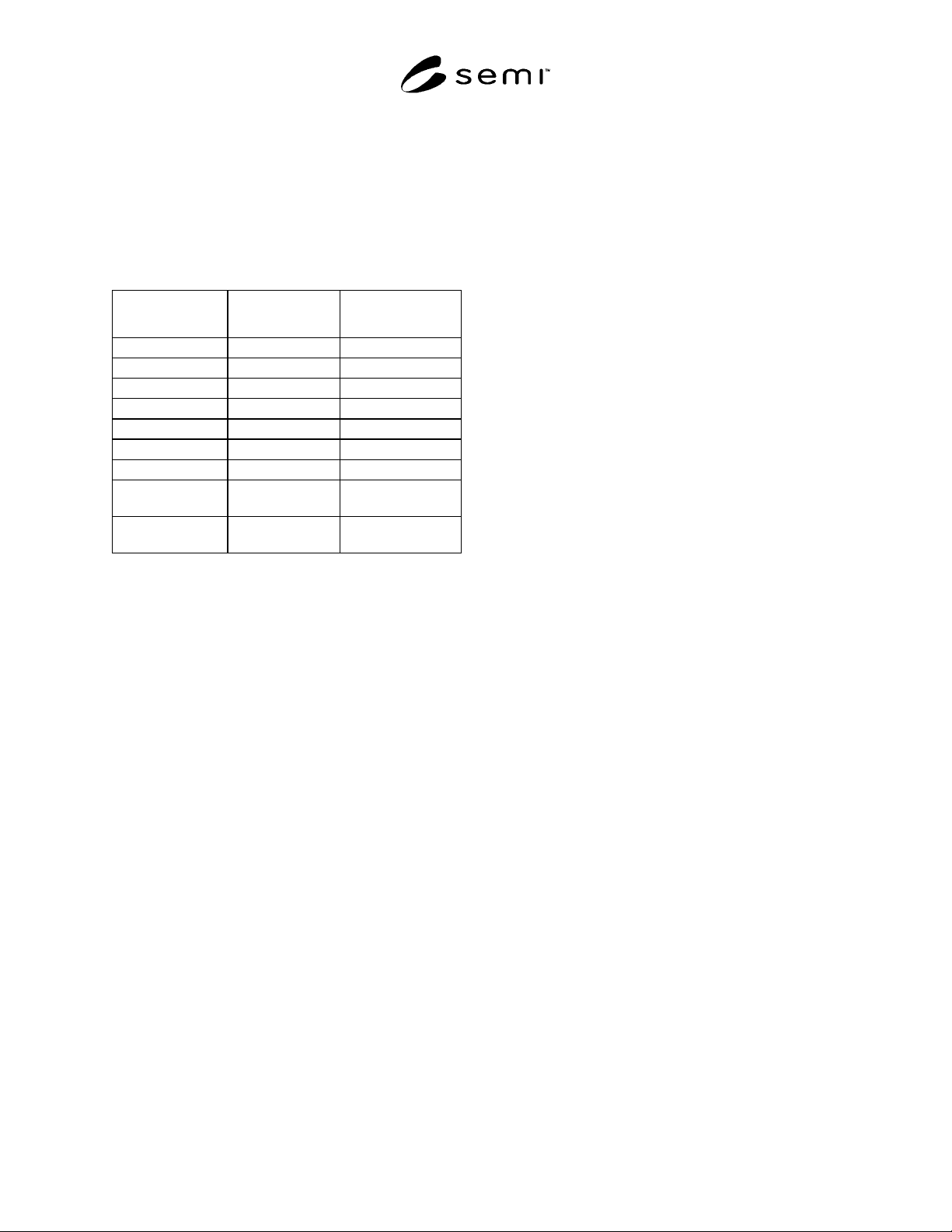
SEMI E54.13-0303 © SEMI 2003 3
5.3.1 As this standard defines the presentation or
mapping of CDM data structure and behavior over a
network, it makes use of many of the terms in the CDM
document. Table 1 provides a mapping of fundamental
terminology of the CDM document into this document
and the EtherNet/IP specification. Note that Column 2
contains an equal sign “=” if the definition is used
exactly as specified in the CDM specification.
Table 1 Mapping of CDM to NCS Terminology
CDM Term NCS Equivalent EtherNet/IP
Equivalent
Device = =
Device Model = Device Profile
Object =, Class =, Class
Instance = =
Attribute = =
Behavior = =
Service = =
Behavior State
Diagram
= State Transition
Diagram
State Transition
Matrix
= State Event Matrix
5.4 EtherNet/IP Specific Definitions
5.4.1 class A set of objects that all represent the
same kind of system component. A class is a
generalization of an object. All objects in a class are
identical in form and behavior, but may contain
different attribute values.
5.4.2 Control and Information Protocol (CIP) The
common network, transport and application layers
shared by EtherNet/IP and DeviceNet.
5.4.3 device profile An EtherNet/IP specification for
a device that contains an object model for the device
type, the I/O data format for the device type, and the
configuration data and the public interface(s) to that
data.
5.4.4 encapsulation The technique used by layered
protocols in which a layer adds header information to
the protocol data unit (PDU) from the layer above. As
an example, in Internet terminology, a packet would
contain a header from the data link layer, followed by a
header from the network layer (IP), followed by a
header from the transport layer (TCP), followed by the
application protocol data.
5.4.5 Ethernet A 10/100-Mb/s standard for LANs,
initially developed by Xerox, and later refined by
Digital, Intel and Xerox (DIX). All hosts are connected
to the network media where they contend for network
access using a Carrier Sense Multiple Access with
Collision Detection (CSMA/CD).
5.4.6 EtherNet/IP EtherNet/IP (Ethernet/Industrial
Protocol) is a networked communications protocol that
specifies the encapsulation of CIP over TCP/IP.
5.4.7 Explicit Message Connections Connections
over an EtherNet/IP network that provide generic,
multi-purpose communication paths between two
devices. These connections often are referred to as just
Messaging Connections. Explicit Messages provide the
typical request/response–oriented network communica-
tions.
5.4.8 Input/Output Connections Connections over
an EtherNet/IP network that provide dedicated, special-
purpose communication paths between a producing
application and one or more consuming applications.
Application-specific I/O data moves though these ports.
6 Communication Protocol High Level
Structure
6.1 Though the protocol specification is called
“EtherNet/IP”, Ethernet is technically not required.
EtherNet/IP may be used on any media that supports
transmission of the Internet Protocol (IP). When
Ethernet is used, it shall comply with the IEEE 802.3
specification.
NOTE 1: Conformance testing of EtherNet/IP products is
limited to those products implemented on Ethernet.
6.2 The following sections give a brief description of
the EtherNet/IP specification in terms of the seven layer
architecture described by the ISO Basic Reference
Model for Open Systems Interconnection (the OSI
model).
6.3 Physical Layer The physical layer requirements
include specifications for topology, media, connectors,
shielding and grounding. Where copper media is used,
the EtherNet/IP specification is based on the
ANSI/TIA/EIA-568-B Category 5/5E cable/connector
specifications. A Commercial grade and Industrial
grade level of conformance are specified. The
signaling and coupling are as specified in the IEEE
802.3 / TP-PMD standard.
6.4 Data Link Layer For compatibility with
EtherNet/IP conformance testing capabilities, the
device must comply with the Ethernet Data Link Layer
Specifications as specified by IEEE 802.3. Otherwise,
any data link layer that supports the IP is acceptable.
6.5 Network Layer The network layer for the
EtherNet/IP protocol is defined by the Internet Protocol
(IP version 4) (RFC 791).
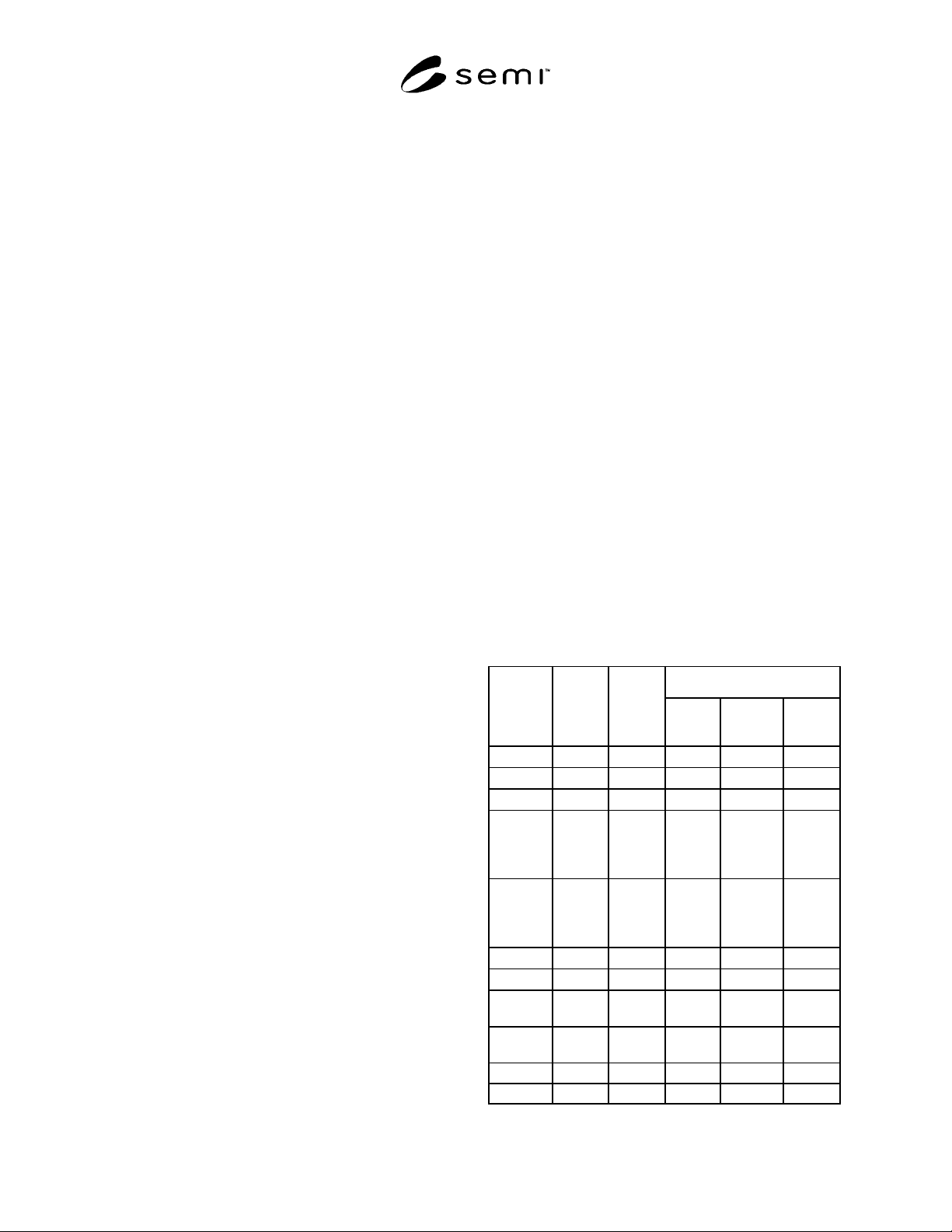
SEMI E54.13-0303 © SEMI 2003 4
6.6 Transport Layer The transport layer requires the
support of Transmission Control Protocol (TCP) (RFC
793) as well as User Datagram Protocol (UDP) (RFC
768).
6.7 Session Layer Many of the services and
functions of the session layer for the EtherNet/IP
protocol are divided and handled, in varying capacities,
by the TCP/UDP protocol specifications and the
EtherNet/IP Application Layer specifications. The first
defines transport level connection sessions, while the
latter defines application level sessions in terms of
Explicit Connection and I/O Connection management.
6.8 Presentation Layer The presentation layer is
defined in terms of standard data types and specific
encoding definitions for application layer data.
6.9 Application Layer The device shall comply with
the EtherNet/IP application layer specification for
defining and addressing objects, including their
attributes and services, and enabling specified network
behavior. The device shall comply with the object
model specifications provided in the EtherNet/IP
specification.
6.10 Object models EtherNet/IP provides an object-
oriented specification for creating, defining and
addressing objects explicitly, including their attributes
and services (i.e., explicit messaging), and creating,
defining and communicating object attribute assemblies
in an application dependent format (i.e., input/output
messaging). The device shall comply with the object
model specifications provided in the EtherNet/IP
documentation. In addition, the device shall comply
with the object specifications defined in Section 7 of
this document.
7 Required Object Types
7.1 The EtherNet/IP specification identifies and
describes objects (i.e., classes) that must exist in all
EtherNet/IP compliant devices. The Common Device
Model (CDM) specification additionally identifies two
objects, the Device Management (DM) and Sensor
Actuator Controller (SAC) objects, that must exist in all
SEMI compliant SAN devices. The required object
types for a SEMI compliant SAN device utilizing the
network communication specification described herein,
necessarily comprises the union of the above two
requirements.
7.2 A list of required and optional object types is given
in Table 2. Note that the Sensor, Actuator, and
Controller object types are not required, and are
indicated as optional in the CDM specification. These
objects are aggregated together to form a SEMI and
EtherNet/IP compliant device.
7.3 The two required object types from the CDM (the
DM and the SAC) are implemented as mapped
components in EtherNet/IP; they are mapped to the
SEMI-specific S-Device Supervisor object class as
described in this section.
7.4 The listed object types are:
• Identity,
• Message Router (MR),
• Connection (Conn),
• Connection Manager (CM),
• Ethernet Link (EL),
• TCP/IP Interface (TCP/IP),
• S-Device Supervisor (S-DS),
• Device Management (DM),
• Sensor Actuator Controller (SAC),
• Sensor,
• Actuator, and
• Controller.
7.5 Also, although not a network addressable object,
each device shall support the Unconnected Message
Manager (UCMM) as defined by EtherNet/IP.
Table 2 Object Types
Required by
Object EIP
Class ID
(See
Note 1.)
CDM
Tag (See
Note 2.)
EIP (See
Note 1.)
CDM (See
Note 2.)
NCS
Identity 01
Yes No Yes
MR 02
Yes No Yes
Conn 05
Yes No Yes
CM 06
Condi-
tional
(See
Note 1.)
No Condi-
tional
(See
Note 1.)
EL F5
Condi-
tional
(See
Note 1.)
No Condi-
tional
(See
Note 1.)
TCP/IP F6
Yes No Yes
S-DS 30
No No Yes
DM
DmI0 No Yes Yes (See
Note 4.)
SAC
SACI0 No Yes Yes (See
Note 4.)
Sensor 31 SenIn No No No
Actuator 32 ActIn No No No