semi合集-English.pdf - 第88页
SEMI E10-0304 E © SEMI 1986, 2004 2 4.1.5 downti me event — a detectable occ urrence significant t o the equipmen t that causes the equipm ent to go from an uptime state to either a scheduled or an unscheduled downtim e …

SEMI E10-0304
E
© SEMI 1986, 2004 1
SEMI E10-0304
E
SPECIFICATION FOR DEFINITION AND MEASUREMENT OF
EQUIPMENT RELIABILITY, AVAILABILITY, AND MAINTAINABILITY
(RAM)
This specification was technically approved by the Global Metrics Committee and is the direct responsibility
of the North American Metrics Committee. Current edition approved by the North American Regional
Standards Committee on October 15, 2003. Initially available at www.semi.org February 2004; to be
published March 2004. Originally published in 1986; previously published July 2001.
E
This standard was editorially modified in February 2004 to include changes omitted from the previous
edition. Changes were made to Table 1, Table R1-3, and Section R1-7.
1 Purpose
1.1 This document establishes a common basis for
communication between users and suppliers of
semiconductor manufacturing equipment by providing
standards for measuring RAM performance of that
equipment in a manufacturing environment.
2 Scope
2.1 The document defines six basic equipment states
into which all equipment conditions and periods of time
must fall. The equipment states are determined by
functional issues, independent of who performs the
function. The measurement of equipment reliability in
this specification concentrates on the relationship of
equipment failures to equipment usage, rather than the
relationship of failures to total elapsed time.
2.2 Section 5 (Equipment States) defines how
equipment time is categorized. Section 6 (RAM
Measurement) defines formulas for measurement of
equipment performance. Section 7 (Uncertainty
Measurement) gives additional methods for evaluating
the statistical significance of calculated performance
metrics.
2.3 Effective application of this specification requires
that equipment performance (RAM) be tracked with
regard to time and/or equipment cycles. Automated
tracking of equipment states is not within the scope of
this specification, but is covered by SEMI E58. Clear
and effective communication among users and suppliers
promotes continuous improvement in equipment
performance.
2.4 The RAM indices in this specification may be
applied directly to non-cluster tools at the whole
equipment and sub-system levels. The RAM indices
may be applied at the sub-system level (e.g., process
module) for multi-path cluster tools.
NOTICE: This standard does not purport to address
safety issues, if any, associated with its use. It is the
responsibility of the users of this standard to establish
appropriate safety and health practices and determine
the applicability of regulatory or other limitations prior
to use.
3 Referenced Standards
3.1 SEMI Standards
SEMI E58 — Automated Reliability, Availability, and
Maintainability Standard (ARAMS)
NOTICE: Unless otherwise indicated, all documents
cited shall be the latest published versions.
4 Terminology
4.1 Definitions
4.1.1 availability — the probability that the equipment
will be in a condition to perform its intended function
when required.
4.1.2 cluster tool — a manufacturing system made up
of integrated processing modules mechanically linked
together (the modules may or may not come from the
same supplier).
4.1.2.1 single path cluster tool — a cluster tool with
only one process flow path (as used).
4.1.2.2 multi-path cluster tool — a cluster tool with
more than one independent process flow path (e.g.,
multiple load ports/load-locks, multiple process
chambers of the same type) and used as such.
4.1.3 cycle — one complete operational sequence
(including unit load and unload) of processing,
manufacturing, or testing steps for an equipment system
or subsystem. In single unit processing systems, the
number of cycles equals the number of units processed.
In batch systems, the number of cycles equals the
number of batches processed.
4.1.4 downtime (DT) — the time when the equipment is
not in a condition, or is not available, to perform its
intended function. It does not include any portion of
non-scheduled time.

SEMI E10-0304
E
© SEMI 1986, 2004 2
4.1.5 downtime event — a detectable occurrence
significant to the equipment that causes the equipment
to go from an uptime state to either a scheduled or an
unscheduled downtime state.
4.1.6 failure — any unscheduled downtime event that
changes the equipment to a condition where it cannot
perform its intended function. Any part failure,
software or process recipe problem, facility or utility
supply malfunction, or human error could cause the
failure.
NOTE 1: It is important to categorize and qualify failures in
ways that facilitate the resolution of problems and improve
overall equipment performance. Use of this specification
requires agreement between supplier and user on categorizing
failures.
4.1.7 equipment-related failure — any unplanned
event that changes the equipment to a condition where
it cannot perform its intended function solely caused by
the equipment.
4.1.8 host — the intelligent system that communicates
with the equipment, acts as a supervisory agent, and
represents the factory and the user to the equipment.
4.1.9 intended function — a manufacturing function
that the equipment was built to perform. This includes
transport functions for transport equipment and
measurement functions for metrology equipment, as
well as process functions such as physical vapor
deposition and wire bonding. Complex equipment may
have more than one intended function.
4.1.10 maintainability — the probability that the
equipment will be retained in, or restored to, a
condition where it can perform its intended function
within a specified period of time.
4.1.11 maintenance — the act of sustaining equipment
in or restoring it to a condition to perform its intended
function. In this document, maintenance refers to
function, not organization; it includes adjustments,
change of consumables,
software upgrades, repair,
preventive maintenance, etc., no matter who performs
the task.
4.1.12 manufacturing time — the sum of productive
time and standby time.
4.1.13 non-scheduled time — the time when the
equipment is not scheduled to be utilized in production.
4.1.14 operations time (oper-time) — total time minus
non-scheduled time.
4.1.15 operator — any person who communicates
locally with the equipment through the equipment’s
control panel.
4.1.16 product — units produced during productive
time (see unit).
4.1.17 ramp-down — the portion of a maintenance
procedure required to prepare the equipment for hands-
on work. It includes purging, cool-down, warm-up,
software backup, storing dynamic values (e.g.,
parameters, recipes), etc. Ramp-down is only included
in scheduled and unscheduled downtime.
4.1.18 ramp-up — the portion of a maintenance
procedure required, after the hands-on work is
completed, to return the equipment to a condition where
it can perform its intended function. It includes pump
down, warm-up, stabilization periods, initialization
routines, software load, restoring dynamic values (e.g.,
parameters, recipes), control system reboot, etc. It does
not include equipment or process test time. Ramp-up is
only included in scheduled and unscheduled downtime.
4.1.19 reliability — the probability that the equipment
will perform its intended function, within stated
conditions, for a specified period of time
4.1.20 shutdown — the time required to put the
equipment in a safe condition when entering a non-
scheduled state. It includes any procedures necessary
to reach a safe condition. Shutdown is only included in
non-scheduled time.
4.1.21 specification (equipment operation) — the
documented set of intended functions within stated
conditions for equipment operation as agreed upon
between user and supplier.
4.1.22 start-up — the time required for equipment to
achieve a condition where it can perform its intended
function, when leaving a non-scheduled state. It
includes pump down, warm-up, cool-down,
stabilization periods, initialization routines, software
load, restoring dynamic values (e.g., parameters,
recipes), control system reboot, etc. Start-up is only
included in non-scheduled time.
4.1.23 support tool — a tool that, although not part of a
piece of equipment, is required by and becomes integral
with it during the course of normal operation (e.g.,
cassettes, wafer carriers, probe cards, computerized
controllers/monitors).
4.1.24 total time — all time (at the rate of 24 hrs/day, 7
days/week) during the period being measured. In order
to have a valid representation of total time, all six basic
equipment states must be accounted for and tracked
accurately.
4.1.25 training (off-line) — the instruction of personnel
in the operation and/or maintenance of equipment done
outside of operations time. Off-line training is only
included in non-scheduled time.
SEMI E10-0304
E
© SEMI 1986, 2004 3
4.1.26 training (on-the-job) — the instruction of
personnel in the operation and/or maintenance of
equipment done during the course of normal work
functions. On-the-job training typically does not
interrupt operation or maintenance activities and can
therefore be included in any equipment state (except
standby and non-scheduled) without special
categorization.
4.1.27 unit — any wafer, substrate, die, packaged die,
or piece part thereof.
4.1.28 uptime — the time when the equipment is in a
condition to perform its intended function. It includes
productive, standby, and engineering time, and does not
include any portion of non-scheduled time.
4.1.29 user — any entity interacting with the
equipment, either locally as an operator or remotely via
the host. From the equipment’s view point, both the
operator and the host
represent the user.
4.1.30 utilization — the percent of time the equipment
is performing its intended function during a specified
time period.
4.1.31 verification run — a single cycle of the equip-
ment (using units or no units) used to establish that it is
performing its intended function within specifications.
5 Equipment States
5.1 To clearly measure equipment performance
(RAM), this document defines six basic equipment
states into which all equipment conditions and periods
of time must fall.
5.2 The equipment states are determined by function,
not by organization. Any given maintenance
procedure, for example, is classified the same way no
matter who performs it, an operator, a production
technician, a maintenance technician, or a process
engineer.
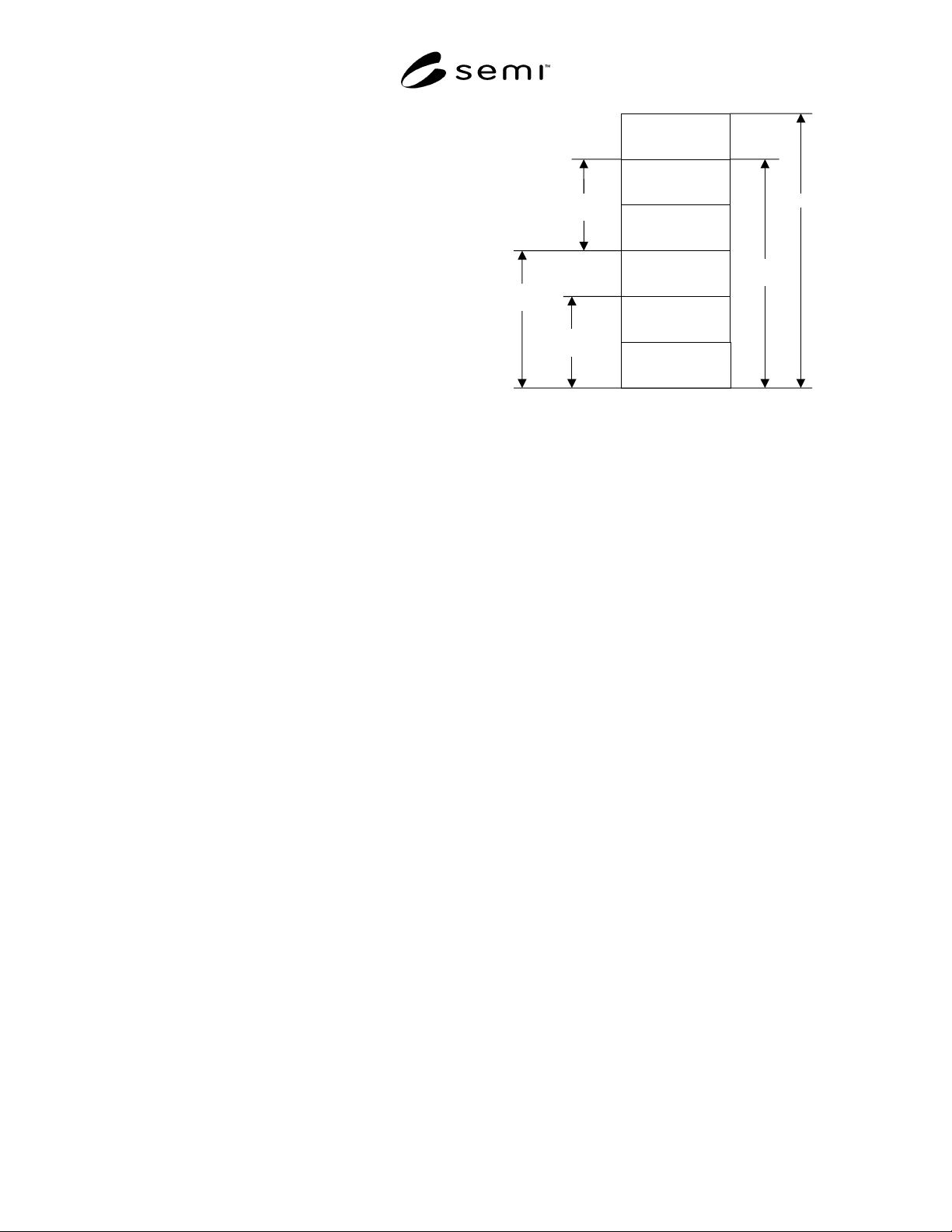
5.3 Figure 1 is a stack chart of the six basic equipment
states. These basic equipment states can be divided into
as many sub-states as are required to achieve the
equipment tracking resolution that a manufacturing
operation desires. SEMI E10 makes no attempt to list
all possible sub-states, but does give some examples for
guidance.
5.4 Key blocks of time associated with the basic states
and example substates are given in Figure 2. These
blocks of time are used in the RAM equations given
later in this document. The blocks of time associated
with the basic states and example substates are
described in the following sections.
SCHEDULED
DOWNTIME
STANDBY
TIME
ENGINEERING
TIME
UNSCHEDULED
DOWNTIME
NON-SCHEDULED
TIME
PRODUCTIVE
TIME
Equipment
Uptime
Operations
Time
Total Time
Manufacturing
Time
Equipment
Downtime
Figure 1
Equipment States Stack Chart
5.5 PRODUCTIVE STATE — The time (productive
time) when the equipment is performing its intended
function. The productive state includes:
• Regular production (including loading and
unloading of units),
• Work for third parties,
• Rework, and
• Engineering runs done in conjunction with
production units (e.g., split lots and new
applications).
5.6 STANDBY STATE — The time (standby time),
other than non-scheduled time, when the equipment is
in a condition to perform its intended function,
chemicals and facilities are available, but it is not
operated. The standby state includes:
• No operator available (including breaks, lunches,
and meetings),
• No units available (including no units due to lack
of available support equipment, such as metrology
tools),
• No support tools (e.g., cassettes, wafer carriers,
probe cards), and
• No input from external automation systems (i.e.,
host).
5.7 ENGINEERING STATE — The time (engineering
time) when the equipment is in a condition to perform
its intended function (no equipment or process
problems exist), but is operated to conduct engineering
experiments. The engineering state includes: