semi合集-English.pdf - 第2007页
SEMI E54.7-0999 © SEMI 1999 1 SEMI E54.7-0999 STANDARD FOR SENSOR/ACTUATOR NETWORK COMMUNIC A TI ON FOR SERIPLEX This st andard w as technica lly approve d by the Global Inform ation & Contr ol Comm ittee and is the …

SEMI E54.6-0997 © SEMI 1997, 2004 12
9 Specific Device Type Information
9.1 This section provides for the mapping of network-
visible specific device structure and behavior, specified
in a SEMI standard SDM specification, to the
LonWorks network. Each subsection is devoted to a
single SDM specification (e.g., Section 9.1: Mass Flow
Controller). Additional SDM mappings are added as
subsections to this NCS specification according to
SEMI guidelines and the guidelines of the SEMI SAN
Interoperability standard. Device-type-specific items,
such as overrides to the standard connector, may also be
noted in these subsections.
NOTICE: These standards do not purport to address
safety issues, if any, associated with their use. It is the
responsibility of the user of these standards to establish
appropriate safety and health practices and determine
the applicability of regulatory limitations prior to use.
SEMI makes no warranties or representations as to the
suitability of the standards set forth herein for any
particular application. The determination of the
suitability of the standard is solely the responsibility of
the user. Users are cautioned to refer to manufacturer’s
instructions, product labels, product data sheets, and
other relevant literature respecting any materials
mentioned herein. These standards are subject to
change without notice.
The user’s attention is called to the possibility that
compliance with this standard may require use of
copyrighted material or of an invention covered by
patent rights. By publication of this standard, SEMI
takes no position respecting the validity of any patent
rights or copyrights asserted in connection with any
item mentioned in this standard. Users of this standard
are expressly advised that determination of any such
patent rights or copyrights, and the risk of infringement
of such rights, are entirely their own responsibility.
Copyright by SEMI® (Semiconductor Equipment and Materials
International), 3081 Zanker Road, San Jose, CA 95134. Reproduction o
f
the contents in whole or in part is forbidden without express written
consent of SEMI.

SEMI E54.7-0999 © SEMI 19991
SEMI E54.7-0999
STANDARD FOR SENSOR/ACTUATOR NETWORK COMMUNICATION
FOR SERIPLEX
This standard was technically approved by the Global Information & Control Committee and is the direct
responsibility of the North American Information & Control Committee. Current edition approved by the
North American Regional Standards Committee on July 15, 1999. Initially available at www.semi.org
August 1999; to be published September 1999.
1 Purpose
1.1 This standard defines a communication
specification based on the Seriplex protocol to enable
communications between intelligent devices on a
sensor/actuator network (SAN) that operate according
to SEMI specified device models (common and device
specific) in a semiconductor manufacturing tool.
1.2 Background and Motivation
1.2.1 Seriplex is a component level network which
provides a simple, inexpensive, fast, and deterministic
means of exchanging data among control level
industrial devices (e.g., sensors and actuators) and
higher level devices such as controllers. Seriplex
provides:
• A solution to low-level device networking
• Access to intelligence present in low-level devices
• Networking between higher level controllers
• Master/Slave and Peer-to-Peer capabilities
1.2.2 Seriplex specifies a communication model and
protocol as well as a complete Physical Layer
definition.
1.2.3 This document enables commu nications between
intelligent devices on a SEMI compliant SAN by
providing a presentation mapping of common and
specific device network visible structure and behavior
to a Seriplex network.
2 Scope
2.1 This document specifies the protocol and services
that compliant intelligent devices must support to
exchange information over this semiconductor
equipment sensor/actuator network.
2.2 This document specifies the utilization of the
Seriplex protocol to present externally visible device
structure and behavior, specified in the Common
Device Model (CDM) and appropriate Specific Device
Models (SDMs), on a Seriplex network.
2.3 This document is used in conjunction with a SEMI
standard SAN Common Device Model specification,
one or more SEMI standard Specific Device Model
(SDM) specifications (e.g. for a mass flow controller)
and the Seriplex Standard Specification. Together, they
describe the Seriplex protocol, the externally visible
data structures and behaviors of devices utilizing the
Seriplex networking capability in a SEMI compliant
SAN system.
2.4 This standard does not purport to address all of the
safety issues associated with its use. It is the
responsibility of the users of this standard to establish
appropriate safety and health practices and determine
the applicablity of regulatory limitations prior to use.
3 Limitations
3.1 This document specifies a semiconductor
equipment SAN based solely on Seriplex and is a
companion document to the Seriplex standard
specification; thus a complete specification of this
standard necessarily includes the Seriplex standard
specifications. There are other semiconductor
equipment SAN communications options. The
specifications for these options are not included here.
3.2 This standard specifies enhancements that provide
additional capabilities over and above those currently
required by Seriplex. In order to avoid document
consistency problems, information in the Seriplex
standard specification that relates to this standard is not
repeated in this document. This document is limited to
describing enhancements or limitations to the Seriplex
standard specification that are imposed by this standard.
4 Referenced Standards
4.1 SEMI Standards
SEMI E54.1 — Standard for Sensor/Actuator Network
Common Device Model
SEMI E54.3 — Specification for Sensor/Actuator
Network Specific Device Model for Mass Flow Device
SEMI E54.7-0999 © SEMI 1999 2
4.2 Other Documents
Bulletin No. 8310PD9603 — Seriplex Standard
Specification: August 1997, Technology Organization,
Inc. Raleigh, NC, USA.
1
ISO 7498 — Basic Reference Model for Open Systems
Interconnection
2
NOTE 1: As listed or revised, all documents cited shall be the
latest publications of adopted standards.
5 Terminology
5.1 Terminology that is common to all of the
documents in this SAN standard may also be defined in
the Sensor/Actuator Network Standard. Terminology
may be reproduced here which is defined in other SEMI
documents.
5.2 Abbreviations and Acronyms
CDM — Common Device Model
DM — Device Manager (object)
NCS — Network Communication Standard
OSI — Open Systems Interconnect
OSS — Object Services Standard
SAC — Sensor, Actuator, Controller (Object)
SAN — Sensor/Actuator Network
SDM — Specific Device Model
STO — Seriplex Technology Organization
VDC — Volts, Direct Current
5.3 Device Component Definitions
5.3.1 As this standard defines the presentation or
mapping of CDM data structure and behavior over a
network, it makes use of many of the terms in the SEMI
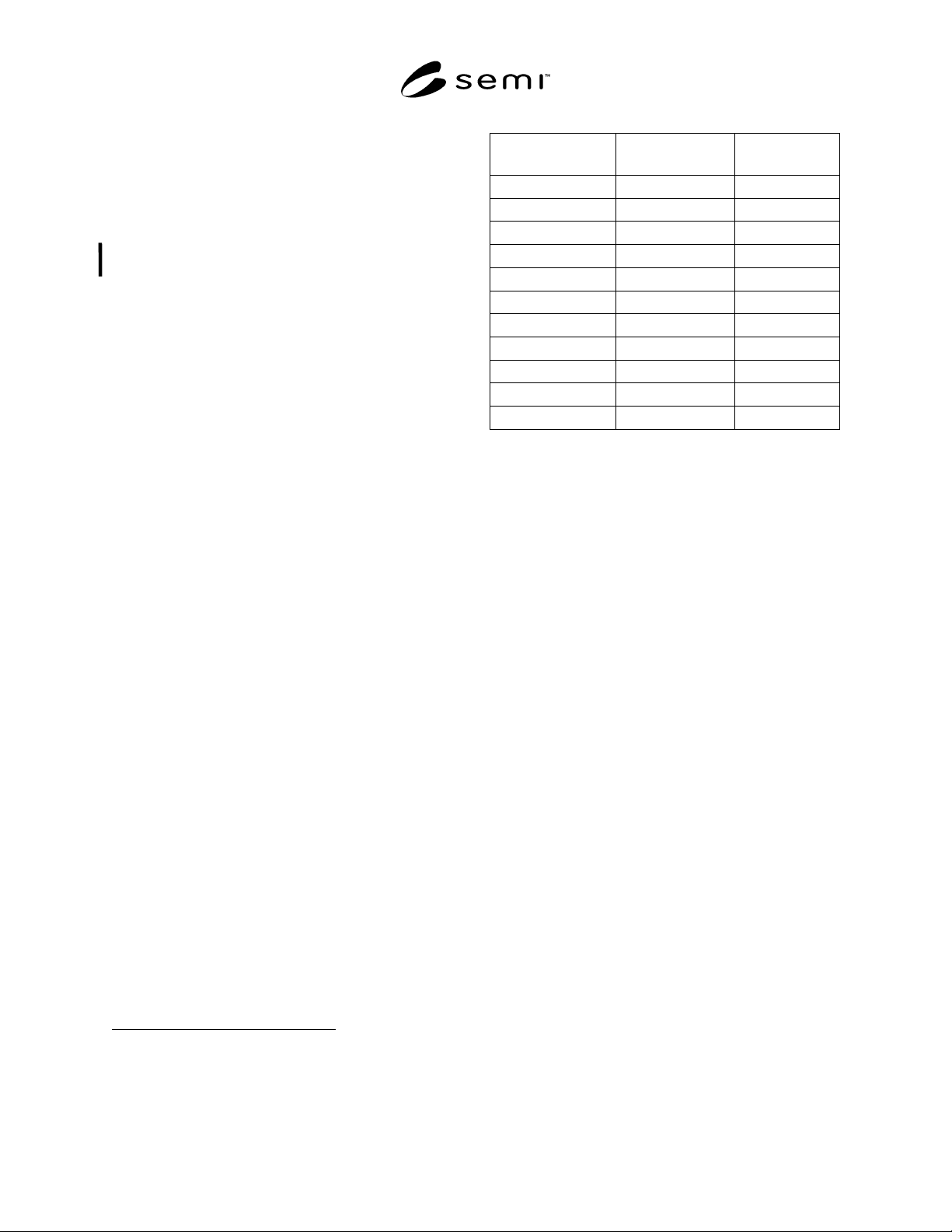
E54.1 CDM document. Table 1 provides a mapping of
fundamental terminology of the CDM document into
this document and the Seriplex standard specification.
Note that Column 2 contains an equal sign ‘=’ if the
definition is used exactly as specified in the CDM
specification.
1 Seriplex Technology Organization, P.O. Box 27446, Raleigh, NC
27611, www.seriplex.org
2 ISO Central Secretariat, 1, rue de Varembé, Case postale 56, CH-
1211 Genève 20, Switzerland
Table 1 Mapping of CDM to NCS Terminology
CDM Term NCS Equivalent Seriplex
Equivalent
Device = =
Device Model = =
Object =, Class =, Class
Instance = =
Attribute = =
Behavior = =
Service = =
State Diagram = =
Byte = =
Nibble = =
Character String ==
5.4 Seriplex Specific Definitions
class — a set of objects that all represent the same kind
of system component. A class is a general-ization of an
object. All objects in a class are identical in form and
behavior, but may contain different attri-bute values.
master/slave mode — communication over a Seriplex
network that provides exclusive control of data by a
“master” or “host” device. All bus input data is reported
exclusively to the host, and the host has exclusive
control over the states of all bus output signals, with all
bus I/O devices acting as ‘slaves”. Master/Slave mode
provides the typical request/ response oriented network
communications.
peer-to-peer mode — communication over a Seriplex
network that provides sharing of bus input and output
data directly among devices. This mode allows
dedicated or broadcast data to be shared between a
producing application and one or more consuming
applications. Application specific I/O data moves
though these devices.
seriplex — an open protocol maintained by the Seriplex
Technology Organization (STO) as a standard means of
interconnection for simple field devices. The Seriplex
standard specification specifies OSI reference model
layers 1, 2, 4 and 7 specifically the physical signaling,
the media access/data link protocols, the transport
capability of end-to-end transmission of data, and the
application layer.
6 Communication Protocol H igh Level
Structure
6.1 The Seriplex protocol is loosely based on a four-
layer architecture. These layers constitute a collapsed
form of the OSI seven layer architecture, mapping into
the physical, data link, transport and application layers