semi合集-English.pdf - 第3194页
SEMI E126-0305 © SEMI 2003, 2005 3 Equipment Process Type ••• Process Inputs ( e .g. ti m e ) ••• Process Qual ity Outputs (e.g. Thickness) Ex t e r n a l s Ev e n t s C o n s u m a b l e s O t h e r Tunable Parameter No…

SEMI E126-0305 © SEMI 2003, 2005 2
4 Referenced Standards
4.1 SEMI Standards
SEMI E5 — SEMI Equipment Communications Standard 2 Message Content (SECS-II)
SEMI E30 — Generic Model for Communications and Control of Manufacturing Equipment (GEM)
SEMI E40 — Standard for Processing Management
SEMI E94 — Provisional Specification for Control Job Management
4.2 Other Sources
Object Oriented Modeling and Design, — Prentice Hall, Englewood Cliffs, NJ, c1991 by James Rumbaugh, et. al.
NOTICE: Unless otherwise indicated, all documents cited shall be the latest published versions.
5 Terminology
5.1 Abbreviations and Acronyms
5.1.1 EQIP (Equipment Quality Information Parameter) — a parameter that relates an aspect or quality of a wafer
process or product. Specifically, an EQIP is a parameter of measure on a wafer that relates to the quality of the
wafer, i.e., the closeness of the wafer to a design specification or the performance of the device being produced.
EQIPs may be measurable directly or indirectly. EQIPs do not have to be measured at the process tool. EQIPs may
also be referred to as “process quality parameters”.
5.1.2 PPP (Process Program Parameter) — a parameter in the preplanned and reusable portion of the set of
instructions, settings, and parameters under control of the equipment that determine the processing environment seen
by the manufactured object and that may be subject to change between runs or processing cycles.
5.1.3 R2R Control—Run-to-Run Control — techniques for varying settings in one run based on analysis of either
incoming product (feedfoward) or product from an earlier run (see SEMI E98). In this document, R2R Control is
further defined as a form of discrete process control in which settable process attributes are adjusted, generally
between process runs, to better achieve selected process quality targets.
5.2 Definitions
5.2.1 equipment type — a categorization or grouping of equipment based on capability, method of operation, effect
on wafer, etc. The boundary of the type should be aligned with a generally perceived categorization of equipment in
the industry.
5.2.2 linked process program parameter — an equipment process program parameter that can be altered to effect
change of an EQIP with which it is associated.
6 Background
6.1 Equipment processes can generally be categorized or grouped into types. An equipment or equipment process
can be associated with one of more types. Further, each type can be associated with a finite set of quality parameters
that relate to the quality of process on the wafer. These process quality parameters are a function of tunable process
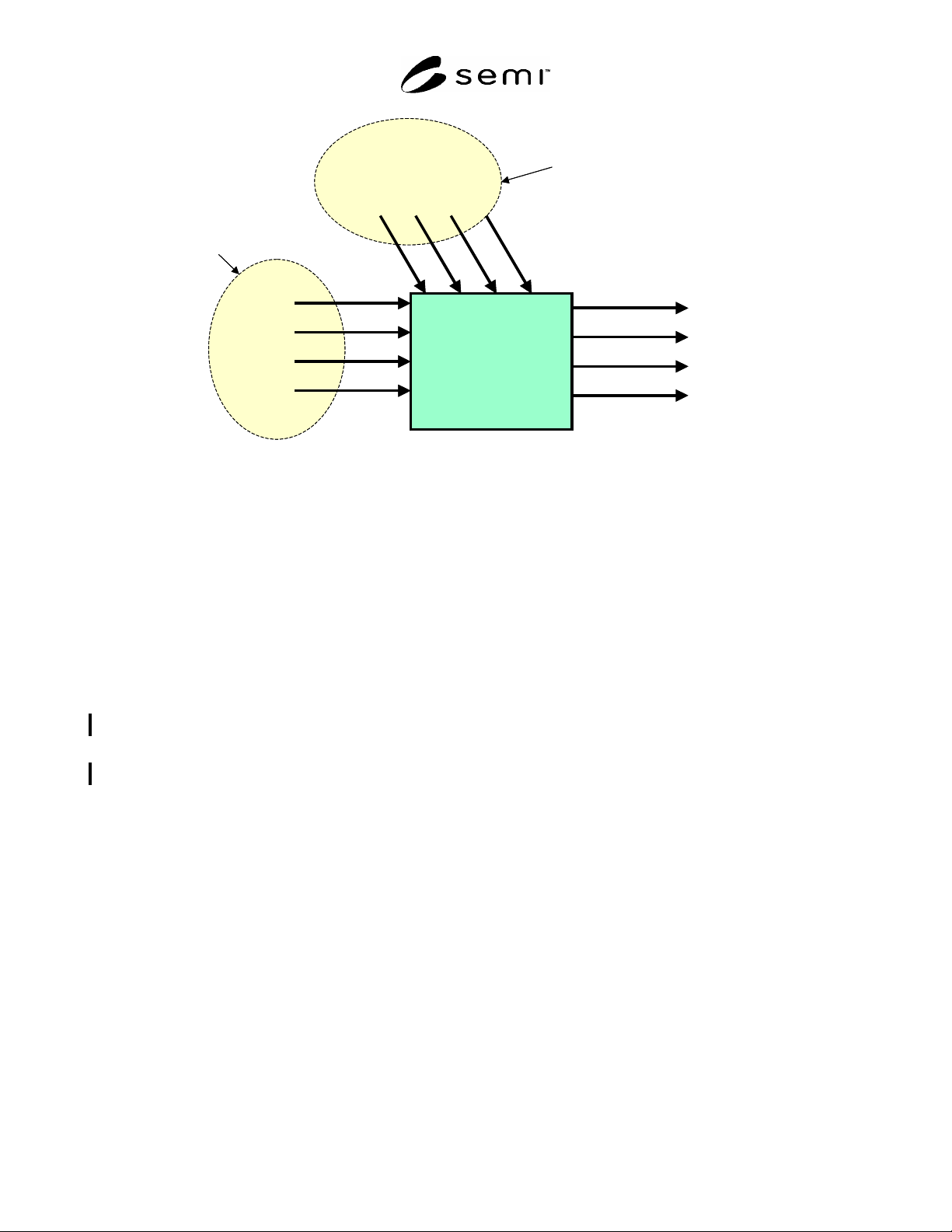
inputs as well as external uncontrollable conditions, as shown in Figure 1.
6.2 Control solutions can provide a capability to improve process quality parameters by suggesting changes to
tunable input parameters. Standards are needed to identify control capabilities for equipment. Specifically, a
standard is needed to specify these quality parameters so as to guide the use of metrology and process program
modification to support capabilities such as run-to-run (R2R) control.
SEMI E126-0305 © SEMI 2003, 2005 3
Equipment
Process
Type
•••
Process Inputs
(e.g. time)
•••
Process Quality Outputs
(e.g. Thickness)
Ex
t
e
r
n
a
l
s
Ev
e
n
t
s
C
o
n
s
u
m
a
b
l
e
s
O
t
h
e
r
Tunable Parameter
Not Tunable
Equipment
Process
Type
•••
Process Inputs
(e.g. time)
•••
Process Quality Outputs
(e.g. Thickness)
Ex
t
e
r
n
a
l
s
Ev
e
n
t
s
C
o
n
s
u
m
a
b
l
e
s
O
t
h
e
r
Tunable Parameter
Not Tunable
Figure 1
Equipment and Process Quality Parameters
(note that, in the figure, EQIPs are Process Quality Outputs and Linked Process Program Parameters—PPPs
are Process Inputs that are tunable according to SEMI defined standard methods)
7 Equipment Type Organization
7.1 This standard categorizes semiconductor equipment into types according to functionality, effect, and or
operational characteristics. The number of types is not limited. An equipment complying with this standard must
belong to at least one type; an equipment can belong to more than one type. Note that the list of types in this
standard does not necessarily provide complete specification for all equipment. Note also that the list of types is
extendible as new equipment types are added.
7.2 For each specified equipment type, the following information shall be provided.
7.2.1 Equipment Type Name — A definition for the type shall be provided that represents a common name used for
this equipment type in the industry.
7.2.2 Equipment Type Definition — A definition of the type shall be provided. This definition shall indicate what
the equipment does and, as necessary, how it does it. It shall also provide a scope of the equipment type, indicating
as necessary which equipment belongs to this type and which equipment does not belong to this type.
7.2.3 List of Equipment Quality Information Parameters (EQIPs). For each equipment type, a non-null list of
EQIPs must be specified.
7.3 For each EQIP specified, the following information shall be provided.
7.3.1 Name — A name for the EQIP shall be provided that represents a common name used for this parameter in
the industry.
7.3.2 Definition — A precise definition of the EQIP shall be provided. If the parameter is derived from
measurement data, the form of this derivation shall be provided. If this parameter is provided in different variants,
each of these variants shall be listed and defined. The definition could include an indication of how the parameter is
or is not measured.
7.3.3 Format Descriptor Fields — A listing of data type fields to be used to specify the format of an EQIP shall be
provided. These fields could include data type, data length, data units, indication of requirement, range of values,
and values used to represent error/fault/invalid data, etc. Note that the specification does not contain values for
these fields; it is the listing of the fields.
SEMI E126-0305 © SEMI 2003, 2005 4
7.4 Specification Mechanism — The listing and definitions of equipment types and EQIPs, and linking of EQIPs to
types are specified utilizing the following components.
7.4.1 Equipment Type Definitions Table — This table (Table 1) contains a definition of all equipment type
elements. Fields in this table include Equipment Type Name and Equipment Type Definition as specified in ¶7.2.
7.4.2 Equipment Type to EQIP Associations Table — This (Table 2) provides a linkage between equipment type
elements and EQIPs. Fields in this table include Equipment Type Name, and “linked” EQIPs.
7.4.3 EQIP Definitions and Format Table — This table (Table 3) contains a definition of all EQIPs specified.
Fields in this table include EQIP Name, EQIP Definition and Format Descriptor.
7.5 Adding to the List of Equipment Types — The standard is structured so that EQIPs for equipment types may be
added to an existing set, as the community reaches consensus on these additions. Further, EQIPs may be defined for
a new equipment type not previously addressed in this standard. Additions to the standard are made utilizing the
SEMI standards balloting process. §10 provides a template of a SEMI ballot for adding to the collection. The
following sub-sections define limitations in adding these equipment types and quality parameters.
7.5.1 Adding Equipment Types — Equipment types added shall comply with the specifications provided in this
document. No addition shall invalidate an existing type. Wherever possible, an equipment type should have a
corollary to a physically distinct classification of equipment or process.
7.5.2 Adding EQIPs — EQIPs added to the collection shall comply with the specifications provided in this
document. A EQIP shall be associated with at least one equipment type. An attempt should be made to define
quality parameters for a type that are exclusive of existing quality parameters.
8 Equipment Quality Information Parameter (EQIP) Specification
8.1 A list of equipment types currently specified, and a definition of each type is provided in Table 1.
8.2 A listing of EQIPs associated with each equipment type is provided in Table 2. Note that all types are required
to have EQIPs associated with them. Note that an EQIP may be associated with more than one equipment type.
8.3 A definition of each EQIP is provided in Table 3.
Table 1 Equipment Type Definitions
Equipment Type Name Equipment Type Definition
Removal Type of equipment that removes material from the surface of a wafer. The method of removal is not
restricted and could include chemical, physical, or nuclear/plasma, or a combination of these methods.
Polishing Type of equipment that removes material from the surface of a wafer using of physical and possibly
chemical means. The physical mechanism involves utilizing abrasive friction and/or grinding
methods. All chemical-mechanical polishers belong to this type, including rotary and linear polishers.
Equipment that utilize purely chemical or non-abrasive physical and chemical methods, such as
equipment commonly referred to as etchers, do not belong to this type.
Lithography Type of equipment cluster that transfers a pattern from a mask or reticle to a layer of resist deposited
on the surface of a wafer.
Deposition Type of equipment that adds material on the surface of a wafer. It does not include equipment that
adds content to the wafer, but does not add material to the surface of the wafer, such as implant. The
method of deposition is not restricted and could include chemical, physical, or nuclear/plasma, or a
combination of these methods.
Diffusion Type of equipment that enables the motion of species in solids in the direction of a concentration
gradient usually utilizing heat. The process often results in a layer (e.g., oxide) growing on the surface
of the wafer.
Etching Type of equipment that removes material from the surface of a wafer using chemical and possibly
physical means. It includes wet etching and dry etching. In wet etching the material is dissolved in
liquid chemicals; in dry etching, which includes reactive ion etching, the material is removed through
conversion into gaseous compounds.
Chemical Vapor A type of deposition equipment where films are deposited on the surface of the wafer as the result of