semi合集-English.pdf - 第2079页
SEMI E54.11-0301 © SEMI 2 001 2 However, SEMI E39 has s p ecific requirements that are intended for higher level applications and thus are not applied to th e Endpoint Devi ce Model. 3.5 Operation over the entire rang e …

SEMI E54.11-0301 © SEMI 20011
SEMI E54.11-0301
SPECIFIC DEVICE MODEL FOR ENDPOINT DEVICES
This specific device model was technically approved by the Global Information & Control Committee and is
the direct responsibility of the North American Information & Control Committee. Current edition approved
by the North American Regional Standards Committee on November 22, 2000. Initially available at
www.semi.org January 2001; to be published March 2001.
1 Purpose
1.1 This specification is part of a suite of standards
that specify the implementation of SEMI standards for
the Sensor/Actuator Network. The specific purpose of
this specification is to describe a network independent
application model comprised of device objects that are
common to all Endpoint Devices on a semiconductor
equipment Sensor/Actuator communication network.
2 Scope
2.1 An Endpoint device (EPD) is a device that
measures and monitors process characteristics to
determine when a specific threshold or event has been
obtained usually to signal the completion of a process
or process step. These endpoint devices are, but not
limited to, devices that may classify a process endpoint
by determining the size and count of particles in the
process environment, detecting and determining optical
light from a sample region of the environment’s space,
or determining motor current of an equipment
component.
2.2 This specification specifically addresses the
minimum attributes, services and behavior an Endpoint
(EPD) device must support to be interoperable on the
Sensor/Actuator Network.
2.3 This specification is intended to ensure a high-
degree of device interoperability on the Sensor/Actuator
Network, while still allowing flexibility for product
differentiation and technology evolution.
2.4 The model specified in this spe cification is used in
conjunction with the Sensor/Actuator Network
Common Device Model (CDM) to completely describe
the Endpoint device (EPD) as it appears from the
network interface.
2.5 This specification, together wi th the
Sensor/Actuator Network Standard, the
Sensor/Actuator Network Common Device Model, and
a Sensor/Actuator Network Communication
Specification, form a complete interoperability
specification for the EPD.
2.6 To comply with this specificat ion, a device must
implement and support, at a minimum, the required
attributes, services, and behavior identified in these
documents. Support for optional attributes, services and
behavior is not required to be compliant to this
specification. Optional attributes, services, and behavior
are specified in these documents to promote further
device interoperability as features evolve and are
adopted by more manufacturers. If optional attributes,
services, and behavior are implemented for this device
they must be implemented as identified in this
document.
2.7 This standard does not purport to address safety
issues, if any, associated with its use. It is the
responsibility of the users of this standard to establish
appropriate safety health practices and determine the
applicability or regulatory limitations prior to use
3 Limitations
3.1 This specification is a compan ion to a suite of
specifications that together make up the
Sensor/Actuator Network Communication standard.
Therefore, using portions of this specification that relate
to network communications necessarily requires an
understanding of the associated network specification.
3.2 As this document is a specifica tion for the
Endpoint Device Model, it does not contain any
definition of objects, attributes, services, or behavioral
descriptions that are already defined in the
Sensor/Actuator Network Common Device Model
(CDM). Additional attributes, attribute assignments,
services and/or service parameters that are Endpoint
Device specific and/or implementation specific are
contained in this specification.
3.3 While this specification is suff icient to completely
describe the EPD as it appears from the network, it does
not fully describe behavior of a specific endpoint device
type which is not visible from the network. This allows
flexibility in implementation techniques and product
differentiation between manufacturers. Manufacturer
specific objects may be defined by the manufacturer but
are, by definition, outside the scope of this standard.
3.4 This specification is compatibl e, but not compliant
with SEMI E39. This means that although this
specification does not require compliance with SEMI
E39, it is extensible such that implementations may be
developed that are fully compliant with both standards.
Note that the concepts and terminology of this
specification are compatible with those of SEMI E39.

SEMI E54.11-0301 © SEMI 2001 2
However, SEMI E39 has specific requirements that are
intended for higher level applications and thus are not
applied to the Endpoint Device Model.
3.5 Operation over the entire range specified for an
attribute within a specific object is not a requisite for
compliance with this specification.
4 Referenced Standards
NOTE 1: As listed or revised, all documents cited shall be the
latest publications of adopted standards.
4.1 SEMI Standards
SEMI E39 — Object Services Standard: Concepts,
Behavior, and Services
SEMI E54 — Sensor/Actuator Network Standard
SEMI E54.1— Standard for Sensor/Actuator Network
Common Device Model
5 Terminology
5.1 Abbreviations and Acronyms
5.1.1 EP — an EPD sensor named E ndpoint.
5.2 Definitions
5.2.1 Endpoint Device (EPD) — a self-contained
device, consisting of device specific signal-processing
electronics, which is capable of monitoring and
measuring the occurrence of a process endpoint.
5.2.2 Endpoint Detection Event — consists of the
device operation of monitoring, measuring, analyzing,
waiting, and reporting endpoint.
5.3 This document inherits the terminology defined by
SEMI E54.1
5.3.1 Attribute
5.3.2 Behavior
5.3.3 Boolean (BOOL)
5.3.4 Byte
5.3.5 Character
5.3.6 Common Device Model (CDM)
5.3.7 Data Type
5.3.8 Data Units
5.3.9 Device
5.3.10 Device Manager (DM) Object
5.3.11 Device Model
5.3.12 Double Integer (DINT)
5.3.13 Enumerated Byte
5.3.14 Full Scale Range
5.3.15 Instance
5.3.16 Last Valid Value (LVV)
5.3.17 Long Integer (LINT)
5.3.18 Long Real (LREAL)
5.3.19 Manufacturer
5.3.20 Nibble
5.3.21 Null Character
5.3.22 Object
5.3.23 Real (REAL)
5.3.24 S, A, and C Objects
5.3.25 Sensor Actuator Controller (SA C) Object
5.3.26 Service
5.3.27 Signed Integer (INT)
5.3.28 Short Integer (SINT)
5.3.29 State Diagram
5.3.30 Test String
5.3.31 Unsigned Double Integer (UDINT)
5.3.32 Unsigned Double Long Integer (UDLINT)
5.3.33 Unsigned Integer (UINT)
5.3.34 Unsigned Long Integer (ULINT)
5.3.35 Unsigned Short Integer (USINT)
6 Requirements and Specifications
6.1 In order to implement this standard in an Endpoint
Device, it is necessary to also implement SEMI E54.1
and one of the Sensor/Actuator Network Communi-
cation Standards (SEMI E54.4–E54.9). See Section 3
for more information on a complete interoperability
standard.
6.2 This specification also require s the implementation
of a Date_And_Time data structure used to represent
the current device Date and Time. Table 1 defines the
format of the Date_And_Time data type.
Table 1 Date_And_Time Format
Data Item Description Range
1 Number of
milliseconds
since midnight
Unsigned Double
Integer (UDINT)
2 Number of days
since 1/1/72
Unsigned Integer
(UINT)
SEMI E54.11-0301 © SEMI 20013
7 Conventions
7.1 This document embraces the c onventions and
notations stated in section 6 of SEMI E54.1.
8 Device High Level Structu re
8.1 General Description
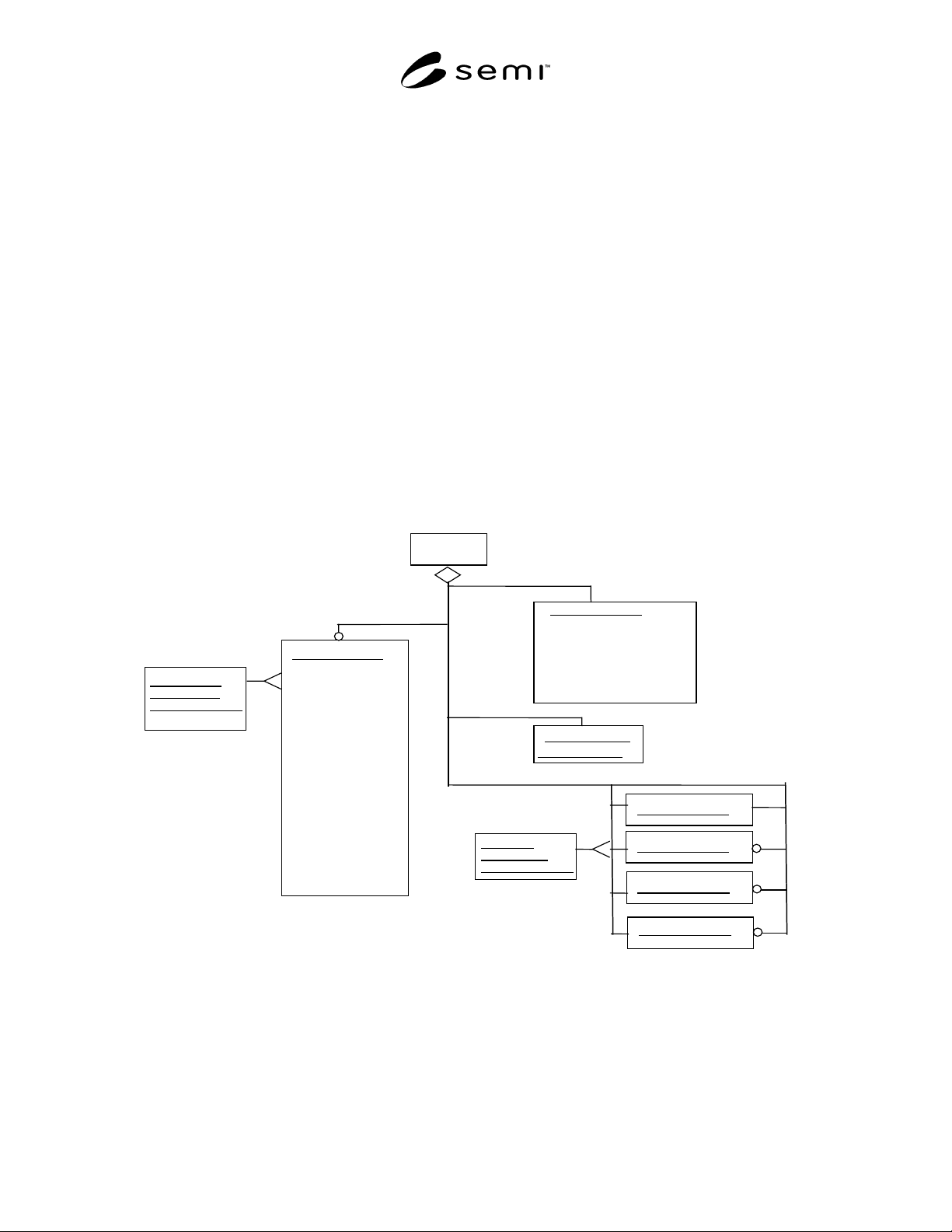
8.1.1 The high-level object view of an Endpoint
Device (EPD) profile is shown in Figure 1.
8.1.2 Note that the profile for an “EP D Device” object
is depicted in Figure 1 only for the purposes of
illustrating a high level view of the device and its
component objects. In the context of this document, this
object is not addressable, does not have addressable
attributes, does not have accessible services and, does
not exhibit any defined behavior.
8.1.3 In the remainder of this section , this document
defines in detail the component objects unique to the
EPD device. References, rather than definitions, are
included for the DM, the SAC and other objects defined
in SEMI E54.1.
8.1.4 Many of the objects defined in this document
inherit properties from other objects. The properties
inherited include attribute, service and behavior
definitions. These other objects are specified here or in
SEMI E54.1.
8.1.5 This document provides for future extensions as
well as manufacturer specific enhancements by
reserving object attribute identifiers and object service
identifiers. Specifically all object definitions in this
document specify or reserve the first 64 attribute
identifiers (A1 through A64) and the first 64 service
identifiers (S1 through S64) allowing manufacturers to
specify identifiers beyond these ranges. Additionally,
byte enumerated attributes are specified or reserved
from 0 to 63 allowing manufacturers to specify an
enumeration beyond this range (64 to 255).
8.1.6 Endpoint Device (EPD) Description — An
Endpoint device profile is composed of the component
objects and object relationships shown in Figure 1.
1+
EPD
Sensor-BI-TH-EP
Maximum Time
Sensor-BI-TH
(see Note 1)
(defined in CDM)
SAC (See Note 1)
Number of Endpoint Objects
-----------
DM (See Note 1)
Assembly
(see Note 1)
(defined in CDM)
Assembly-EPD#1
Assembly-EPD#2
(See
N
ote 2)
Elapsed Time
Time Stamp
-----------
Endpoint On
Endpoint Off
Endpoint Start
Recipe Number
(defined in CDM)
Assembly-EPD#3
Endpoint Suspend
Endpoint Resume
Reset Endpoint
Minimum Time
Target Time
Step Number
Download Recipe
Upload Recipe
Calibrate
Assembly-EPD#4
Figure 1
Endpoint Device High Level Structure
NOTE 1: The Sensor-BI-TH, DM, SAC, and Assembly are defined in the CDM. Additional attributes and services are added to
support the EPD.
NOTE 2: Assembly-EPD #1 object is required. Other Assembly-EPD objects are optional.