semi合集-English.pdf - 第7650页
SEMI T6-0697 © SEMI 1997, 2004 3 7.7 Multiple levels of lot definitions (i.e., Lo ts and Sub-lots) m ay be handled throug h nesting within the LIN loop. 8 Listing of Appendices 8.1 Appendix 1 — EDI Busi ness Model 8.2 Ap…

SEMI T6-0697 © SEMI 1997, 2004 2
4.2.5 mapping — the process of identifying the
standards data element relationship to application data
elements.
4.2.6 message — entire data stream including the outer
envelope.
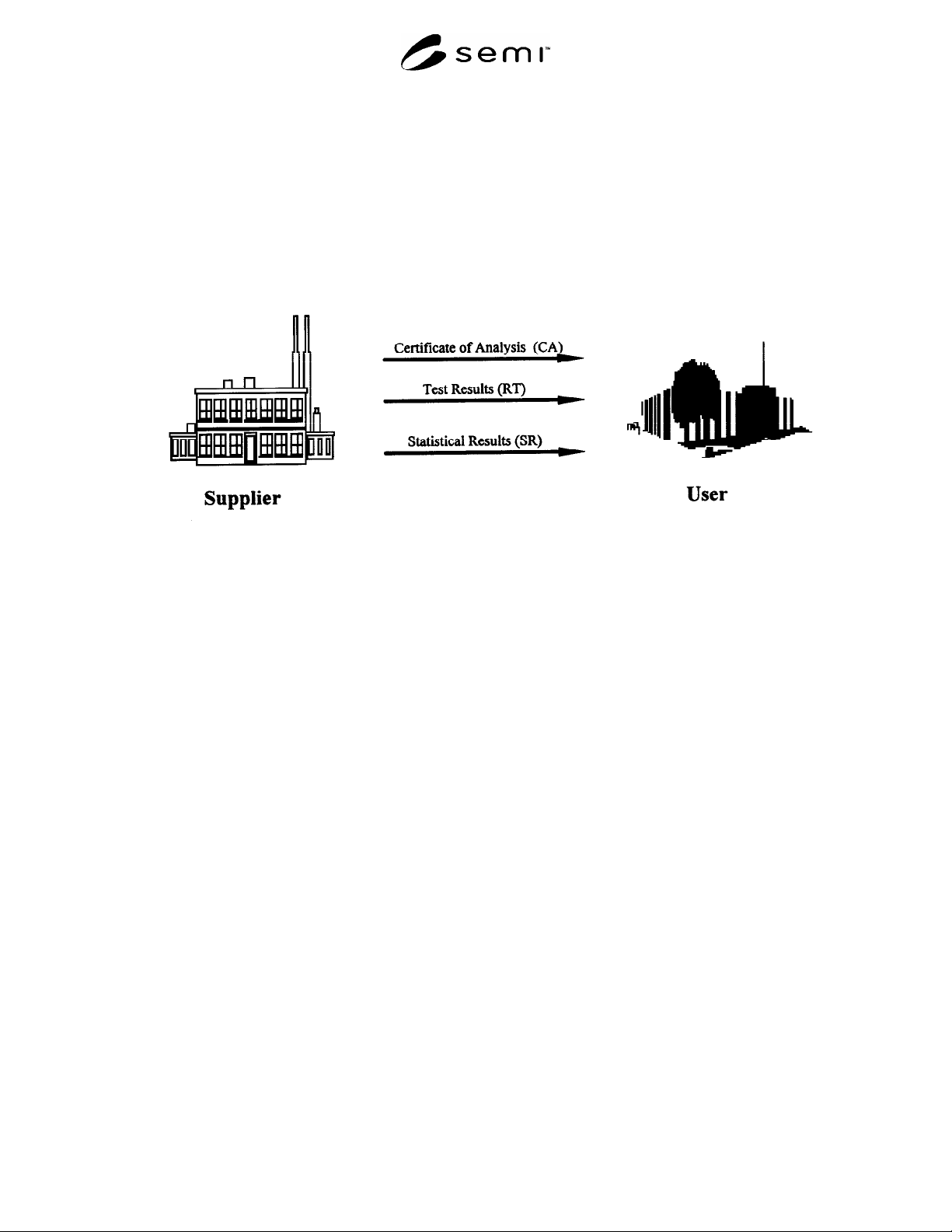
4.2.7 statistical results EDI message — one message
containing measurement or statistical data for defined
parameters for a stated period of time (see Appendix 5).
4.2.8 test results EDI message — used to designate
data provided by special request (e.g., engineering,
qualifications). This message contains specific
measurement or statistical data for one request, from
one trading partner to another trading partner, of one
part number against one purchase order. Multiple lot
numbers may be included (see Appendix 5).
4.2.9 trading partner — all members within the
channels of distribution within an industry (suppliers,
carriers, users, and intermediaries)
2
. This includes
buyers and sellers which represent SEMI terms of user
and supplier as well.
5 Requirements
5.1 An implementation model shall be agreed upon by
trading partners. It is the intent of this document to
make interpretation of the models used for transmitting
electronic messages more consistent, so that
implementations are based upon common practices.
5.1.1 Select one of the report types in Table 1 using the
business model (Appendix 1) and the definitions found
in Section 4.
Table 1 Report Types
Code Type of EDI Message
CA Certificate of Analysis
RT Test Results
SR Statistical Results
5.1.2 Define data requirements representing the
requested measurements and statistics that are recorded
for reporting electronically. (See Appendix 2.)
5.1.3 Select codes for parameters, units of measure,
and statistical terms. Appendix 4 is a guideline to assist
in modeling the EDI message. It uses codes selected
from the ANSI Data Dictionary as well as codes created
by SEMI for the semiconductor industry.
2 The term “Trading Partner” is referenced from the Global
Electronics Guidelines (DRAFT) for Bar Code & 2D Symbol
Marking of Products and Packages in Conjunction with EDI.
5.1.4 Data is electronically reformatted from the
application where it resides into a format suitable for
EDI transmission. This usually requires the use of
translation software and the development of application
interface programs.
5.2 Thorough piloting, testing, and educating is
required for successful implementation.
6 Procedures
6.1 See Appendix 4.
7 Application Notes
7.1 Pending ANSI approval, SEMI is an authorized
agency to maintain the tables of codes.
7.2 The material contained in Appendix 4 was created
by using an EDI simulator referencing the ASC X12
“863 Report of Test Reports”, version 003 release 050.
7.3 In using Appendix 4, refer to the column “SEMI
Use” (far-left) to determine if data element usage is
mandatory, conditional, or optional. SEMI mandatory
elements include all ASC X12 863 mandatory elements,
as well as selected other elements that are optional or
conditional within ASC X12 863.
7.4 In Appendix 5, the example messages in this
appendix were simplified by showing only a portion of
what they can do. In practice, all of the transaction
types (CA, RT, and SR) can use any combination of the
statistical codes in Appendix 4, the new statistical codes
in Appendix 4, or raw measurement data.
7.5 Additional statistical codes are defined in
Appendix 3. These codes are pending ANSI approval.
7.6 This procedure will accommodate date/time
considerations for the turn of the century. There are
many options found in the data transmission segments
in this document. The end result for which option is
utilized will be agreed upon by the trading partners.
The message is itself part of the ANSI standard, and
any revisions to this standard will be incorporated.
7.6.1 In the data element type, DT is a standard ANSI
definition and is being addressed by ASC X12
Committee.
7.6.2 In the BTR segment, used to identify the date of
the actual transmission, BTR06 may be used as a
century reference number.
7.6.3 In the DTM segments, used to identify the date
for the actual data, the DTM05 data element of CC
represents a two-digit century code (e.g., 19 for 1999,
20 for 2000).

SEMI T6-0697 © SEMI 1997, 2004 3
7.7 Multiple levels of lot definitions (i.e., Lots and
Sub-lots) may be handled through nesting within the
LIN loop.
8 Listing of Appendices
8.1 Appendix 1 — EDI Business Model
8.2 Appendix 2 — EDI Transmission Flowchart
8.3 Appendix 3 — New EDI Statistics (Definitions)
8.4 Appendix 4 — EDI Transmission Components (863
Report of Test Results)
8.5 Appendix 5 — Examples of EDI Transmissions
SEMI T6-0697 © SEMI 1997, 2004 4
APPENDIX 1
EDI BUSINESS MODEL
NOTICE: The material in this appendix is an official part of SEMI T6 and was approved by full letter ballot procedures.
A1-1 Any implementation model is agreed upon by trading partners. It is the intent of this
document to make interpretation of the models used for transmitting electronic messages more
consistent, so that implementations are based upon common practices.
A2-1 Attributes of EDI Messages
A2-1.1 Certificate of Analysis (CA) — One message containing measurement or statistical data for one shipment,
from one supplier site to one user site, of one user part number against one user purchase order shipped. Multiple lot
numbers may be included in the shipment.
A2-1.2 Test Results (RT) — Used to designate data provided by special request (e.g., engineering, qualifications).
This message contains specific measurement or statistical data for one request, from one trading partner to another
trading partner, of one part number against one purchase order. Multiple lot numbers may be included.
A2-1.3 Statistical Results (SR) — One message containing measurement or statistical data for defined parameters
for a period of time from one trading partner to another.