semi合集-English.pdf - 第1517页
SEMI E32-0997 © SEMI 1994 , 1997 12 move ment pr ocess. This dia gram as sumes a si mple transf er j ob inv olving only two partn ers and only one port on each. It also assumes that the partners take the same role (prim …
SEMI E32-0997 © SEMI 1994, 199711
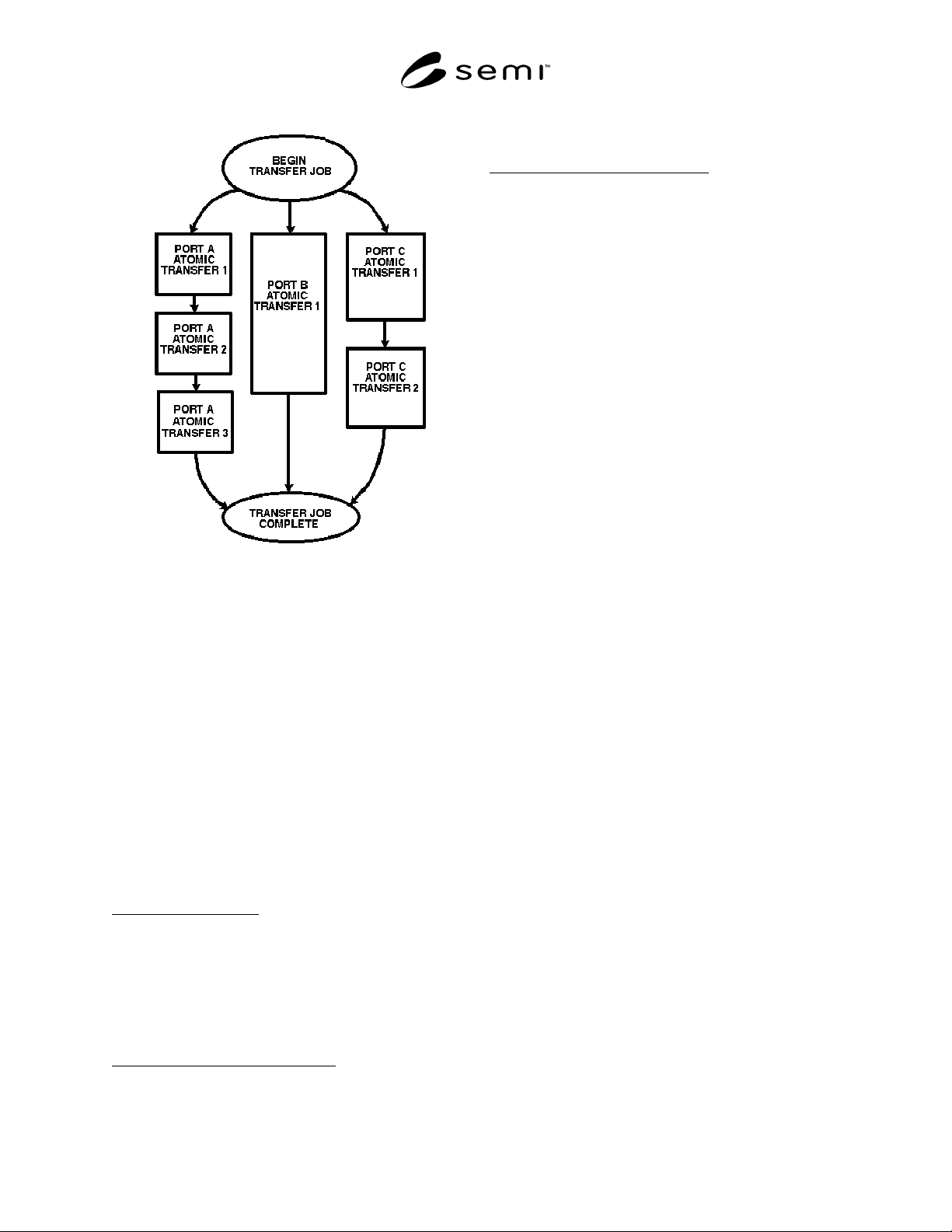
Figure 4.1
Transfer Job Sequencing
There are exceptions to the sequencing guidelines
above. One case would be a device designed to
simultaneously transfer from multiple ports on one
machine to corresponding ports on another. This would
translate into synchronized parallel atomic transfers on
separate ports. Another case would be two atomic
transfers involving the same port that might happen
concurrently. That is, a transfer object is transferred out
of the port at the same time
4
another is transferred in.
In either of these cases, the equipment is responsible
for:
1. recognizing that such transfers can and should be
combined and
2. synchronizing the execution of the transfers.
Multiple Transfer Jobs — Multiple transfer jobs may
exist simultaneously on an equipment. Although not a
requirement, an equipment may
1. queue transfer jobs for later execution or
2. allow them to execute in parallel with other
transfer jobs.
4 “At The Same Time” in this case means that both atomic transfers
are in progress. It does not imply that both transfer objects must move
simultaneously.
Queued transfer jobs and parallel transfer jobs are
separate concepts, either of which may be supported.
Resource Allocation/Deallocation — Transfer jobs
allocate the needed material locations prior to
beginning. These material locations remain allocated
until the transfer job chooses to release them. In many
cases, a material location is physically linked with a
single port, and the allocation of that location infers
allocation of the port. However, this is not a
requirement.
If the material locations for a transfer job are not
available or are not in the proper state, the job shall be
rejected or queued (if queuing supported and queue not
full). For the transfer job to begin, each location
referenced in the equipment's transfer job must contain
the proper material for the first atomic transfer which
would use that location.
If parallel transfer jobs are supported and the necessary
locations are available, a second (or third, etc.) transfer
job may begin execution.
In some cases a port may provide direct access to
multiple locations. This may be true for the specialized
ports described in Section 3.2 and in cases where the
port serves as a pass–through to internal locations. For
each atomic transfer, the needed port and its resources
are allocated just prior to the start and released
(deallocated) at the end of that atomic transfer.
4.2 Macro Level Behavior
4.2.1 Macro Level Communications — This section
provides a high-level definition of the communications
between the host and each transfer partner needed to
achieve the macro level of material transport. This is
not intended to define the messages, but rather to
describe the concepts. The message detail is addressed
in the Macro Level Services Section (4.4). Section 4.2.2
shows how these messages are integrated into the
transfer job behavior model.
First, the control message flow is presented as Figure
4.2. Then additional informational messaging is
described (see Figure 4.3). The arrows represent
significant information exchange. Some replies that do
not contain significant information may not be shown.
The ordering of the messages between one partner and
host shall be retained. The key synchronization point
between the partners at the macro level is that both
partners shall complete their setup activities before the
“atomic transfer started” event may occur.
4.2.1.1 Macro Level Job Control — Figure 4.2
illustrates the job control-related message flow
expected on a normal transfer as seen by the host.
These messages are used to control the material
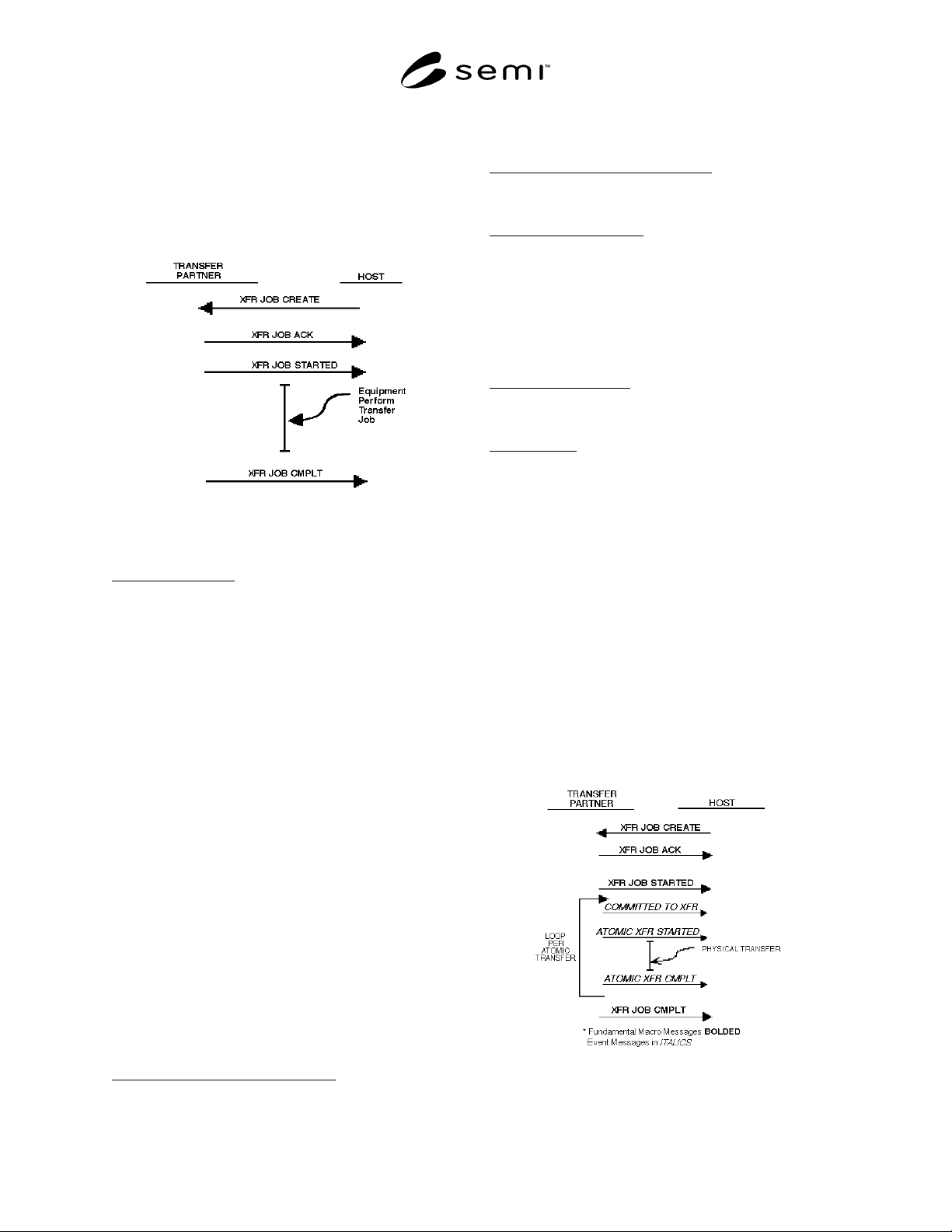
SEMI E32-0997 © SEMI 1994, 1997 12
movement process. This diagram assumes a simple
transfer job involving only two partners and only one
port on each. It also assumes that the partners take the
same role (primary or secondary) for each atomic
transfer that occurs. The messaging is no different if
these assumptions are not made, but diagrams become
quite difficult to create.
Figure 4.2
Macro Level Message Flow
Transfer Job Create — The host requests that the device
participate in a specified transfer job. This may consist
of a single atomic transfer or a compound job. This
request may be acted upon immediately, or, if necessary
resources are currently busy, saved for later execution
5
.
The request shall supply a transfer specification for
each atomic transfer, in which the host supplies such
information as
• which port is to be used,
• whether the port is to send or receive material,
• identification of the material to be transferred,
• role of the equipment (primary or secondary
transfer partner),
• mechanism or recipe to be used in the transfer,
• identification of the other transfer partner, and
• an identifier for the atomic transfer.
Upon receipt of the Transfer Job Create request and
before acknowledging, the equipment should check the
transfer specification(s) to ensure that they are valid.
That is, that the specified parameters (ports, transfer
recipes, role of the equipment, etc.) have legal values.
Depending upon its ability to queue jobs, it may check
such dynamic information as presence of transfer
5 If the equipment does not support queuing or if the queue is full, the
request may be rejected.
object, availability of resources, etc. to determine
whether to accept or reject.
Transfer Job Create Acknowledge — The equipment
responds to the host that the requested job is accepted
or rejected, and if rejected, supplies the reason.
Transfer Job Complete — Once a transfer partner
completes the restore operation, it declares the transfer
job to be complete. This message is also used should a
transfer job end abnormally. It declares the end of job.
All movement of the involved mechanisms shall have
ceased before this message is sent. This message shall
provide information on the success or failure of the
transfer.
Transfer Job Started — This message marks the
beginning of the transfer job. It signifies that the setup
activities for the first atomic transfer are beginning.
Get Attribute — The host may request information
relating to a specific job. This may include portions of
the transfer specification and current status information.
4.2.1.2 Macro Level Information Messaging — There
are a number of material transfer-related events which
may be of significance to the host. These are designated
as “collection events” and shall be available for
reporting to the host. This section describes those
collection events and shows how they fit into the
chronology of a transfer job. Refer to Figure 4.3 as each
event is described.
Collection event messages provide valuable
information to the host, but are not strictly required to
perform material movement. Therefore, it is expected
that some message protocol implementations will
provide a method by which the factory host may disable
those events which are not needed in a particular
implementation.
Figure 4.3
Macro Level Messaging With Events
SEMI E32-0997 © SEMI 1994, 199713
Committed To Transfer — The equipment informs the
host when it is fully prepared for a specific atomic
transfer. This signifies the completion of the setup
activities. It does not indicate that the two transfer
partners have agreed to begin the physical handoff. This
event coincides with the “Transfer Ready” message
defined in the micro level (see Section 5 below).
Atomic Transfer Started — The transfer partners
inform the host, via an event, when the atomic transfer
has begun
6
. This may represent a logical start rather
than physical movement. This indicates that any
necessary coordination of the transfer partners has been
done to ensure that the atomic transfer may start. A
secondary partner may sense the start of transfer later
than the primary partner.
NOTE 3: The physical transfer begins following the Atomic
Transfer Started event and ends prior to the Atomic Transfer
Complete event message.
Atomic Transfer Complete — This event indicates that
an atomic transfer has completed. This indicates that
either the next atomic transfer for this port will begin
the setup phase, or, if none remain, restore activities
may begin.
4.2.2 Transfer Job State Model — Message flow
diagrams are useful to show simple situations. Material
movement may range from very simple to quite
complex. The transfer job state model presented in this
section provides the information necessary to
extrapolate the message flow diagrams above to fit all
situations within the scope of this report. It does not
cover the states of the various hardware which may
exist (e.g., elevators, doors). See Section A1-1 for a
discussion of the port hardware and related
mechanisms.
The state model notation used in this report is that
defined by Harel and is described in a reference cited in
Section 1.3 above.
The transfer job is a transient entity. It is created by the
host (Transfer Job Create message), executes, and then
is dissolved by the equipment.
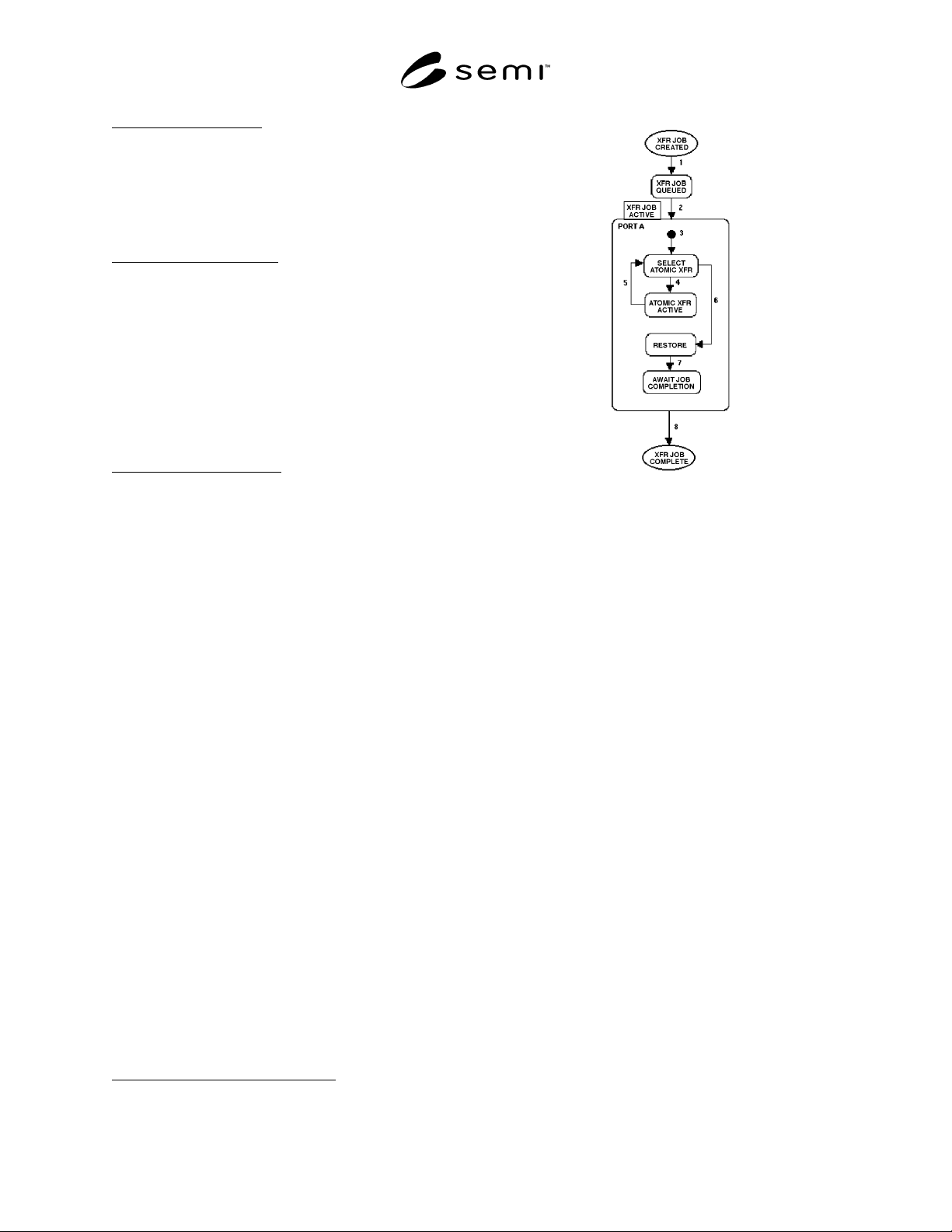
Figure 4.4 shows a basic state diagram for a transfer
job. The ovals at top and bottom show where the job is
created and then deleted. The portion between the ovals
is standard Harel notation. This model is from an
equipment view and assumes that only one port on the
equipment is used by the transfer. It also assumes that
pause, resume, abort, and stop activities do not exist
(these are addressed later in the document).
6 The primary transfer partner will determine readiness to start based
on micro level handshaking with the secondary transfer partner.
Figure 4.4
Transfer Job State Diagram for a Single Port
State definitions and then the state transition table
follow.
TRANSFER JOB QUEUED
In this state, the transfer job has been accepted by the
equipment through the Transfer Job
Create/Acknowledge messages and is awaiting
execution. Transfer jobs are begun sequentially in the
order received by the equipment. Execution may not
begin until all previously queued transfer jobs have
been started and the material locations needed for this
transfer job may be allocated.
All transfer jobs pass through this state. If the
equipment allows queuing of transfer jobs, they may
remain in this state for prolonged periods. A transfer
job remains queued until the material locations needed
for that transfer are available.
TRANSFER JOB ACTIVE
In the TRANSFER JOB ACTIVE state, all atomic
transfers defined in the transfer job are performed.
PORT A
This substate of TRANSFER JOB ACTIVE encloses
the job activities related to a single port on the
equipment. Within this state, the atomic transfers
involving this port are executed sequentially (except as
noted in Section 4.1.7 under Atomic Transfer
Sequencing Guidelines). Substates of PORT A (or
PORT B, etc.) include SELECT ATOMIC