semi合集-English.pdf - 第2456页
SEMI E87-0705 © SEMI 1999, 2005 25 Table 11 Load Port/Carrier Associ ation State Transition Defin itions # Previous State Trigger Ne w State Actions Comments 1 (no state) System reset. NOT ASSOCIATED No event report is r…
SEMI E87-0705 © SEMI 1999, 2005 24
13 Load Port/Carrier Association State Model
13.1 The purpose of the Carrier Association State Model is to define the host view of carrier to load port association
of the production equipment, as well as the host interactions with the production equipment necessary to associate a
carrier to load port, and to perform equipment based carrier verification. Each load port shall maintain an
independent instance of the Carrier Association State Model. Each instance of this state model must not influence
the state of the same state model for a different load port.
13.1.1 This state model provides the ability to perform carrierID verification with two different methods. If the
CarrierID is provided before the equipment reads the CarrierID, the CarrierID that becomes associated with the load
port can be used later for equipment based carrier verification. If the association happens by CarrierID read (not by a
service execution), then the production equipment shall report the CarrierID information in a data collection event.
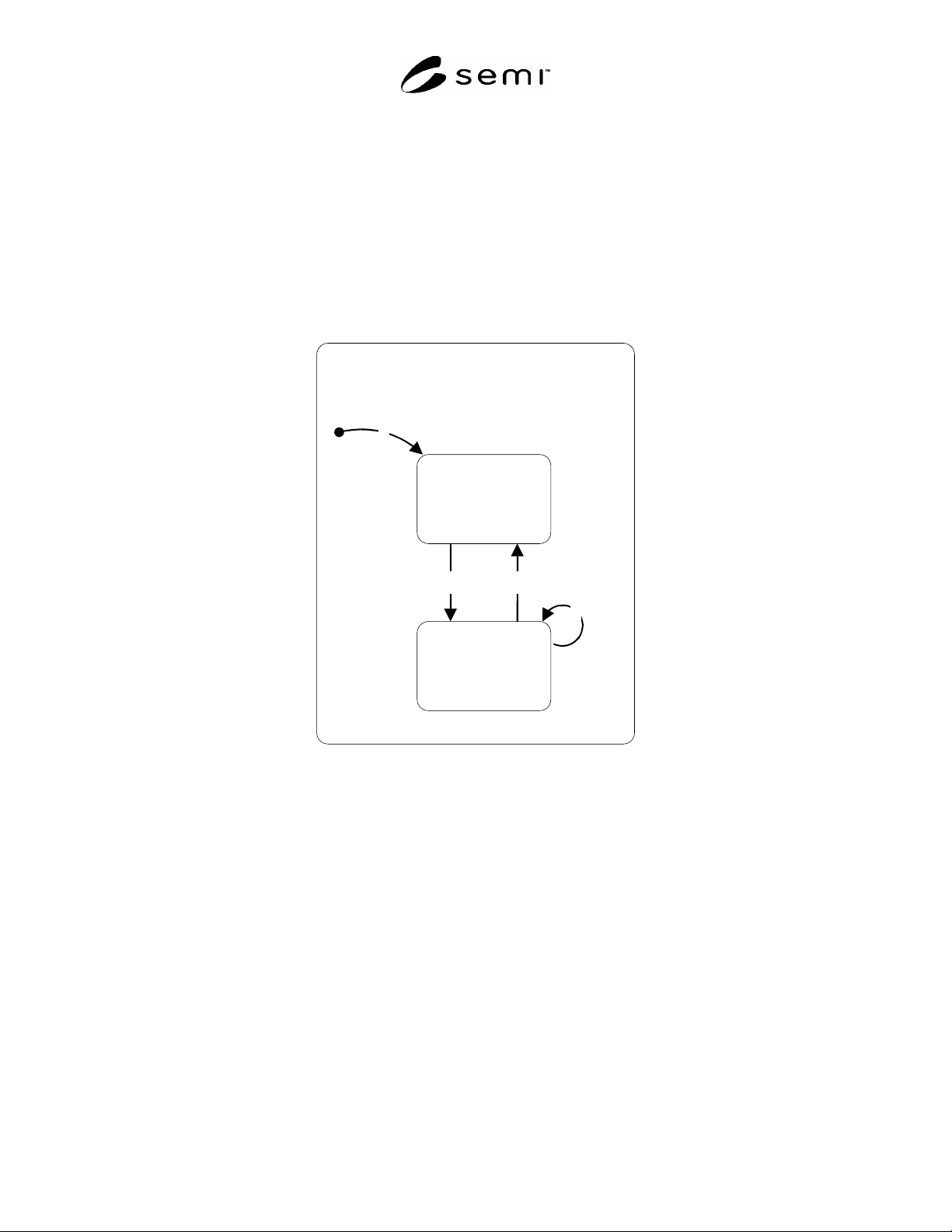
13.2 Load Port/Carrier Association State Model Diagram
NOT
ASSOCIATED
ASSOCIATED
2 3
1
LOAD PORT/CARRIER
ASSOCIATION
4
Figure 6
Load Port/Carrier Association State Model Diagram
13.2.1 Load Port/Carrier Association State Definitions
13.2.1.1 LOAD PORT/CARRIER ASSOCIATION — The parent state of the NOT ASSOCIATED and
ASSOCIATED sub-states.
13.2.1.2 NOT ASSOCIATED — A sub-state of LOAD PORT/CARRIER ASSOCIATION. There is no carrier
association present for this load port.
13.2.1.3 ASSOCIATED — A sub-state of LOAD PORT/CARRIER ASSOCIATION. A CarrierID has been
associated with this load port. The load port is not available for a new carrier association.
13.2.2 Load Port/Carrier Association State Transition Table
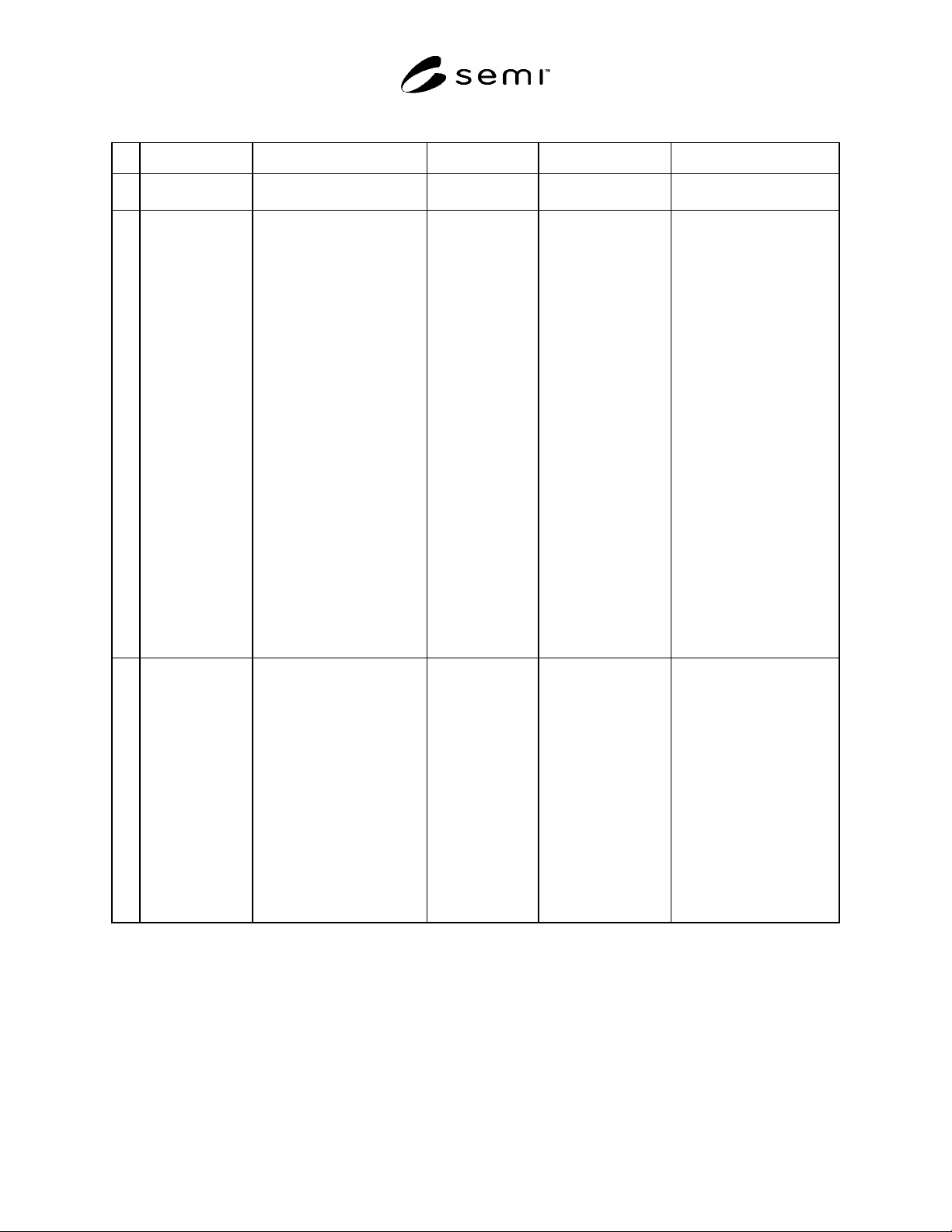
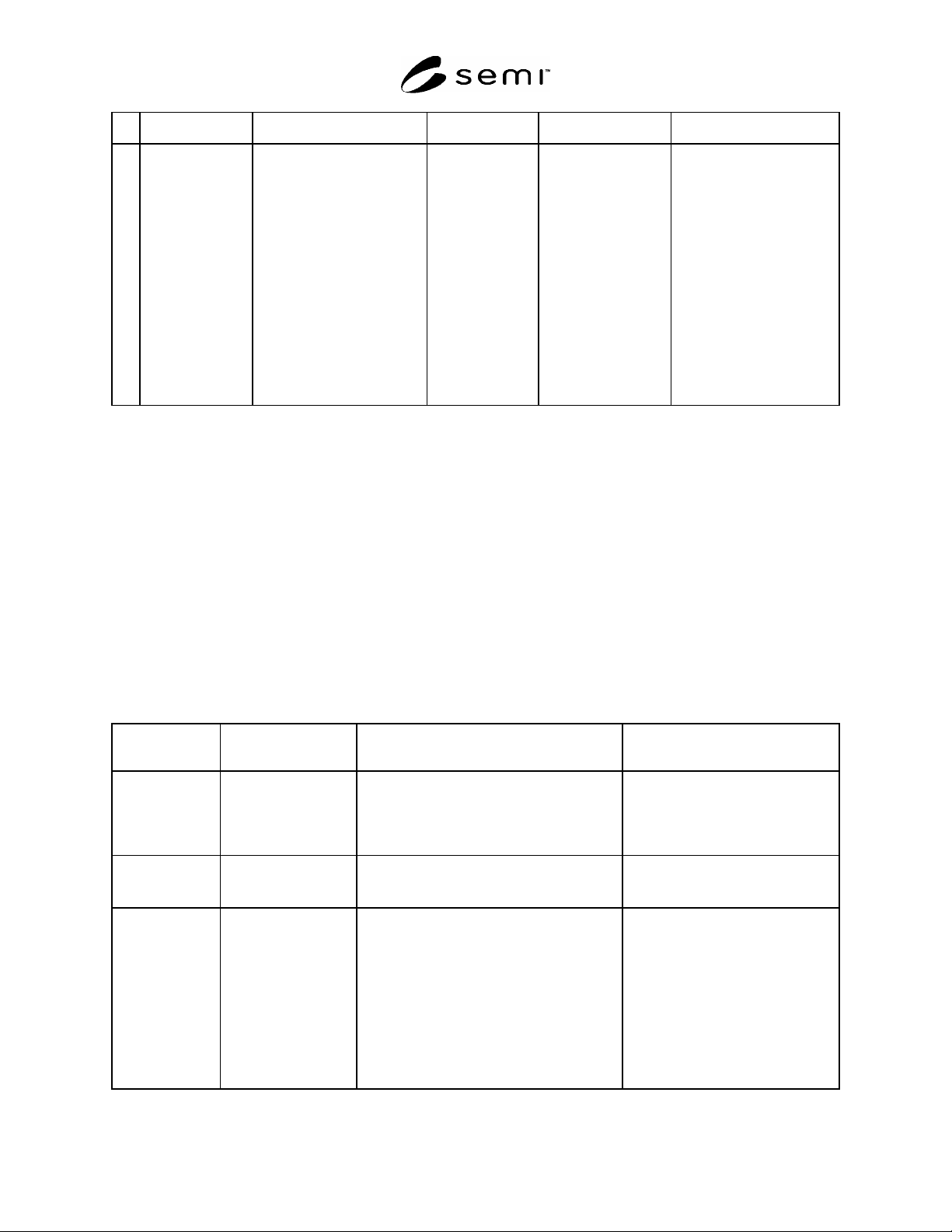
13.2.2.1 Table 11 defines the transitions of the Load Port/Carrier Association State Model.
SEMI E87-0705 © SEMI 1999, 2005 25
Table 11 Load Port/Carrier Association State Transition Definitions
# Previous State Trigger New State Actions Comments
1 (no state) System reset. NOT
ASSOCIATED
No event report is required
for this transition
2 NOT
ASSOCIATED
Service Normal: If associated
by service in the noraml
situation, the host sends a
Bind service to the
production equipment when
the port is unoccupied.
Service Abnormal: If
associated with a service in
an abnormal situation, the
host sends a
ProceedWithCarrierService
to the production equipment
when the load port is
ocuupied.
CarrierID Read: If
associated by a CarrierID
read, the production
equipment creates the
association at the time the
CarrierID read is performed.
Known Carrier: A carrier
already known to the
production equipment is
being loaded onto the load
port. This happens when the
CarrierOut service is
initiated.
ASSOCIATED Once the CarrierID to load
port association is complete,
the load port is not available
for association until the state
returns to NOT
ASSOCIATED again.
Data required to be
available for this event
report:
PortID
CarrierID
PortAssociationState
3 ASSOCIATED Service: If cancellation of a
load port association is
required; then, this can be
accomplished by sending a
CancelBind service to the
production equipment before
the carrier arrives to the
loadport or before a transfer
sequence has started.
Carrier Unload: An
association cancellation may
also be performed by
removing the carrier from the
load port or by the production
equipment moving a carrier
to an internal buffer position.
NOT
ASSOCIATED
A carrier unload, may
happen before or after
processing occurs. The load
port is available for another
association once the carrier
is removed.
Data required to be
available for this event
report:
PortID
PortAssociationState
SEMI E87-0705 © SEMI 1999, 2005 26
# Previous State Trigger New State Actions Comments
4 ASSOCIATED Production equipment based
carrier verification fails, and
the carrier assumes the ID
value from the carrier that is
on the load port.
Internal buffer:
A carrier is unloaded and a
queued CarrierOut service
starts.
ASSOCIATED The existing carrierID
that was associated by
a Bind service is
unassociated by the
production equipment
and the new carrierID
is now associated to
the Load Port. The
production equipment
shall delay further
action until receiving
either a CancelCarrier
or a
ProceedWithCarrier
command from the
host.
This transition only occurs
when the Bind command
has been used.
Data required to be
available for this event
report:
PortID
CarrierID
PortAssociateState
14 Verification
14.1 Verification is the operation of comparing an actual value with an expected value. Verification may be
performed by either the host or the equipment, depending upon whether the host is using the Bind service or not.
14.1.1 If the host provides the expected value before the actual value is obtained by the production equipment, then
the production equipment shall perform the verification.
14.1.2 If the host does not provide the expected value, using the Bind service, before the actual value is read, then
the production equipment shall provide to the host, the information necessary for host based verification.
14.1.3 There are two values that are defined by Carrier Management that require verification: Carrier ID and Carrier
Slot Map.
14.2 CarrierID Verification
14.2.1 Table 12 defines the methods for verifying the Carrier ID.
Table 12 Carrier ID Verification Methods
Verification
Method Desired
Host Actions before
Load
Equipment Action When Carrier Is Loaded Host Actions after Load
Production
Equipment Based
Bind Service: The host
executes the Bind
service to associate a
load port and a
CarrierID.
Bind Service: The production equipment
reads the Carrier ID from the carrier,
compares it to the CarrierID supplied with the
Bind service.
Verification Passed: Transition 6 of the
Carrier State Model occurs. The production
equipment proceeds with processing.
Verification Passed: None.
Verification Failed: The equipment initiates
by itself a CancelBind and destroys the
carrier created with the “Bind” service and
instantiates a new carrier with the newly read
CarrierID. The carrier shall not be opened or
moved to an internal buffer in the production
equipment until and unless the
ProceedWithCarrier service is received from
the host.
Verification Failed: The host uses
either the CancelCarrier service to
force the carrier to the unload
position, or indicates to the
production equipment that it may
proceed with the unexpected carrier,
by sending the ProceedWithCarrier
service. In both cases the carrierID
specified in the service is equal to
the one determined by the carrierID
read.