semi合集-English.pdf - 第570页
SEMI E79-0304 © SEMI 1999, 2004 4 NOTE 3: One application of PEE is to measure the productivity of non-constraint tools that are expected to have periods of idle time due to la ck of available work. 4.2.9 reference overa…

SEMI E79-0304 © SEMI 1999, 2004 3
4.1.25 theoretical production time per unit (THT) (time
per unit) — the minimum rate of time per unit to
complete processing, given:
• the specified recipe
• the equipment design
• continuous operation
• no efficiency losses
NOTE 2: Recipe specifications and settings for THT are the
ones actually used in production and are not idealized.
Equipment of the same design (e.g., same make and model)
are expected to have the same THTs, whereas equipment of a
different design may have different THTs even if they
perform the same intended function. Continuous operation
requires that equipment loading is optimized for throughput
and there are no internal or external interruptions or delays to
processing. Given the constraints of specified recipe,
equipment design, and continuous operation, THTs shall
not include allowances for any other efficiency losses (e.g.,
slower than ideal changes in temperature or pressure, longer
than ideal reaction times for valves or moving parts, different
moments within a maintenance cycle or the life-cycle of a
consumable, etc.).
4.1.26 theoretical production time (time) — production
time during a period that is theoretically required to
complete the unit quantities of the production recipes
undertaken during the period. Theoretical production
time is computed as the aggregation over all recipes of
the theoretical production time per unit for the recipe
applied to the unit quantity of that recipe (CSM 21,
CSM 42). For flexible-sequence cluster tools,
theoretical production time is the sum of the theoretical
production times for the set of virtual machines.
4.1.27 theoretical unit throughput by recipe (units per
time) — for a given production recipe, the number of
units per period of time that theoretically could be
processed by the equipment. For each recipe,
theoretical unit throughput is equal to the reciprocal of
theoretical production time per unit.
4.1.28 total time (time) — all time (at the rate of 24
hours per day, seven days per week) during the period
being measured. In order to have a valid representation
of total time all six basic equipment states shall be
accounted for and tracked accurately (SEMI E10). For a
flexible-sequence cluster tool, total time is defined as
the aggregate total time of the set of virtual machines
encompassed by the cluster tool (CSM 42).
4.1.29 unit — any wafer, die, packaged device, or
piece part thereof (includes product and non-product
units) (SEMI E10).
4.1.30 uptime (equipment uptime) (time) — the time
when the equipment is in a condition to perform its
intended function. It includes productive, standby, and
engineering time, and does not include any portion of
non-scheduled time (SEMI E10). For a flexible-
sequence cluster tool, uptime is defined as the
aggregate uptime of the set of virtual machines
encompassed by the cluster tool (CSM 42).
4.1.31 virtual machine — an individual processing
module within a flexible-sequence cluster tool, in
combination with the transport module(s) serving that
processing module. A flexible-sequence cluster tool has
one virtual machine defined for each of its processing
modules (CSM 42).
4.2 Terminology Applicable to Computation of
Additional Productivity Metrics Defined in Appendix 2
4.2.1 demand equipment efficiency (DEE) (time
divided by time) — a measure of equipment
productivity during the time that products are planned
to be available to process at the equipment.
4.2.2 engineering overall equipment efficiency (E-
OEE) (time divided by time) — a measure of
equipment productivity assuming process specifications
are optimized for minimum production time.
4.2.3 engineering theoretical production time per unit
(ETHT) – (time per unit) — the theoretical time
required to process a given recipe assuming the recipe
specification is optimized for minimum production
time. ETHT is based on minimum durations for the
objective processing steps, e.g., implant time for ion
implant systems, plus minimum allowances for any
additional supporting process steps, e.g., heating,
cooling, gas stabilization, that are deemed absolutely
necessary. ETHT
shall be defined to be less than or
equal to the corresponding theoretical time per unit
(THT) used in calculating OEE.
4.2.4 equipment down no product time (time) — the
period of equipment downtime during which there are
no units available at the equipment to process.
4.2.5 intrinsic equipment efficiency (IEE) (time divided
by time) — a measure of equipment productivity that
considers the combined effect of rate efficiency losses,
recipe design, and equipment design.
4.2.6 no product time (time) — the period of standby
time that the equipment is idle because there are no
units available at the equipment to process.
4.2.7 planned no product time (time) — the period of
operations time that the factory model or production
schedule expects the equipment to be idle because there
are no units available to process at the equipment.
4.2.8 production equipment efficiency (PEE) (time
divided by time) — a measure of equipment
productivity during the time that products are available
to process at the tool.

SEMI E79-0304 © SEMI 1999, 2004 4
NOTE 3: One application of PEE is to measure the
productivity of non-constraint tools that are expected to have
periods of idle time due to lack of available work.
4.2.9 reference overall equipment efficiency (R-OEE)
(time divided by time) — a measure of equipment
productivity relative to a benchmark theoretical
production time.
4.2.10 reference theoretical production time per unit
(RTHT) (time per unit) — the theoretical time required
to process a given recipe on benchmark equipment (i.e.,
the fastest equipment model of similar type), for a
benchmark product and process design. RTHT
shall be
defined to be less than or equal to the corresponding
theoretical time per unit (THT) used in calculating
OEE.
4.2.11 value-added in-process overall equipment
efficiency (VA-OEE) (time divided by time) — a
measure of equipment productivity assuming all time
except the value-added portion of processing cycles is
wasted equipment time.
4.2.12 value-added in-process theoretical production
time per unit (VTHT) (time per unit) — theoretical
production time per unit that credits only the objective
processing steps that add value to products. VTHT
shall
be defined to be less than or equal to engineering
theoretical production time per unit (ETHT) used in
calculating engineering OEE (E-OEE).
5 Equipment Productivity Measurement
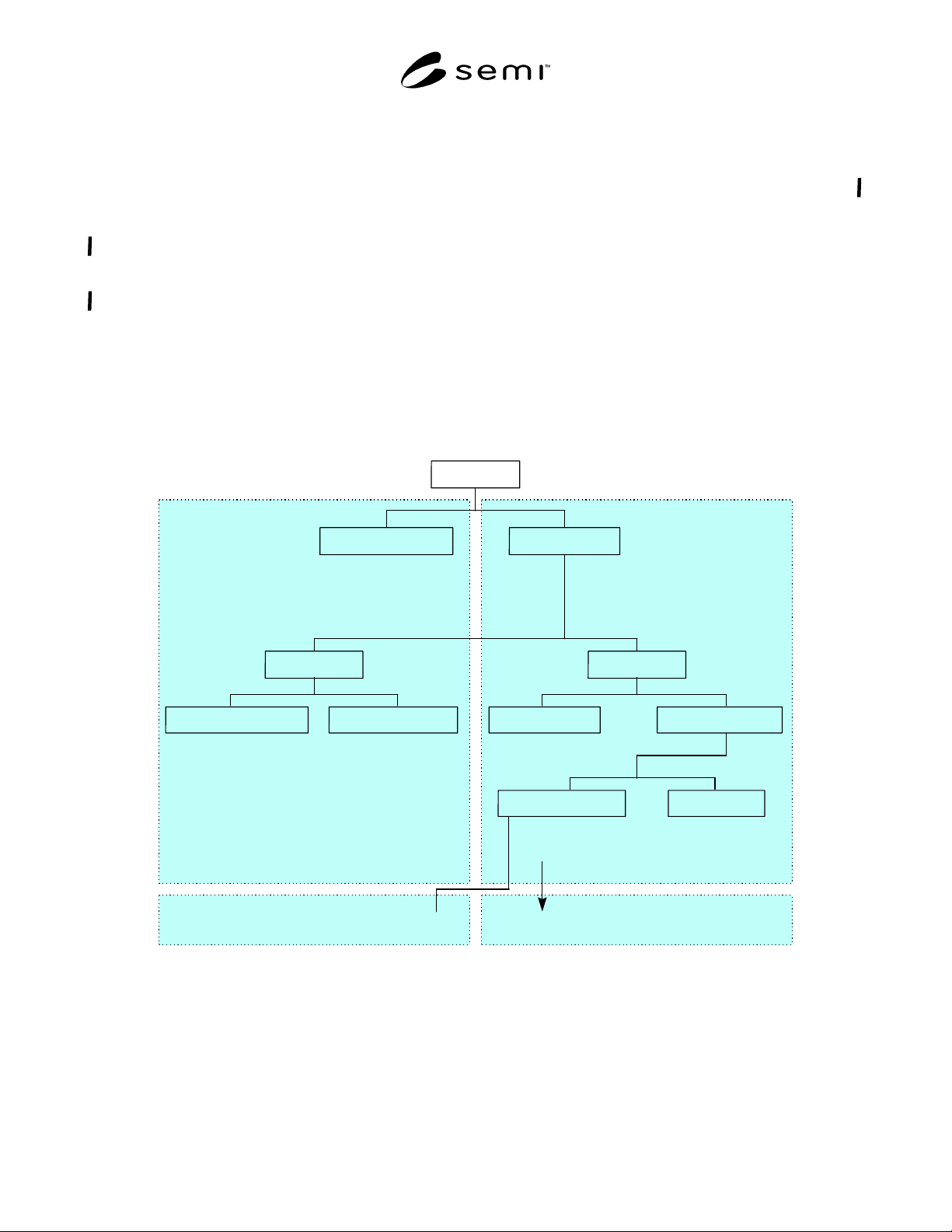
5.1 The OEE calculation has been stated in terms that
are consistent with SEMI E10. Reference may be made
to Figure 1.
5.1.1 Figure 2 indicates how total time may be divided
into portions representing theoretical production time
for effective units and various sources of productivity
loss. The domain for productivity improvement of all
losses except operational efficiency is shared between
the equipment supplier and equipment user.
Productivity improvement of operational efficiency is
the exclusive domain of the equipment user.
5.1.2 The formulas introduced in this section require as
inputs the following fundamental quantities: total time,
equipment uptime, production time, and theoretical
production time. Sample calculations for each of the
formulas are provided in Appendix 1.
5.1.3 For efficiency measurement of individual
processing modules or of fixed-sequence cluster tools,
the fundamental quantities may be tallied in a
straightforward manner, and consequently the formulas
of this section may be applied in a straightforward
fashion.
5.1.4 For efficiency measurement of flexible-sequence
cluster tools, determination of the fundamental
quantities requires more involved calculations.
Formulas are provided in Section 6 for computing the
fundamental quantities for flexible-sequence cluster
tools. These fundamental quantities then may be used
as inputs to the formulas of this section to compute the
efficiency of a flexible-sequence cluster tool.
5.1.5 Additional supplemental efficiency metrics that
will enable users to assess more specific aspects of
equipment productivity are:
• Reference OEE,
• Engineering OEE,
• Value-Added In-Process OEE,
• Demand Equipment Efficiency,
• Production Equipment Efficiency, and
• Intrinsic Equipment Efficiency.
Definitions and formulas for these metrics are presented
in Appendix 2.
5.2 Overall Equipment Efficiency (OEE) — The
fraction of total time that equipment is producing
effective units at theoretically efficient rates.
Overall Equipment Efficiency (OEE)
= (Theoretical Production Time for Effective Units)
/(Total Time)
= (Availability Efficiency) × (Performance Efficiency)
× (Quality Efficiency)
5.2.1 Availability Efficiency — The fraction of total
time that the equipment is in a condition to perform its
intended function.
Availability Efficiency =
(Equipment Uptime)/(Total Time)
5.2.2 Performance Efficiency — The fraction of
equipment uptime that the equipment is processing
actual units at theoretically efficient rates.
Performance Efficiency =
(Operational Efficiency) × (Rate Efficiency)
5.2.2.1 Operational Efficiency — The fraction of
equipment uptime that the equipment is processing
actual units.
Operational Efficiency =
(Production Time)/(Equipment Uptime)
5.2.2.2 Rate Efficiency — The fraction of production
time that equipment is processing actual units at
theoretically efficient rates.
Rate Efficiency =
= (Theoretical Production Time for Actual Units)
/(Production Time)
SEMI E79-0304 © SEMI 1999, 2004 5
5.2.2.3 Theoretical Production Time (for Actual Units
or for Effective Units) — Production time (for actual
units or for effective units) during a period of
observation that is earned at strictly theoretically
efficient rates and assumes no efficiency losses.
Theoretical Production Time for Actual Units =
∑
i
(Actual Units of Recipe i × THT
i
)
Theoretical Production Time for Effective Units =
∑
i
(Effective Units of Recipe i × THT
i
)
where
THT
i
= theoretical production time per unit of recipe
i
NOTE 4: Theoretical Production Time (for actual units or for
effective units) may be calculated in terms of theoretical unit
throughput by recipe.
Theoretical Production Time for Actual Units =
∑
i
(Actual Units of Recipe i/UPH
i
)
Theoretical Production Time for Effective Units =
∑
i
(Effective Units of Recipe i/UPH
i
)
where
UPH
i
= theoretical unit throughput by recipe
of recipe i
5.2.3 Quality Efficiency — The theoretical production
time for Effective Units divided by the theoretical
production time for Actual Units.
Quality Efficiency =
(Theoretical Production Time for Effective Units)
/(Theoretical Production Time for Actual Units)
Total Time
Operations Time
Engineering Time
Uptime
Manufacturing Time
•Process experiments
•Equipment experiments
Productive Time Standby Time
•Regular production
•Work for 3rd party
•Engineering runs
•Rework
•Scrap
•No operator
•No product
•No support tool
•Associated cluster
module down
Operational
Efficiency
Quality Efficiency
Non-Scheduled Time
•Unworked shifts, days
•Installation, modification
rebuild or upgrade
•Off-line training
•Shutdown/startup
Downtime
Unscheduled Downtime Scheduled Downtime
•Maintenance delay
•Repair time
•Change of consumables
•Out of spec input
•Facilities related
•Maintenance delay
•Production tests
•Preventive maintenance
•Change of consumables
•Setup
•Facilities related
Availability
Efficiency
Rate Efficiency
Not specified in
SEMI E10 but occurs
during Productive Time
Figure 1
The Relationship Between SEMI E10 and OEE