semi合集-English.pdf - 第2676页
SEMI E96-1101 © SEMI 1999 , 2001 16 6.6.12 The AC ID properties prov ided by either OTS or MT S may be used for CI M Fra mewor k tran sactio ns. Many implementation details are supplier sp ecific; however, th e major arc…

SEMI E96-1101 © SEMI 1999, 200115
equipment should change in order to accurately track
the state of the factory. Coordinating the lot and
equipment state changes as a transaction guarantees that
factory state can be recovered accurately.
6.6.4 Transactions are created by a user of a service
(the client) requesting an operation from a provider of a
service (the server). To maintain the ACID properties
of a transaction, the server should be able to return to
the state prior to the request for the operation in the
event of a failure. In this sense, the server should be
recoverable. Failures are either software or hardware
events that prevent the completion of the transaction.
The server is a recoverable server if it is able to main-
tain the ACID properties when faced with a failure.
6.6.5 Transactions should be designed in a manner
such that they do not span a period of interaction with
an external entity such as a person using a GUI or a
piece of equipment. Waiting for the response from an
external entity can result in locks being held for multi-
ple seconds, minutes, or longer. This can adversely
affect other transactions by causing time-outs or dead-
locks. These types of transactions can usually be split
into multiple serially executed transactions with some
small amount of extra revalidation of current states at
succeeding transactions.
6.6.6 Coordinating the completion of transactions may
involve multiple servers and may entail either commit-
ting the successfully completed transaction or rolling
back the unsuccessful transaction. This activity imposes
additional overhead on a system. Suppliers and
consumers should assess the impact of transactions on
system performance during component design and
selection of transactional events.
6.6.7 Transactions may cause physical effects in the
manufacturing system that cannot simply be rolled back
in accordance with the ACID properties. Application
and system designers should include ways to modify
the logical view of the system to match the physical
reality of the manufacturing floor if such a mismatch
occurs.
6.6.8 Transactions can create CIM Framework events
as state changes occur. As the transaction may not be
committed at the point of event creation, the event
should not be visible outside the transaction until the
final commit point. The details of performing this task
are implementation dependent. For example, the event
announcing the completion of a lot at a processing step
should not be published until the processing step
completion transaction is committed. Otherwise, the
event could be published, but the transaction subse-
quently rolled back, creating a system inconsistency.
6.6.9 Transactions should be able to be nested, thus
providing the ability to define transactions within other
transactions. These sub-transactions can generate addi-
tional sub-transactions, thus forming a hierarchy of
transactions. In the spirit of maintaining the ACID
properties, each sub-transaction can issue a commit or
rollback for its piece of work. The results of the sub-
transaction are only available to the parent transaction.
The sub-transactions commit becomes permanent only
after it issues a local commit and all ancestors commit.
If the parent transaction does a rollback, all descendent
transactions are rolled back regardless of any local
commits.
6.6.10 There are two types of transactions widely sup-
ported for distributed object infrastructures. The OMA
support for transactions is described in the OMG’s
Object Transaction Service (OTS). Microsoft provides
support for transactions with its Microsoft Transaction
Server (MTS) product. The OTS closely aligns with
other standards such as The Open Group Distributed
Transaction Processing (DTP) model.
7
Using industry
standard protocols as a base, the OTS supports inter-
facing with products from the major database suppliers.
Using the provided OTS interfaces and information
about The Open Group standards, non-ORB supplied
database interfaces could be developed to allow for
interoperability with other cooperating transaction
services. MTS also supports transactions with major
database suppliers through use of The Open Group XA
interface. Using the MTS Software Developer Kit,
transaction support can be extended to other resources.
6.6.11 Combining heterogeneous components based on
a combination of OTS and MTS is not straightfor-ward.
Although both rely on the XA interface for dis-tributed
transaction coordination, they are not designed to
operate with each other. Both OTS and MTS hide the
details of transactions from users. This makes either so-
lution very convenient, but makes linking them together
more difficult. For example, suppose a CORBA-based
component adhering to OTS should interact with an
MTS-based component. The scenario calls for the
CORBA based component to use the XA interface to
work with the MTS provided transaction coordinator
(see Gray
8
for additional information on distributed
transactions). However, in hiding XA complexity, OTS
also hides the ability to readily specify the transaction
coordinator (OTS does this behind the scenes). CIM
Framework component developers and consumers
should determine the relative need for distributed trans-
actions spanning OTS and MTS against the additional
complexity of developing a XA-based mechanism for
combined OTS and MTS transactions.
7 The Open Group, Distributed TP: The XA+ Specification, Version
2, The Open Group, 11 Cambridge Center, Cambridge MA, 1994.

SEMI E96-1101 © SEMI 1999, 2001 16
6.6.12 The ACID properties provided by either OTS or
MTS may be used for CIM Framework transactions.
Many implementation details are supplier specific;
however, the major architectural principles have been
described above.
6.7 Component Management
6.7.1 A component refers to a collection of related
interfaces that form a coherent subsystem. Components
may have a component manager to assist in the tracking
and management of the instantiated interfaces (objects).
The objects that are managed by a component manager
are called managed objects.
6.7.2 Component Level Interface
6.7.2.1 Component managers provide services such as
reporting on the collection of instances they manage
and creating object instances. The component manager
provides the following:
Object references to managed objects.
Collective queries for some aspect (usually a state)
across all the objects it manages.
Services for:
Creating a managed object and returning a
reference to it, or receiving an object reference
to a newly created object. The component
manager then “registers” the object reference.
Removing managed objects.
Finding managed objects.
6.7.3 Component Manager Classification
6.7.3.1 Component Managers are classified by their
allowable number of instances.
6.7.3.2 Unique Component Managers
6.7.3.2.1 A unique component manager describes a
component manager for which there is only one running
instance in an MES implementation. Unique component
managers are used when a single point of factory level
control or focus is required. An example use of this pat-
tern might be an interface within a Dispatcher compo-
nent called DispatchingManager. This might be a
unique component manager because multiple dispatch-
ing systems on the factory floor could create problems
with work scheduling.
6.7.3.3 Non-Unique Component Managers
6.7.3.3.1 A non-unique component manager describes
a component manager for which multiple instances may
be running in an installed MES system. The component
manager instances are derived from the same code base,
but have separate instance data for each running in-
stance. Non-unique component managers should be
registered with the factory with some selection criteria
in order for a requester to be able to obtain a handle to
the correct instance. An example use of this pattern is
the scenario in which several ProductManagers are
employed within a production system.
6.8 Architecture For Service Requests
6.8.1 Services are implemented by a factory object that
is the service provider. The productive entity in a
factory invokes the service methods on that factory
object.
6.8.1.1 For example, a recipe server could offer the
following interface:
interface RecipeManagementServer {
// upload a recipe
void acceptRecipe(
in string recipeName,
in Recipe recipe);
// download a recipe
Recipe provideRecipe(in string
recipeName);
};
6.8.1.2 The problem with service requests is that they
require a flow from the productive entity to the factory
object that provides the service. This kind of reverse
flow contradicts the principle of layered architecture by
which the productive entity is supposed to be a more
primitive entity, unaware of factory objects, their
locations and their structures. The trading service
addresses this problem.
6.8.2 Trading Service
6.8.2.1 Using Trading Service
6.8.2.1.1 A trading helps clients to locate services. An
object that must locate a service must know how to
access the trading service.
6.8.2.1.2 A trading service relies on the description of
the service itself, rather than any attribute relating to the
server that provides the service (such as the name of the
server). It must be able to describe the service it
requires. The trading server locates a server that fulfills
the required service profile.
NOTE 3: The trading service described here is based on the
CORBA COS Trading Object Service, implementations of
which are available from vendors of CORBA environments.
The solution however does not require the full generality of
the COS Trading Object Service, and can be viewed as a strict
subset of the latter.
6.8.2.2 The Trading Concept
6.8.2.2.1 A trading scenario is based on a server that
exports a service to a trader. The client then imports the
service from the trader, receiving a reference to the
server on which it can invoke the service.
6.8.2.2.2 This is depicted in the following diagram:
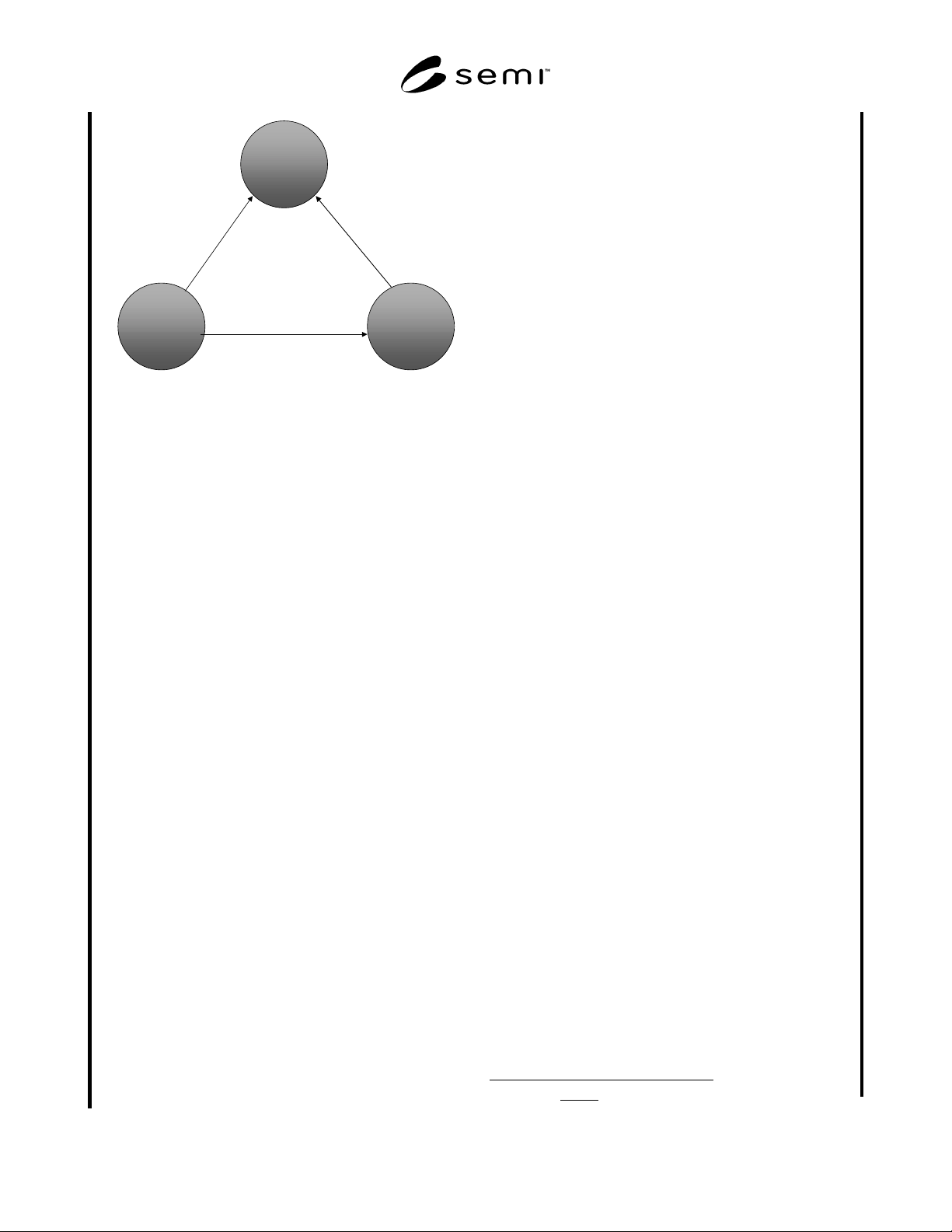
SEMI E96-1101 © SEMI 1999, 200117
Trader
Client Server
export(1)import(2)
service interaction(3)
Figure 2
6.8.2.2.3 The diagram suggests that the server exports
its service to the trader. In practice any object aware of
the server and its provided services could assume this
job. For example, a factory configuration object could
be responsible for exporting all services to the trader.
6.8.2.3 Trading Service Models
6.8.2.3.1 The trader has to implement two interfaces:
• The Register interface allows other objects to
register export service offers to the trader.
NOTE 4: This interface is used e.g. by the service
provider to inform the trader about the services the
service provider offers.
• The Lookup interface allows other objects to
lookup the trader for a required service.
NOTE 5: This interface is used by e.g. the productive
entity to find a service provider for a specific service.
6.8.2.4 Export Use Cases
6.8.2.4.1 The trader offers an interface named Register,
that allows a server to register its services with the
trader.
6.8.2.4.2 The IDL definitions given below are for
illustrative purposes. They are extracted from the COS
Trading Object Service specification [OMG]. For
clarity, not all services are included here.
6.8.2.4.3 Exporting a Service
6.8.2.4.4 To export a service, the server uses:
OfferId export (
in Object reference,
in ServiceTypeName type,
in PropertySeq properties
);
6.8.2.4.5 The server passes a reference to itself, and
describes its offer by passing in a service type name and
a list of properties of the service. The trader answers an
offer id, through which the server can further
manipulate its offer.
6.8.2.4.6 Factory service offers are described as
follows:
6.8.2.4.6.1 Service Type Name
6.8.2.4.6.2 The type is a string naming the service
itself. We are yet to agree upon the services supported
by this specification. The following are obvious
candidates:
• Recipe Service
• Wafer Map Service
• Fixtures Service
8
6.8.2.4.6.3 Properties
6.8.2.4.6.3.1 Properties are used to characterize and
specialize the service. A property is a name/value pair,
where the name is a string naming the property, and the
value specifies the property value offered by the server.
The constraint language defined by the COS Trading
Object Service [OMG] limits the type of values to the
basic data types (such as numbers, chars, booleans and
strings) and sequences of these.
6.8.2.4.6.3.2 The following properties are to be used
for registering factory services:
• “Serviced Productive entities” The value of this
property is a list of the ids of the productive entities
serviced by this server. This allows multiple
servers of the same type to be installed, and
partition the productive entity service among the
available servers. Note that it does not require the
server to know the productive entities it serves,
since the server registration can be done by a
factory configuration service.
• “Serviced Areas” The value of this property is a
string collection naming the factory areas serviced
by the server. This property is another means of
partitioning the service among multiple servers.
The area could be a name of a cell controller if
cellular manufacturing is practiced, or the name of
any organizational unit implemented by the
factory, and known to the factory configuration
service.
6.8.2.4.7 Withdrawing a Service
6.8.2.4.7.1 To withdraw a registered service, the server
(or the configuration service) uses:
void withdraw (
in OfferId Id);
8 In back end fixtures is a generic name for durables and consumable
materials