semi合集-English.pdf - 第731页
SEMI E99-1104 E © SEMI 2000, 2004 21 NOTICE: SEMI makes no warranties or representations as to the su itability of the standard set fo rth herein for any particular application . The determinati on of the suitability o f…
SEMI E99-1104
E
© SEMI 2000, 2004 20
RELATED INFORMATION 4
NOTICE: This related information is not an official part of SEMI E99 and was derived from the Japanese
Information and Control Committee. This related information was approved for publication by full letter ballot on
January 10, 2003.
R4-1 Application of RF Tag as Carrier ID Tag
R4-1.1 In case that RF Tag is utilized as Carrier Tag for SEMI E99 application, to secure the interoperability among
the CIDRW units for writing / reading the Carrier ID into / out of the RF Tag, some basic consideration should be
taken as follows:
R4-1.1.1 Coincidence of Carrier ID Written and Read in Tag Memory — Fundamentally Carrier ID, which is read
out, should be quite same as written, with no addition.
R4-1.1.2 Caution for Carrier ID Contents Applied to Object ID — Carrier ID as Material ID can be used as Object
ID. But the Space Character (20
16
) should not be used as the first or the last character of Carrier ID. SEMI E39
restricts these.
R4-1.1.3 Non-Visible Character in Carrier ID — If non-visible ASCII character is found within the specified tag
area, CIDRW shall send out an error (i.e. Execution error) to the upstream controller when “Read ID” service was
executed. The contents of Carrier ID issued by host/upstream controller should be compliant with visible Character.
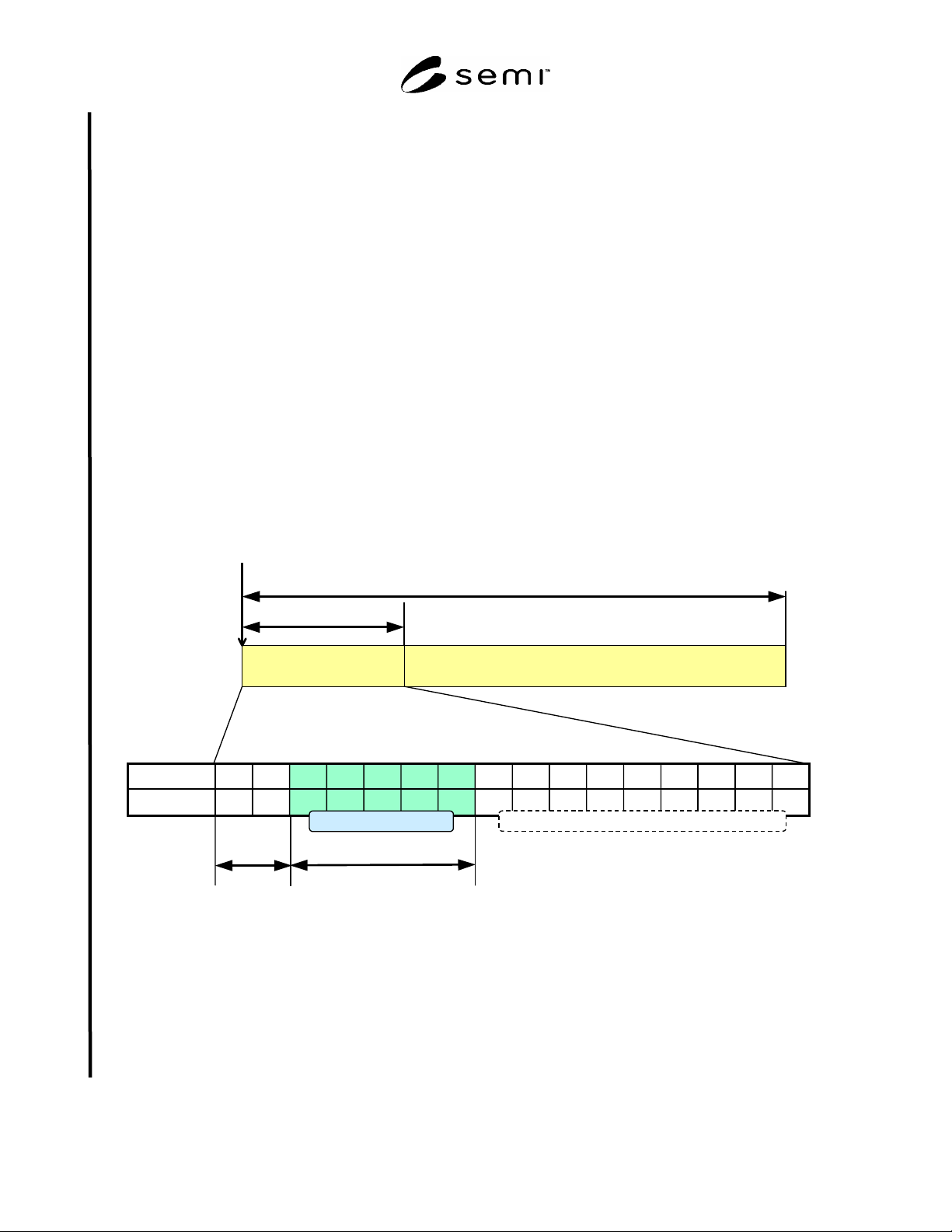
R4-1.1.4 Location of Carrier ID Field (CID Field) — Carrier ID field shall be located from the first byte to the
maximum byte of Carrier ID in the memory of the Electric Tag. The relation of Carrier ID Offset and Carrier ID
length are shown bellow:
CID Field
First Byte
Maximum Byte of CID
Total Tag Length
141312111009
E
06
D
05
C
04
B
03 07
A
02
NUL
01
NUL
00 1508
ASCII
Address 141312111009
E
06
D
05
C
04
B
03 07
A
02
NUL
01
NUL
00 1508
ASCII
Address
Offset
Length
Do Not Care
CID
Figure R4-1
Example of Carrier ID in Tag (“CID = ABCDE”)
R4-1.1.5 Condition of CarrierIDOffset and CarrierIDLength —
By setting the condition of CarrierIDOffset and
CarrierIDLength, CIDRW can correspond to CarrierID Tag characteristic to device makers already existing, if they
are compliant with the reinforced specification for RF Tag in SEMI E99.
R4-1.1.5.1 The information of the Offset value and Length of Carrier ID should be stored as the CIDRW Attribute.
R4-1.1.5.2 When a CIDRW is installed in the equipment, it needs to set up a condition of CarrirIDOffset and
CarrierIDLength as per user requirement once at least.

SEMI E99-1104
E
© SEMI 2000, 2004 21
NOTICE: SEMI makes no warranties or representations as to the suitability of the standard set forth herein for any
particular application. The determination of the suitability of the standard is solely the responsibility of the user.
Users are cautioned to refer to manufacturer’s instructions, product labels, product data sheets, and other relevant
literature respecting any materials mentioned herein. These standards are subject to change without notice.
The user’s attention is called to the possibility that compliance with this standard may require use of copyrighted
material or of an invention covered by patent rights. By publication of this standard, SEMI takes no position
respecting the validity of any patent rights or copyrights asserted in connection with any item mentioned in this
standard. Users of this standard are expressly advised that determination of any such patent rights or copyrights, and
the risk of infringement of such rights, are entirely their own responsibility.
Copyright by SEMI® (Semiconductor Equipment and Materials
International), 3081 Zanker Road, San Jose, CA 95134. Reproduction of
the contents in whole or in part is forbidden without express written
consent of SEMI.
SEMI E99.1-1104 © SEMI 2000, 2004 1
SEMI E99.1-1104
SPECIFICATION FOR SECS-I AND SECS-II PROTOCOL FOR CARRIER
ID READER/WRITER FUNCTIONAL STANDARD
This specification was technically approved by the Global Information and Control Committee and is the
direct responsibility of the Japanese Information and Control Committee. Current edition approved by the
Japanese Regional Standards Committee on July 23, 2004. Initially available at www.semi.org September
2004; to be published November 2004. Originally published June 2000; previously published November
2003.
1 Purpose
1.1 This document maps the services and data of the
Carrier ID Reader/Writer (CIDRW) standard to SECS-
II streams and functions and data definitions.
2 Scope
2.1 This document applies to all implementations of
CIDRW that use the SECS-II message protocol (SEMI
E5).
NOTICE: This standard does not purport to address
safety issues, if any, associated with its use. It is the
responsibility of the users of this standard to establish
appropriate safety and health practices and determine
the applicability of regulatory or other limitations prior
to use.
3 Referenced Standards
3.1 SEMI Standards
SEMI E4 SEMI Equipment Communications
Standard 1 Message Transfer (SECS-I)
SEMI E5 SEMI Equipment Communications
Standard 2 Message Content (SECS-II)
NOTICE: As listed or revised, all documents cited
shall be the latest publications of adopted standards.
4 Terminology
4.1 Abbreviations and Acronyms
4.1.1 CIDRW — Carrier ID Reader/Writer; represents
both the Reader and the Read/Writer.
4.1.2 SECS — SEMI Equipment Communications
Standard
5 Physical Requirements
5.1 The CIDRW using the SECS-I protocol shall use a
9-pin female connector.
6 Service Message Mapping
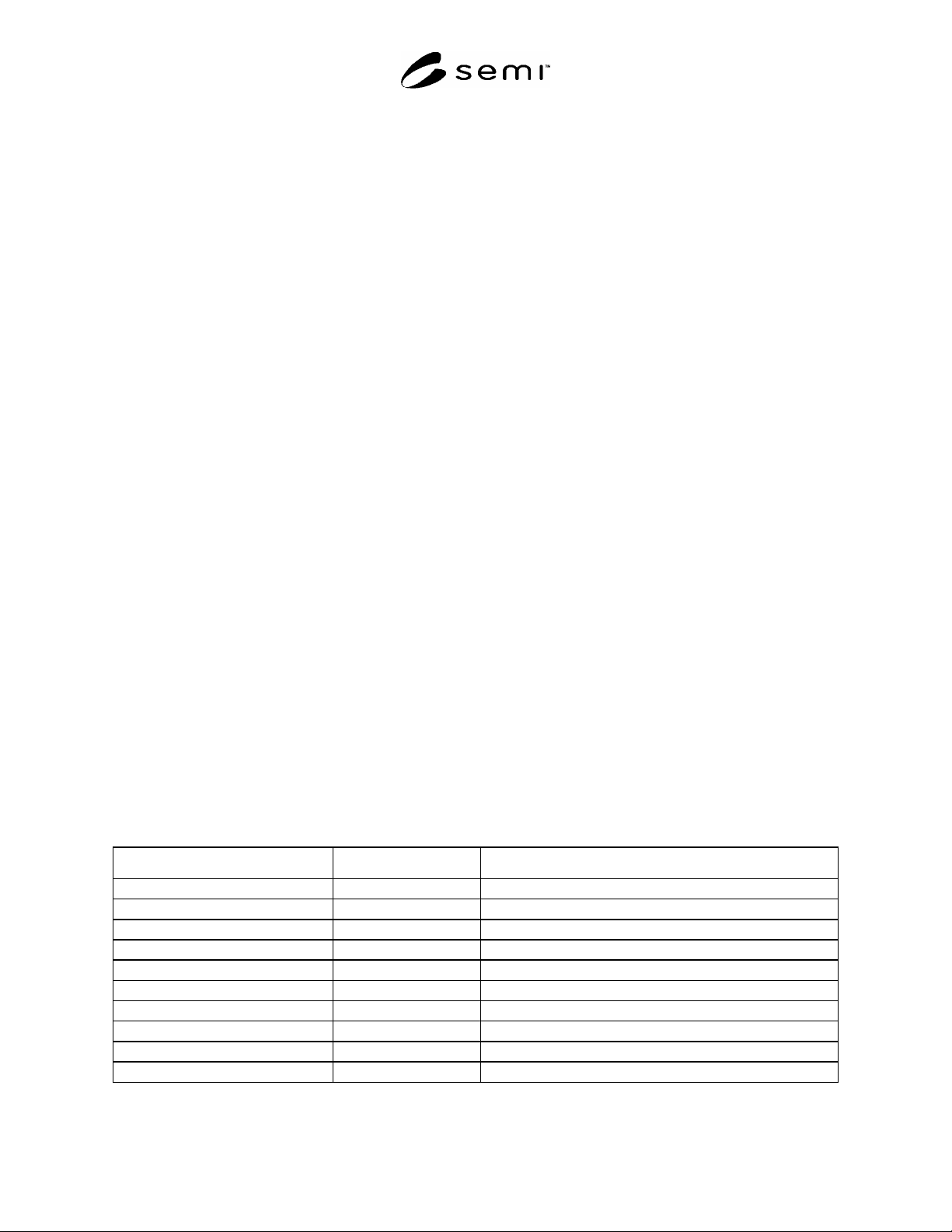
6.1 Table 1 shows the specific SECS-II streams and
functions that shall be used for SECS-II
implementations of the service messages defined in
SEMI E99.
6.2 Request and notification messages are mapped to
primary (odd-numbered) SECS-II functions and
response messages are mapped to secondary (even-
numbered) SECS-II functions.
6.3 In some cases, a common set of parameters allows
more than one service to be mapped to the same stream
and function, with an additional SECS-II data item used
to differentiate between the two services.
Table 1 Services Mapped to SECS-II Messages
Message Name Stream,Function SECS-II Name
ChangeState S18,F13/F14 Subsystem Command Request/Acknowlege
Get Attributes S18,F1/F2 Read Attribute Request/Data
Get Status S18,F13/F14 Subsystem Command Request/Acknowledge
Perform Diagnostics S18,F13/F14 Subsystem Command Request/Acknowledge
Read Data S18,F5/F6 Read Request/Data
Read ID S18,F9/F10 Read ID Request/Data
Reset S18,F13/F14 Subsystem Command Request/Acknowledge
Set Attributes S18,F3/F4 Write Attribute Request/Acknowledge
Write Data S18,F7/F8 Write Request/Acknowledge
Write ID S18,F11/F12 Write ID Request/Acknowledge