semi合集-English.pdf - 第5392页
SEMI M56-1103 © SEMI 2003 7 RELATED INFORMATION 2 PICTORIAL REPRESENTATION OF PROCESS DISTRIBUTION AND MEASUREMENT VARIABILITY AND BIAS NOTICE: This relat ed information is not an official part o f SEMI M56. It was deriv…

SEMI M56-1103 © SEMI 2003 6
R1-4.1.1 The characteristics being measured are
independent or an independent combination of their
values is used.
R1-4.1.2 All tests are performed before a decision to
reject or pass is made.
R1-4.1.3 F(x) has been deconvolved from F·G.
R1-4.1.4 A conforming item is defined as one in which
all measured characteristics are shown to be in
specification.
R1-4.1.5 A non-conforming item is taken to be one in
which at least one characteristic is outside of
specification.
R1-4.2 It is then possible to define a set of
α
and
β
errors for each gauge. Let
α
1
,
α
2
, …,
α
n
be the
α
values and
β
1
,
β
2
, …,
β
n
be the
β
values associated with
the n different characteristics.
R1-4.3 The overall
α
value,
α
T
, is calculated from the
equation:
α
T
=
∏∏
==
−−
n
i
n
i
ii
11
)1(
απ
where:
,d)(
∫
∞−
=
USL
ii
xxf
π
and
f
i
(x) = PDF of the characteristic i.
NOTE 3: This equation is based on the probability P that all
characteristics conform, but that at least one test failed:
α
T
= P[All characteristics conform, At least one test failed]
= P[All characteristics conform] −
P[All characteristics conform, All tests passed]
R1-4.4 The overall
β
value,
β
T
, is calculated from the
equation:
β
T
=
∏∏
==
−−
n
i
n
i
ii
p
11
)1(
α
where:
p
i
= proportion of observations within specification
for characteristic i.
NOTE 4: This equation is based on the probability P that one
or more characteristics are nonconforming but that all tests
passed:
β
T
= P[≥1 characteristic nonconforming, All tests passed]
= P[All pass] −
P[All characteristics conform, All tests passed]
SEMI M56-1103 © SEMI 2003 7
RELATED INFORMATION 2
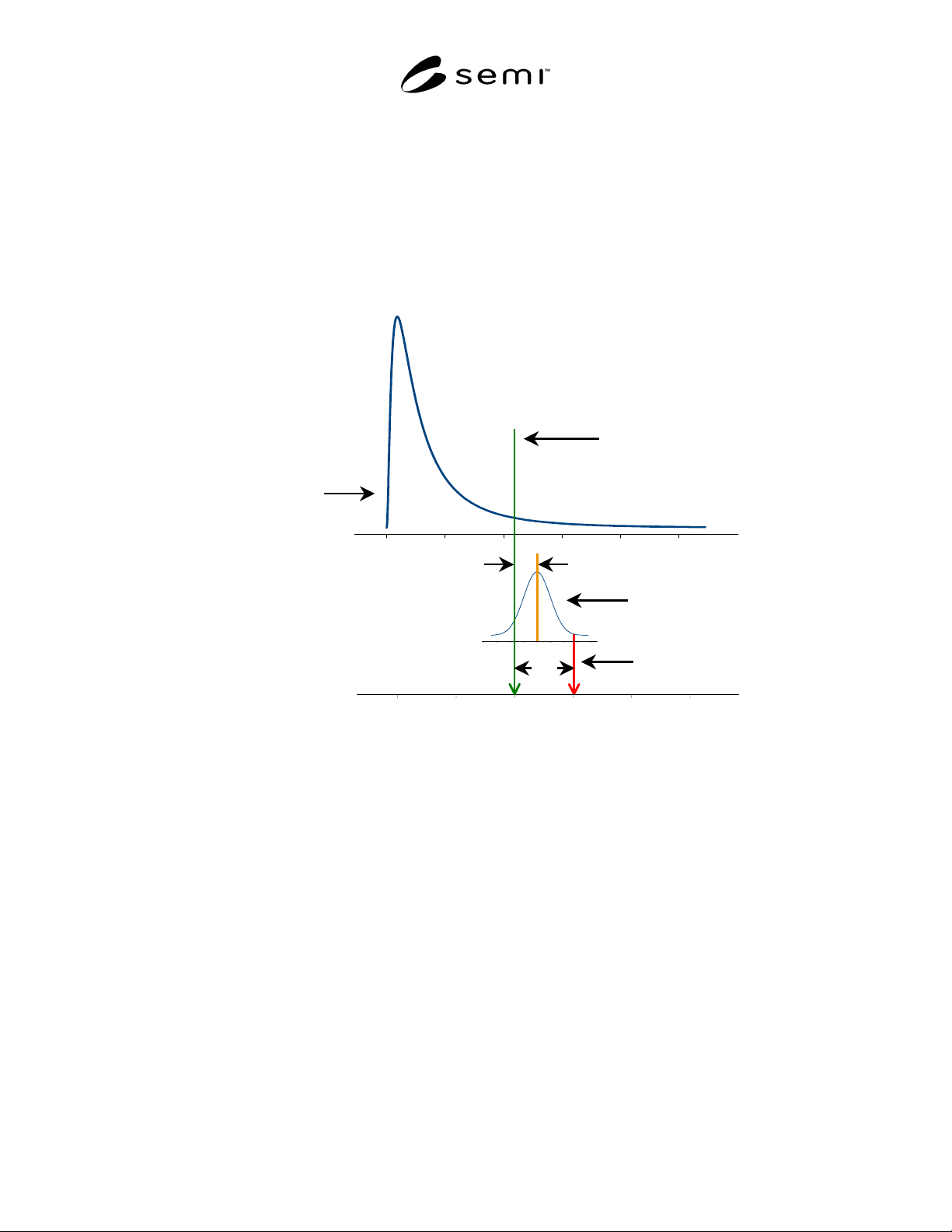
PICTORIAL REPRESENTATION OF PROCESS DISTRIBUTION AND
MEASUREMENT VARIABILITY AND BIAS
NOTICE: This related information is not an official part of SEMI M56. It was derived from task force
deliberations during the development of the document. This related information was approved for publication by
full letter ballot procedures on September 3, 2003.
Process
Characteristic
PDF [= f
(
x
)
]
Measurement
Variability PDF
[=
Φ
(
u
)
]
Observed
Measurement
Bias
[=
δ
]
True Value
[=
x
]
U
NOTE: The observed measurement is displaced from the true value, x, by an amount U with a frequency of occurrence for each
value of U given by the measurement variability PDF.
Figure R2-1
Relationship of Process Characteristic PDF, Measurement Variability PDF, True Value, Bias, and an
Observed Measurement

SEMI M56-1103 © SEMI 2003 8
RELATED INFORMATION 3
BACKGROUND OF THE METHODOLOGY
NOTICE: This related information is not an official part of SEMI M56. It was derived from task force
deliberations during the development of the document. This related information was approved for publication by
full letter ballot procedures on September 3, 2003.
R3-1 The model in this practice is used to assign
probabilities (risks) to specification-related events. In
general, there are two probabilities that are of interest.
The first is the probability of getting a measurement
outside of the specification range for a conforming
item. This is often called the producer’s risk because
conforming product would be needlessly rejected in this
situation. The second probability is that of getting a
measurement within specifications for a non-
conforming item. Consumer’s risk is the term applied
to this probability, since there is a chance of non-
conforming product being accepted.
R3-1.1 For the purposes of this standard, the event of
rejecting an item whose true value lies inside of the
specification limits is considered a Type I error with
error rate (probability)
α
.
R3-1.2 The event of accepting an item whose true
value lies outside of the specification limits is
considered a Type II error with error rate (probability)
β
.
R3-1.3 One of the difficulties in formulating the
statistical model is that there are two or more
distributions involved, possibly in an interdependent
fashion. Given a true underlying (fixed) value, x, a
single measurement of that value produces the obser-
vation Y = x + U, where U is a random and unobs-
ervable value attributable to measurement variability.
If one takes n measurements of the same value x, i.e.,
Y
i
= x + U
i
, where i = 1,…, n, Y and U are treated as
random variables from the observation and
measurement variability distributions, respectively.
The situation is further complicated if several x values
are measured. In this situation, the x values come from
the process (or characteristic) distribution X such that
Y
ij
= X
j
+ U
ij
, where i = 1,…, n and j = 1,…, m. The
relationship between X and U is known as a
convolution. Additional distributions may be involved
if one assumes that certain characteristics of the
measurement process do not remain constant over the
measurement range. For example, one may assume that
bias is a function of the measured value. To model this
a third distribution would be needed, but the scope of
this practice is limited to the use of only two
distributions (characteristic and measurement
variability).
R3-2 The symbols in the equations derived for
α
and
β
have the following meanings:
X = random value attributable to the process
characteristic,
U = random and unobservable value attributable
to measurement variability,
f (x) = process characteristic PDF,
G(u) = measurement variability CDF,
USL = upper specification limit,
LSL = lower specification limit, and
Φ(u) = Gaussian CDF.
R3-3 The process characteristic PDF and measurement
variability CDF are assumed to be independent of each
other.
R3-4 For a process characteristic with only a USL:
R3-4.1 Define
α
as a joint probability:
[
]
()()
,
1
USL
PX USLX U USL
GUSL x f xdx
α
−∞
=≤ +>
=− −
∫
R3-4.2 Similarly, define
β
as:
[
]
()()
,
USL
PX USLX U USL
GUSL x f xdx
β
∞
=> +≤
=−
∫
R3-5 For a process characteristic with only an LSL, the
formulae for
α
and
β
are:
()()
LSL
GLSL x f xdx
a
•
=-
Ú
()()
1
LSL
GLSL x f xdx
b
-•
È˘
=- -
Î˚
Ú