semi合集-English.pdf - 第3838页
SEMI F20-0305 © SEMI 1995, 2005 2 E 45 — Recommended Practice for Determin ing the Inclusion Content of Steel E 112 — Test Methods for De termining Average Grain Size NOTICE: Unless otherwise indicated, all documents cit…

SEMI F20-0305 © SEMI 1995, 2005 1
SEMI F20-0305
SPECIFICATION FOR 316L STAINLESS STEEL BAR, FORGINGS,
EXTRUDED SHAPES, PLATE, AND TUBING FOR COMPONENTS
USED IN GENERAL PURPOSE, HIGH PURITY AND ULTRA-HIGH
PURITY SEMICONDUCTOR MANUFACTURING APPLICATIONS
This specification was technically approved by the Global Gases Committee and is the direct responsibility of
the North American Gases Committee. Current edition approved by the North American Regional Standards
Committee on November 4, 2004. Initially available at www.semi.org January 2005; to be published January
2005. Originally published in 1995; previously published July 2004.
1 Purpose
1.1 The purpose of this specification is to define the metallurgical cleanliness requirements and material
composition of 316L stainless steel required for use in the manufacture of components for general purpose, high
purity, and ultra-high purity chemical (gas or liquid) distribution systems.
2 Scope
2.1 This specification defines the requirements for 316L stainless steel bar, forgings, and extruded shapes as
specified in ASTM A 276, plate stock as specified in ASTM A 240, and tubing as specified in ASTM A 269 and
ASTM A 632, for use in the manufacture of components used in general purpose and high purity chemical (gas or
liquid) distribution systems in semiconductor manufacturing facilities.
NOTICE: This standard does not purport to address safety issues, if any, associated with its use. It is the
responsibility of the users of this standard to establish appropriate safety and health practices and determine the
applicability of regulatory or other limitations prior to use.
3 Referenced Standards
3.1 ASTM Standards
1
A 182/A 182M — Specification for Forged or Rolled Alloy-Steel Pipe Flanges, Forged Fittings, and Valves and
Parts for High Temperature Service
A 240/A 240M — Specification for Heat-Resisting Chromium and Chromium-Nickel Stainless Steel Plate, Sheet,
and Strip for Pressure Vessels
A 262 — Practices for Determining Susceptibility to Intergranular Attack in Austenitic Stainless Steels
A 269 — Standard Specification for Seamless and Welded Austenitic Stainless Steel Tubing for General Service
A 276 — Specification for Stainless and Heat-Resisting Steel Bars and Shapes
A 479/A 479M — Specification for Stainless and Heat Resisting Steel Bars and Shapes for Use in Boilers and Other
Pressure Vessels
A 480/A 480M — Specification for General Requirements for Flat-Rolled Stainless and Heat-Resisting Steel Plate,
Sheet and Strip
A 484/A 484M — Specification for General Requirements for Stainless and Heat-Resisting Wrought Steel Products
(Except Wire)
A 632 — Standard Specification for Seamless and Welded Austenitic Stainless Steel Tubing (Small-Diameter) for
General Service
A 751 — Test Methods, Practices and Terminology for Chemical Analysis of Steel Products
1 American Society for Testing and Materials, 100 Barr Harbor Drive, West Conshohoken, PA 19428-2959, USA. Telephone: 610.832.9585,
Fax: 610.832.9555, Website: www.astm.org

SEMI F20-0305 © SEMI 1995, 2005 2
E 45 — Recommended Practice for Determining the Inclusion Content of Steel
E 112 — Test Methods for Determining Average Grain Size
NOTICE: Unless otherwise indicated, all documents cited shall be the latest published versions.
4 Terminology
4.1 Definitions
4.1.1 inclusion — Indigenous or foreign material within the metal, usually referring to non-metallic compound
particles such as oxides, alumina, sulfides or silicates.
4.1.2 Grades
4.1.2.1 General Purpose (GP) Grade — For components intended for use in chemical distribution systems of
semiconductor manufacturing facilities that do not have stringent cleanliness requirements. Examples are clean dry
air and vacuum lines.
4.1.2.2 High Purity (HP) Grade — For components intended for use in high performance capability chemical
distribution systems of semiconductor manufacturing facilities.
4.1.2.3 Ultra High Purity (UHP) Grade — For components intended for use in advanced chemical distribution
systems of semiconductor manufacturing facilities in which optimum resistance to corrosion and contamination in
critical process chemicals are required.
5 Ordering Information
5.1 Orders for bar, forgings, extruded shapes, plate, or tubular products under this specification shall include:
5.1.1 Grade – General purpose, high purity, or ultra-high purity,
5.1.2 Quantity (kilograms, pounds, meters, inches, or feet),
5.1.3 Cross section description (round, square, hex, etc. or detailed drawing),
5.1.4 Size (nominal diameter or shape dimensions for other than those identified with an extrusion drawing),
5.1.5 Wall thickness (for tubing),
5.1.6 Length (specific or random),
5.1.7 Reference to this specification number, and
5.1.8 Any special and/or supplementary requirements such as melting and refining processes.
6 Requirements
6.1 General
6.1.1 Bar stock, forgings, or extruded shapes furnished under this specification shall conform to the requirements of
ASTM A 182/A 182M, ASTM A 276, ASTM A 479/A 479M, or ASTM A 484/A 484M, and the additional
requirements of this specification.
6.1.2 Plate stock furnished under this specification shall conform to the requirements of ASTM A 240 or A 480/A
480M, and the additional requirements of this specification.
6.1.3 Tubing furnished under this specification shall conform to the requirements of ASTM A 269 or A 632, and
the additional requirements of this specification.
6.1.4 Where the requirements of this specification conflict with referenced specifications, the requirements of this
specification take precedence.
6.2
Manufacture
6.2.1 The stainless steel billet material used for processing shall be manufactured by such melting, casting and
refining processes required to conform to the composition and metallurgical requirements of this specification.
SEMI F20-0305 © SEMI 1995, 2005 3
6.2.2 The annealing temperature used to achieve the grain size requirements of ¶6.4.1 shall be 982
o
C (1800
o
F)
minimum.
6.3 Composition
6.3.1 Material shall be type 316L stainless steel, as specified in Table I of ASTM A 182/A 182M, ASTM A 240,
ASTM A 269, ASTM A 276, ASTM A 479/A 479M, or ASTM A 632, except where otherwise specified herein.
6.3.2 General purpose grade material shall have a composition per ASTM A 269 and ASTM A 632, with the
exception of limited Sulfur 0.012% maximum.
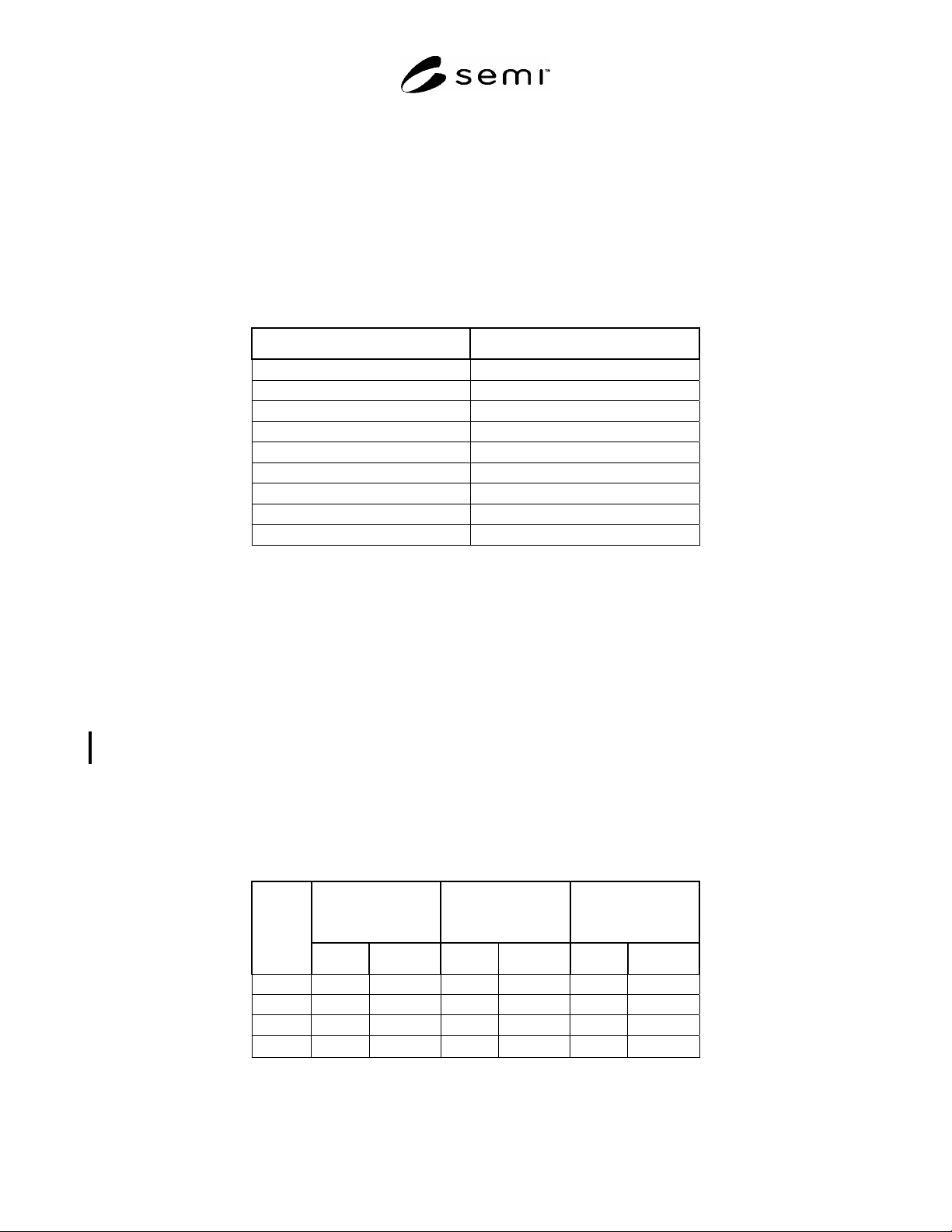
6.3.3 Additional composition requirements for the high purity and ultra-high purity grades are shown in Table 1.
Table 1 Additional Composition Requirements
Element Range – Wt %
Carbon 0.030 Max
Sulfur 0.010 Max
Manganese 1.5 Max
Copper 0.30 Max
#1
Niobium 0.05 Max
Aluminum 0.01 Max
Calcium 0.02 Max
Titanium 0.02 Max
Selenium 0.02 Max
#1
Agreement may be reached between the supplier and the customer to accept a higher level of copper.
6.3.4 Effects of Sulfur content on welding are significant, as discussed in Appendix 1.
6.3.5 Effects of Copper content on welding are discussed in Appendix 2.
6.3.6 No deviations in material composition from the minimum or maximum values specified in the appropriate
ASTM document or herein shall be allowed without approval by the purchaser.
6.4 Metallurgy
6.4.1 Grain size per ASTM E 112 shall be 5 or finer for hot or cold finished product and tubing of nominal size 3
inches in diameter and smaller, and 3 or finer for material stock greater than 3 inches. These requirements may be
modified as agreed upon between supplier and user. Grain size on flats and squares shall be as agreed upon by the
supplier and the user.
6.4.2 The inclusion content of the material shall be determined from representative samples of the material heat in
accordance with ASTM E 45, Method A, but with ratings based on Plate III. Maximum allowable JK ratings at the
billet stage are shown in Table 2.
Table 2 Maximum JK Inclusion Ratings
General Purpose
Grade High Purity Grade
Ultra-High Purity
Grade
Type
Thin Heavy Thin Heavy Thin Heavy
A 2.5 1.0 2.0 1.0 1.5 1.0
B 2.5 1.0 2.0 1.0 1.0 1.0
C 2.5 1.0 2.0 1.0 1.0 1.0
D 2.5 1.0 2.0 1.0 1.0 1.0
6.4.3 Material shall meet the intergranular corrosion test specified in Practice E of ASTM A 262. This requirement
shall apply in the sensitized condition (1 hour at 677°C [1250°F]).