semi合集-English.pdf - 第3230页
SEMI E127-0705 © SEMI 2003, 2005 31 calibration results based on measuring a substrate with ex pected values. Internal storage of IMM Data is implem entation-specific. Its appare nt structure through the com munication l…
SEMI E127-0705 © SEMI 2003, 2005 30
Comments Control Client (CC) Msg Dir STPO Comments
10b
XfrCommand.rsp
XfrStatus = normal completion, no
errors.
11a Confirm transfer is
complete.
XfrVerify.req
XfrLink = 1
11b
XfrVerify.rsp Acknowledge transfer is
complete.
XfrStatus = normal completion, no
errors.
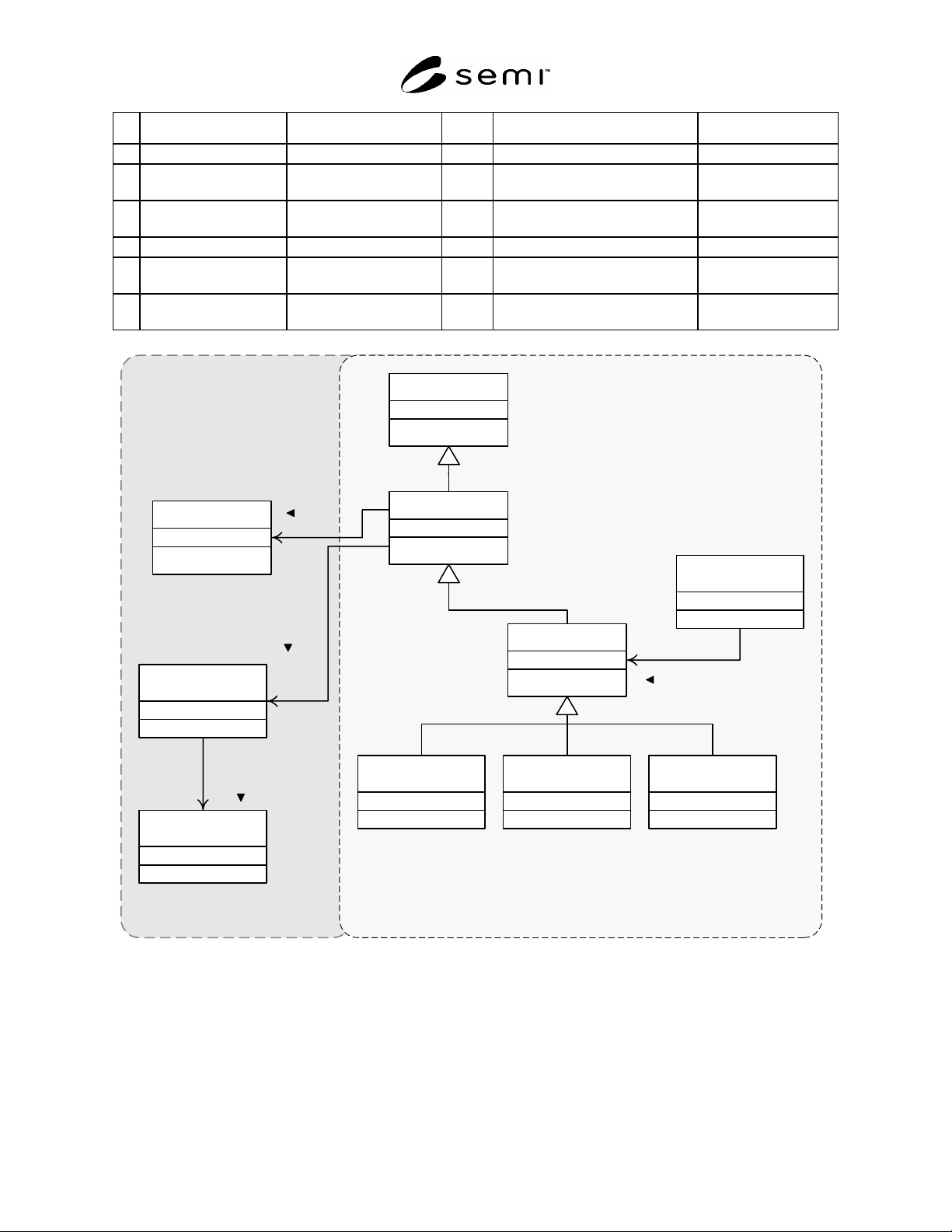
Data Table Object Model
references
Table
Data Table
IMM Data Table
Substrate Data
Set
IMM Converted
Data Table
IMM Raw Data
Table
IMM Calibration
Data Table
Data Row
Data Row
Template
Data Information
stores
site
data in
describes
order of data
within row
stores
attributes for
named data
0...*
0...*
1
1...*
1...*
0...* 0...*
1
Figure 8
Full Data Object Model
13 IMM Data
13.1 Overview
13.1.1 IMM Data consists of substrate context information together with one of the following: (1) measurements
taken on a substrate and stored as raw data, (2) meaningful results based on measurements, or (3) substrate

SEMI E127-0705 © SEMI 2003, 2005 31
calibration results based on measuring a substrate with expected values. Internal storage of IMM Data is
implementation-specific. Its apparent structure through the communication link is that of a type of table object.
Table attributes contain context information about the substrate, primarily collected from the Substrate Object
measured, while the data provided by the IMM is stored as ordered rows, where each row represents a single site
where measurements were taken.
13.1.2 There are two primary aspects to IMM Data, the data itself that provides the content of a table, and the
structure of the table as it appears using SEMI E39 object services.
13.1.3 Actual data table instances store the raw data collected during measurement, the results based upon that raw
data, or the results of calibrating to a known good substrate. This is reflected in the subtypes of the Data Table
object shown in Figures 9 and 10 below.
13.1.4 The second aspect is the structure of the Data Table Object, which is visible through use of templates. These
templates allow a user to discover the types of data available from the IMM and the format of that data (signed or
unsigned integer, floating point, text, etc.) without having to upload an actual table.
13.1.5 Data Table Objects and IMM Data Table Objects are abstract objects. All implementations of tables in IMM
shall be of a subtype of IMM Data Table Objects.
13.2 Tables
13.2.1 Table objects are defined in SEMI E58, §10 and §13. A Data Table Object is a type of Table object that
provides templates for individual data entries and for rows of entries. This allows a client that needs to use the data
provided in a data table to determine the information available in a table before an actual table is transferred.
13.2.2 All objects shown in Figures 5, 6, and 8 are used for purposes of exchanging data over the communication
link only. Data does not need to be stored internally in any particular manner.
13.2.3 Object Ownership — The IMM is considered to own both the tables that it stores and the set of Data Row
Templates. A specific instance of IMM table is considered to own its Data Rows and the associated Data Row
Template for that table. This allows the client to query a specific table for its template.
13.2.3.1 Ownership, as defined in SEMI E39, is not necessarily exclusive. An owner is expected to know about the
types of objects that it owns, their attributes, and their services.
14 IMM Data Table Object
14.1 Description
14.1.1 The IMM Data Object is a type of Data Table Object and inherits its attributes and relationships with
templates shown in Figures 8 and 11. The Data Table Object and its templates are discussed in §16. This section
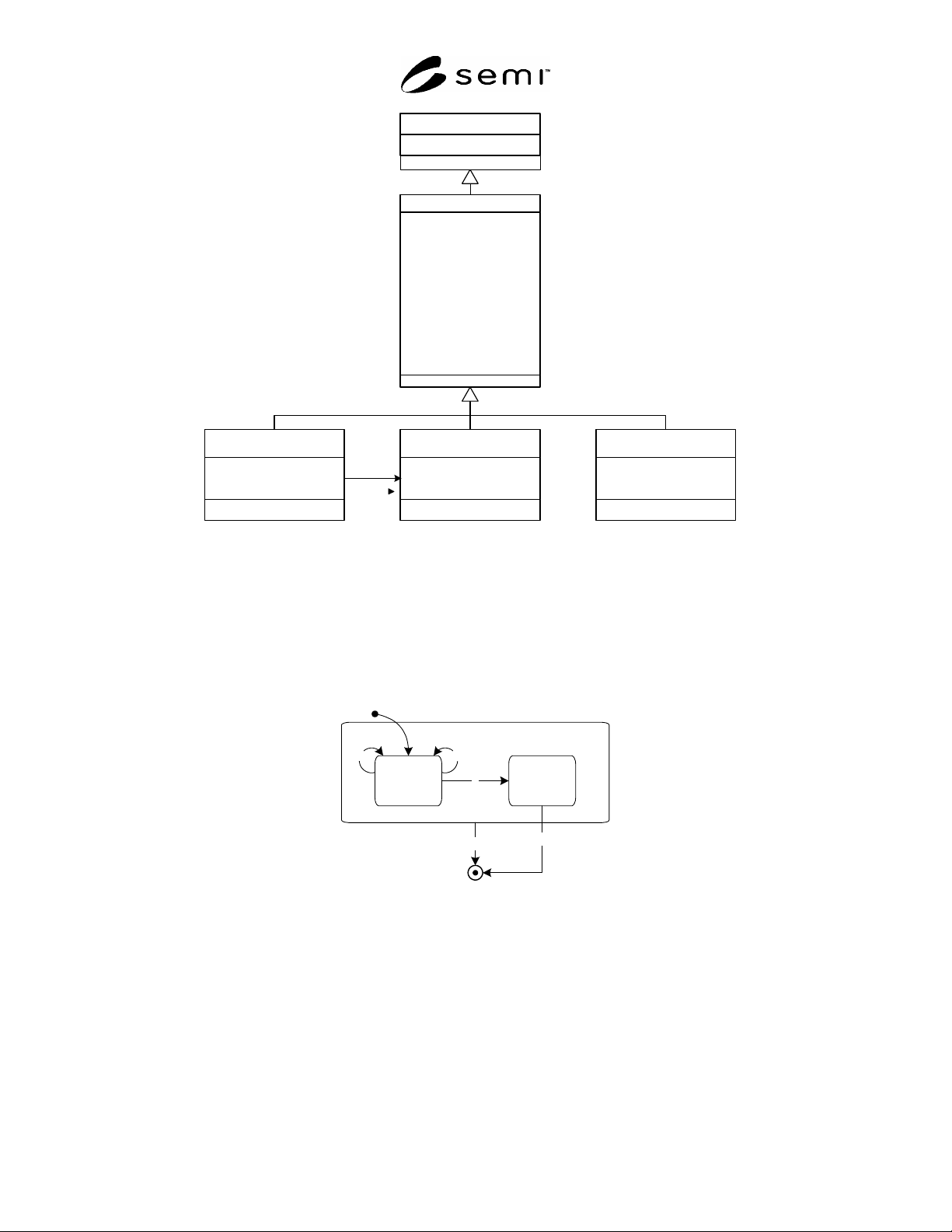
specifies the IMM Data Object and its subtypes. Figure 9 shows the model for a Data Object.
SEMI E127-0705 © SEMI 2003, 2005 32
IMM Data Table
DataValidity: enumeration
EventList: list of text/integer pairs
IMM_ID: text
LotID: text
ProcessFlowStep: text
ProcessToolID: text
ProcessRecipeID: text
RegionRanges: list of RangeDef
Status: enumeration
SubstID: text
SubstIDRead: text
SubstOrientation: float
SubstSide: enumeration
Summary: list of SummaryData
TimeStampFormat: enumerated
TimeStart: variant
TimeComplete: variant
IMM Converted Data
Table
IMM Raw Data Table
MeasurementRecipeID: text ConversionRecipeID: text
FeatureType: enumerated text
RawDataTable: text
Data Table
RowTemplateID: text
0...* 0...*
IMM Calibration Data
Table
CalibrationDuration: integer
CalibrationStatus: enumeration
CalibrationTimeStamp: variant
RefSubstID: text
provides
data for
Figure 9
Data Table Object Hierarchy
14.2 IMM Data Table Object State Model
14.2.1 The IMM Data Table Object has a state model showing when a new instance of data object is created, when
it is finished with the current set of data, and when it has been deleted after all current retention rules have been
satisfied. The diagram of the state model is shown in Figure 10. Table data is available only for complete data rows
(following transitions 2, 3, and 4).
IMM DATA TABLE
1
2
5
3
4
In Process
In
Retention
6
Figure 10
IMM Data Table Object State Model
14.2.2 State Definitions
14.2.2.1 The IMM Data Table Object has two states: IN PROCESS, and IN RETENTION.
14.2.2.1.1 IN PROCESS — An IMM Data Table Object is IN PROCESS as long as more data is to be stored in the
data object.
14.2.2.2 IN RETENTION — This state is active when the IMM Data Table Object is complete and conditions for
ending retention have not been satisfied.
14.2.3 Table 12 shows the transitions for the IMM Data Table Object state model.