semi合集-English.pdf - 第7030页
SEMI S14-0704 © SEMI 2000, 2004 9 A1-3.2 “System ” refers to the eq uipment as confi gured and offered by th e supplier. A1-4 Risk A1-4.1 The Risk sh ould be calculated based on the Se verity and Likelihood assi gned abo…
SEMI S14-0704 © SEMI 2000, 2004 8
APPENDIX 1
RISK ASSESSMENT CRITERIA
NOTICE: The material in this appendix is an official part of SEMI S14 and was approved by full letter ballot procedures on
September 3, 1999 by the North American Regional Standards Committee.
A1-1 The risk assessment should be performed for each identified fire hazard using the method provided in SEMI
S10 and the following definitions of Likelihood and Severity Groupings and Risk Categories.
NOTE A1-1: Unlike SEMI S10, in which the tables are provided only as examples, this document defines the Severity,
Likelihood, and Risk to be used herein.
A1-2 Severity
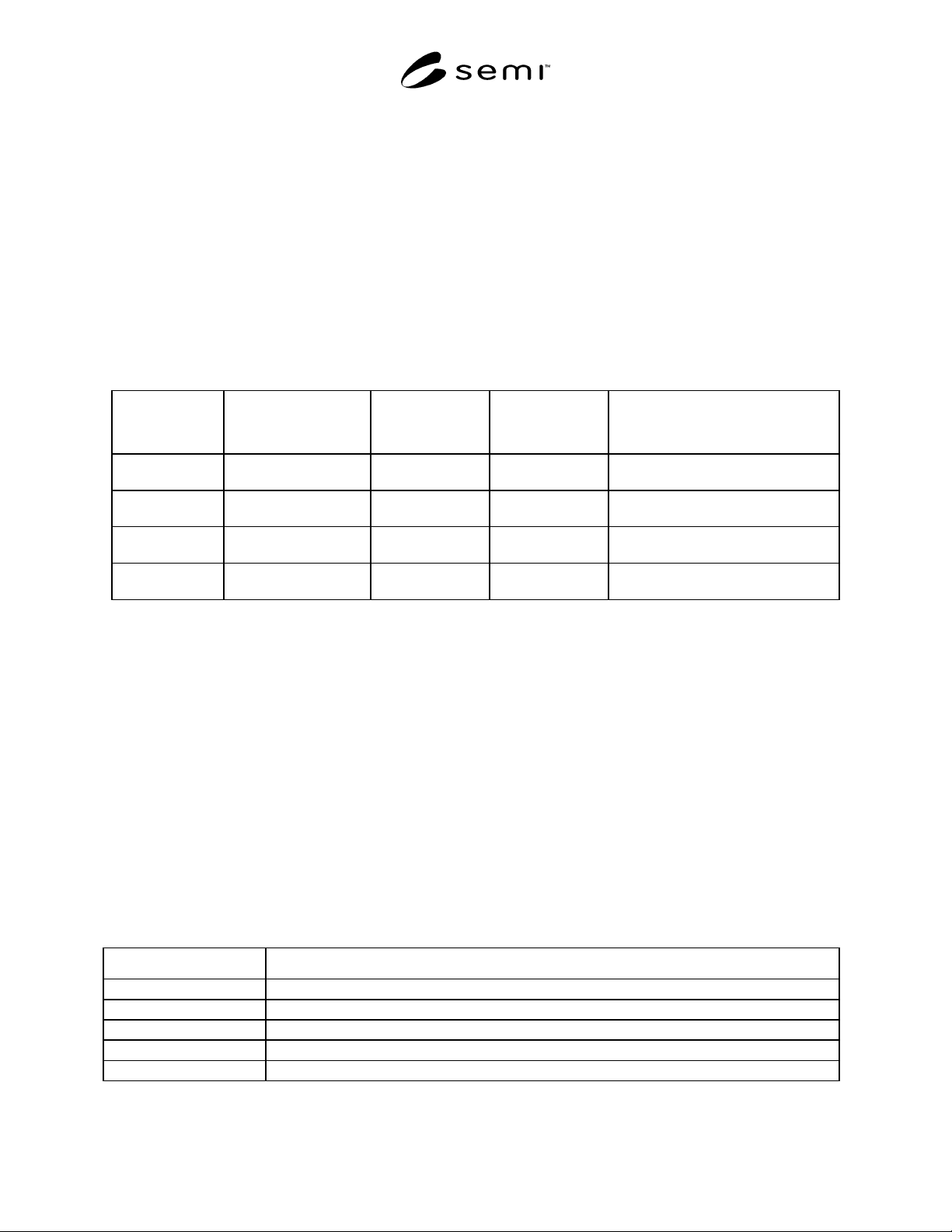
A1-2.1 The Severity Groupings are given in Table A1-1.
Table A1-1 Severity Groupings
Severity Group
Equipment Physical
Damage
Equipment Loss
of Use
Facility Loss of
Use (Minimum
Times)
Environmental and Real Property
Contamination
1 Catastrophic Loss of entire piece of
equipment
One year One week Lasting facility or environmental
impact
2 Severe Loss of major
subsystem
One month One day Temporary facility or environmental
impact
3 Moderate Loss of minor
subsystem
One week One shift Limited to the equipment, but
requiring more than routine cleanup
4 Minor Non-serious
equipment loss
One day Less than one
shift
Requiring routine cleanup but not
external reporting
A1-2.2 The Severity should be assigned for each of the columns for which information is available.
A1-2.3 The most severe Group assigned should be used in determining the risk.
A1-2.4 Each of the Severities should be reported.
A1-2.5 Contamination is by release of materials that were used in the equipment or by combustion or thermal
degradation byproducts.
A1-2.6 To be included in the assessment, a foreseen occurrence must be unplanned and include a loss.
A1-2.7 Losses exclude the performance of the design function of protective devices, such as fuses.
A1-2.8 The scope of the assessment in this document is limited to the consequences of fire.
A1-2.9 The Equipment Loss of Use time is the downtime, as defined in SEMI E10, resulting from the fire incident.
A1-3 Likelihood
A1-3.1 The Likelihood Groupings are given in Table A1-2.
Table A1-2 Likelihood Groupings
Likelihood Group Expected Frequency (% of Systems per Year)
A Frequent More than 1%
B Likely More than 0.2% but not more than 1%
C Possible More than 0.04%, but not more than 0.2%
D Rare More than 0.02%, but not more than 0.04%
E Unlikely Not more than 0.02%
SEMI S14-0704 © SEMI 2000, 2004 9
A1-3.2 “System” refers to the equipment as configured and offered by the supplier.
A1-4 Risk
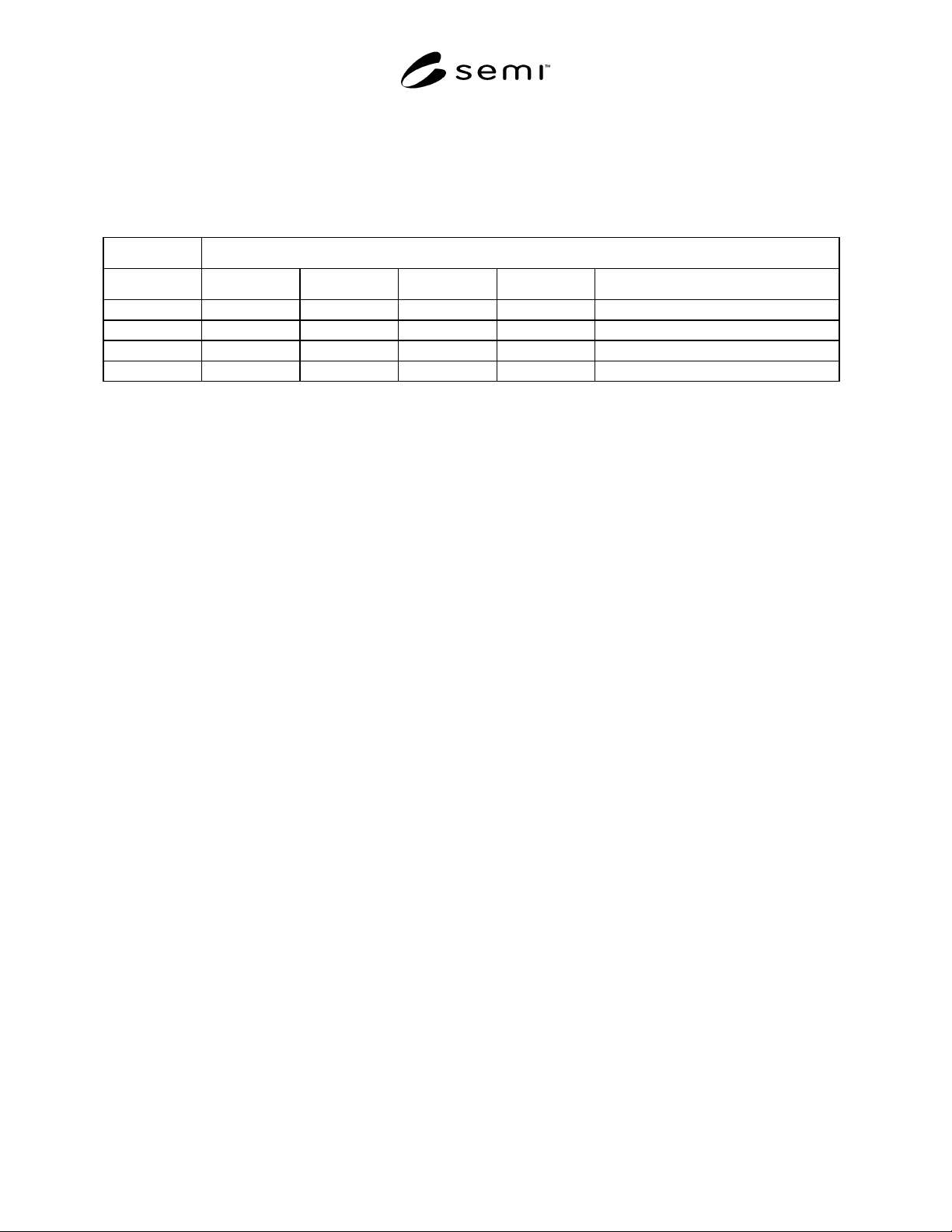
A1-4.1 The Risk should be calculated based on the Severity and Likelihood assigned above and the Risk Categories
defined in Table A1-3.
Table A1-3 Risk Categories
Likelihood
Severity A B C D E
1 Critical Critical High Medium Low
2 Critical High Medium Low Low
3 High Medium Low Low Slight
4 Medium Low Low Slight Slight
A1-4.2 The Risks are to be reported in total for the equipment as offered for sale. (e.g., if the equipment being
evaluated is a cluster tool, the risks should be reported by the system integrator for the assembled tool, not the
individual modules.)
NOTE A1-2: Although the risks for cluster tools should be reported for the assembled tool, the modules are not necessarily
contiguous and this may bear on the risk.
NOTE A1-3: The Risks of components or subsystems may be increased or decreased by their integration into the equipment
being assessed.

SEMI S14-0704 © SEMI 2000, 2004 10
APPENDIX 2
ASSESSMENT OF THE FIRE PROPERTIES OF MATERIALS
NOTICE: The material in this appendix is an official part of SEMI S14 and was approved by full letter ballot procedures on
September 3, 1999 by the North American Regional Standards Committee.
A2-1 This Appendix describes the qualitative criteria
for evaluating some of the relevant fire properties of
materials. It also provides references to several
standards which may be used in these evaluations.
Each of the standards listed defines test methods and
provides quantitative criteria for consideration.
A2-2 Preferable Materials:
A2-2.1 Require higher heat fluxes to be ignited.
A2-2.2 Once ignited may burn locally in the ignition
area, but they will not propagate a fire beyond the
ignition zone.
A2-2.3 Generate lower quantities of smoke and
corrosive products or generate smoke and corrosive
products that are less damaging.
A2-3 The following standards provide means of
assessing the fire properties of materials. Each of these
standards specifies the types of materials and uses of
materials to which it applies and the fire properties that
its application assesses. Therefore, each must not be
used outside of the scope for which it was written. It
may be appropriate to use different standards for
assessing the materials used in different components in
the equipment.
NOTE A2-1: There are many other standard methods
available for characterizing the fire properties of materials and
it is not the intent of the document to exclude methods other
than those listed here, as long as the methods are applied
appropriately.
A2-3.1 Factory Mutual Research Corp.
Standard 4910,
Clean Room Materials Flammability Test Protocol
A2-3.2 Underwriters Laboratory Standard 94, Tests for
Flammability of Plastic Materials for Parts in Devices
and Appliances
A2-3.3 Underwriters Laboratories Standard 746A,
Polymeric Materials - Short Term Property Evaluations
A2-3.4 Underwriters Laboratories Standard 746B,
Polymeric Materials - Long Term Property Evaluations
A2-3.5 Underwriters Laboratories Standard 746C,
Polymeric Materials - Use in Electrical Equipment
Evaluations
A2-3.6 Underwriters Laboratories Standard 900,
Standard for Safety for Air Filter Units
A2-3.7 Underwriters Laboratories Standard 2360,
Standard for Test Methods for Determining the
Combustability Characteristics of Plastics Used in
Semiconductor Tool Construction
NOTE A2-2: Although the list includes, for some materials,
more than one document that could be applied, the intent is to
provide alternatives, not to suggest that testing to more than
one standard be performed.
NOTICE: SEMI makes no warranties or
representations as to the suitability of the guideline set
forth herein for any particular application. The
determination of the suitability of the guideline is solely
the responsibility of the user. Users are cautioned to
refer to manufacturer’s instructions, product labels,
product data sheets, and other relevant literature
respecting any materials mentioned herein. This
guideline is subject to change without notice.
The user’s attention is called to the possibility that
compliance with this guideline may require use of
copyrighted material or of an invention covered by
patent rights. By publication of this guideline, SEMI
takes no position respecting the validity of any patent
rights or copyrights asserted in connection with any
item mentioned in this guideline. Users of this guideline
are expressly advised that determination of any such
patent rights or copyrights, and the risk of infringement
of such rights, are entirely their own responsibility.