semi合集-English.pdf - 第2041页
SEMI E54.9-0303 © SEMI 2000, 2003 2 4 Referenced Standards 4.1 SEMI Standar ds SEMI E39 — Object Se rvices Standard: Concepts, Behavior, and Services (OSS) SEMI E54.1 — Standa rd for Sensor/Actuator Net work Common Devi …

SEMI E54.9-0303 © SEMI 2000, 2003 1
SEMI E54.9-0303
SPECIFICATION FOR SENSOR/ACTUATOR NETWORK
COMMUNICATION FOR MODBUS/TCP OVER TCP/IP
This specification was technically approved by the Global Information and Control Committee and is the
direct responsibility of the North American Information and Control Committee. Current edition approved by
the North American Regional Standards Committee on October 25, 2002. Initially available at
www.semi.org December 2002; to be published March 2003. Originally published February 2000; previously
published October 2000.
1 Purpose
1.1 This standard defines a communication
specification based on the Modbus/TCP protocol over a
Transmission Control Protocol/Internet Protocol
(TCP/IP) network to enable communications between
intelligent devices on a sensor/actuator network (SAN)
that operate according to SEMI specified device models
(common and device specific) in a semiconductor
manufacturing tool.
1.2 Background and Motivation
1.2.1 Modbus/TCP over TCP/IP is a component level
network which provides a simple, inexpensive, and fast
means of exchanging data among control level
industrial devices (e.g., sensors and actuators) and
higher level devices such as controllers. Modbus/TCP
over TCP/IP provides:
• A solution to low-level device networking,
• Access to intelligence present in low-level devices,
• Networking between higher level controllers, and
• Master/Slave and Peer-to-Peer communication
capabilities.
1.2.2 Modbus/TCP specifies a communication model
and protocol. The Physical, Data Link, and Network
Layer definitions are defined by the network in which
the Modbus/TCP protocol is embedded such as TCP/IP
Ethernet.
1.2.3 This document enables communications between
intelligent devices on a SEMI compliant SAN by
providing a presentation mapping of common and
specific device network visible structure and behavior
to Modbus/TCP over a TCP/IP network.
2 Scope
2.1 This document specifies the protocol and services
that compliant intelligent devices must support to
exchange information over this semiconductor
equipment sensor/actuator network.
2.2 This document specifies the utilization of the
Modbus/TCP protocol to present externally visible
device structure and behavior, specified in the Common
Device Model (CDM) and appropriate Specific Device
Models (SDMs), for the Modbus/TCP protocol over a
TCP/IP network.
2.3 This document is used in conjunction with a SEMI
standard SAN Common Device Model specification,
one or more SEMI standard Specific Device Model
(SDM) specifications (e.g., for a mass flow device), the
Modicon Modbus Protocol Reference Guide and the
Open Modbus/TCP Specification. Together, they
describe the Modbus/TCP protocol, the externally
visible data structures and behaviors of devices utilizing
the Modbus/TCP networking capability in a SEMI
compliant SAN system.
3 Limitations
3.1 This document specifies a semiconductor
equipment SAN based solely on Modbus/TCP over a
TCP/IP network and is a companion document to the
Open Modbus/TCP Specification; thus a complete
specification of this standard necessarily includes the
Modbus/TCP and Modbus protocol specifications.
There are other semiconductor equipment SAN
communications options. The specifications for these
options are not included here.
3.2 This standard specifies enhancements that provide
additional capabilities over and above those currently
required by Modbus/TCP. In order to avoid document
consistency problems, information in the Modbus/TCP
standard specifications that relate to this standard is not
repeated in this document. This document is limited to
describing enhancements or limitations to the
Modbus/TCP standard specifications that are imposed
by this standard.
NOTICE: This standard does not purport to address
safety issues, if any, associated with its use. It is the
responsibility of the users of this standard to establish
appropriate safety and health practices and determine
the applicability of regulatory or other limitations prior
to use.

SEMI E54.9-0303 © SEMI 2000, 2003 2
4 Referenced Standards
4.1 SEMI Standards
SEMI E39 — Object Services Standard: Concepts,
Behavior, and Services (OSS)
SEMI E54.1 — Standard for Sensor/Actuator Network
Common Device Model
SEMI E54.3 — Specification for Sensor/Actuator
Network Specific Device Model for Mass Flow Device
4.2 Other Standards
IEEE 802.3 –– Telecommunication and Information
Exchange between System Local and Metropolitan
Networks Specific Requirement Part 3: Carrier Sense
Multiple Access CSMA/CD Method and Physical
Layer Specification, 1998
1
IP RFC 791 — Reference for data transmission
2
ISO 7498 — Basic Reference Model for Open Systems
Interconnection
3
PI-MBUS-300 Rev. E — Modicon Modbus Protocol
Reference Guide, March 1993
4
Specification — Open Modbus/TCP Specification
Version 1.0 March 29, 1999
4
NOTICE: As listed or revised, all documents cited
shall be the latest publications of adopted standards.
5 Terminology
5.1 Terminology that is common to all of the
documents in this SAN standard may also be defined in
the Sensor/Actuator Network standard. Terminology
may be reproduced here which is defined in other SEMI
standards.
5.2 Abbreviations and Acronyms
5.2.1 CDM — Common Device Model
5.2.2 DM — Device Manager (object)
5.2.3 IP — Internet Protocol
5.2.4 NCS — Network Communication Standard
5.2.5 OSI — Open Systems Interconnect
5.2.6 OSS — Object Services Standard
5.2.7 SAC — Sensor, Actuator, Controller (Object)
1 IEEE, 3 Park Avenue, 17th Floor, New York, NY 10016 U.S.A.
tel: 212 419 7900 fax: 212 752 4929. http://www.ieee.org/
2 http://src.doc.ic.ac.uk/computing/internet/rfc/rfc791.txt
3 ISO Central Secretariat, 1, rue de Varembé, Case postale 56,
CH-1211 Genève 20, Switzerland
4 http://www.modicon.com/openmbus/standards/standards.htm
5.2.8 SAN — Sensor/Actuator Network
5.2.9 SDM — Specific Device Model
5.2.10 TCP — Transmission Control Protocol
5.3 Device Component Definitions
5.3.1 As this standard defines the presentation or
mapping of CDM data structure and behavior over a
network, it makes use of many of the terms in SEMI
E54.1. Table 1 provides a mapping of fundamental
terminology of the CDM document into this document
and the Modbus/TCP standard specifications.
NOTE 1: Column 2 contains an equal sign “=” if the
definition is used exactly as specified in the CDM
specification.
Table 1 Mapping of CDM to NCS Terminology
CDM Term NCS
Equivalent
Modbus/TCP
Equivalent
Device = =
Device Model = =
Object =, Class,
Instance
=, Class,
Instance
Instance = =
Attribute = =
Behavior = =
Service = =
State Diagram = =
Byte = =
Nibble = =
Character String = =
5.4 Modbus/TCP Specific Definitions
5.4.1 class — a set of objects that represent the same
kind of system component. A class is a generalization
of an object. All objects in a class are identical in form
and behavior, but may contain different attribute values
as well as additional attributes and services. Refer to
SEMI E39 for further definition.
5.4.2 master/slave — communication over a Modbus
network, which is referred to as “client/server”, that
provides exclusive control of data by a “master” or
“host” device acting as a “client”. All network input
data is reported exclusively to the host when requested
by the host, and the host has exclusive control over the
states of all network output signals of all nodes acting
as it’s “slaves” or “servers”. Master/Slave communica-
tion provides the typical request/response oriented
network communications.
5.4.3 modbus/TCP — an open protocol established at
The University of Michigan’s Electronics Manufact-
uring Laboratory as a standard means of intercon-
SEMI E54.9-0303 © SEMI 2000, 2003 3
nection for simple field devices. The Modbus/TCP over
TCP/IP standard specifies OSI reference model layers
1, 2, 3, 4 and 7 specifically the physical signaling, the
media access/data link protocols, internetworking
capability, the transport capability of end-to-end
transmission of data, and the application layer.
5.4.4 peer-to-peer — on Modbus/TCP over TCP/IP
networks, messages formatted according to the
Modbus/TCP protocol are embedded into the TCP
packet structure that is used on the TCP/IP network.
The Modbus protocol over TCP/IP supports the
asynchronous or unsolicited bi-directional transmission
of data between nodes. This type of communication is
referred to as peer-to-peer.
6 Communication Protocol High Level
Structure
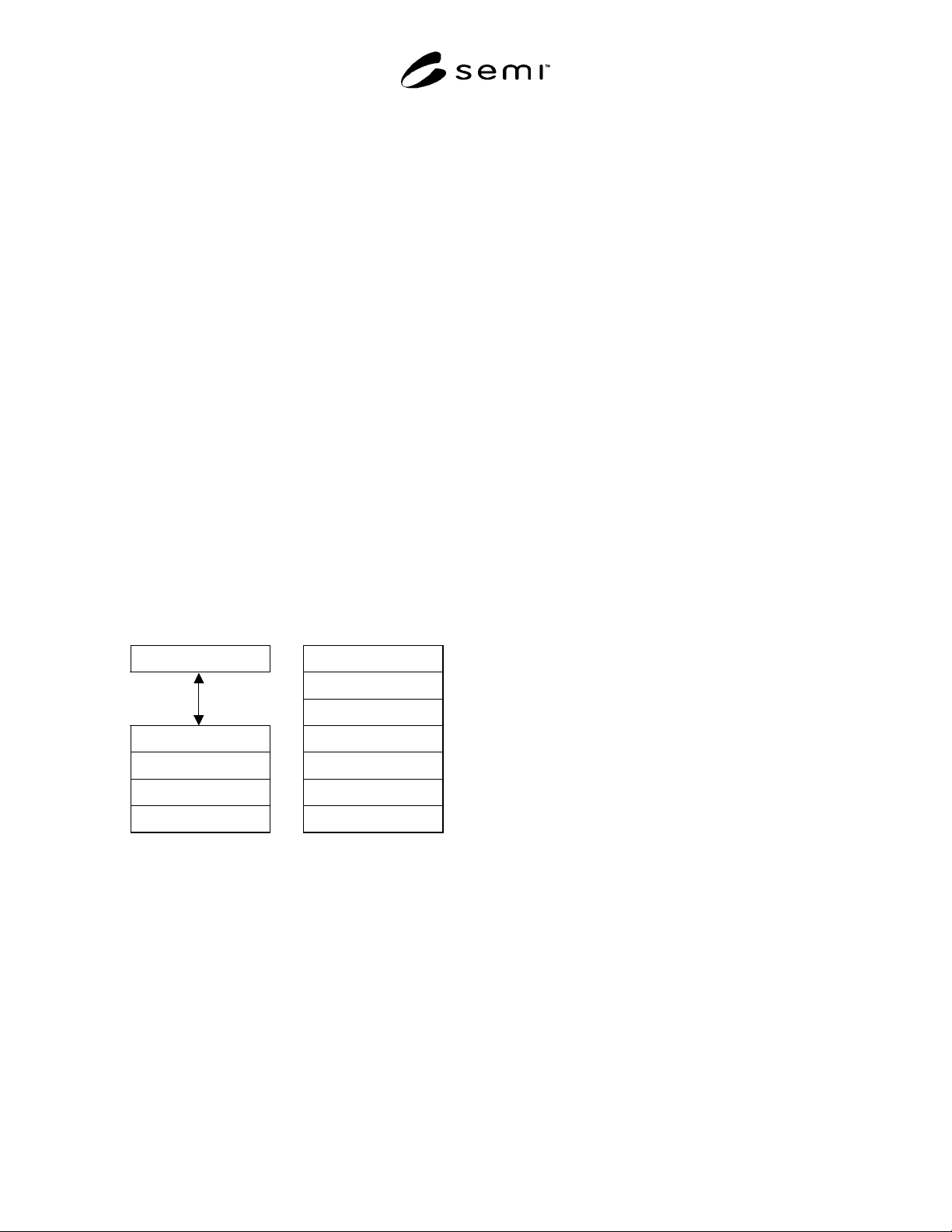
6.1 The Modbus/TCP protocol over TCP/IP is loosely
based on a five-layer architecture. These layers
constitute a collapsed form of the OSI seven layer
architecture, mapping into the physical, data link,
network, transport, and application layers of the
Reference Model. This section has been formatted to be
aligned with the Basic Reference Model for OSI. The
high-level protocol architecture is shown in Figure 1.
Application Layer Application Layer
Presentation Layer
Session Layer
Transport Layer Transport Layer
Network Layer Network Layer
Data Link Layer Data Link Layer
Physical Layer Physical Layer
Layered View of Modbus/TCP
OSI Reference Model
Figure 1
Layered View of Modbus/TCP Over TCP/IP
NOTE 2: Figure 1 represents a conceptual view of the com-
munication device architecture. Conforming implementations
must implement the services defined in this specification at
each layer and must appear (from the network) to have
implemented this architecture, however, an internal modular
partitioning is not required. Implementations may sacrifice
modularity in order to achieve high performance.
6.1.1 The application layer is specified in the Modicon
Modbus Protocol Reference Guide and provides for the
definition of Modbus applications as a collection of
addressable objects. A subset of these objects may be
addressed over the network (as defined by the
implementation).
6.1.2 In the remainder of this section the protocol
structure is described in more detail in terms of the OSI
seven layer reference model, the object model
environment and network management specifications.
6.2 Physical Layer — The device shall comply with a
physical layer specification identified in the
Modbus/TCP specification. The recommended and
default Modbus/TCP physical layer is IEEE 802.3. If
an accepted physical layer specification other than
IEEE 802.3 is being used, this must be clearly specified
in product literature. Physical layer specification
includes physical signaling (levels and data rates),
transceivers, node isolation, media topology, cable
specifications, network connectors and taps, and power
considerations (load limits, system tolerances, and
power supply options).
6.3 Data Link Layer — The device shall comply with a
data link layer specification of the Modbus/TCP
specification. The recommended and default Modbus/
TCP data link layer is IEEE 802.3. If an accepted data
link layer specification other than IEEE 802.3 is being
used, this must be clearly specified in product literature.
Data link layer specification includes the media access
control mechanism and the logical link control
mechanism.
6.4 Network Layer — The device shall comply with a
network layer specification of the Modbus/TCP specifi-
cation. This specification is the IP or Internet Protocol
as defined in the Modbus/TCP standard specification.
The network layer specification includes network
routing and internetworking.
6.5 Transport (Messaging) Layer — The device shall
comply with the Modbus/TCP standard specification
for the Transport Layer. This specification is the
Transmission Control Protocol as defined in the
Modbus/TCP standard specification. The transport
layer provides transparent transfer of data between
objects in application-entities. Some of the functionality
of this layer is implemented in the Application Layer.
Specific functions include: object data segmentation/re-
assembly (fragmentation) for full message delivery.
6.6 Session Layer — There is no distinct session layer.
6.7 Presentation Layer — There is no distinct
presentation layer. Object addressing and data
presentation in Modbus messages are specified as part
of the Modbus object definitions and object attribute
and service communication protocol. Data byte
transmission ordering is defined in IP RFC 791,
Appendix B.