semi合集-English.pdf - 第7100页
SEMI S20-0303 © SEMI 2003 9 RELATED INFORMATION 3 EXAMPLE OF A LOTO EID DIFFERENTIATION MARKING NOTICE : This R elated Information i s not an official part of SEMI S 20 and was derived from task force activity and indivi…
SEMI S20-0303 © SEMI 2003 8
RELATED INFORMATION 2
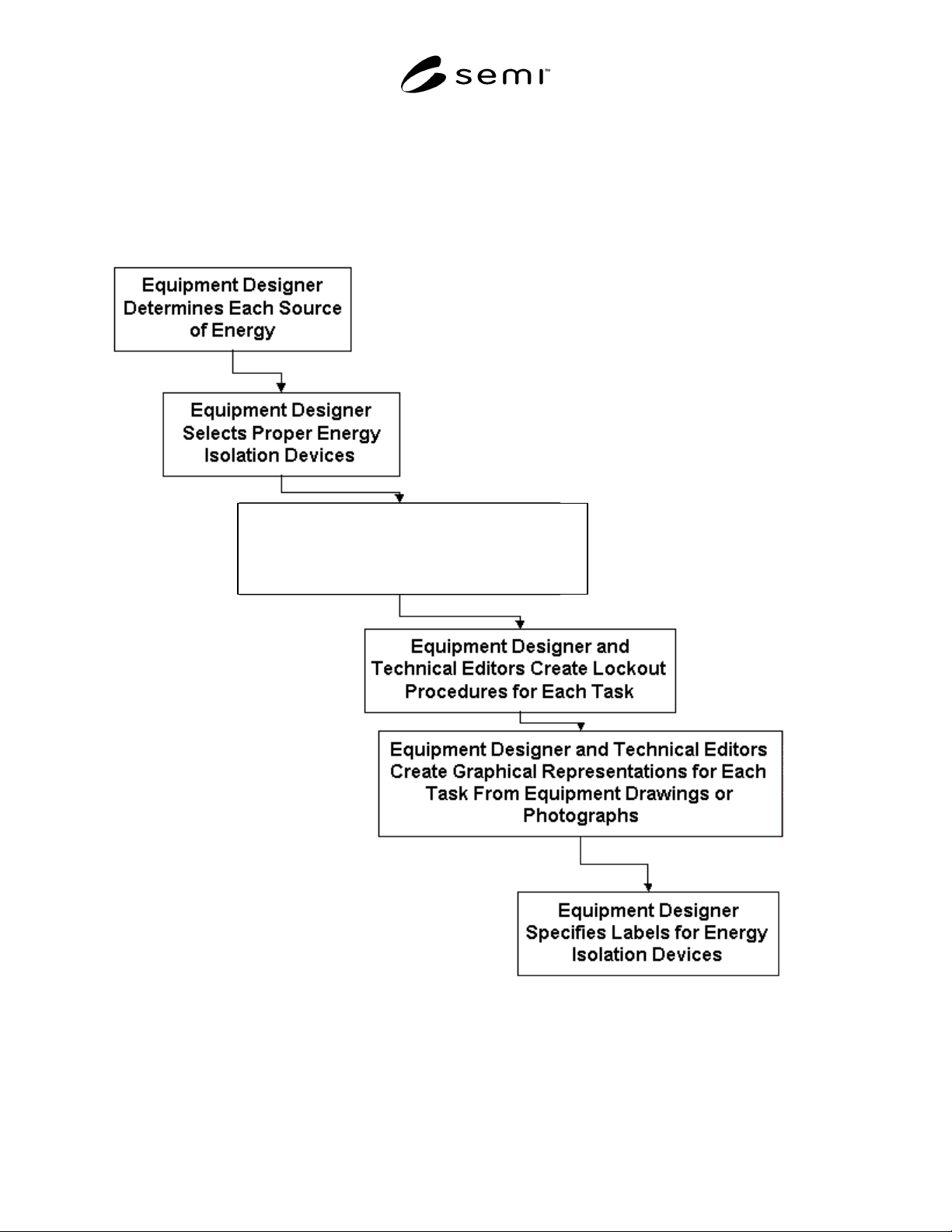
EXAMPLE FLOW FOR HAZARDOUS ENERGY CONTROL DESIGN
NOTICE: This Related Information is not an official part of SEMI S20 but was derived from task force activity.
This related information was approved for publication by inclusion in the ballot and by vote of the SEMI Standards
EHS Committee. It is included to assist the user of the document in understanding what the graphical
representations should provide in the way of information and location identification.
Equipment Designer Specifies Which
Lockout Devices are Necessary for
Energy Control for Each Task
Figure R2-1
Flow Chart for HEC Design and Graphical Representation Generation

SEMI S20-0303 © SEMI 2003 9
RELATED INFORMATION 3
EXAMPLE OF A LOTO EID DIFFERENTIATION MARKING
NOTICE: This Related Information is not an official part of SEMI S20 and was derived from task force activity and
individual task force participants. This related information was approved for publication by inclusion in the ballot
and by vote of the SEMI Standards EHS Committee. It is included to assist the user of the document in
understanding what the graphical representations should provide in the way of information and location
identification.
R3-1 Differentiation Marking
R3-1.1 In addition to a unique identifier, it may be beneficial to differentiate LOTO EIDs from non-LOTO EIDs
by using the following symbol. This symbol may be on or adjacent to, or combined with the unique identifier
marking for that specific LOTO EID.
R3-1.2 SEMI S8 provides guidance for sizing of this differentiation symbol so it will be readable from the normal
viewpoint of a person’s access to the LOTO EID.
R3-1.3 Where LOTO EIDs are located behind a panel, it is useful to mark the exterior of the panel in order to
indicate the path of access to the LOTO EID or approximately where the EID is hidden.
NOTICE: SEMI makes no warranties or representations as to the suitability of the guidelines set forth herein for
any particular application. The determination of the suitability of the guideline is solely the responsibility of the
user. Users are cautioned to refer to supplier’s instructions, product labels, product data sheets, and other relevant
literature respecting any materials mentioned herein. These guidelines are subject to change without notice.
By publication of this standard, SEMI takes no position respecting the validity of any patent rights or copyrights
asserted in connection with any item mentioned in this standard. Users of this standard are expressly advised that
determination of any such patent rights or copyrights, and the risk of infringement of such rights, are entirely their
own responsibility.
Copyright by SEMI® (Semiconductor Equipment and Materials
International), 3081 Zanker Road, San Jose, CA 95134. Reproduction o
f
the contents in whole or in part is forbidden without express written
consent of SEMI.

SEMI S21-1103 © SEMI 2003 1
SEMI S21-1103
SAFETY GUIDELINE FOR WORKER PROTECTION
This safety guideline was technically approved by the Global Environmental, Health, & Safety Committee
and is the direct responsibility of the Japanese Environmental, Health, & Safety Committee. Current edition
approved by the Japanese Regional Standards Committee on August 8, 2003. Initially available at
www.semi.org October 2003; to be published November 2003.
1 Purpose
1.1 This safety guideline identifies preferred methods
for the protection of persons from safety and health
hazards as they perform work on or around
semiconductor manufacturing equipment.
2 Scope
2.1 This guideline describes methods for protection
against hazards that workers may encounter in the work
area, such as hazardous energies, physical hazards, or
hazardous chemicals.
2.2 This guideline is intended to recommend
considerations for protecting all persons that work on or
around semiconductor equipment.
2.3 This guideline applies to equipment suppliers and
users of equipment, including activities related to
semiconductor manufacturing, and equipment and
process development activities.
2.4 This guideline includes the following sections:
1 Purpose
2 Scope
3 Limitations
4 Referenced Standards
5 Terminology
6 General Worker Safety
7 Chemical Hazards
8 Control of Hazardous Energy
9 EEW at Hazardous Voltage or Energy Levels
10 Radiation-Producing Equipment
11 Physical Hazards
12 Personal Protective Equipment
13 Emergency Preparation and Managing
Abnormal Situations
NOTICE: This safety guideline does not purport to
address all of the safety issues associated with its use.
It is the responsibility of the users of this safety
guideline to establish appropriate safety and health
practices and determine the applicability of regulatory
or other limitations prior to use.
3 Limitations
3.1 This guideline is intended to be used by the
equipment suppliers and users in consideration of
worker protection. This guideline is not intended to be
all-inclusive or used to verify conformance to any
regulatory requirements.
3.2 Equipment design criteria are outside the scope of
this document.
4 Referenced Standards
4.1 SEMI Standards
SEMI F34 — Guide for Liquid Chemical Pipe Labeling
SEMI S2 — Environmental, Health, and Safety
Guidelines for Semiconductor Manufacturing
Equipment
SEMI S8 Safety Guidelines for Ergonomics
Engineering of Semiconductor Manufacturing
Equipment
SEMI S13 Safety Guideline for Operation and
Maintenance Manuals Used with Semiconductor
Manufacturing Equipment
SEMI S19 — Safety Guideline for Training of
Semiconductor Manufacturing Equipment Installation,
Maintenance and Service Personnel
4.2 ANSI Standards
1
ANSI B 11.21 — Machine Tools - Machine Tools
Using Lasers for Processing Materials - Safety
Requirements for Design, Construction, Care, and Use
ANSI Z136.1 — Safe Use of Lasers
ANSI/NFPA 70E Standard for Electrical Safety
Requirements for Employee Workplaces 2000 Edition
1 American National Standards Institute, New York Office: 11 West
42nd Street, New York, NY 10036, USA. Telephone: 212.642.4900;
Fax: 212.398.0023 Website: www.ansi.org