semi合集-English.pdf - 第7602页
SEMI T1-95 © SEMI 1993, 2003 3 7.2 The dimensions gi ven in Tabl e 5 are those found on the finished wafer, reg ardless of where in the process the wafer is marked. 7.3 These dimensions are derive d with the assumption t…

SEMI T1-95 © SEMI 1993, 2003 2
3.1.8 bi-directional bar code symbol — a bar code
symbol capable of being read successfully, either by
scanning from right to left or from left to right.
3.1.9 character — of a bar code — a single group of
bars and spaces that together represent an individual
numeral, letter, punctuation mark, or other symbol.
3.1.10 character set — the complete range of
characters available for encoding within a particular bar
code symbology.
3.1.11 check character — of a bar code symbol — a
character included within the symbol whose value is
used for the purpose of mathematical verification of the
accuracy of the read.
3.1.12 continuous code — a bar code symbol in which
all spaces within the symbol are parts of characters so
that there are no inter-character gaps.
3.1.13 element — of a bar code symbol — a single bar
or space.
3.1.14 module — of a bar code symbol — narrowest
element, bar, or space.
3.1.15 nominal width — of a bar code element — the
average width of each size element.
3.1.16 quiet zone — of a bar code symbol — a clear
background area that precedes the start character and
follows the stop character of the symbol.
3.1.17 self-checking bar code symbol — a bar code
symbol that uses a checking algorithm that can be
applied against each character such that substitution
errors can only occur if two or more “printing” defects
appear within a single character.
3.1.18 self-clocking bar code symbol — a bar code
symbol in which the number of modules, bars, and
spaces is the same in each character.
3.1.19 space — in a bar code symbol — the more
reflective element of the symbol, usually formed by the
background between bars.
3.1.20 start/stop character — in a bar code symbol —
special characters that provide initial timing references
and direction-of-read information to the decoding logic.
3.1.21 start/stop character pattern — a special bar
code character that provides the scanner with start and
stop reading instructions as well as scanning direction.
The start character is at the left end of a BC-412 symbol
(position #2). The stop character is at the right end of
the symbol (position #11).
3.1.22 symbol — a combination of characters, inclu-
ding start/stop characters, quiet zones, data characters,
and check characters, required by a particular
symbology, which form a complete scannable entity.
4 Method of Marking
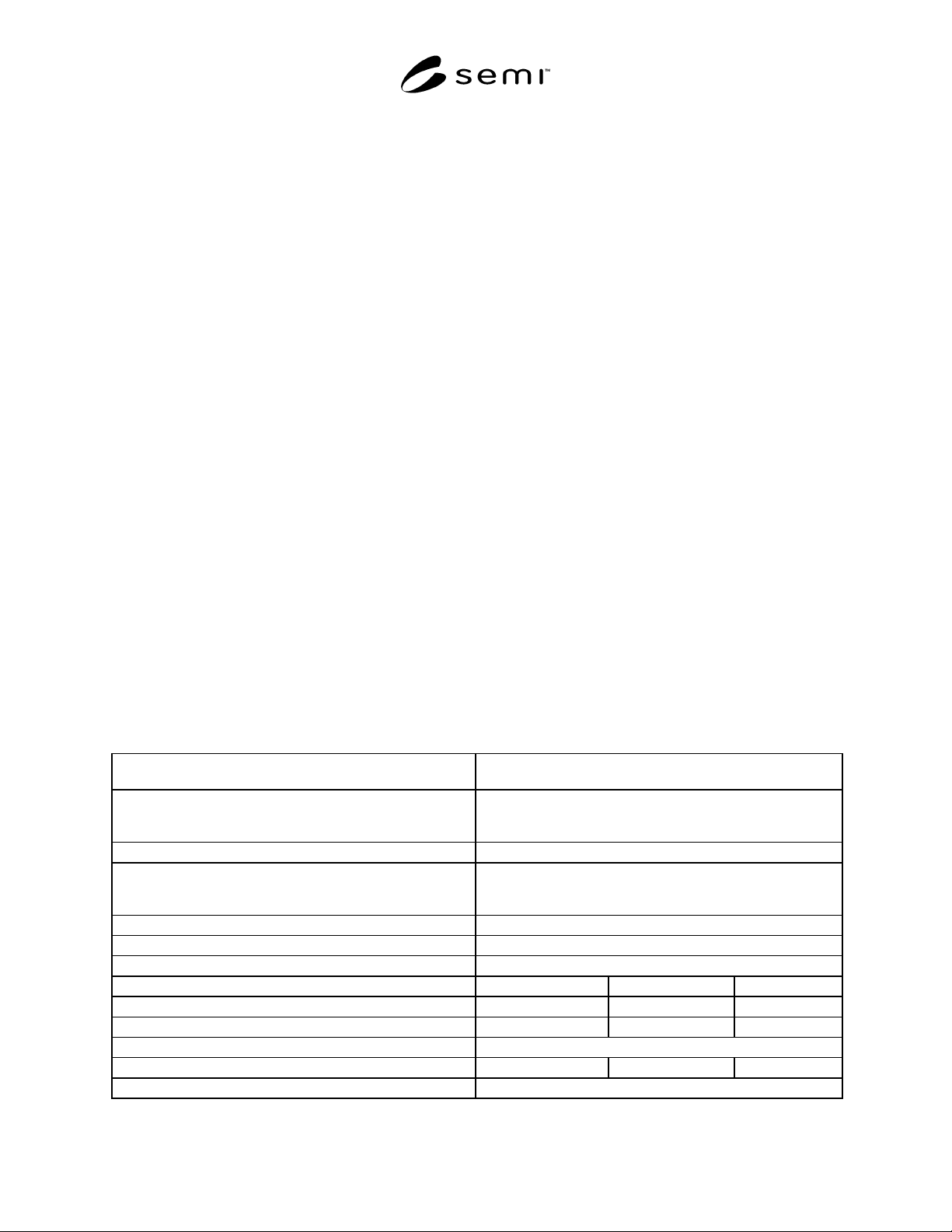
4.1 The dot matrix laser method shall be used to write
characters. The minimum bar matrix shall be 1 dot
horizontal and 11 dots/mm vertical as shown in Table 1
and Figure 1. The minimum matrix for alphanumeric
characters shall be as specified in SEMI M12. In either
case, more dots may be used, up to and including a
solid line.
5 BC-412 Code
1
5.1 Characteristics — BC-412 is a presence-absence
bar code symbology which uses an alphanumeric
character set as outlined in Table 2. The name BC-412
is derived from the method used to encode data
characters. Each data character is comprised of four
single-width bars incremented within 12 modules. The
code is a continuous code.
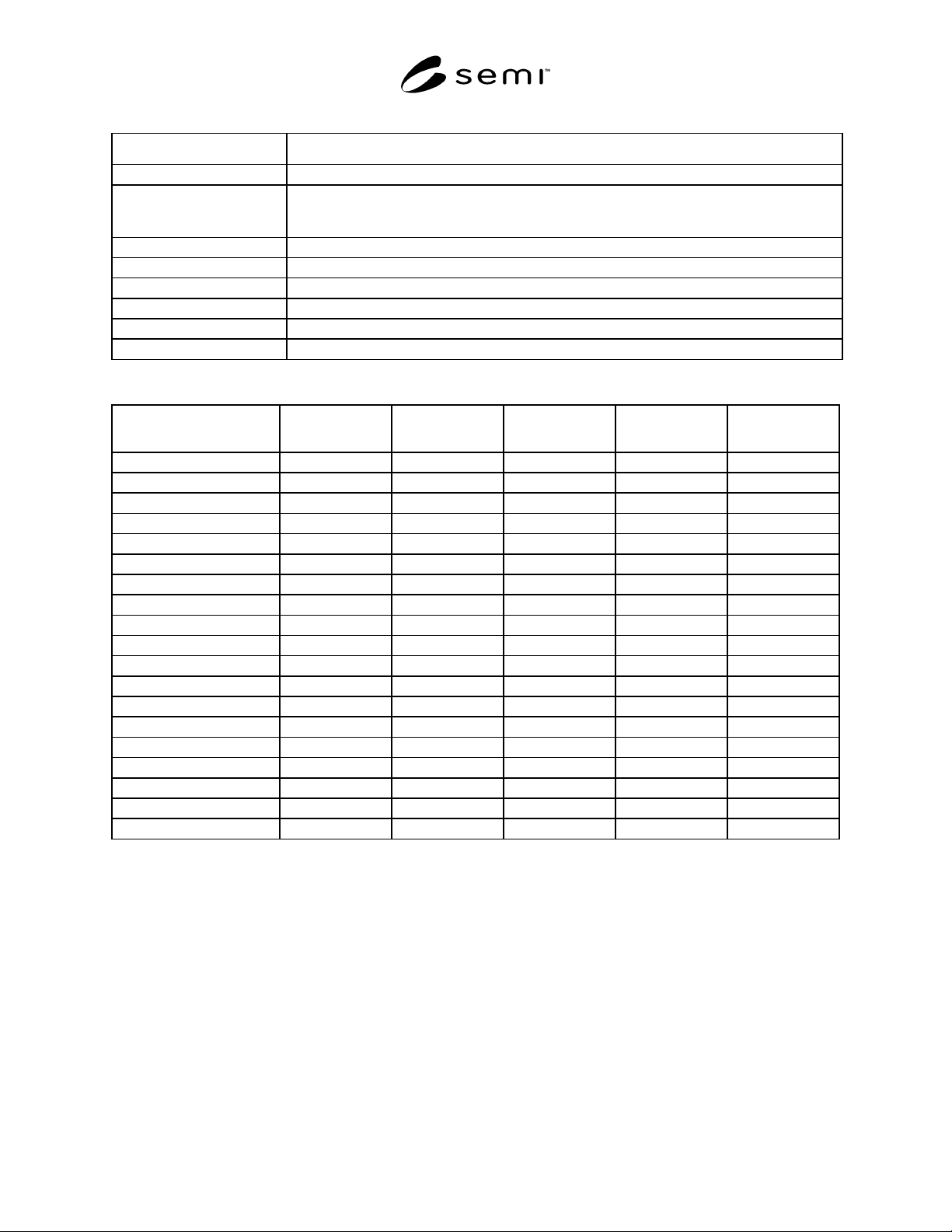
5.2 Character Set — The character set available for
marking wafers consists of the ten digits (0−9) and all
capital letters in the English alphabet except O as listed
in Table 3. In addition, there is a start character and a
stop character.
5.2.1 Character Construction and Value — The
module sequence and value for use in calculating the
check character are listed for each character in Table 3.
5.3 Symbol Content — All character count and content
in the wafer marking symbol are user-definable and
vary in number from 7 to 18. The checksum character
position is fixed.
6 Optional Alphanumeric Code
6.1 The optional alphanumeric symbol is variable and
user definable, and similar to existing SEMI standards
M12 and M13 with respect to font style.
6.2 The characters may be oriented with the bottom or
top of each character toward the primary fiducial user
definable.
6.3 The characters in the optional alphanumeric
symbol are those in position #3 through position #
(n + 2) of the BC-412 symbol (see Table 4).
7 Code Field Locations
7.1 The code field locations for flatted and notched
wafers are specified in Figures 3 and 4, respectively.
Values of the dimensions for both cases are given in
Table 5.
1 IBM Corporation, 2000 Purchase Street, Purchase, NY 10577,
Director of Commercial Relations
SEMI T1-95 © SEMI 1993, 2003 3
7.2 The dimensions given in Table 5 are those found
on the finished wafer, regardless of where in the
process the wafer is marked.
7.3 These dimensions are derived with the assumption
that both the bar code and the optional alphanumeric
markings are placed on the wafer without realignment
of the wafer.
7.4 The code field locations are defined by the limits of
the bar code elements and the optional alphanumeric
characters. Character dimensions are from centerline to
centerline of the extreme features of the character.
8 Definition of the Error-Detecting Method
8.1 Define the following symbols:
CD = Check character
i = Position of a data character within
a string from left to right, i ≥1
CV(i) = Character value of i (Table 4)
F
o
= Mod
35
CV(i)
i =odd∑
()
F
e
= Mod
35
CV(i)
i =even∑
()
F = Mod
35
F
o
+ 2F
e
()
8.2 Compute the check character:
8.2.1 Assign the value “0” to the check character
(position #4, second character in string).
8.2.2 Calculate F
o
and F
e
.
8.2.3 Calculate F.
8.2.4 Calculate CD as Mod
35
(17 × F).
8.3 Verification
8.3.1 Recalculate F
e
and F
o
with the value of CD found
in Section 8.2.4 to the second character in the string
(position #4).
8.3.2 Calculate F.
8.3.3 If F = 0, the check character is correct.
8.4 As an example, calculate the check character for
A_Q45670 as follows:
8.4.1 Write the code as A0Q45670.
8.4.2 Calculate F
o
, F
e
, and F:
F
o
=
Mo
d
35
(A(i) + Q(i) + 5(i) + 7(i)) =
F
o
= Mod
35
(7 + 18 + 33 + 21) = Mod
35
(79) = 9
F
o
= Mod
35
(0 + 11 +19 + 0) = Mod
35
(30) = 30
F = Mod
35
(9 + 60) = Mod
35
(69) = 34
8.4.3 Calculate the value for CD:
CD = Mod
35
(17
×
34) = Mod
35
(578) =18
8.4.4 This corresponds to the character, Q, so the
symbol is now AQQ45670.
8.4.5 Verify that the check character in AQQ45670 is
correct as follows:
F
o
=
Mod
35
(A(i) + Q(i) + 5(i) + 7(i))
= Mod
35
(7 +18 + 33 + 21) = Mod
35
(79) = 9
F
e
= Mod
35
(Q(i) + 4(i) + 6(i) + 0(i))
= Mod
35
(18 + 11 + 19 + 0) = Mod
35
(48) =13
F = Mod
35
(F
o
+ 2F
e
)
= Mod
35
(9 + 26) = Mod
35
(35) = 0
Table 1 Character Dimensions (see Figure 1)
Module Height
(dot centerline to dot centerline)
2.000 mm ± 0.025 mm (0.0790" ± 0.0010")
Bar Code Character Spacing
(centerline to centerline, non-cumulative within the Symbol
Length [see Table 2])
1.440 mm ± 0.025 mm (0.0570" ± 0.0010")
Mark Width 0.110 mm ± 0.025 mm (0.0043" ± 0.0010")
Module Spacing
(centerline to centerline, non-cumulative within the Character
Spacing [see above])
0.120 mm ± 0.025 mm (0.0047" ± 0.0010")
Scribing Features: Scribing Features:
Density of dots along module length 11 dots/mm, minimum
Number of dots per module width 1 dot per module width
Character Construction: # of Bars # of Spaces Modules
Data Character 4 8 12
Start Character 1 2 3
Start Character Dimension 0.360 mm ± 0.025 mm (0.0140" ± 0.0010")
Stop Character 2 1 3
Stop Character Dimension 0.360 mm ± 0.025 mm (0.0140" ± 0.0010")
SEMI T1-95 © SEMI 1993, 2003 4
Table 2 Characteristics of BC-412 Bar Code
Encodable Character Set Alphanumeric (except O) with No Non-Numeric or Non-Alphabetic Characters (see Table 3)
Code Type Continuous
Symbol Length Variable: for this application, symbol can be formed from 13.200 mm ± 0.050 mm (0.5760" ±
0.020") including the Quiet Zones, to 29.040 mm ± 0.050 mm (1.1400" ± 0.0020") including the
Quiet Zones.
Bi-Directional Decoding Yes
Number of Check Characters One
Character Self Checking Yes
Character Self Clocking Yes
Character Dimensions See Table 1 and Figure 1.
Non-Data Overhead Six Modules
Table 3 BC 412 Code — Character Construction and Values
Character
Module Sequence
Check Character
Value
Character
Module Sequence
Check Character
Value
0 |-|-|-|----- 00 I |--|-|----|- 27
1 |-|-|--|---- 15 J |--|--|-|--- 16
2 |-|-|---|--- 17 K |--|--|--|-- 24
3 |-|-|----|-- 29 L |--|--|---|- 04
4 |-|-|-----|- 11 M |--|---|-|-- 34
5 |-|--|-|---- 33 N |--|---|--|- 12
6 |-|--|--|--- 19 O
7 |-|--|---|-- 21 P |--|----|-|- 32
8 |-|--|----|- 08 Q |---|-|-|--- 18
9 |-|---|-|--- 02 R |---|-|--|-- 01
A |-|---|--|-- 07 S |---|-|---|- 14
B |-|---|---|- 25 T |---|--|-|-- 13
C |-|----|-|-- 20 U |---|--|--|- 26
D |-|----|--|- 22 V |---|---|-|- 05
E |-|-----|-|- 09 W |----|-|-|-- 31
F |--|-|-|---- 30 X |----|-|--|- 28
G |--|-|--|--- 03 Y |----|--|-|- 23
H |--|-|---|-- 06 Z |-----|-|-|- 10
Start |-- Stop |-|
Legend: |=one bar; -=one module blank (no bar)