semi合集-English.pdf - 第1916页
SEMI E54.1-1000 © SEMI 1996, 2000 22 7.3.2.9 Lock (Option al) — T his serv ic e is used to restrict network access to all READ only attributes of all objects of th i s dev ice. This service gu arantee s th a t the R E AD…
SEMI E54.1-1000 © SEMI 1996, 200021
GetAttribute Service Message Definition Table*
Parameter Req/Ind Rsp/Conf Description
AttributeID M C**, = Attribute Identifier of attribute whose value is being requested. Inclusion
of attribute in Rsp/Conf. is optional.
AttributeValue — M Value of attribute requested.
* See Section 6.4.3 for a further description of terminology used in this table.
** The determination of whether Attribute ID is supplied in the service response/confirm is outside the scope of this document.
7.3.2.5 SetAttribute (Service Identifier: DmS5) — Used to modify a DM object attribute.
Set_Attribute Service Message Definition Table*
Parameter Req/Ind Rsp/Conf Description
AttributeID M C, = Attribute Identifier of attribute whose value is to be modified. Inclusion
of Attribute in Rsp/Conf. is optional.
AttributeValue M C Value to which the attribute is to be modified. Inclusion of Attribute in
Rsp/Conf. is optional. Conditions under which the value may differ from
that supplied in the associated Req/Ind. message (e.g., negative response)
are not defined in this document.
* See Section 6.4.3 for a further description of terminology used in this table.
7.3.2.6 Execute (Service Identifier: DmS6) — Used to move the DM object from its IDLE state to its EXECUTING
state. Note that this service may be internally generated by the DM object. There are no parameters specified for this
service.
7.3.2.7 PerformDiagnostics (Service Identifier: DmS7) — Used to instruct the DM object to perform a diagnostic
test. A diagnostic test is either of type “common” or “device-dependent.” “Common” diagnostic tests could include:
RAM, EPROM, non-volatile memory, and communications. The structure of “common” type diagnostic tests is
implementation-specific. All detail of “device-dependent” diagnostics is outside the scope of this document. The
following table describes parameters specified for this service.
Perform_Diagnostics Service Message Definition Table*
Parameter Req/Ind Rsp/Conf Description
TestID M C, = Indicates the type and possibly detail of the test to be performed.
* See Section 6.4.3 for a further description of terminology used in this table.
Additional services and/or service parameters that are device-specific and/or implementation-specific may be
provided by a DM object. These services may be Notification or Request type services (see Section 6.4.1). A
complete definition of additional services and service parameters that are device-specific may be found in an
appropriate sensor/actuator network specific device model specification.
7.3.2.8 PublishAttribute (Optional — Service Identifier: DmS8) — Used to proactively communicate a DM object
attribute. The following table describes parameters specified for this service.
PublishAttribute Service Message Definition Table*
Parameter Ind Description
AttributeID M Attribute Identifier of attribute whose value is being reported.
AttributeValue M Value of attribute being reported.
* The utilization of a service response message and its format is outside the scope of this document.
SEMI E54.1-1000 © SEMI 1996, 2000 22
7.3.2.9 Lock (Optional) — This service is used to restrict network access to all READ only attributes of all objects
of this device. This service guarantees that the READ only attributes of this device are not modified over the
network. There are no parameters specified for this service.
7.3.2.10 Unlock (Optional) — This service is used to make READ only attributes of objects of this device
modifiable over the network. Not only is support of this object optional, but the degree to which it is supported is
also specified by the manufacturer (i.e., only some attributes may become “unlocked”). Table 25 describes the
parameters specified for this service.
Table 25 DM Object Unlock Parameter Definitions
Parameter Request/
Indication
Response/
Confirmation
Form Description
Password Key C C Manufacturer-
Specific
Password may be specified to restrict access or to
provide a manufacturer-specified security scheme.
7.3.2.11 GetExceptionQueue (Optional) — This service is used to read all or portions of the AlarmQueue and
WarningQueue elements. Table 26 describes the parameters specified for this service.
Table 26 DM Object GetExceptionQueue Parameter Definitions
Parameter Request/
Indication
Response/
Confirmation
Form Description
ExceptionType M C**, = Byte, enumerated0 = Alarm1 =
Warning
Used to indicate which exception queue is being
queried.
ElementNumb M M unsigned integer < 65,536 Used to indicate the number of Exception queue
events to be returned with the service response. A
zero value implies that all elements in the queue
should be returned.
ExceptionList — M List of elements; element data
type.
Dependent on the Reporting
Mode (Basic or Expanded —
See Sections 7.3.1.12, 7.3.1.19,
7.3.1.20, and 7.3.3).
An array of exception queue events of size
ElemNumb returned with the response.
Clear M C Boolean Used to indicate whether or not the exceptions are
to be removed from the exception queue upon
reporting.
7.3.2.12 ClearExceptionQueue (Optional) — This service is used to clear all elements out of either the
AlarmQueue or WarningQueue. Table 27 describes the parameters specified for this service. If the ExceptionType
attribute is set to 0, 1, or 2 with the service request, the Alarm, Warning, or both queues respectively are cleared
completely of their members.
Table 27 DM Object Clear ExceptionQueue Parameter Definitions
Parameter Request/
Indication
Response/
Confirmation
Form Description
ExceptionType M C**, = Byte,
enumerated
0 = Alarm
1 = Warning
2 = Both
Used to indicate which exception queue(s) is/are to be
cleared.
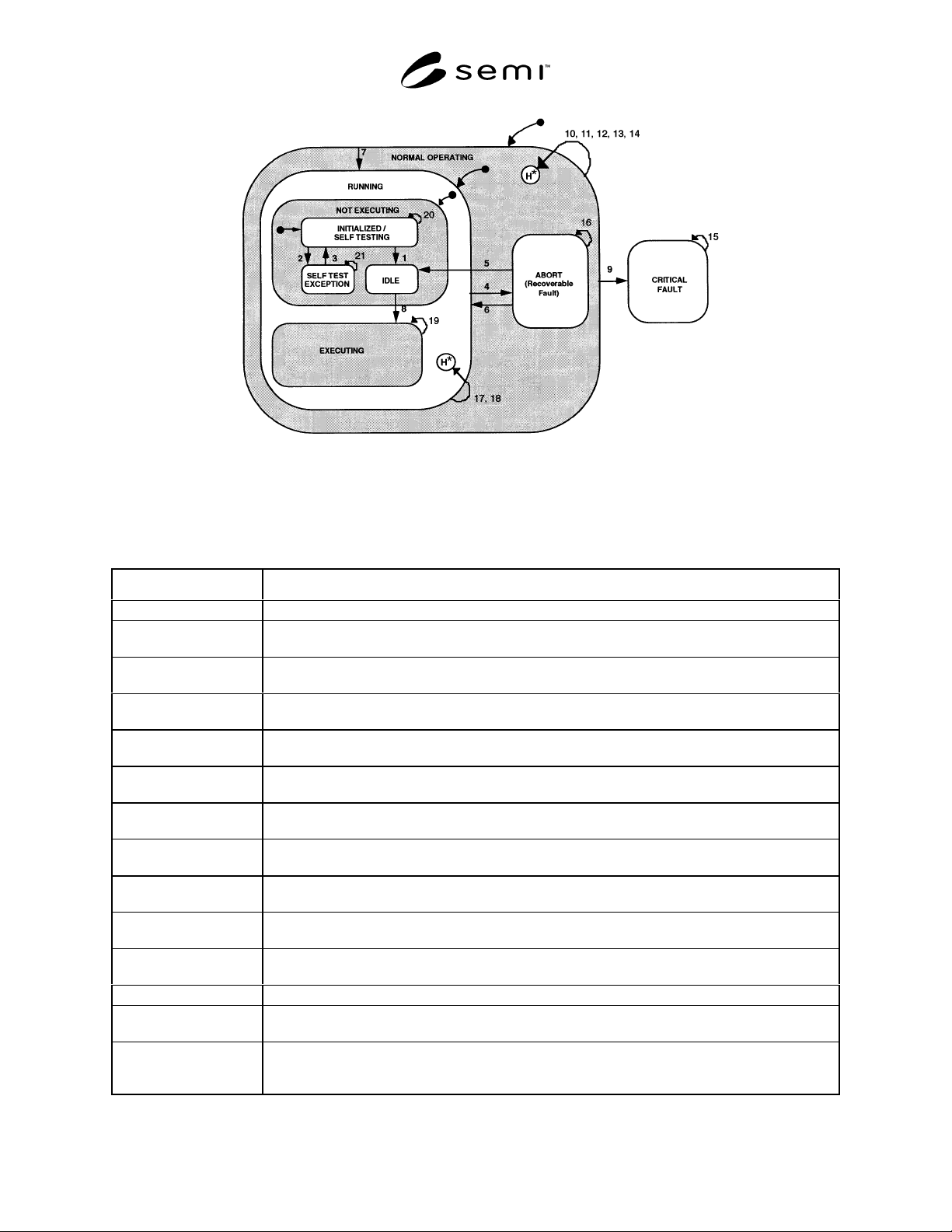
7.3.3 DM Object Behavior — The DM object behavior is illustrated in Figure 6 and in Tables 28 and 29.
SEMI E54.1-1000 © SEMI 1996, 200023
Figure 6
DM Object Instance Behavior*
*Transitions 10 through 21 are recursive (i.e., the New State is the same as the Current State (including all nested sub-states)).
Table 28 DM Instance Behavior State Description
State Description
NORMAL OPERATING Object instance exists. Object services can be processed.
RUNNING This is the entry sub-state to NORMAL OPERATING. Object instance is not in an aborted state.
Object is capable of reporting attribute values, including exceptions.
NOT EXECUTING Device is not executing (e.g., it is not performing its device-specific function). A detailed description
of this state is outside the scope of this document.
This state may be further specified in an appropriate sensor/actuator network specific device model
specification.
EXECUTING Device is executing (e.g., it is performing its device-specific function). A detailed description of this
state is outside the scope of this document.
This state may be further specified in an appropriate sensor/actuator network specific device model
specification.
INITIALIZED/SELF
TESTING
This is the entry sub-state to NORMAL OPERATING and RUNNING.
Object instance exists and has been initialized; all attributes have appropriate initial values(as
indicated herein and in an appropriate sensor/actuator network specific device model specification).
Device is performing device-specific and device type-specific tests to determine if it is qualified to be
running.
Note that as this is a sub-state of RUNNING, object is not initialized unless it is capable of reporting
attribute values, including exceptions.
SELF TEST
EXCEPTION
Object has detected an exception condition during self testing. The details of the exception are stored
in the appropriate attribute values of the DM object.
IDLE Object and device have been initialized and have successfully completed self testing.
ABORT Object instance is in an aborted state; a detailed description of this state is outside the scope of this
document. The object will not initiate communication over the network while in this state.
CRITICAL FAULT The object (and device) are in a fault state from which there is no recovery. Object services cannot be
processed. The conditions required for exit from a critical fault are outside the scope of this
document.