semi合集-English.pdf - 第6293页
SEMI G58-94 © SEMI 1994 8 NOTICE: T hese standards do n ot purport to address safety issues, if any, ass o ciated with their use. It is the responsibility of t he user of these standards to establish appropriate safety a…
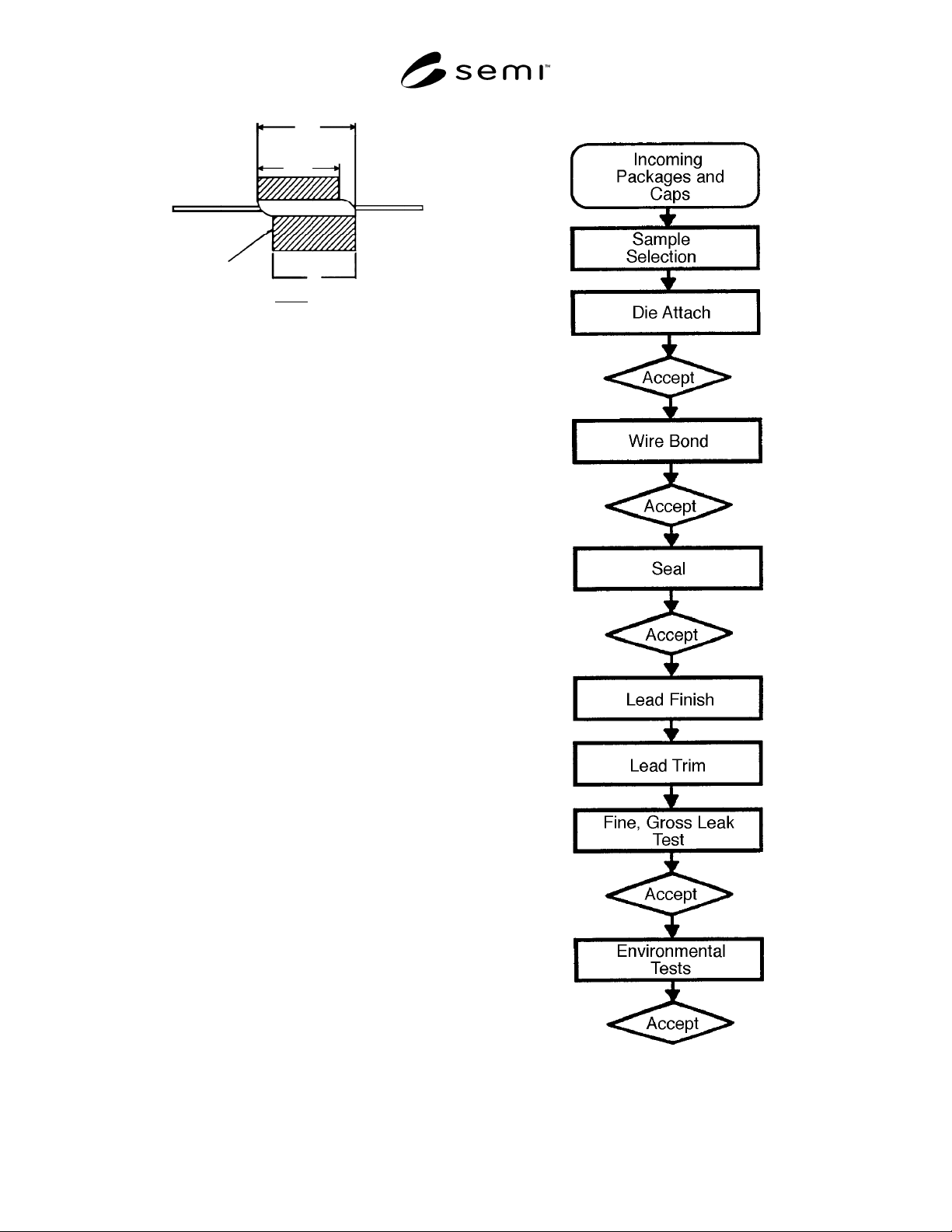
SEMI G58-94 © SEMI 19947
ENV
S
window frame
base
L
ENV – L + Š .015
L – S
2
Figure 7
Figure 8

SEMI G58-94 © SEMI 1994 8
NOTICE: These standards do not purport to address
safety issues, if any, associated with their use. It is the
responsibility of the user of these standards to establish
appropriate safety and health practices and determine
the applicability of regulatory limitations prior to use.
SEMI makes no warranties or representations as to the
suitability of the standards set forth herein for any
particular application. The determination of the
suitability of the standard is solely the responsibility of
the user. Users are cautioned to refer to manufacturer’s
instructions, product labels, product data sheets, and
other relevant literature respecting any materials
mentioned herein. These standards are subject to
change without notice.
The user’s attention is called to the possibility that
compliance with this standard may require use of
copyrighted material or of an invention covered by
patent rights. By publication of this standard, SEMI
takes no position respecting the validity of any patent
rights or copyrights asserted in connection with any
item mentioned in this standard. Users of this standard
are expressly advised that determination of any such
patent rights or copyrights, and the risk of infringement
of such rights, are entirely their responsibility.
Copyright by SEMI® (Semiconductor Equipment and Materials
International), 3081 Zanker Road, San Jose, CA 95134. Reproduction o
f
the contents in whole or in part is forbidden without express written
consent of SEMI.

SEMI G59-94 © SEMI ,1994, 2002 1
SEMI G59-94 (Reapproved 0302)
TEST METHOD FOR MEASUREMENT OF IONIC CONTAMINATION ON
LEADFRAME INTERLEAFING AND THE CONTAMINATION
TRANSFERRED FROM THE INTERLEAFING TO THE LEADFRAMES
This specification was technically approved by the Global Assembling and Packaging Committee and is the
direct responsibility of the Japanese Assembling and Packaging Committee. Current edition approved by the
Japanese Regional Standards Committee on November 26, 2001. Initially available at www.semi.org
December 2001; to be published March 2002. Originally published in 1994.
1 Purpose
1.1 This test method describes a procedure to
determine the ionic contamination on leadframe
interleafing and the contamination transferred from the
interleafing to the leadframes using a water extraction
method.
2 Scope
2.1 This test method is sensitive to the following ionic
species:
Na
+
, NH
4
+
, K
+
, Cl
-
, NO
3
-
, Br
-
, SO
4
2-
, PO
4
3-
.
2.2 This standard does not purport to address safety
issues, if any, associated with its use. It is the
responsibility of the users of this standard to establish
appropriate safety health practices and determine the
applicability or regulatory limitations prior to use.
3 Referenced Standards
3.1 ASTM Specifications
1
D 4327 — Anions in Water by Ion Chromatography
D 1193 — Specification for Reagent Water
4 Terminology
4.1 eluent — The solvent used to carry the extracted
ions through the ion exchange chromatograph.
4.2 interleaf (for semiconductor leadframes) — A
paper or plastic film which is placed between layers of
semiconductor leadframes strips to prevent tangling.
4.3 regenerant — A chemical solution containing the
ions originally present in the chromatograph column
prior to a test run, used to prepare the column for a new
test.
4.4 retention time — The time required for a particular
ion type to pass from the injection port to the detector.
1 American Society for Testing and Materials, 100 Barr Harbor
Drive, West Conshohocken, Pennsylvania 19428-2959, USA.
Telephone: 610.832.9585, Fax: 610.832.9555 Website:
www.astm.org
Retention time is characteristically different for each
ion type.
4.5 standard solution — A solution containing a
known concentration of the ion to be measured and
used to calibrate the chromatograph.
5 Summary of Method
Ionic contamination is extracted in water at > 95°C for
30 ± 2 minutes. The contamination is quantitatively
analyzed by ion type using ion chromatography, and the
result is presented as nanograms/unit area.
6 Significance
6.1 Contamination on the interleaf may contribute to
semiconductor device reliability problems by
transference of the contamination to the leadframes.
6.2 The method may be used by leadframe
manufacturers for the incoming inspection of the
interleafing material, or by users at incoming inspection
of the leadframes.
6.3 Correlation of device reliability results with
interleaf contamination level measurements may lead to
improved interleaf materials.
7 Interferences
7.1 The interleaf material and the leadframes must only
be touched with cleaned tweezers or while wearing
double-layer gloves with polyethylene outer gloves in
order to avoid additional contamination.
8 Equipment
8.1 Ion Chromatograph for Anion and Cation Analysis
— This equipment is to consist of a concentration
pump, guard column, separator column, and a detector
module.
The minimum sensitivity of the chromatograph for each
ion type is defined in Table 1.