semi合集-English.pdf - 第1597页
SEMI E37-0303 © SEM 1995, 2003 19 A1-3 HSMS Alterna ting Mode Connect Procedure Some users ha ve particular requi rements which preve nt them from determining which connect m ode (active or passive) a given entity will u…
SEMI E37-0303 © SEMI 1995, 2003 18
A1-2 HSMS Scenarios
The following scenarios are provided to illustrate the HSMS procedures as used for a typical complete session. The
terminology, procedure names, and message names are further explained in the remainder of this document. Also
note that either entity may initiate the HSMS Select procedure, the Deselect or Separate procedures, and HSMS Data
Messages and Transactions. For convenience, the scenarios show the left-hand entity as the initiator of all
transactions.
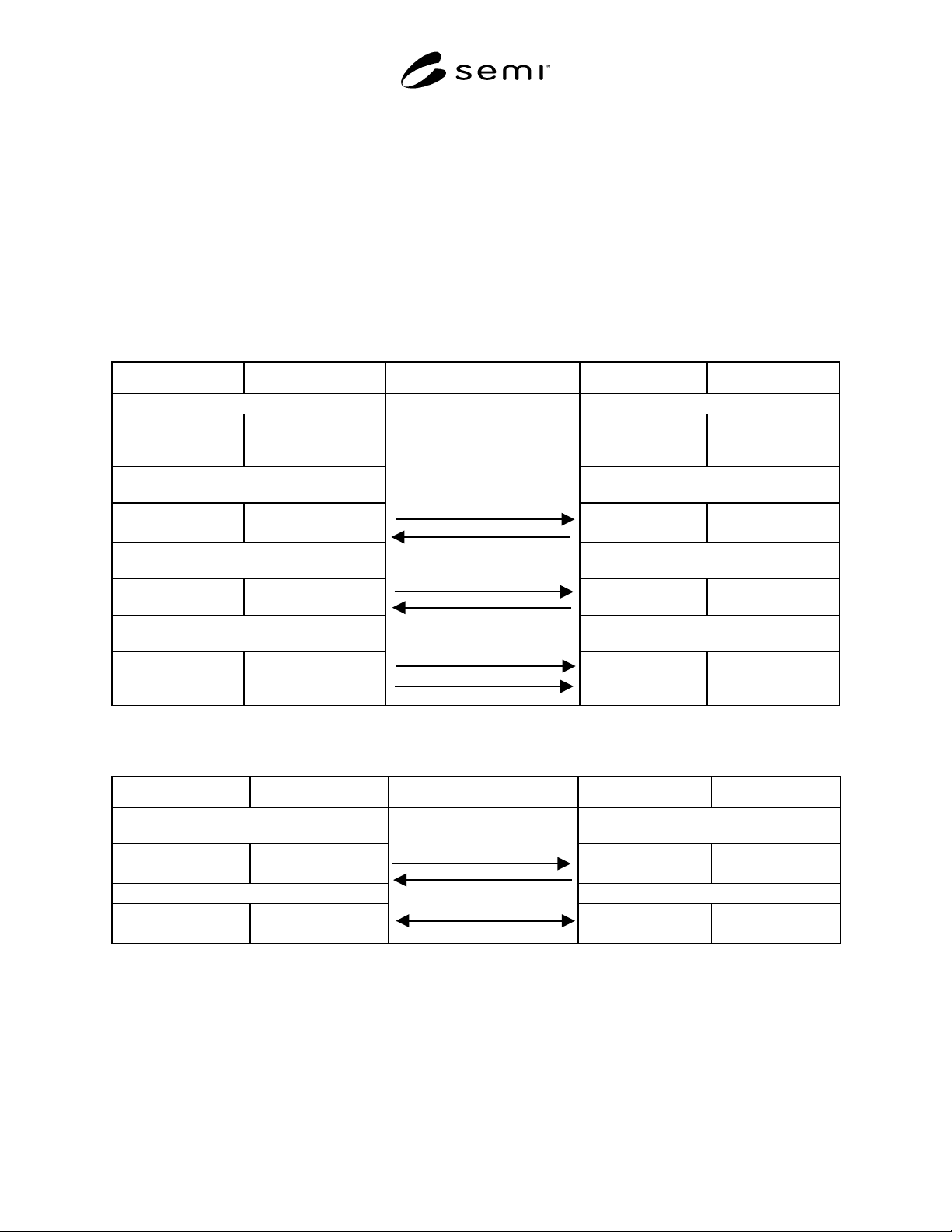
A1-2.1 Begin HSMS Communication — This scenario illustrates the TCP/IP connection procedure, an HSMS select
procedure, and exchange of data messages. Note that the data message activity for TCP is for illustrative purposes
only. In fact, the actual network activity can vary. For example, even if the data messages are sent as separate calls
to t_snd (or write) as shown, the TCP/IP implementation may buffer the header and transmit it in a single packet
with the text, or the text may be split into multiple packets.
Table 5
BSD API Calls TLI API Calls Network Activity TLI API Calls BSD API Calls
Prepare to initiate a connection request. Prepare to receive a connection request.
skt = socket(...); tep = t_open(...);
t_bind(tep, ...);
tep = t_open(...);
t_bind(tep,...);
skt =
socket(...);bind(skt,...);
listen(skt,...);
Initiate a connection request and wait fo
r
response.
Receive a connection request, accept it, and
send response.
connect(skt,...); t_connect(tep,...);
t_rcvconnect(tep,...);
t_listen(tep,...);t_acce
pt(tep,...);
accept(skt,...);
Initiate an HSMS Select procedure: sen
d
request and receive response.
Respond to HSMS select procedure: receive
request and send response.
write(skt,hdr,14);
read(skt,hdr,14);
t_snd(tep,hdr,14,0);
t_rcv(tep,hdr,14,...);
t_rcv(tep,hdr,14,...);
t_snd(tep,hdr,14,0);
read(skt,hdr,14);
write(skt,hdr,14);
Send an HSMS data message as length bytes
and header, followed by Text.
Receive an HSMS data message as length
bytes and header, followed by Text.
hdr->Len = Length;
write(skt,hdr,14);
write(skt,Text,...);
hdr->Len = Length;
t_snd(tep,hdr,14,0);
t_snd(tep,Text,...);
TCP/IP Connect Req Msg(s)
TCP/IP Accept Msg(s)
Select.req Message
Select.rsp Message
HSMS Data Message (hdr)
HSMS Data Message (text)
t_rcv(tep,hdr,14,...);
t_rcv(tep,Text,...);
read(skt,hdr,14);read(s
kt,Text,...);
A1-2.2 Ending Communicaiton Using Deselect — This scenario illustrates ending an HSMS Session using the
Deselect procedure to end the HSMS session.
BSD API Calls TLI API Calls Network Activity TLI API Calls BSD API Calls
Send the Deselct.req and receive Deselect.rsp. Receive the Deselect.req and send the
Deselect.rsp.
write(skt,hdr,14);
read(skt,hdr,14);
t_snd(tep,hdr,14,0);
t_rcv(tep,hdr,14,...);
t_rcv(tep,hdr,14,...);
t_snd(tep,hdr,14,0);
read(skt,hdr,14);
write(skt,hdr,14);
Disconnect the TCP/IP Connection. Respond to Disconnect of connection.
shutdown(skt,2);
close(skt);
t_snddis(tep;
t_close(tep);
Deselect.req Message
Deselect.rsp Message
TCP/IP Disconnect Msg(s)
t_rcvdis(tep,...); close(skt);

SEMI E37-0303 © SEM 1995, 2003 19
A1-3 HSMS Alternating Mode Connect
Procedure
Some users have particular requirements which prevent
them from determining which connect mode (active or
passive) a given entity will use at any particular time. In
such a case, a Local Entity alternately attempts the
active mode and passive mode connect procedure until
a connection is successfully established. Note that this
requires that local entity provide a published port when
in the passive phase. The general logic sequence at the
Alternating Local Entity is as follows:
1. Attempt an active connect procedure as described
in Section 6.3.3 using a timeout value for the
t_rcvconnect greater than or equal to the
connection separation timeout T5.
2. If the active connect procedure completes
successfully, the alternating mode connect
procedure completes successfully.
3. If the active connect procedure terminates
unsuccessfully, attempt the passive connect
procedure as described in 6.3.2 with the timeout for
the t_listen greater than or equal to the connection
separation timeout T5.
4. If the passive connect procedure completes
successfully, the alternating mode connect
procedure completes successfully as described in
6.3.2.
5. If the passive connect procedure terminates
unsuccessfully, the local entity may either return to
step 1 to continue the alternating mode procedure
or terminate unsuccessfully. The number of times
the above sequence of steps are repeated in
attempting to form a connection is a local entity-
specific issue.
A1-3.1 Alternating Mode Cycle Time — The
Alternating Mode Cycle Time is the time between
iterations of the Connect Procedure of an Alternating
Mode entity. In the above procedure, this corresponds
to the duration between the initiation of step 1 and
completion of step 5 immediately prior to the
reinitiation of step 1. This time is implementation-
dependent.
In the case that two entities are both using the
Alternating Mode Connect Procedure, it is desirable to
ensure that they both have different alternating mode
cycle times, to prevent the entities from attempting to
connect in lock step: both in active mode, then both in
passive mode. Adjusting the Alternating Mode Cycle
Time can be readily achieved by adjustment of T5 so
that the cycle time is different for the two entities:
A1-3.2 HSMS Connect Combinations — An entity
configured as alternating between active and passive
mode can connect with either an passive or active mode
remote entity. The list below summarizes the
combinations possible using the standard with this
particular connections strategy.
1. An Entity “A” configured as ACTIVE can connect
to an Entity “B” configured as PASSIVE or as
ALTERNATING, and Entity A always establishes
the Connection.
2. An Entity “A” configured as ALTERNATING can
connect to an Entity “B” configured as PASSIVE,
and Entity “A” always establishes the Connection.
3. An Entity “A” configured as ALTERNATING can
connect to an Entity “B” configured as
ALTERNATING, and either end can establish the
Connection. In implementations which use multi-
threaded connect logic, rather than the sequential
logic described in this document, it may be
possible that both ends of the HSMS connection
attempt to connect at the same time. In this case,
there can be two separate TCP/IP connections
established, and it is necessary to establish a
convention so that one connection is allowed to
remain and the other is terminated.
4. It is not allowed to connect two Entities both
configured as PASSIVE, or both configured as
ACTIVE.
A1-4 Non-HSMS TCP/IP Protocols
For typical TCP/IP implementations, HSMS can co-
exist with other TCP/IP based protocols on the same IP
Address. This can be very useful. For example, a
SECS-II message transaction could trigger an
application to begin a TCP/IP FTP (File Transfer
Protocol) sequence to transfer a large data file.
A1-5 Non-TCP/IP Protocols
The use of protocols other than TCP/IP on the same
network as the HSMS entities is possible but beyond
the scope of this standard. Typically, other protocols
could be used, provided they have no impact on TCP/IP
or HSMS entities on the network.
A1-6 Multiple LANs
The HSMS specification considers only a single
TCP/IP LAN. Interconnecting multiple LANs is outside
the scope of HSMS. However, since TCP/IP
implementations typically support such configurations
seamlessly through gateways, routers, and similar
entities, it may be possible to establish an HSMS
Connection across interconnected LAN’s.
SEMI E37-0303 © SEMI 1995, 2003 20
A1-7 TCP/IP Physical Layer
HSMS does not specify the physical layer of IP. Any
physical layer supported by TCP/IP can be used. Most
commonly, TCP/IP implementations use Ethernet
(IEEE 802.3) as the physical layer. However, some
TCP/IP implementations use other protocols (e.g.,
Token Bus, IEEE 802.4 and .5). To ensure
interoperability within a given installation, it may be
desirable to establish additional local standards for the
physical layer.
A1-8 Well-Known TCP/IP Port Numbers
Some TCP/IP-based protocols specify a particular
“Well Known” TCP Port Number, which is published
and is not available for other protocols. HSMS does not
specify a particular “Well Known” TCP Port Number,
but instead requires that it be configurable. The IETF
defines “Assigned Well Known Port Numbers” in RFC
1340.
A1-9 Delay between Disconnect and Re-
Connect
Some TCP/IP systems exhibit problems with
applications which terminate a connection and then
quickly re-connect, when using identical TCP ports on
both ends of the connection. When using such systems,
it may be advisable to delay after disconnect before re-
connecting. The delay time varies among TCP/IP
implementations, but typically can be calculated as
twice the “Maximum Segment Lifetime” or MSL. For
example, most TCP/IP systems based on BSD (e.g.,
Sun, AIX) use a MSL of 30 seconds, so a delay of 60
seconds would be appropriate. If rapid connects are
required, your application should use a different Port, if
allowed by the Connect Mode you are using. In some
TCP/IP systems, this problem does not occur.
A1-10 User-Defined Message Types
It is recognized that equipment suppliers may find it
desirable to develop additional features not found in the
base level HSMS or any defined subsidiary standards.
This will be the case during the testing and
development of any proposed new subsidiary standard.
User-defined extensions through new message types are
permissible as long as they are confined to intra-vendor
communication interfaces: any inter-vendor
communications interface which requires the use of
such extensions is considered to be noncompliant with
the HSMS standard.
If a supplier does deem it necessary to extend or
otherwise go outside the standard, the use of “reserved,
not used,” values of PType and SType may simplify
their implementation by permitting the reuse of the
HSMS implementation rather than the implementation
and use of a completely separate parallel standard. By
remaining within the “reserved, not used,” ranges for
SType and PType, the implementor can be assured that
future subsidiary standards which define new values for
SType and/or PType will not conflict with user-defined
extensions.
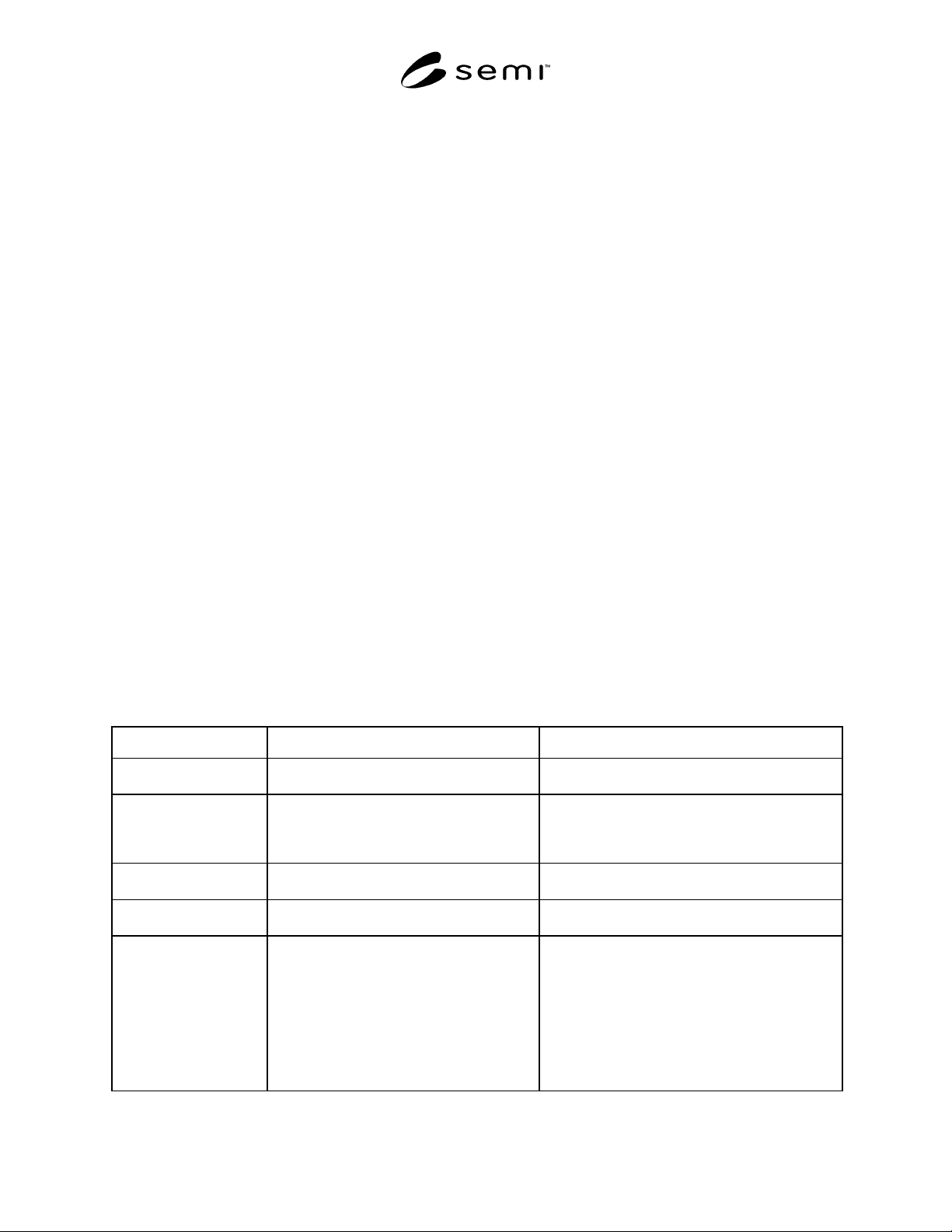
A1-11 Comparison of SECS-I and HSMS
The following table compares major features of SECS-I
and HSMS.
Feature SECS-I HSMS
Communications Protocol
Base
RS-232 TCP/IP
Physical Layer 25-pin connector and 4-wire serial cable Physical layer not defined. HSMS allows any
TCP/IP supported physical medium. Typical
example is Ethernet (IEEE 802.3) and thin coax (10-
BASE-2).
Communications Speed Typically about 1000 bytes/second (assuming
9600 baud).
Typically 10 MBits/second (assuming typical
Ethernet).
Connections One physical RS-232 cable per SECS-I
connection.
One physical network cable can support many
HSMS Connections.
Message Format Message text is SECS-II Data Items.
Transmits a SECS-II message as a series of
transmittal blocks each approximately 256
bytes in size. Each block has a one-byte block
length, a ten-byte Block Header, text, and a
two-byte Checksum.
Message Text is SECS-II Data Items.
Transmits a SECS-II message as a TCP/IP byte
stream. The message has a four-byte Message
Length, a ten-byte Message Header, and text. The
TCP/IP layer may impose blocking limits which
depend on the physical layer used, but this blocking
is transparent to the TCP/IP API and is outside the
scope of HSMS.