semi合集-English.pdf - 第2570页
SEMI E90-0705 © SEMI 1999, 2005 10 AT SOURCE AT DESTINA TION 1 AT W O RK 8 NEEDS PROCESSING PROC ESSING C OMPLE TE 10 IN PROCESS 14 SUBSTRA TE PROCESSED AB OR TE D REJEC TED C LOST STOPPED SKIPPED 4 NOT CONFIRMED WAITIN …

SEMI E90-0705 © SEMI 1999, 2005 9
SubstTypeList
SubstUsageList
8.5.3 As an example of how the variables are constructed for related state transitions, the value of SubstIDList shall
be the list of SubstID data items that identify the Substrate Objects related by the collection event.
8.6 Each Substrate Location Object instantiated on the equipment must maintain an independent instance of the
appropriate Substrate Location Object State Model. Each Substrate Location Object shall trigger a separate
collection event for each state transition. The data items defined in Table 16 are required to be valid for collection
events triggered by each state model transition.
8.7 Each Batch Location Object instantiated on the equipment must maintain an independent instance of the Batch
Location Object State Model. Each Batch Location Object shall trigger a separate collection event for each state
transition. The data items defined in Table 17 are required to be valid for collection events triggered by each state
model transition.
9 Substrate Object Definition
9.1 A substrate is a base upon which a product unit is built in the manufacturing equipment. Wafers and flat panel
displays are examples of substrates. A substrate may be associated with a lot, which the factory uses for tracking
purposes.
9.1.1 The substrate object shall be created when the substrate is registered by the equipment. There are two
possible ways of registering the substrate.
(1) The substrate is registered by the equipment when the information for the carrier containing the substrate is
registered. The information required to create a substrate object must be provided with the carrier. However, the
specification of carrier management services is outside the scope of this standard. Substrate Tracking
implementations shall be consistent with the Carrier Management standard. For instance, if the Carrier Management
standard specifies the method of identifying the substrates in a carrier, then Substrate Tracking shall recognize those
identifiers.
(2) The substrate is registered when the substrate is transferred directly (not in a carrier) to the equipment by the
Create service defined in SEMI E39 to inform the equipment of this event.
9.2 Substrate Object State Model
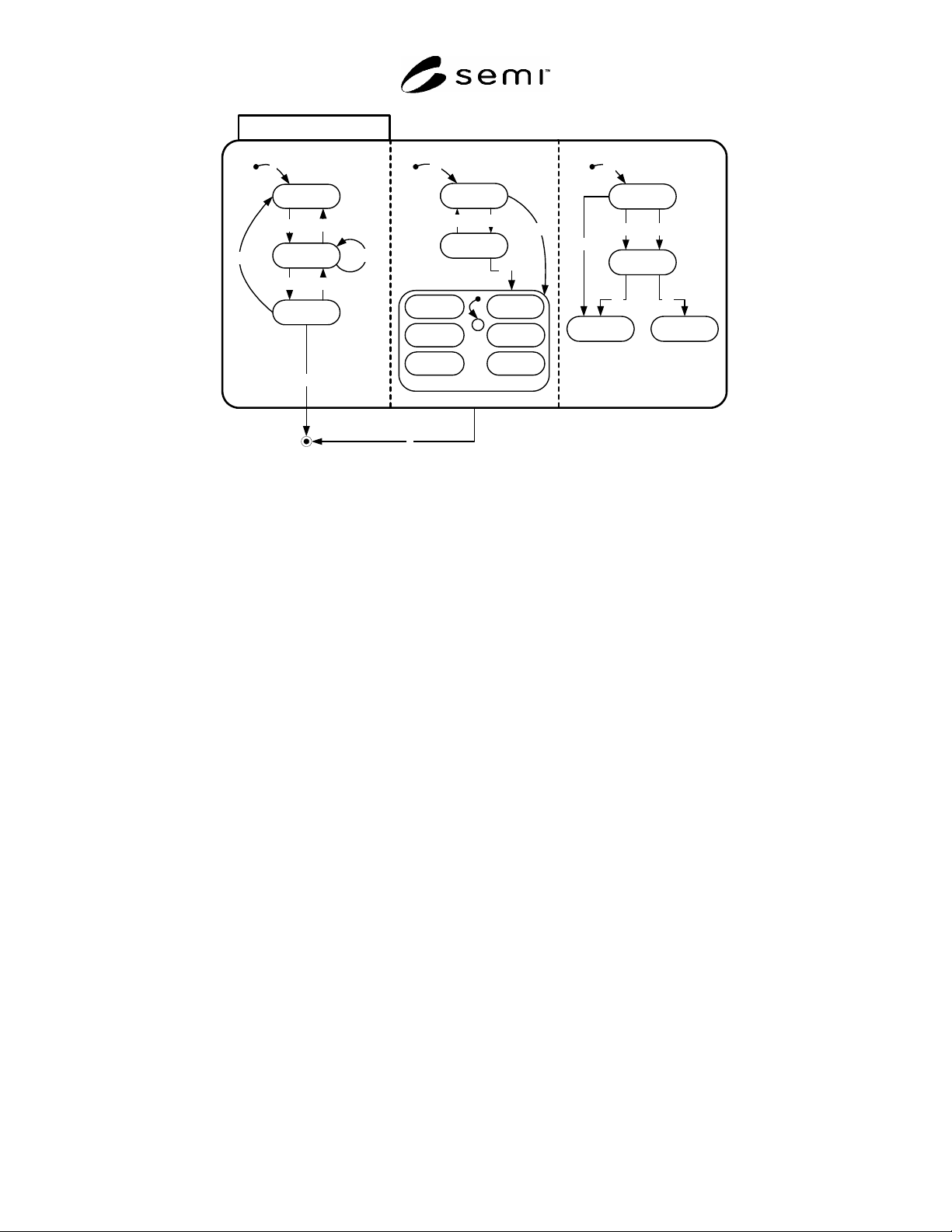
9.2.1 A substrate has both a state indicating where it is located and a state indicating the progress of processing.
These states are represented by the SUBSTRATE TRANSPORT and the SUBSTRATE PROCESSING states,
which are concurrent substates of the SUBSTRATE State Model shown in Figure 3.
9.2.2 If the equipment provides a mechanism for reading substrates, then, the equipment shall include a state model
in parallel with the Substrate Transport and Substrate Processing States called “Substrate Reading Status” See
Figure 3 and Table 1 for additional requirements.
9.3 Substrate Object State Definitions
9.3.1 ABORTED — The process has been aborted during the processing. The substrate will require special
treatment.
9.3.2 AT DESTINATION — The substrate has been placed at its designated destination substrate location. The
substrate may have been placed at a carrier substrate location when the carrier is used to unload the substrate from
the equipment, or at an equipment substrate location when the substrate is to be removed by itself from the
equipment.
9.3.3 AT SOURCE — The state which the substrate is originally received. The substrate is held at carrier substrate
location when a carrier is used to supply the substrate.
9.3.4 AT WORK — The substrate has been taken from the original substrate location or destination substrate
location, and is traveling on intermediate equipment substrate locations. The substrate has been taken out of the
carrier and placed into the equipment when a carrier is used to supply the substrate.
SEMI E90-0705 © SEMI 1999, 2005 10
AT SOURCE
AT
DESTINATION
1
AT WORK
8
NEEDS
PROCESSING
PROCESSING COMPLETE
10
IN PROCESS
14
SUBSTRATE
PROCESSED ABORTED
REJECTED
C
LOST
STOPPED SKIPPED
4
NOT
CONFIRMED
WAITING FOR
HOST
CONFIRMED
CONFIRMATION
FAILED
17
2120
16
13
7
5 6
32
12
11
9
18 19
SUBSTRATE TRANSPORT SUBSTRATE PROCESSING SUBSTRATE READING STATUS
Figure 3
Substrate Object State Model
A-1.1.1.1
9.3.5 IN PROCESS — Substrate is being processed. One or more substrate properties are being changed by the
processing instructions or measurement of the substrate in the equipment. The nature of the process depends upon
the equipment processing capabilities.
9.3.6 LOST — The terminal state when the substrate has been broken and/or removed from the equipment by an
external entity and it no longer exists at the equipment.
9.3.7 NEEDS PROCESSING — Processing requirements exist that have not yet been fulfilled. This is the default
entry state when the substrate is originally received. In some cases, the substrate may return to this state while it
waits for additional processing to be performed.
9.3.8 PROCESSED — All substrate processing has successfully completed. No further processing will be
performed by the equipment.
9.3.9 PROCESSING COMPLETE — The state in which the substrate has completed all processing associated with
a recipe specification. The substrate processing completed because the process requirement was aborted, stopped or
successfully completed. The substrate is no longer changed by the recipe’s processing instructions or its
measurment/inspection requirements completed. This state is a super-state of the terminal states of the substrate;
PROCESSED, ABORTED, REJECTED, LOST, STOPPED, or SKIPPED.
9.3.10 REJECTED — The state which the substrate has been processed completely; however, the result of the
processing may have a problem. The substrate will require special treatment. This substate is not required for
equipment that is unable to identify rejected substrates.
9.3.11 SKIPPED — As directed by an operator or a host, the substrate was not processed.
9.3.12 STOPPED — The process has been stopped during the processing. The substrate will require special
treatment.
9.3.13 SUBSTRATE — The superstate of the SUBSTRATE TRANSPORT and SUBSTRATE PROCESSING.
SUBSTRATE TRANSPORT and SUBSTRATE PROCESSING are concurrent substates. The state is created when
the substrate is initially registered to the equipment, and deleted when the substrate is removed from the equipment.
9.3.14 SUBSTRATE PROCESSING — The superstate of NEEDS PROCESSING, IN PROCESS, PROCESSING
COMPLETE which represents the processing state of the substrate.
9.3.15 SUBSTRATE TRANSPORT — The superstate of the AT SOURCE, AT WORK, AT DESTINATION
which represents the transport state of the substrate within the equipment.
SEMI E90-0705 © SEMI 1999, 2005 11
9.3.16 SUBSTRATE READING STATUS — The superstate of NOT CONFIRMED, WAITING FOR HOST,
CONFIRMED and CONFIRMATION FAILED that represents the status of the substrate ID confirmation by the
equipment.
9.3.17 NOT CONFIRMED — This is the entry state for the substrate object at the time of its creation when a
substrate reader is available and enabled in the equipment.
9.3.18 WAITING FOR HOST — The status of the substrate when the substrate ID could not be identified by the
reader, was discovered to be at a wrong source location or there was no matching ID in the source set.
9.3.19 CONFIRMED — The state of the substrate when it’s substrate ID has been confirmed by the equipment or
the host after it was read.
9.3.20 CONFIRMATION FAILED — The state of the substrate when the host decides to cancel the substrate.
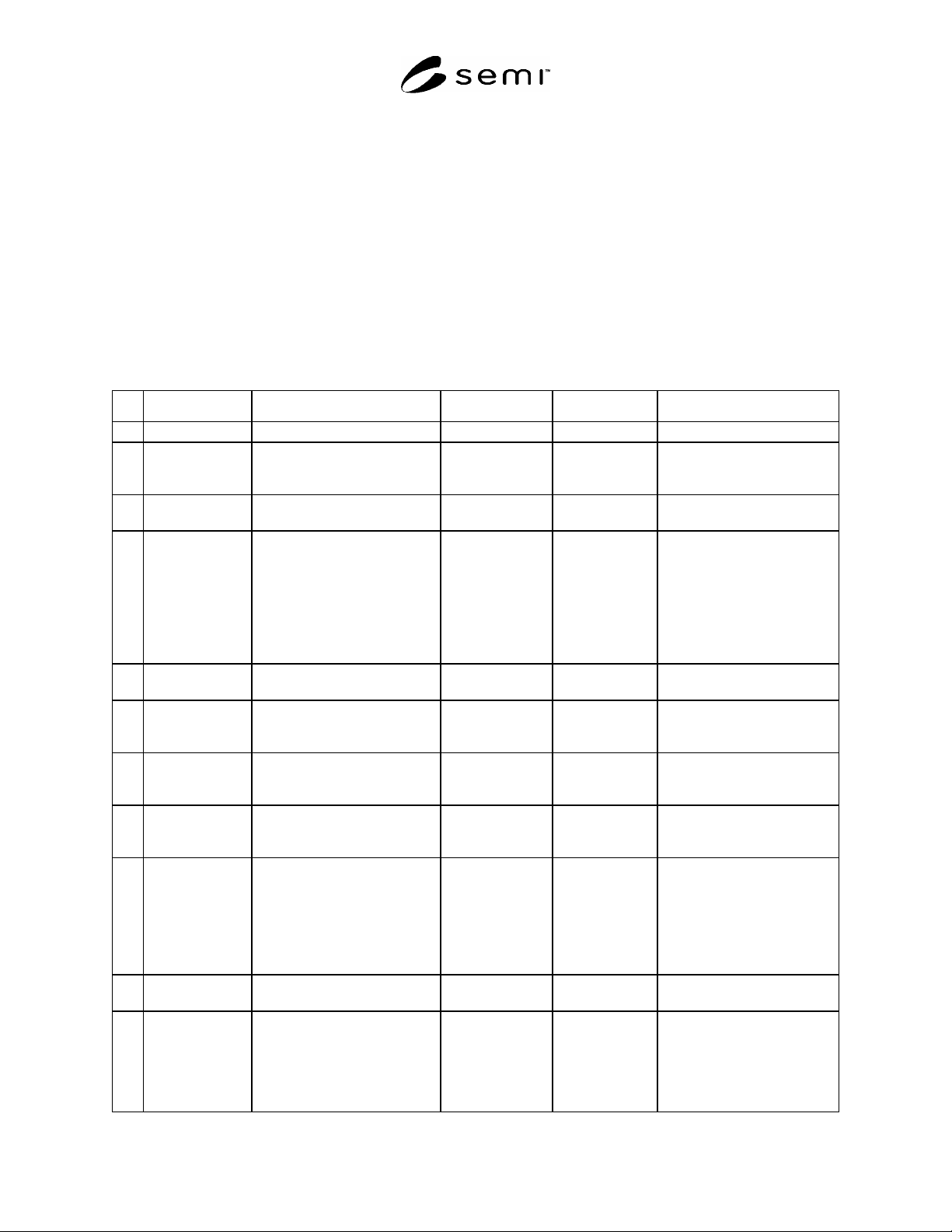
9.4 Substrate State Transition
Table 1 Substrate State Model Transition Table
No. Current State Trigger New State Action Comment
1 no state The substrate is registered. AT SOURCE
2 AT SOURCE The substrate is taken from the
source substrate location and
placed into the equipment.
AT WORK Update substrate
location history.
Substrate tracking through the
equipment substrate locations
begin.
3 AT WORK The substrate has moved to the
source substrate location.
AT SOURCE Update substrate
location history.
This transition is not required
for compliance to this standard.
4 AT WORK The substrate has moved out
from current equipment
substrate location towards a new
equipment substrate location.
AT WORK Update substrate
location history.
The substrate has moved
between equipment substrate
locations. This transition is not
required for compliance to this
standard. This transition is not
required if the equipment only
provides a single Equipment
Substrate Location.
5 AT WORK The substrate is moved to the
destination substrate location.
AT
DESTINATION
Update substrate
location history.
6 AT
DESTINATION
The substrate is taken from the
destination substrate location
and placed into the equipment.
AT WORK Update substrate
location history.
This transition is not required
for compliance to this standard.
7 AT
DESTINATION
The substrate is removed from
the equipment by a normal
transfer sequence.
(Extinction) The substrate
object is deleted
in the equipment.
8 AT
DESTINATION
The user informs or the
equipment detects that the
substrate is AT SOURCE.
AT SOURCE Update substrate
location history.
This transition is not required
for compliance to this standard.
9 Any
SUBSTRATE
substate
The equipment detects or is
informed by the user that a
substrate has been removed.
(Extinction) The substrate
object is deleted
in the equipment.
The removal may be detected
by the equipment or informed
by the user. This transition
would not occur during normal
wafer movement. So if
transition 7 occurs, there is no
need to report a transition 9.
10 no state The substrate object is created. NEEDS
PROCESSING
11 NEEDS
PROCESSING
Substrate starts actual
processing. One or more
substrate properties begin to be
affected by the equipment recipe
instructions or measurement of
the substrate.
IN PROCESS The document for each
equipment implementation
shall describe the trigger for
this transition.