semi合集-English.pdf - 第3276页
SEMI E128-0304 © SEMI 2003, 2004 10 6.6.7 Example Callback Message f or a Fixed Number of Events — Figure 8 shows another callback m essage from a server to a client. The CorrelationId “9” allows the client to correlate …

SEMI E128-0304 © SEMI 2003, 2004 9
6.6.6 Example Callback Message for a Variable Number of Events — Figure 7 shows a callback message from a
server to a client. The callback delivers some additional data related to a prior request message. The CorrelationId
“8” allows the client to correlate the callback with a prior request message. This callback uses the EventIndex
element to convey that this callback is the third of a variable number of callbacks. When the value of Finished is
“true” then the client will know not to expect any further callback messages with this CorrelationId.
<?xml version="1.0" encoding="UTF-8"?>
<SOAP-ENV:Envelope xmlns:SOAP-
ENV="http://schemas.xmlsoap.org/soap/envelope/">
<SOAP-ENV:Header>
<MessageHeader xmlns="urn:semi-org:schema:xmlmsg:0:0"
elementFormDefault="qualified">
<From>EQ99</From>
<To>EqHost</To>
<MessageType>CALLBACK</MessageType>
<CorrelationId>8</CorrelationId>
<Action>dataSubscribe</Action>
<EventIndex>
<Position>3</Position>
<Finished>false</Finished>
</EventIndex>
</MessageHeader>
</SOAP-ENV:Header>
<SOAP-ENV:Body>
<data>
<DATAID type="ASC">420</DATAID>
<CEID type="ASC">GAS</CEID>
<DATASETS type="LIST">
<DATASET>
<DSID>A</DSID>
<DVS>
<DV>
<NAME>ARGON</NAME>
<VAL>156</VAL>
</DV>
</DVS>
</DATASET>
<DATASET>
<DSID>B</DSID>
<DVS>
<DV>
<NAME>ARGON</NAME>
<VAL>67</VAL>
</DV>
</DVS>
</DATASET>
</DATASETS>
</data>
</SOAP-ENV:Body>
</SOAP-ENV:Envelope>
Figure 7
Callback Message (Variable Number of Events) Example

SEMI E128-0304 © SEMI 2003, 2004 10
6.6.7 Example Callback Message for a Fixed Number of Events — Figure 8 shows another callback message from a
server to a client. The CorrelationId “9” allows the client to correlate the callback with a prior request message.
The EventIndex element establishes this callback as the third of five callbacks. When the value of Position equals
the value of Total, then the client will know not to expect any further callback messages with this CorrelationId.
<?xml version="1.0" encoding="UTF-8"?>
<SOAP-ENV:Envelope xmlns:SOAP-
ENV="http://schemas.xmlsoap.org/soap/envelope/">
<SOAP-ENV:Header>
<MessageHeader xmlns="urn:semi-org:schema:xmlmsg:0:0"
elementFormDefault="qualified">
<From>EQ99</From>
<To>EqHost</To>
<MessageType>CALLBACK</MessageType>
<CorrelationId>9</CorrelationId>
<Action>dataSubscribe</Action>
<EventIndex>
<Position>3</Position>
<Total>5</Total>
</EventIndex>
</MessageHeader>
</SOAP-ENV:Header>
<SOAP-ENV:Body>
<data>
<DATAID type="ASC">420</DATAID>
<CEID type="ASC">GAS</CEID>
<DATASETS type="LIST">
<DATASET>
</DATASET>
</DATASETS>
</data>
</SOAP-ENV:Body>
</SOAP-ENV:Envelope>
Figure 8
Callback Message (Fixed Number of Events) Example
7 Related Documents
None.
NOTICE: SEMI makes no warranties or representations as to the suitability of the standards set forth herein for any
particular application. The determination of the suitability of the standard is solely the responsibility of the user.
Users are cautioned to refer to manufacturer’s instructions, product labels, product data sheets, and other relevant
literature, respecting any materials or equipment mentioned herein. These standards are subject to change without
notice.
By publication of this standard, Semiconductor Equipment and Materials International (SEMI) takes no position
respecting the validity of any patent rights or copyrights asserted in connection with any items mentioned in this
standard. Users of this standard are expressly advised that determination of any such patent rights or copyrights, and
the risk of infringement of such rights are entirely their own responsibility.
SEMI E128-0304 © SEMI 2003, 2004 11
RELATED INFORMATION 1
USAGE SCENARIOS
NOTICE: This related information is not an official part of SEMI E128 and was derived from the work of the
originating committee. This related information was approved for publication by full letter ballot procedures.
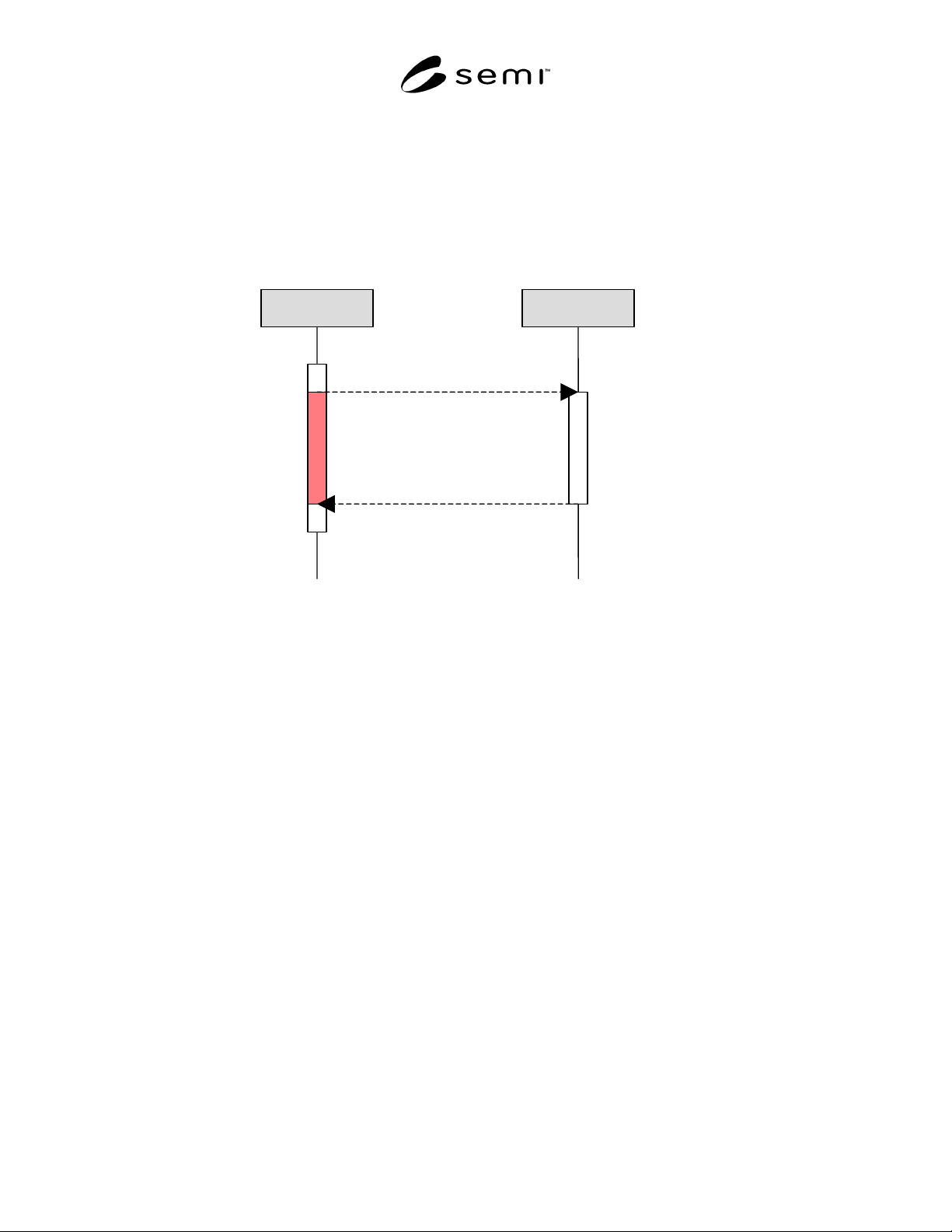
R1-1 Request/Reply (Synchronous)
Client Server
Request
Reply
Blocking
Request session
waits for reply,
no routing info
needed in
Figure R1-1
Synchronous Request/Reply Interaction
R1-1.1 The synchronous form of request reply shows the client blocking after sending a request message to wait for
the reply message. The transport used in a synchronous interaction typically manages the correlation of the request
with the reply by completing the interaction in a single step. Synchronous interactions have the advantage of
simplicity.
R1-1.2 Synchronous interactions often also come with limitations. The client may not perform other activities
while waiting for the reply. If the requested action takes a long time, this can limit the client’s ability to respond to
other events. Another limitation is the risk of having a failure occur in the server that is not reported to the client. In
general, synchronous interactions may prove more fragile than asynchronous messaging in distributed systems.