semi合集-English.pdf - 第1904页
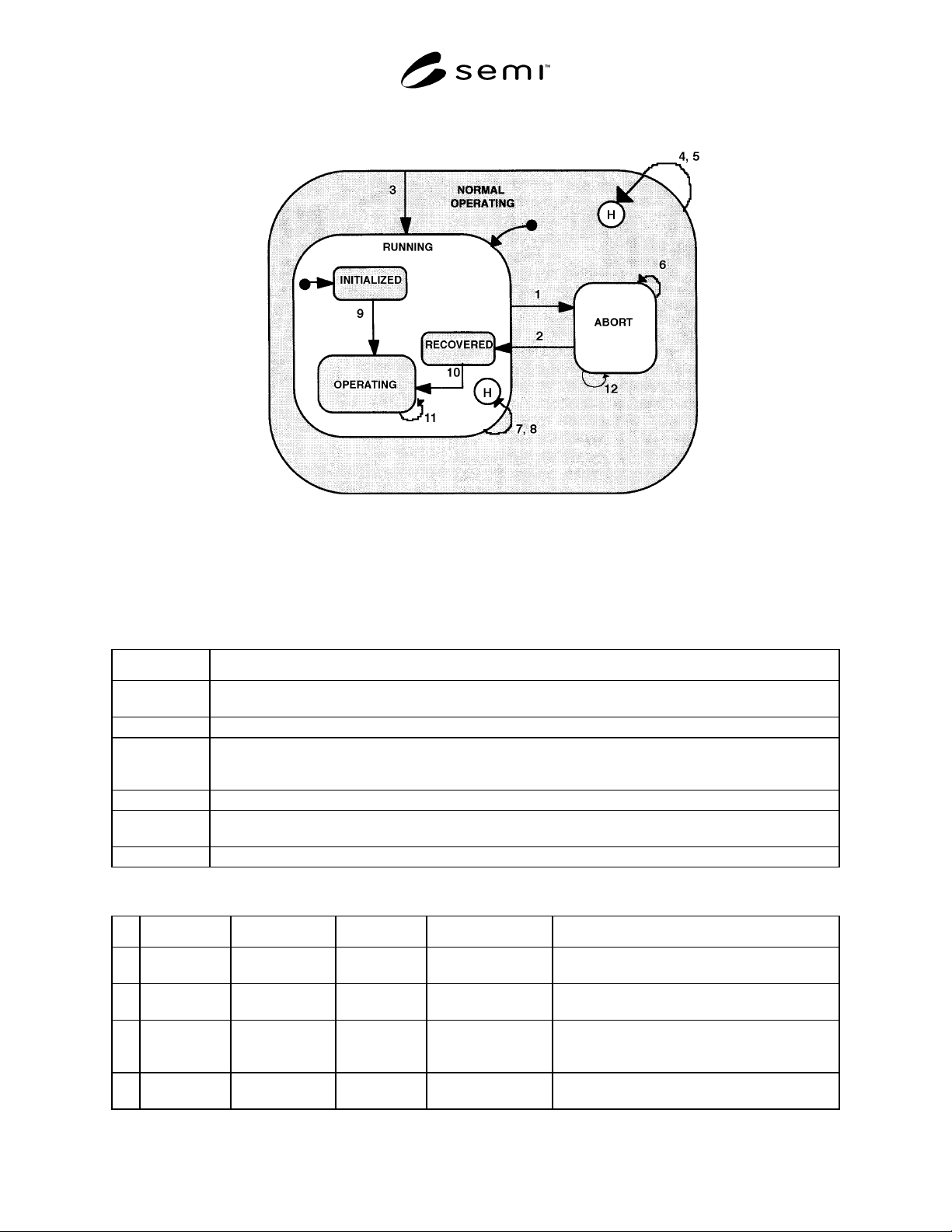
SEMI E54.1-1000 © SEMI 1996, 2000 10 7.2.3 SAC Instance Behavior — SAC o b ject instance behavior that is co mmon to all devices is illustrated in Figure 5. Associated states a nd state transitio ns are described in Tabl…

SEMI E54.1-1000 © SEMI 1996, 20009
7.2.2.4 Get Attribute — This service is used to read the value of an object instance attribute over the network.
Table 7 describes the parameters specified for this service.
Table 7 SAC Object Get Attribute Parameter Definition
Parameter Request/
Indication
Response/
Confirmation
Form Description
Attribute ID M C Network-Specific Attribute Identifier of the attribute whose value is being
requested.
Attribute Value – M Context-Specific Value of the attribute requested.
7.2.2.5 Set Attribute — This service is used to modify the value of an object instance attribute over the network
which has been identified as modifiable. Table 8 describes the parameters specified for this service.
Table 8 SAC Object Set Attribute Parameter Definition
Parameter Request/
Indication
Response/
Confirmation
Form Description
Attribute ID M C Network-Specific Attribute Identifier of the attribute whose value is being
modified.
Attribute Value M C Context-Specific Value of the attribute to modify.
7.2.2.6 Operate — This service is used to move the object instance to the OPERATING state from the
INITIALIZING or RECOVERING state There are no parameters specified for this service. Operate requests are
issued to all S, A, and C objects.
7.2.2.7 Restore Default (Optional) — This service is used to restore attributes of this object instance to their default
values. Table 9 describes the parameters specified for this service. For Restore Default Conditions = 2, a Restore
Default Condition = 1 request is issued to all S, A, and C objects.
Table 9 SAC Object Restore Default Parameter Definition
Parameter Request/
Indication
Response/
Confirmation
Form Description
Restore Conditions M C byte, enumerated 0 = Restore specific attribute of this object
1 = Restore this object
2 = Restore all objects of this device
Attribute ID C C Network-Specific Attribute ID of the attribute whose value is being restored.
This parameter is only used for Restore Conditions = 0.
7.2.2.8 Publish Attribute (Optional) — Used to proactively communicate a SAC object attribute. Table 10
describes parameters specified for this service.
Table 10 SAC Publish Attribute Service Message Definition Table*
Parameter Req/Ind Rsp/Conf* Description
Attribute ID M – Attribute Identifier of the attribute whose value is being reported.
Attribute Value M – Value of attribute being reported.
*The utilization of a service response message and its format is outside the scope of this document.

SEMI E54.1-1000 © SEMI 1996, 2000 10
7.2.3 SAC Instance Behavior — SAC object instance
behavior that is common to all devices is illustrated in
Figure 5. Associated states and state transitions are
described in Tables 11 and 12. The following also
applies to SAC object behavior:
A SAC object service may be requested internally by
the SAC object.
Upon SAC object instantiation or upon receipt of a
reset request, the SAC responds by entering or staying
in its INITIALIZED state.
Upon receipt of an abort request, the SAC object
responds by entering or staying in its ABORT state.
Upon receipt of a recover request, the SAC object
responds by transitioning to its RECOVERED state if
and only if it is currently in its ABORT state.
Otherwise, it responds with an error indication.
Additional behavior may be exhibited by a SAC object
that is device-specific. A complete definition of this
additional SAC object behavior may be found in an
appropriate sensor/actuator network specific device
model specification.
All SAC services have the same behavior associated
with invalid service requests unless otherwise indicated.
Common service error responses are listed in Appendix
2.
If a Set Attribute request is received over the network
for an attribute that is not network-settable, or if the
value in the SetAttribute request is beyond the specified
range allowed for the value of the specified attribute,
the attribute value is not changed and an error service
response is generated.
When the SAC object instance is INITIALIZED, all
attributes are set to their appropriate initial values (as
indicated in their associated object instance attribute
descriptions). Initial values could correspond to those
retrieved from the device’s non-volatile memory and
reflect, in large part, the values set in a previous
NORMAL OPERATING state.
Additionally, whenever the SAC object instance enters
the INITIALIZED state, it must issue a Reset service
request to all Sensor, Actuator, and Controller object
instances. Each object instance must then respond with
a Pass or Fail response indication upon completion of
its respective INITIALIZING application process. The
SAC object instance must coordinate these responses in
order to determine whether the device is qualified to
enter the OPERATING state. If qualified, an Execute
service request is issued to the DM object instance. If
not qualified, an exception condition is reported to the
DM object instance (see Section 7.3).
When the SAC object instance is recovering from an
ABORT state, all attributes are set to their appropriate
values (as determined by the associated object instance
recovering application process defined by the
manufacturer). Additionally, the SAC object instance
must issue a Recover service request to all Sensor,
Actuator, and Controller object instances. Each object
instance must then respond with a Pass or Fail response
indication upon completion of its respective recovering
application process. The SAC object instance must
coordinate these responses in order to determine whe-
ther the device is qualified to enter the OPERATING
state. If qualified, an Execute service request is issued
to the DM object instance. If not qualified, an exception
condition is reported to the DM object instance.
The SAC object optionally includes an Expiration
Timer attribute. The value of this attribute is decremen-
ted at a rate described by the “ExpirationTimer”
attribute format definition. Whenever the “Expiration-
Timer” attribute is less than or equal to zero, a warning
exception condition exists and is reported to the DM
object instance (utilizing the PublishAttribute service)
provided the “ExpirationWarningEnable” attribute is
set to Enable. When the “ExpirationWarningEnable”
attribute is set to Disable, the “ExpirationTimer”
attribute continues to decrement; however, a warning
exception condition will not be reported to the DM
object instance.
The “ExpirationTimer” attribute will continue to be
decremented to values less than zero. Therefore, a
negative number indicates an elapsed time past
expiration. When this attribute reaches its most negative
value, it maintains this value and no longer decrements.
The “ExpirationTimer” is also maintained by the object
while in the ABORT state. In the RECOVERING state,
the current status of the device is evaluated and any
exception conditions that exist are reported to the DM
object instance.
SEMI E54.1-1000 © SEMI 1996, 200011
Figure 5
SAC Object Instance Behavior*
NOTE: Only generic behavior is indicated in this chart. A complete state chart necessarily requires the inclusion of device-
specific behavior.
* Transitions 4 through 8, 11, and 12 are recursive (i.e., the New State is the same as the Current State (including all nested sub-states)).
Table 11 SAC Object Instance Behavior State Description
State Description
NORMAL
OPERATING
Object instance exists. Object services can be processed.
RUNNING This is the entry sub-state to NORMAL OPERATING. Object instance is not in its ABORT state.
INITIALIZED This is the entry sub-state to NORMAL OPERATING and RUNNING. Object instance exists and has been
initialized. All attributes set to appropriate initial values (as indicated in an appropriate sensor/actuator network
specific device model specification).
RECOVERED Object instance is in an abort recovered state.
OPERATING This represents the entire collection of sub-states within RUNNING except INITIALIZED and RECOVERED.
The further delineation of this sub-state and transition into this sub-state is outside the scope of this document.
ABORT Object instance is in an aborted state; a detailed description of this state is outside the scope of this document.
Table 12 SAC Object Instance Behavior State Transition Matrix*, **
# Current State Trigger New State Action Comment
1 RUNNING Abort request. ABORT Abort. Abort
response.
ABORT state is device-specific.
2 ABORT Recover request. RECOVERED Recover. Recover
response.
RECOVERED state is device-specific.
3 NORMAL
OPERATING
Reset request. RUNNING Reset. Reset
response.
Valid for all sub-states of
NORMAL OPERATING. Move to
RUNNING/INITIALIZED.
4 NORMAL
OPERATING
Invalid service
request.
NORMAL
OPERATING
Error response. Valid for all substates of
NORMAL OPERATING.