semi合集-English.pdf - 第3176页
SEMI E125.1-0305 © SEMI 2005 30 is used when referring to a Parameter that is d efined by the same source as the one making the reference. It is expected that the most common Parameter references in equipment metadata wi…
SEMI E125.1-0305 © SEMI 2005 29
Attribute or Role Name UML Name/Type XML Element or Attribute XML Name/Type
eventData Parameter element EventData:
esd:ParameterCollectionType (see ¶7.2.14.5.4 for
description of the ParameterType complexType)
stateMachine StateMachineInstance element StateMachine: esd:StateMachineInstanceType
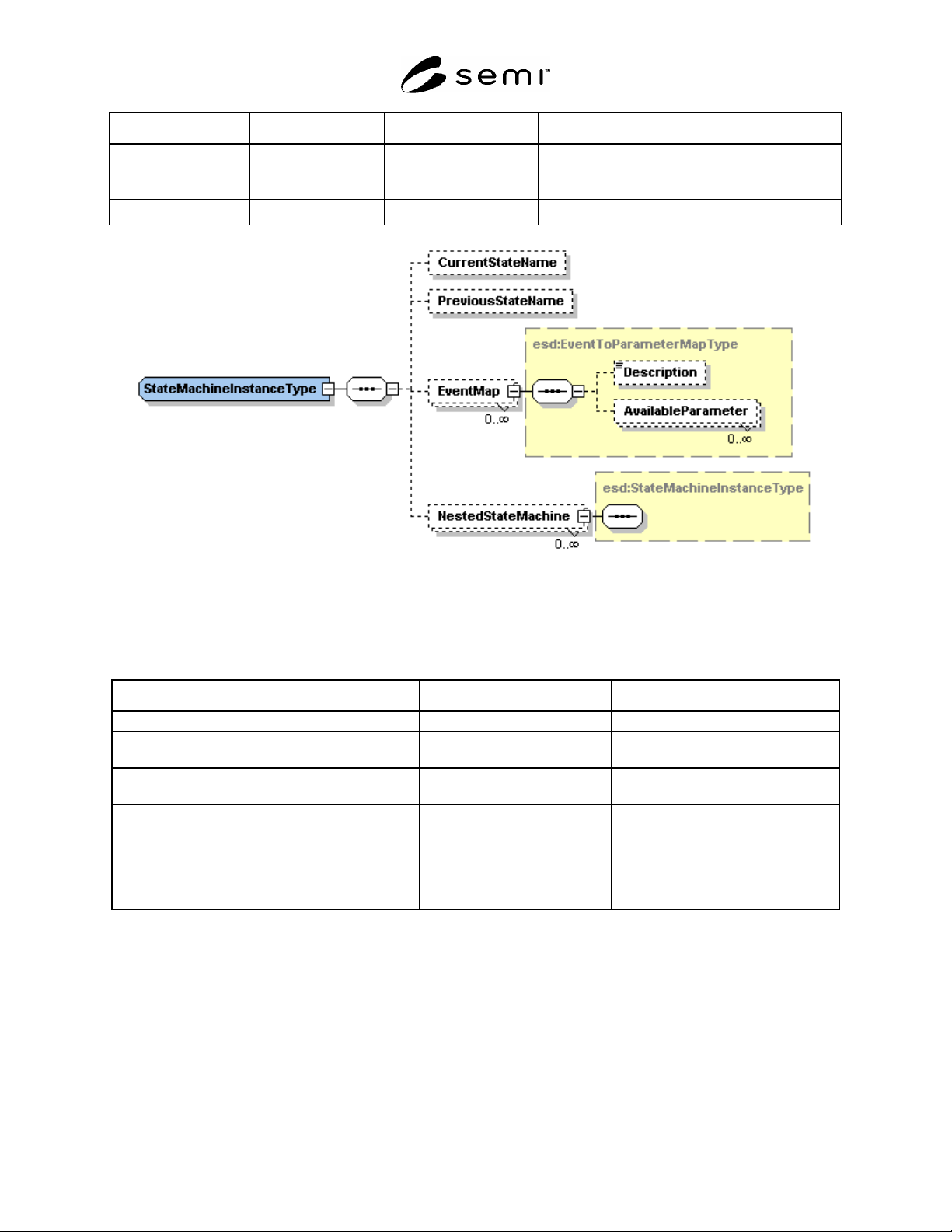
Figure 20
StateMachineInstanceType Global complexType
7.2.11.5.4 StateMachineInstanceType — This global complexType is the XML Schema representation of the SEMI
E125 StateMachineInstance class.
Table 54 SEMI E125 StateMachineInstance
StateMachineInstanceType Translation Table
Attribute or Role Name UML Name/Type XML Element or Attribute XML Name/Type
stateMachineId text attribute stateMachineId: xsd:string
currentStateName Parameter element CurrentStateName:
esd:ParameterReferenceType
previousStateName Parameter element PreviousStateName:
esd:ParameterReferenceType
eventMaps EventToParameterMap element EventMap:
esd:EventToParameterMapType (zero
or more)
nestedStateMachines StateMachineInstance element NestedStateMachine:
esd:StateMachineInstanceType (zero or
more)
7.2.11.5.5 ParameterReferenceType — This global complexType is the XML Schema representation of a reference
to a Parameter defined in the equipment metadata. Referenceable Parameters are defined either by SEMIObjTypes
as “Attributes” or “EventData”, or by equipment nodes in the set of Parameters provided with
“EquipmentNodeDescription” metadata. Equipment nodes and SEMIObjTypes are said to be valid Parameter
“sources”. Parameters defined for Exceptions are not referenceable. This type defines two attributes, “source” and
“name” that are used to uniquely identify Parameters in equipment metadata.
7.2.11.5.5.1 Parameter references may be “absolute” or “relative”. An absolute Parameter reference is used when
referring to a Parameter that is defined by a different source than the one making the reference. A relative reference
SEMI E125.1-0305 © SEMI 2005 30
is used when referring to a Parameter that is defined by the same source as the one making the reference. It is
expected that the most common Parameter references in equipment metadata will be relative references.
7.2.11.5.5.1.1 For an example of an “absolute” reference, consider two equipment nodes: a
“TemperatureController” equipment node that provides a “TemperatureSetpoint” Parameter; and a
“TemperatureSensor” equipment node that provides a “MeasuredTemperature” Parameter. The
“TemperatureSetpoint” Parameter is a control Parameter whose setting affects the “MeasuredTemperature”
Parameter, so it may need to refer to that Parameter from the context of the “TemperatureController” node. In this
case, an “absolute” reference is required, since the “referred-to” Parameter is defined by a different node than the
node making the reference.
7.2.11.5.5.1.2 For an example of a “relative” reference, consider a SEMIObjType that has a SEMI E39 attribute
defined for it that stores the current state of the object. In the StateMachineInstance for that same SEMIObjType,
the “CurrentStateName” element is used to refer to a Parameter that can be used to determine the current state of
that StateMachine. In this case, the Parameter belongs to the same “source” (the same SEMIObjType) that
implements the StateMachine, so a relative reference can be used.
7.2.11.5.5.2 source — This attribute is optional and shall be either not present (relative reference) or present and set
to a valid CEM Locator (absolute reference) identifying the equipment node that provides the referenced Parameter.
If not present, the source is inferred by the context that the reference is made (either a SEMIObjType or an
equipment node).
7.2.11.5.5.3 name — For relative references to Parameters provided directly from an equipment node or
SEMIObjType, this attribute shall be set to the value of the “name” attribute of the Parameter that is referred to. For
absolute references to Parameters provided directly from an equipment node, this attribute shall be set to the value of
the “name” attribute of the corresponding Parameter. For absolute references to SEMIObjType attributes or event
data Parameters provided from a specific equipment node, this shall be a string of the form “urn:semi-
org:objType:<typeName>:objAttr:<parameter name>”, where “<typeName>” is the ObjType name, and
“<parameter name>” is the name of the Parameter representing the attribute or event data.
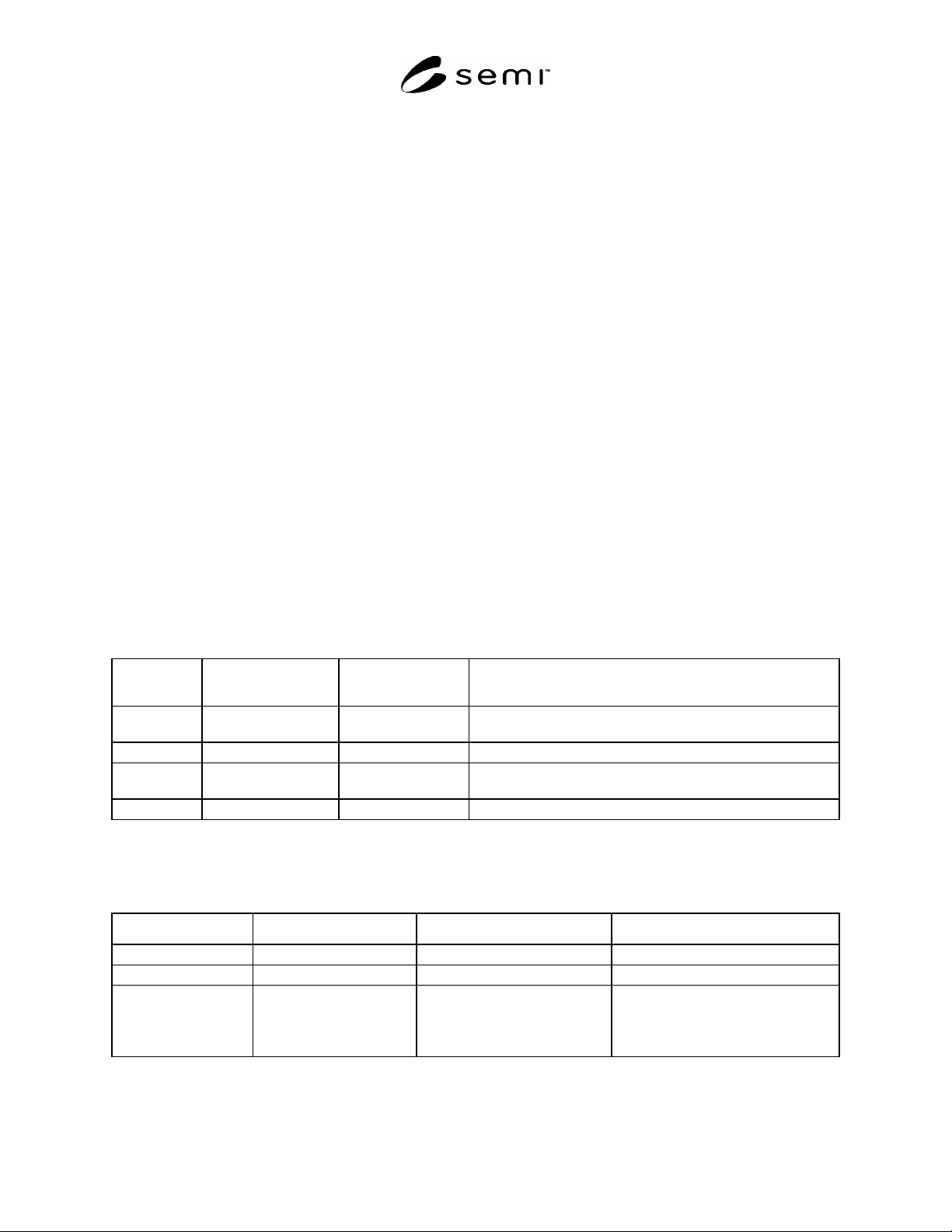
7.2.11.5.5.4 Some examples of valid Parameter references are shown in the following table.
Table 55 Example Parameter References
Absolute /
Relative
Referring Source Referenced Source Referenced Parameter Name
relative SEMIObjType
definition
“” “PRJobState”
relative Equipment Node “” “MeasuredTemperature”
absolute Equipment Node “Equipment/
Oven/RTD-1”
“OvenTemp”
absolute Equipment Node “Equipment” “urn:semi-org:objType:ProcessJob:objAttr:PRJobState”
7.2.11.5.6 EventToParameterMapType — This global complexType is the XML Schema representation of the
SEMI E125 EventToParameterMap class.
Table 56 SEMI E125 EventToParameterMap
EventToParameterMapType Translation Table
Attribute or Role Name UML Name/Type XML Element or Attribute XML Name/Type
eventId text attribute eventId: xsd:string
description text element Description: xsd:string
availableParameters Structured data of type
Parameter
element AvailableParameter:
esd:ParameterReferenceType
(zero or more, see ¶7.2.11.5.5 for
description of Parameter references)
SEMI E125.1-0305 © SEMI 2005 31
7.2.12 GetExceptions
7.2.12.1 This section is provisional, pending approval of SEMI E132.1 and SEMI E138.
7.2.12.2 WSDL Operation Binding
7.2.12.2.1 See the operation binding for “GetExceptions” in E125-1-V0305-EqpMetadataMgr-Binding.wsdl. Key
information is shown for convenience in the following table.
Table 57 GetExceptions Operation Binding
SOAPAction
urn:semi-org:ws.E125-1.V0305.esdMetaEqp-
binding:GetExceptions
Input Headers (WSDL Message, Required) E132HeaderMessage, required
Output Headers (WSDL Message, Required) E132HeaderMessage, required
7.2.12.3 WSDL PortType Operation
7.2.12.3.1 See the portType operation definition for “GetExceptions” in E125-1-V0305-EqpMetadataMgr-
PortType.wsdl. Key information is shown for convenience in the following table.
Table 58 GetExceptions PortType Operation
Input Message Name GetExceptionsRequestMessage
Output Message Name GetExceptionsResponseMessage
7.2.12.4 WSDL Message(s)
7.2.12.4.1 See the message definitions for “E132HeaderMessage”, “GetSEMIObjTypesRequestMessage”, and
“GetSEMIObjTypesResponseMessage” in E125-1-V0305-EqpMetadataMgr-PortType.wsdl. Key information is
shown for convenience in the following table.
Table 59 EquipmentMetadataManager Binding
Message Name
Schema
Element Name
E132HeaderMessage auth:E132Header
GetExceptionsRequestMessage esd:GetExceptionsRequest
GetExceptionsResponseMessage esd:GetExceptionsResponse
7.2.12.5 XML Schema Types
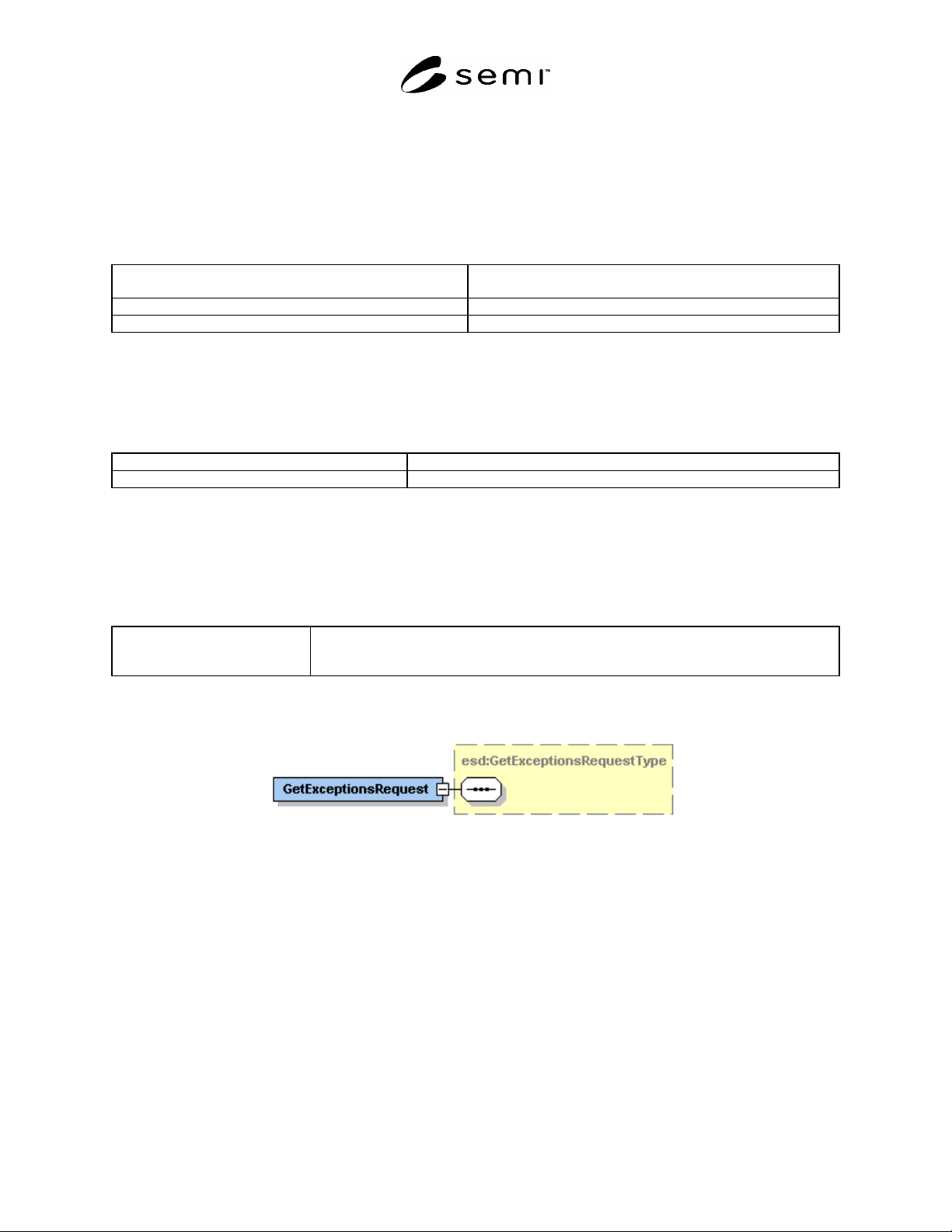
Figure 21
GetExceptionsRequest Global Element
7.2.12.5.1 GetExceptionsRequest — This global element acts as a top-level container entity representing the SOAP
body of a GetExceptions request. As defined in SEMI E125, this operation has no input arguments, so the element
has no contents.