semi合集-English.pdf - 第7097页
SEMI S20-0303 © SEMI 2003 6 NOTICE: SEMI makes no warranties or representations as to the su itability of the standard set forth herein for any particular application . The determinati on of the suitability o f the stand…
SEMI S20-0303 © SEMI 2003 5
NOTE 17: Supplier standard color coding may be any colors
including black and white.
Table 1 Recommended Identifying Color Matrix
Type of Energy Text/Background
Electrical Black/Orange
Compressed Gases White/Blue
Pressurized Liquids White/Green
Chemical Black/Yellow
Mechanical White/Black
Thermal Red/White
Ionizing Radiation Purple/Yellow
Non-Ionizing Radiation (Laser,
RF, UV, IR, etc.)
Black/Red
NOTE 18: Recommended color shades may be found in
standards such as ANSI Z535.1, Colors for Safety Labels ISO
3864 Safety Colours & Safety Signs or other international
equivalent for uniformity.
9.3.1 Colors (whether from the recommended list or
from the suppliers’ standard color coding) should be
assigned depending on the type of energy being
isolated, not the hazard being controlled. For example,
a circuit breaker that removes power from a robot
should have a unique identifier on the graphical
representation color-coded as Electrical, not
Mechanical energy.
9.4 Graphical reference guides should be either
electronic media or made from clean room compatible
materials that can be located at the equipment or can be
carried there during the performance of the tasks.
9.4.1 The supplier may offer optional media as part of
the purchase.
NOTE 19: Certain types of electronic devices (e.g.,
broadcasting handheld computers) may be restricted from use
in clean rooms due to system interference issues.
9.4.1.1 If the reference guide is intended to be
displayed electronically, the display device should be
conveniently available to personnel while they perform
the particular task.
9.4.1.2 The supplier may also specify that users have
the option to convert the guides to clean room
compatible, color printed versions.
9.5 Each graphical reference guide should be designed
so that it is clearly cross-referenced with its related
maintenance task(s).
9.5.1 Text instructions for operating and verifying the
isolation of each LOTO EID should be in the same field
of view as the graphical representation of that LOTO
EID on the graphical reference guide.
EXCEPTION: In an electronic file, the field of view is
controlled by the screen size and therefore text
instructions and graphics may not be in the same field
of view or may even be connected via hyperlink to each
other.
NOTE 20: One possible design is where the graphical
reference guides each consists of a card or page (perhaps in a
bound collection of reference guides) that can be placed near
the computer or manual and show the steps of the task.
Another possibility is to provide the ability to produce a split
screen display on a computer.
10 Related Documents
10.1 SEMI Standards
SEMI F34 Guide for Liquid Chemical Pipe Labeling
10.2 NFPA Standards
4
NFPA 70E Standard for Electrical Safety
Requirements for Employee Workplaces
NFPA 79 Electrical Standard for Industrial
Machinery
10.3 ANSI Standards
5
ANSI Z244.1 Personnel Protection, Lockout/Tagout
of Energy Sources – Minimum Safety Requirements
10.4 United States Code of Federal Regulations
6
29 CFR 1910.333b Working on or Near Exposed
De-energized Parts
OSHA STD 1-7.3 — 29 CFR 1910.147, the Control of
Hazardous Energy (Lockout/Tagout) - Inspection
Procedures and Interpretive Guidance
OSHA document 3120 — Control of Hazardous Energy
(Lockout/Tagout) - 1997 (Revised)
NOTICE: Unless otherwise indicated, all documents
cited shall be the latest published versions.
4 National Fire Protection Association, 1 Batterymarch Park, PO Box
9101, Quincy, MA 02269-9101
5 American National Standards Institute, New York Office: 11 West
42nd Street, New York, NY 10036, USA. Telephone: 212.642.4900;
Fax: 212.398.0023 Website: www.ansi.org
6 Available from Occupational Safety and Health Administration,
U.S. Department of Labor, http://www.osha.gov

SEMI S20-0303 © SEMI 2003 6
NOTICE: SEMI makes no warranties or representations as to the suitability of the standard set forth herein for any
particular application. The determination of the suitability of the standard is solely the responsibility of the user.
Users are cautioned to refer to manufacturer’s instructions, product labels, product data sheets, and other relevant
literature respecting any materials or equipment mentioned herein. These standards are subject to change without
notice.
By publication of this standard, SEMI takes no position respecting the validity of any patent rights or copyrights
asserted in connection with any item mentioned in this standard. Users of this standard are expressly advised that
determination of any such patent rights or copyrights, and the risk of infringement of such rights, are entirely their
own responsibility.
SEMI S20-0303 © SEMI 2003 7
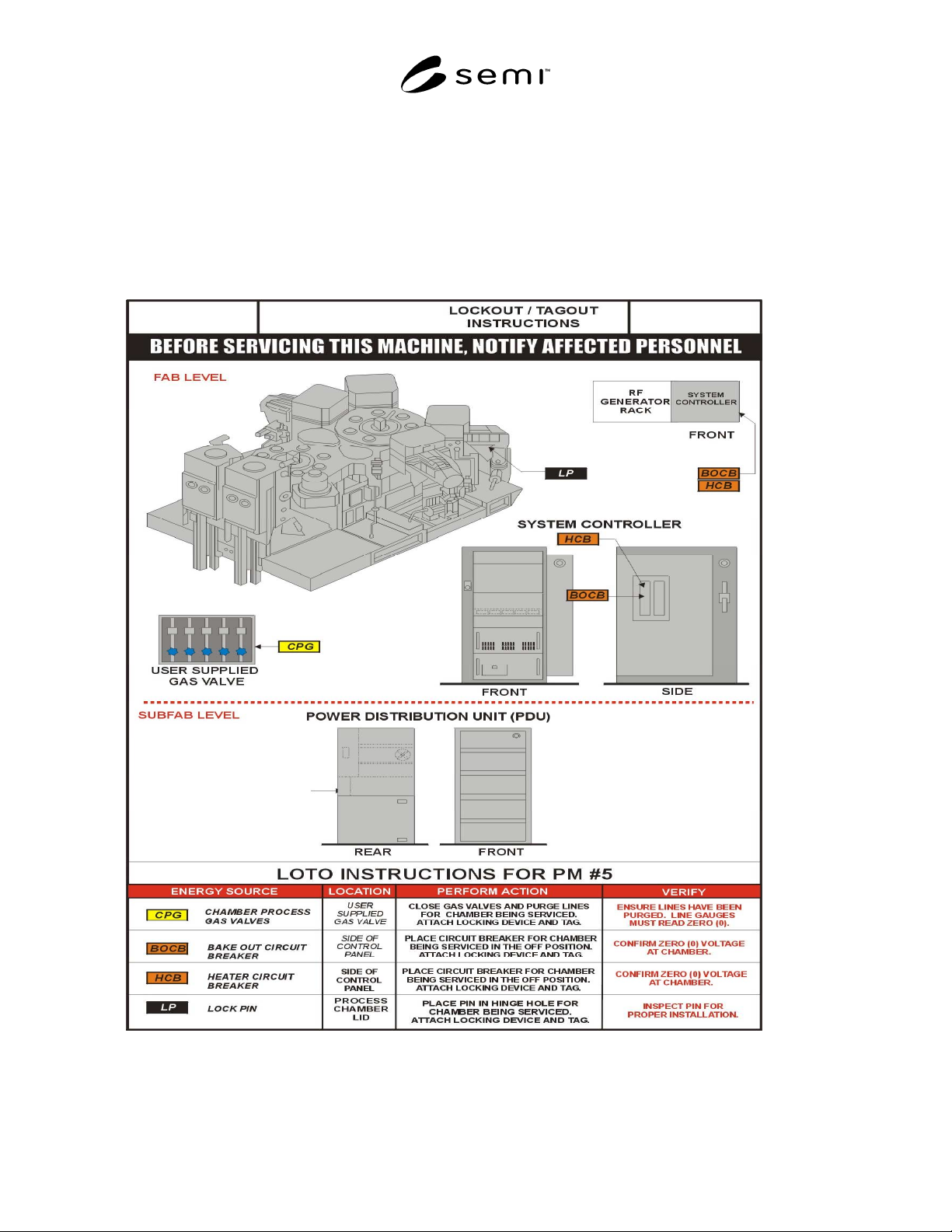
RELATED INFORMATION 1
EXAMPLES OF GRAPHICAL REPRESENTATIONS
NOTICE: This Related Information is not an official part of SEMI S20. It was derived from AMD activity, but is
generic and not copyrighted. This related information was approved for publication by inclusion in the ballot and by
vote of the SEMI Standards EHS Committee. It is included to assist the user of the document in understanding what
the graphical representations should provide in the way of information and location identification.
R1-1 Drawings