semi合集-English.pdf - 第7843页
SEMI T13-1104 © SEMI 2004 3 5.2.10 hybrid IC — a kind of Device which has one or more semi conductor dice and other active/passive elements packaged together. 5.2.11 reusable co ntainer — a container for electronics part…

SEMI T13-1104 © SEMI 2004 2
verification occurs. Even if some physical
identification may be difficult to verify because
something is hidden by the other material or no
physical identification tag is provided, they have to
cover by some means.
3.4 Tracking die coordinate information on substrates
is a subset of full device tracking. Readers who have
just interested in die coordinate information (narrow
Device Tracking) can skip most sections and go
straight to Appendix and Related Information sections
to implement the specification.
4 Referenced Standards
4.1 SEMI Standards
SEMI E130 — Specification for Prober Specific
Equipment Model for 300 mm Environment
(PSEM300)
SEMI G81 — Specification for Map Data Items
SEMI G84 — Specification for Strip Map Protocol
SEMI G85 — Specification for Map Data Format
SEMI M17 — Guide for Universal Wafer Grid
SEMI M20 — Specification for Establishing a Wafer
Coordinate System
SEMI M21 — Specification for Assigning Addresses
to Rectangular Elements in a Cartesian Array
4.2 The Internet Engineering Task Force
1
RFC2396 — Uniform Resource Identifiers (URI):
Generic Syntax
NOTICE: Unless otherwise indicated, all documents
cited shall be the latest published versions.
5 Terminology
5.1 Abbreviations & Acronyms
5.1.1 PCB — Print Circuit Board
5.1.2 SMT — Surface Mount Technology
5.1.3 SMTP — Simple Mail Transfer Protocol
5.1.4 SIP — System In Package
5.2 Definitions
5.2.1 cabinet — a kind of enclosure for electronics to
keep from exposure of electrodes and/or
subcomponents, and/or to give some means of human
operation.
5.2.2 cassette — a kind of container of electronics
materials or parts for the purpose of carrying
1 The Internet Engineering Task Force;
www.ietf.org,
capability, grouping operation, replaceability at
inlet/outlet port or similar objectives.
5.2.3 circuit module — an implemented electric circuit
with active/passive elements in a cell, on a substrate or
packaged together.
5.2.4 device — a concise representation of a
semiconductor device. It must be a semiconductor die
regardless whether it is on the way of fabrication or
completed, whether it has been diced or not, whether it
is installed/mounted on some substrate or not, or
whether it is packaged or not. If it is packaged, the
whole package is assumed as a device and a device
may have more than one dice. In some specific case a
device may have some other active or passive elements
in the package.
5.2.5 Device Tracking — generic term of Die Trace
regardless of unit of tracing or category of information.
Following narrow sense is also applied in some specific
fields. A specific case of tracking especially for
geometric coordinates information on holding
substrate. Because sometimes this specific type of
Device Tracing information is very convenient to such
end user industries as the automobile or car parts
industries, this is defined separately. This can be
realized with limited specification presented in
Appendix sections of this specification.
5.2.6 dicing frame — a frame with sticky plastic film
to mount a semiconductor wafer for dicing.
5.2.7 die — a semiconductor product which has
electric elements and wiring. Many dice are usually
fabricated on a semiconductor substrate at a time which
is often referred to as wafer and the substrate is diced
for dice before packaging or mounting on some other
substrate. Some die may be fabricated on such isolator
as thin transparent glass plate. Die is intended as it is
just one piece of substrate even if it is packaged with
the other dice.
5.2.8 Die Trace — acquiring die information for
tracing the die and/or processing the information to
investigate what happens on the die during
manufacturing or to ensure such properties of the die as
producer and facilities. The information for such
aggregating entities as wafer and PCB may be included
depending on the usefulness of the information for
tracing because they are produced with the die on them.
5.2.9 glass plate — a rectangular thin insulator plate to
fabricate one or more electric elements on it. Often the
material of this plate is transparent glass for flat panel
display, sometimes it may be ceramic for passive
electric elements. The purpose of definition of this item
is just to introduce one of possible examples to trace
and this document doesn’t specify details.

SEMI T13-1104 © SEMI 2004 3
5.2.10 hybrid IC — a kind of Device which has one or more semiconductor dice and other active/passive elements
packaged together.
5.2.11 reusable container — a container for electronics parts which is usually used more than once.
5.2.12 packaged device — a Device which is not exposed in bared shape on substrate for passivation, physical
protection and manipulation purposes. It is often independently packaged by ceramic base or plastic molding with
leads. Sometimes it has more than one dice and some separated electric elements packaged in a package.
5.2.13 strip — rectangular shaped substrate or flexible tape to mount semiconductor devices. The purpose of use is
not only for products but also for carrier or some other purpose used during production of electronics products.
5.2.14 substrate — base on which electronics elements, especially semiconductor devices, are fabricated or on
which electronics parts are mounted. Examples are silicon wafers, flat panel display glass substrates, lead frames,
print circuit boards and so on.
6 Convention
6.1 This section defines the conventions followed by this document.
6.2 Object Conventions — This document conforms to the conventions for objects established by SEMI E39,
including object diagrams, object terminology, and requirements for standardized objects. Accordingly, notation is
based on Unified Modeling Language (UML).
6.2.1 Formal Name of an Object — The text capitalizes formal object name references. Similar to the way
capitalization is normally used when discussing entities. When describing something in the general (like cities)
lower case is used, but when a specific entity is of interest (New York City), then first letters are capitalized.
6.2.2 Components of Complex Attributes — The names of object attributes defined in tables are left-justified. The
individual elements of complex attributes are right-justified in order of appearance below the complex attribute.
6.3 State Model Conventions
6.3.1 This document uses the Harel state chart convention for describing dynamic operation of defined objects. The
outline of this convention is described in an attachment of SEMI E30. The official definition of this convention is
described in “State charts: A Visual Formalism for Complex Systems”
2
.
6.3.2 The Harel convention has not the concept of state models of “creation” and “extinction” for expressing a
temporary entity. The “job” described in this document is such an entity, and a copy of the same state model is used
for an independent job newly created. In this document, a circle with a black circle inside is used for expressing
extinction of an entity. A filled black circle denotes the entry to the state model (the entity creation).
6.3.3 Transition tables are provided in conjunction with the state diagrams to explicitly describe the nature of each
state transition. A transition table contains columns for Transition number, Previous State, Trigger, New State,
Actions, and Comments. The “trigger” (column 3) for the transition occurs while in the “previous” state. The
“actions” (column 5) includes a combination of:
1. Actions taken upon exit of the previous state.
2. Actions taken upon entry of the new state.
3. Actions taken which are most closely associated with the transition.
4. No differentiation is made between these cases.
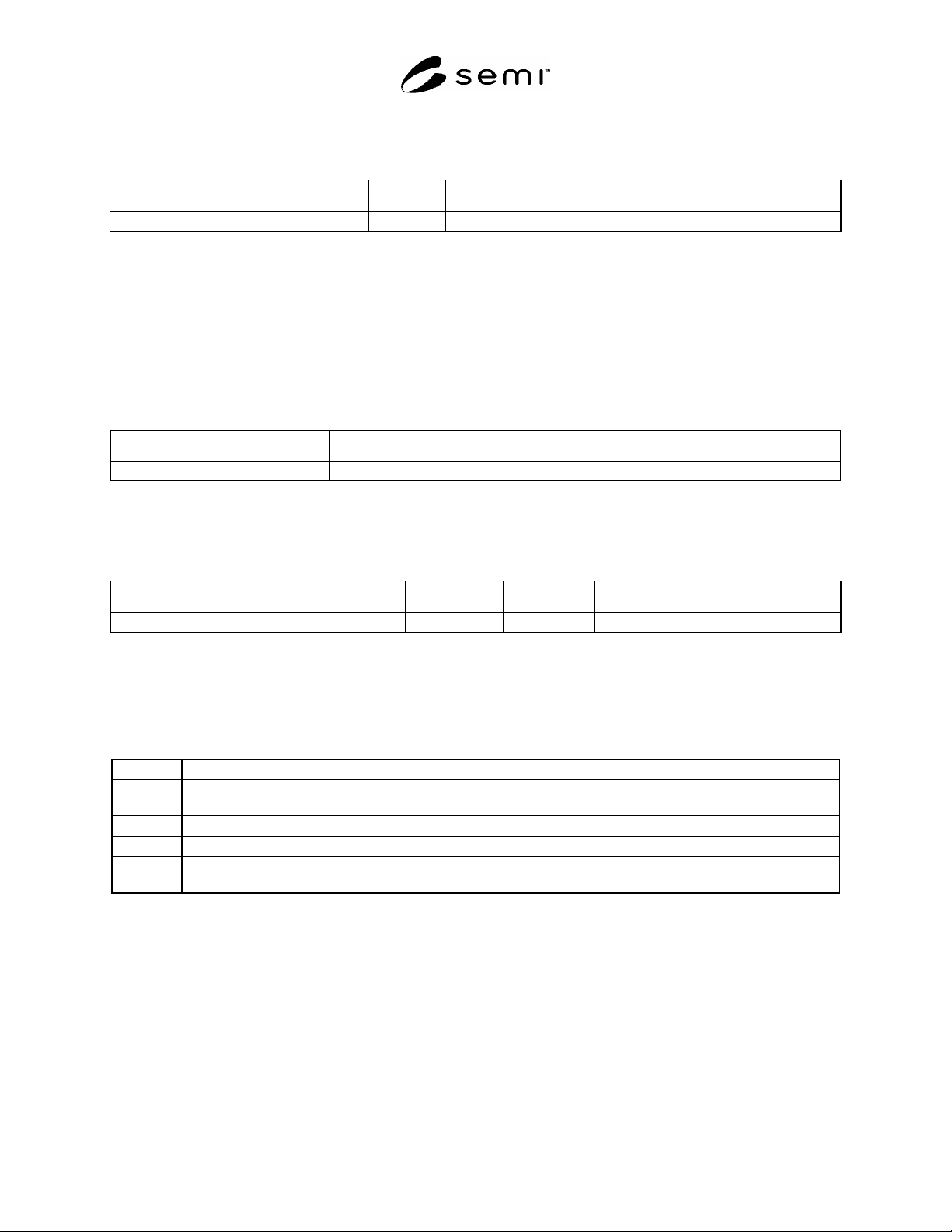
Num Previous State Trigger New State Actions Comments
6.4 Service Message Representation — Services are functions or methods that may be provided by either the
equipment or the host. A service message may be either a request message, which always requires a response, or a
notification message, that does not require a response.
2 D. Harel, “State charts: A Visual Formalism for Complex Systems”, Science of Computer Programming 8,
1987.
SEMI T13-1104 © SEMI 2004 4
6.4.1 Service Definition
6.4.1.1 A service definition table defines the specific set of messages for a given service resource, as shown in the
following table:
Message Service Name Type Description
6.4.1.2 Type can be either “N” = Notification or “R” = Request & Response.
6.4.1.3 Notification type messages are initiated by the service provider (e.g., the equipment) and the provider does
not expect to get a response from the service user. Request messages are initiated by a service user (e.g., the host).
Request messages ask for data or an activity from the provider. Request messages expect a specific response
message (no presumption on the message content).
6.4.2 Service Parameter Dictionary
6.4.2.1 A service parameter dictionary table defines the description, format and its possible value for parameters
used by services, as shown in the following table:
Parameter Name Description Format: Possible Value
6.4.2.2 A row is provided in the table for each parameter of a service.
6.4.3 Service Message Definition
6.4.3.1 A service message definition table defines the parameters used in a service, as shown in the following table:
Parameter Req/Ind Res/Cnf Comment
6.4.3.2 The columns labeled REQ/IND and RSP/CNF link the parameters to the direction of the message. The
message sent by the initiator is called the “Request”. The receiver terms this message the “Indication” or the request.
The receiver may then send a “Response” which the original sender terms the “Confirmation”.
6.4.3.3 The following codes appear in the REQ/IND and RSP/CNF columns and are used in the definition of the
parameters (eg., how each parameter is used in each direction):
M Mandatory Parameter — Must be given a valid value.
C Conditional Parameter — May be defined in some circumstances and undefined in others. Whether a value is
given may be completely optional or may depend on the value of the other parameter.
U User-Defined Parameter.
- The parameter is not used.
= (For response only.) Indicates that the value of this parameter in the response must match that in the primary (if
defined).
NOTE 1: Concatenated words are often used for names of class, attribute, service and data. However they are official,
sometimes separated words may be preferred in figures and explanatory sentences for readability even they are no differences.
7 General Requirements
7.1 Identification Means — Equipment and other computer or software have to have some means to identify entities
that appear in this document.
7.2 Communication Means — Each entity on equipment and other computer or software has to have some electric
communication means to transact.