semi合集-English.pdf - 第6992页
SEMI S12-0298 © SEMI 1998 2 7 Personnel Safety 7.1 A ssessment and decontaminat i o n procedures should be performed on l y by properly trained and equipped person nel. 7.2 Any specific procedures us ed t o follo w these…

SEMI S12-0298 © SEMI 19981
SEMI S12-0298
GUIDELINES FOR EQUIPMENT DECONTAMINATION
1 Purpose
1.1 This document establishes guidelines for
decontaminating equipment which has been exposed to
hazardous materials and which is intended for further
productive use. Equipment intended for further
productive use may include, but is not limited to, that
being offered for reuse, resale, repair, refurbishment, or
relocation.
1.2 These guidelines should be adapted at each site
with proper consideration given to local, state, national,
and international regulations and organization policies.
2 Scope
2.1 These guidelines apply to the preparation for
transfer or relocation of equipment which has been
exposed to hazardous or toxic materials and may pose a
threat to human health or the environment. These
activities may include, but are not limited to, shutdown,
dismantling, removing, labeling, and packaging prior to
transport.
2.2 These guidelines describe minimum requirements
for documentation of decontamination and notification
of residual hazards associated with decontamination.
2.3 The level of decontamination required for
equipment designated for reuse in the same service in
the same location may be assessed on a case-by-case
basis by the site Environmental, Health, and Safety
organization.
2.4 These guidelines are intended to be used to ensure
that decontamination prior to transport occurs to the
greatest extent possible, while acknowledging practical
limitations which may exist in individual
circumstances.
3 Referenced Documents
None.
4 Limitations
4.1 These guidelines are not intended to address
decontamination requirements for the preparation of
equipment for final “end-of-life” disposal.
4.2 These guidelines are not intended to supersede
applicable international, governmental, site, or original
equipment manufacturer requirements.
5 Terminology
5.1 decontamination — The remo val of materials in or
on equipment.
5.2 equipment — Process tools, chemical (liquid or
gas) controls and delivery systems, ancillary support
systems, structures, piping, ductwork, parts, and
subassemblies (e.g., vacuum pumps, pump packages,
effluent/exhaust treatment systems).
5.3 hazardous material — Any chemical, substance,
or compound which is defined or interpreted to pose
risks or hazards to human health or the environment by
applicable international, national, regional, or local
laws or regulations.
5.4 health hazard — A chemical for which there is
statistically significant evidence based on at least one
study conducted in accordance with established
scientific principles that acute or chronic health effects
may occur in exposed persons. Health hazards include
chemicals which are carcinogens, toxic or highly toxic
materials, reproductive toxins, irritants, corrosives,
sensitizers, hepatotoxins, neurotoxins, agents which act
on the hematopoietic system, and agents which damage
the lungs, skin, eyes, or mucous membranes.
5.5 transferor — The party with physical custody of
the equipment and responsibility for transfer.
5.6 transferee — The party who will receive physical
custody of the equipment.
6 Responsibility
6.1 It is the responsibility of the equipment transferor
to ensure the removal or minimization of all hazardous
materials associated with the subject equipment prior to
transfer or relocation. Hazards not addressed in the
guideline may exist, including undissipated electrical
charges or mechanical energy. It is recognized that, in
many cases, complete chemical decontamination cannot
be achieved without destruction of the equipment. The
equipment transferor should ensure that all known
remaining potential hazards are clearly identified to the
transferee.
6.2 It is the responsibility of the equipment transferor
to ensure residues, waste materials, and scrap parts/
equipment that are generated as part of the equipment
decontamination process are safely handled and
appropriately disposed of as per local, state, national,
and international regulations or standards.

SEMI S12-0298 © SEMI 1998 2
7 Personnel Safety
7.1 Assessment and decontamination procedures
should be performed only by properly trained and
equipped personnel.
7.2 Any specific procedures used to follow these
guidelines should be pre-approved by the site
environmental, health, and safety organization prior to
decontamination activities.
7.3 Assessment and decontamination procedures
should include requirements for appropriate personal
protective equipment.
8 Equipment Assessment P rior to
Decontamination
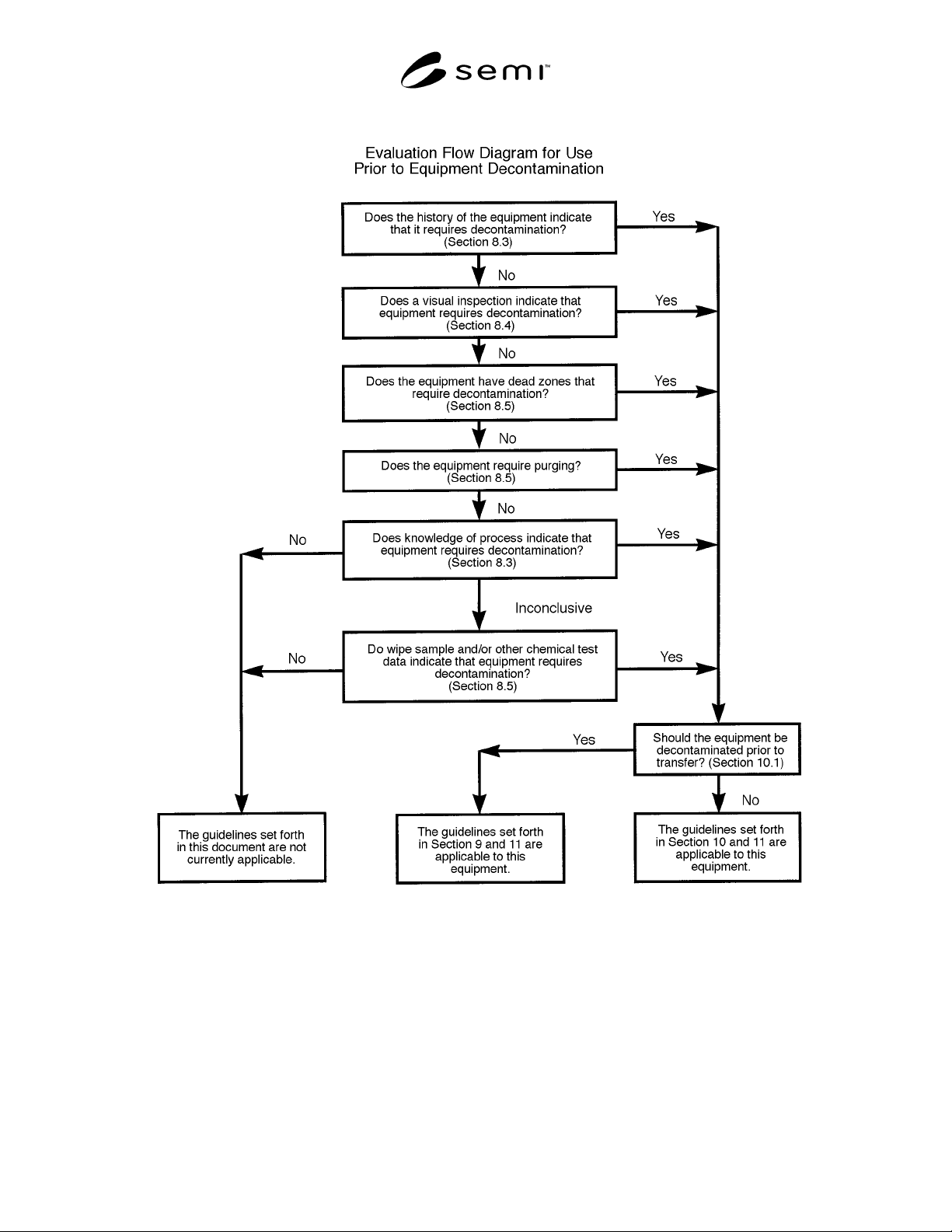
8.1 An assessment should be performed on all
equipment prior to transfer. Assessment of equipment
should initially consider history of the equipment and
visual inspection. If initial assessment shows a potential
for equipment to have contacted hazardous materials
during the life of the equipment, further assessment
needs to be performed. (See the flowchart in Figure 1.)
SEMI S12-0298 © SEMI 19983
Figure 1
Equipment Assessment Flowchart
8.2 Prior to decontamination, the equipment should be evaluated for abnormalities or non-functionality that may
affect the evaluation and decontamination efforts.
8.3 Decontamination should be performed on all areas of equipment which had potentially contacted hazardous
materials during the life of the equipment, unless the areas are judged non-hazardous by the criteria set forth in this
section. The areas to be decontaminated include external surfaces, internal areas which are accessible without
disassembly, and areas accessible during normal operations. Normally inaccessible areas should be addressed on a
case-by-case basis by the site Environmental, Health, and Safety organization. Normally removable parts may also
require cleaning.