semi合集-English.pdf - 第696页
SEMI E89-1104 E © SEMI 1999, 2004 23 R6-3.4.2 The calculation for SS L is 3 2 1 28 1.5336 Lj j SS Y Y (R6-17) where j Y is the mean for the j th load and Y the grand m ean. R6-3.4.2 .1 In gene…
SEMI E89-1104
E
© SEMI 1999, 2004 22
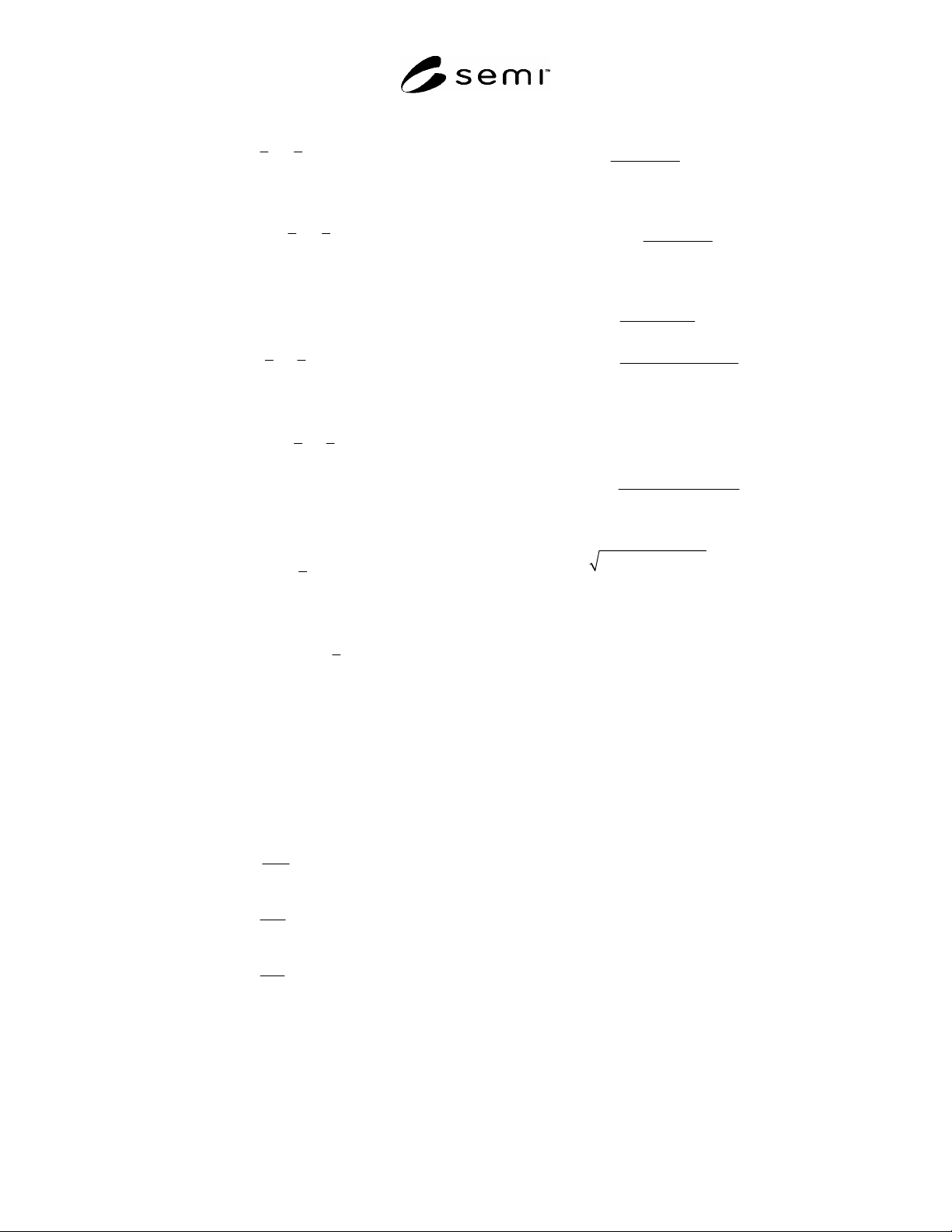
R6-2.5 Calculate the Sum of Squares for Day (SS
D
) as
4
2
1
21 43395
Di
i
SS Y Y
(R6-2)
R6-2.5.1 In general, the formula for SS
D
is
2
1
D
Dd i
i
SS n Y Y
(R6-3)
where n
d
is the number of observations per day and D
the number of days.
R6-2.6 Calculate the Sum of Squares for Load (SS
r
):
34
2
11
7 4.5352
Liji
ji
SS Y Y
(R6-4)
R6-2.6.1 In general, the formula for SS
L
is
2
11
LD
Liji
ji
SS n Y Y
(R6-5)
where n is the number of repeats per load and L the
number of loads.
R6-2.7 Calculate the Sum of Squares for Repeat (SS
r
):
734
2
111
28.6925
r ijk ij
kji
SS Y Y
(R6-6)
R6-2.7.1 In general, the formula for SS
r
is
2
111
nLD
r ijk ij
kji
SS Y Y
(R6-7)
R6-2.8 Calculate the degrees of freedom for Day (df
D
)
as D – 1. Calculate the degrees of freedom for Load
(df
L
) as D(L – 1). Calculate the degrees of freedom for
Repeat (df
r
) as DL(n – 1).
R6-2.9 Calculate the Mean Squares for Day (MS
D
),
Load (MS
L
), and Repeat (MS
r
) as the Sum of Squares
divided by degrees of freedom
14465
D
D
D
SS
MS
df
(R6-8)
0.5669
L
L
L
SS
MS
df
(R6-9)
0.3985
r
r
r
SS
MS
df
(R6-10)
R6-2.10 The variance component for Repeatability
(VC
r
) is MS
r
.
R6-2.11 The variance component for Load is
0.02241
7
Lr
L
MS VC
VC
(R6-11)
R6-2.11.1
In general, the formula for VC
L
is
L
r
L
M
SVC
VC
n
(R6-12)
R6-2.12 The variance component for Day is
21
7
21
688.7806
DL
D
D
Lr
MS MS
VC
M
SVCVC
(R6-13)
R6-2.12.1 In general, the formula for VC
D
is
D
Lr
D
M
S LVC VC
VC
nL
(R6-14)
R6-2.13 Reproducibility is
26.25
rrLD
VC VC VC
(R6-15)
R6-3 Crossed Effects
R6-3.1 Assume, instead, that each sample represents
measurements made on different wafers randomly
sampled from a population of wafers.
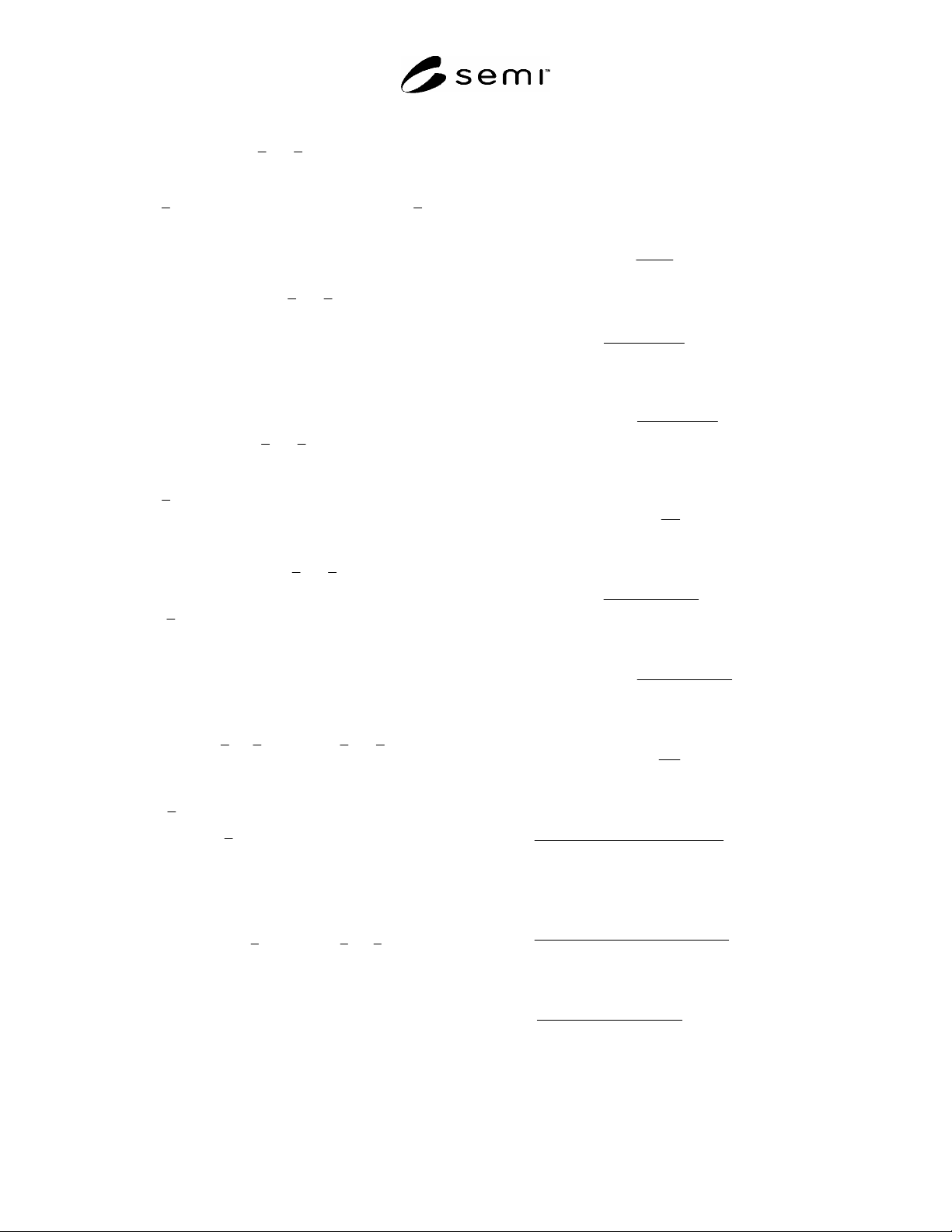
R6-3.2 The model for the MSA is
Y
ijk
=
+ w
i
+ l
ij
+ r
ijk
+ w
i
*l
ij
+ w
i
*r
ijk
(R6-16)
Y
ijk
= measurement on the i
th
wafer, j
th
load, and k
th
repeat,
= true value of the measurand,
w
i
= error term associated with the i
th
wafer,
l
ij
= error term associated with the i
th
wafer, j
th
load,
r
ijk
= error term associated with the i
th
wafer, j
th
load, k
th
repeat,
w
i
*l
ij
= interaction between wafer and load, and
w
i
*r
ijk
= interaction between wafer and repeat.
R6-3.3 In this case, Load would be crossed with Wafer
because it is possible to randomize the wafer in which a
load is observed. Repeat (when treated as nested in
Load) is also crossed with Wafer for the same reason.
R6-3.4 Calculate the Sum of Squares for Wafer (SS
W
),
Load (SS
L
), Repeat (SS
r
), Load by Wafer (SS
LxW
), and
Repeat by Wafer (SS
rxW
)
R6-3.4.1 The calculation of SS
W
is identical to the
calculation of SS
D
shown in Equation 2.
SEMI E89-1104
E
© SEMI 1999, 2004 23
R6-3.4.2 The calculation for SS
L
is
3
2
1
28 1.5336
Lj
j
SS Y Y
(R6-17)
where
j
Y
is the mean for the j
th
load and Y
the
grand mean.
R6-3.4.2.1 In general, the formula for SS
L
is
2
1
L
Lj
j
SS wn Y Y
(R6-18)
where w is the number of wafers, n the number of
repeats per load, and L the number of loads on each
wafer.
R6-3.4.3 The calculation for SS
r
is
37
2
11
4 7.9095
rjkj
jk
SS Y Y
(R6-19)
Where
j
k
Y
is the mean for the j
th
load, k
th
repeat.
R6-3.4.3.1 In general, the formula for SS
r
is
2
11
Ln
rjkj
jk
SS w Y Y
(R6-20)
where
j
k
Y
is the mean for each load-by-repeat
combination.
R6-3.4.4
Sum of Squares for Load by Wafer (SS
LxW
) is
the difference between SS
L
calculations in Equations
R6-4 and R6-15
34 3
22
x
11 1
728
3.0016
LW ij i j
ji j
SS Y Y Y Y
(R6-21)
where
ij
Y
is the mean for each load-by-wafer
combination and
i
Y
is the mean for each wafer.
R6-3.4.5 Sum of Squares for Repeat by Wafer (SS
rxW
)
is the difference between SS
L
calculations in Equations
R6-6 and R6-17
734 37
22
x
111 11
4
20.783
r W ijk ij jk j
kji jk
SS Y Y Y Y
(R6-22)
R6-3.5 Calculate the degrees of freedom for Wafer
(df
W
), w – 1, Load (df
L
), L – 1, Repeat (df
r
), L(n – 1),
Load by Wafer (df
LxW
), (L – 1)(w – 1), and Repeat by
Wafer (df
rxW
), L(n – 1) (w – 1).
R6-3.6 Calculate the Mean Squares for Wafer (MS
W
),
Load (MS
L
), Repeat (MS
r
), Load by Wafer (MS
LxW
), and
Repeat by Wafer (MS
rxW
) as the Sum of Squares divided
by degrees of freedom.
R6-3.7 The variance component for Repeat by Wafer
(VC
rxW
) is equal to MS
rxW
x
x
x
0.3849
rW
rW
rW
SS
VC
df
(R6-23)
R6-3.8 The variance component for Repeat (VC
r
) is
x
0.01364
4
rrW
r
MS VC
VC
(R6-24)
R6-3.8.1 In general, the equation for VC
r
is
xrrW
r
MS VC
VC
w
(R6-25)
If N is the total number of observations, then the
denominator is derived from
N
w
nL
(R6-26)
R6-3.9 The variance component for Repeat (VC
LxW
) is
xx
x
0.01649
7
LW rW
LW
MS VC
VC
(R6-27)
R6-3.9.1 In general, the equation for VC
LxW
is
xx
x
L
WrW
LW
MS VC
VC
n
(R6-28)
The denominator is derived from
N
n
Lw
(R6-29)
R6-3.10
The variance component for Load (VC
L
) is
xx
74
28
0.00757
L
LW r rW
L
MS VC VC VC
VC
(R6-30)
R6-3.10.1 In general, the equation for VC
L
is
xx
L
LW r rW
L
MS nVC wVC VC
VC
nw
(R6-31)
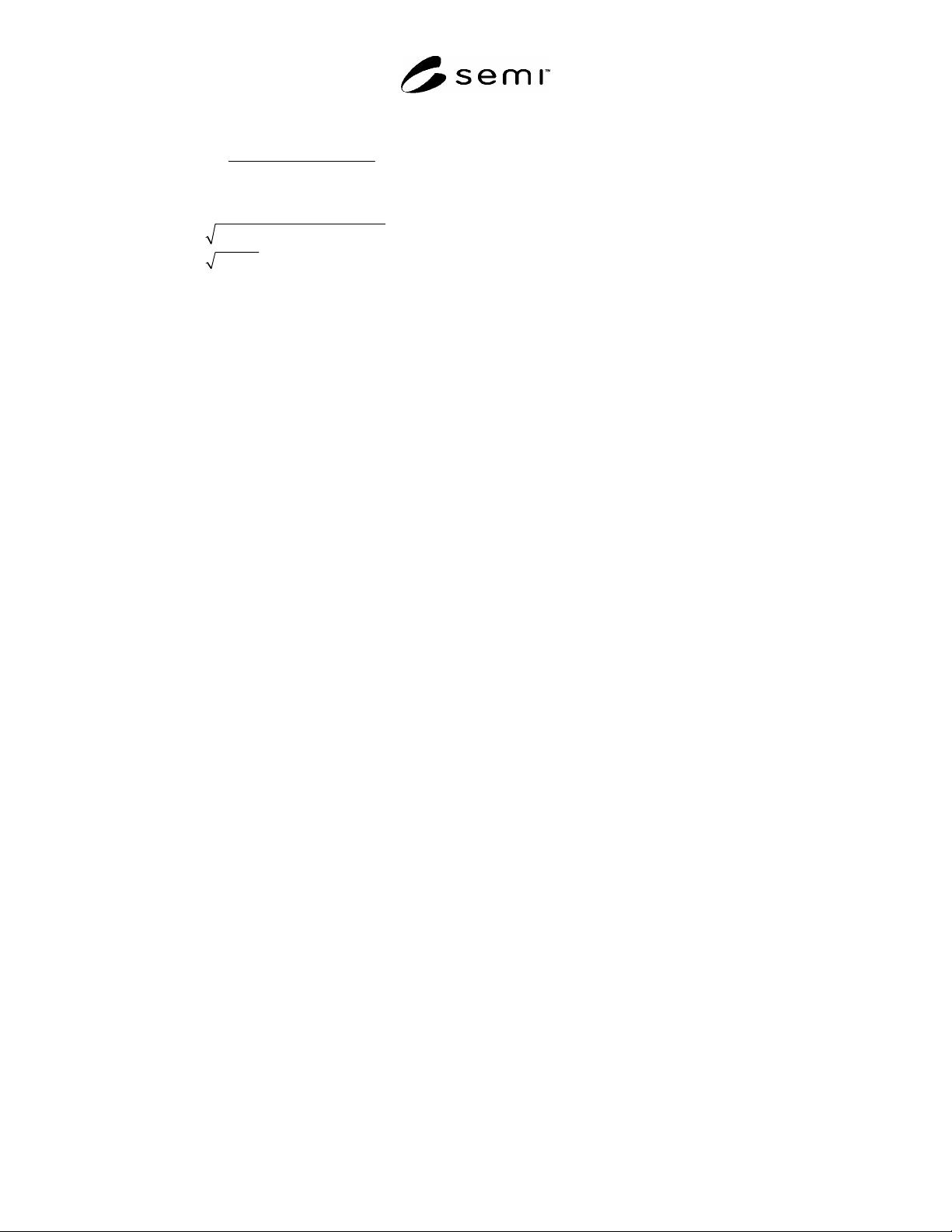
R6-3.11 The variance component for Wafer (VC
W
) is
xx
7
688.78
21
WLWrW
W
MS VC VC
VC
(R6-32)
SEMI E89-1104
E
© SEMI 1999, 2004 24
R6-3.11.1 In general, the equation for VC
W
is
xxWLWrW
W
MS nVC VC
VC
nL
(R6-33)
R6-3.12
Reproducibility is
xx
0.4225
0.65
rrLrWLW
VC VC VC VC
(R6-34)
R6-3.12.1 Typically, VC
W
is not included in
reproducibility because it is a function of true
differences on the measurand. If, however, the
measurands are known to be the same value, and
differences are associated with measurement variability,
it should be included in reproducibility.
NOTICE: SEMI makes no warranties or
representations as to the suitability of the standards set
forth herein for any particular application. The
determination of the suitability of the standard is solely
the responsibility of the user. Users are cautioned to
refer to manufacturer's instructions, product labels,
product data sheets, and other relevant literature,
respecting any materials or equipment mentioned
herein. These standards are subject to change without
notice.
By publication of this standard, Semiconductor
Equipment and Materials International (SEMI) takes no
position respecting the validity of any patent rights or
copyrights asserted in connection with any items
mentioned in this standard. Users of this standard are
expressly advised that determination of any such patent
rights or copyrights, and the risk of infringement of
such rights are entirely their own responsibility.
Copyright by SEMI® (Semiconductor Equipment and Materials
International), 3081 Zanker Road, San Jose, CA 95134. Reproduction of
the contents in whole or in part is forbidden without express written
consent of SEMI.