semi合集-English.pdf - 第6269页
SEMI G53-92 © SEMI 1992 1 SEMI G53-92 SPECIFICA TION FOR METAL LID/PREFOR M A SSEM BLY 1 Preface 1.1 Scope — This specification pr o vi des guidelines for the design and acceptan ce of metal lid/preform assemblies (see F…
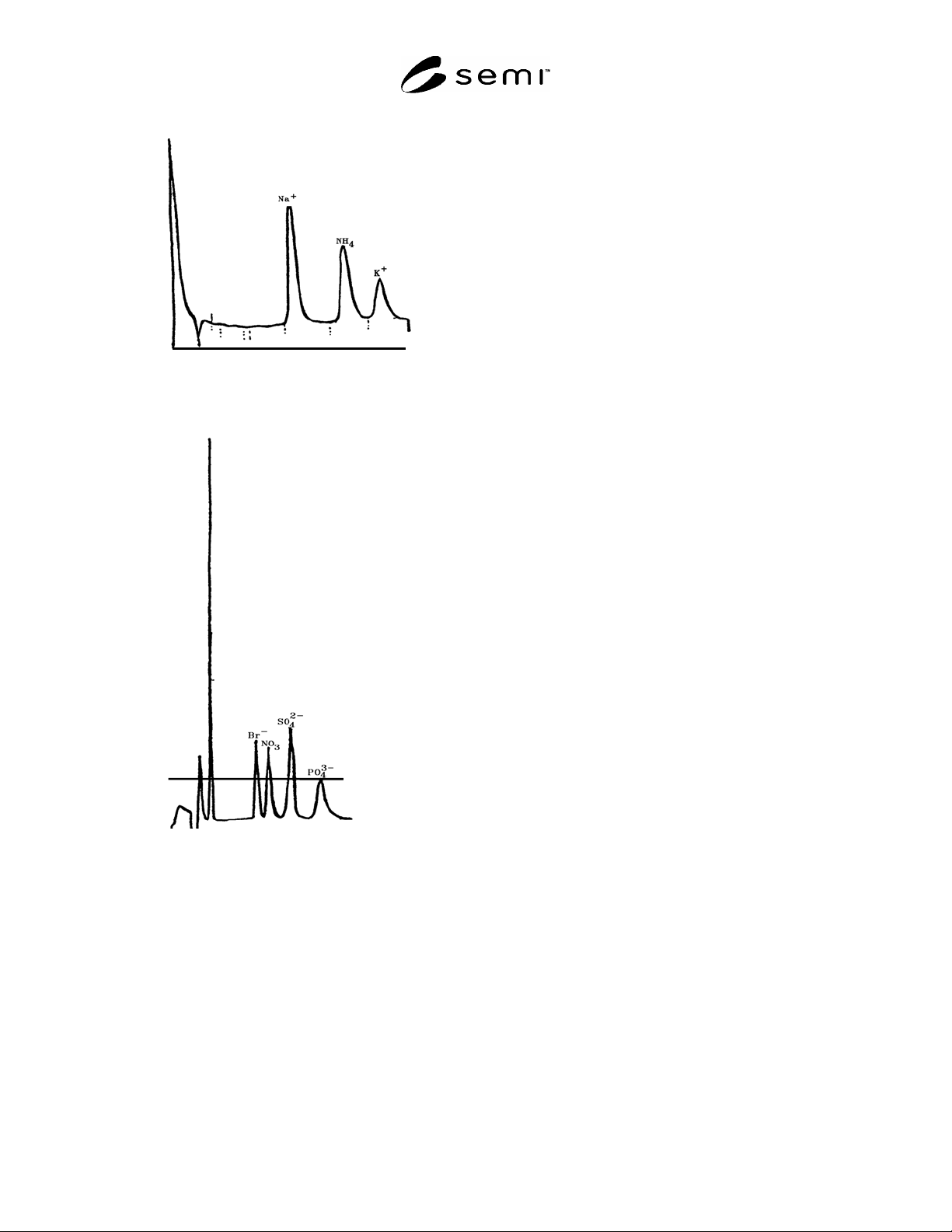
SEMI G52-90 © SEMI 1990, 2004 4
Retention Time (Min.)
0
5
10
Cation
10
0
5
Retention Time (Min.)
A
nion
+
2
–
Figure 1
Schematic of Ion Chromatograph
NOTICE: SEMI makes no warranties or
representations as to the suitability of the standards set
forth herein for any particular application. The
determination of the suitability of the standard is solely
the responsibility of the user. Users are cautioned to
refer to manufacturer’s instructions, product labels,
product data sheets, and other relevant literature
respecting any materials mentioned herein. These
standards are subject to change without notice.
The user’s attention is called to the possibility that
compliance with this standard may require use of
copyrighted material or of an invention covered by
patent rights. By publication of this standard, SEMI
takes no position respecting the validity of any patent
rights or copyrights asserted in connection with any
item mentioned in this standard. Users of this standard
are expressly advised that determination of any such
patent rights or copyrights, and the risk of infringement
of such rights, are entirely their own responsibility.
Copyright by SEMI® (Semiconductor Equipment and Materials
International), 3081 Zanker Road, San Jose, CA 95134. Reproduction of
the contents in whole or in part is forbidden without express written
consent of SEMI.

SEMI G53-92 © SEMI 19921
SEMI G53-92
SPECIFICATION FOR METAL LID/PREFORM ASSEMBLY
1 Preface
1.1 Scope — This specification provides guidelines for
the design and acceptance of metal lid/preform
assemblies (see Figure 1). This specification may be
used by suppliers at outgoing inspection and by the
customers at incoming inspection.
The design and acceptance criteria may be used for
metal lid/preform assemblies used on all types of
semiconductor packages.
1.2 Significance — Improper lid/preform design and
poorly specified lid/preforms contributes to low sealing
yields and unreliable devices.
1.3 Units — U.S. Customary (inch -pound) or SI
(metric) units may be used at the customer’s discretion.
This specification uses U.S. Customary units as the
prime unit.
2 Applicable Documents
2.1 Order of Precedence — To avoid conflicts, the
order of precedence when ordering metal lid-preform
assemblies shall be as follows:
Purchase Order
Customer’s Lid-Preform Drawing
This Specification
Reference Documents
Related Documents
2.2 Referenced Documents
2.2.1 Military and Federal Specifications
1
MIL-STD 883 — Test Methods and Procedures for
Microelectronics
MIL-M-38510 — General Specification for
Microcircuits
2.2.2 ANSI Specification
2
Y14.5M — Dimensioning and Tolerancing
2.2.3 ASTM Specification
3
B 568 — Measurement of Coating Thickness by X-Ray
Spectrometry
1 Military Standards, Naval Publications and Form Center, 5801
Tabor Avenue, Philadelphia, PA 19120
2 ANSI, 1430 Broadway, New York, NY 10018
3 American Society of Testing and Materials, 100 Barr Harbor Drive,
West Conshohoken, PA 19428-29597
E 10 — Standard Test Method for Brinell Hardness of
Metallic Materials
E 384 — Standard Test Method for Microhardness of
Materials
E 29 — Practice for Using Significant Digits in Test
Data to Determine Conformance to Specifications
E 1182 — Measurement of Surface Layer Thickness by
Radial Sectioning
3 Definitions
blister — any enclosed localized separation of the
plating from the base material or from another layer of
plating which can be depressed by a sharp instrument.
bow — relative flatness of the preform to the lid after
spot welding.
burr — an adherent fragment of parent material, lid or
preform, at the edge of the lid or preform.
chipout — a region of material which is missing from
the surface or edge of the lid or preform.
contamination — three dimensional alien material
adhering to a surface.
corrosion — electrochemical degradation of the
material usually exhibited by discoloration such as rust.
crack — a cleavage or fracture which extends to the
surface of the lid or through the preform.
discoloration — any change in the color of the plating
as detected by the unaided eye which normally occurs
after the application of heat.
foreign material — an adherent particle other than
parent material of that component.
NOTE: Adherent means inability to be removed with an air or
Nitrogen blow-off at 20 psi.
gouges — mechanically formed depressions in the lid
surface.
nodules — lumps of plating extending above the
surface of the lid.
oil canning — lid concavity after sealing.
peeling — the lifting of plating from a surface.
pit — a hole or depression extending below the surface
of the lid or preform.
preform — a solder material of defined volume that is
attached to the base material.
SEMI G53-92 © SEMI 1992 2
protrusion — an adherent fragment of excess material
on the surface of lid or preform.
scratch — surface mark which exposes underlying
metal.
seal ring — area designated for attaching the lid to the
package by welding or soldering techniques.
stain — a two-dimensional substance on a surface of
the lid or preform.
tack weld — small spot welds, generally located in the
corners which are used to attach the preform to the lid.
void — absence of plating from designated area.
weld splatter — melted preform material which extends
from the weld.
4 Ordering Information
Purchase orders for metal lid/preform assemblies
furnished to this specification shall include the
following information.
4.1 Current customer drawing revision detailing:
All dimensions and tolerances per ANSI Y14.5M
Base material and hardness
Type, and thickness of the plating(s)
Preform type and composition
4.2 Reference to this specification.
4.3 Supplier certification requirements
4.4 Any additions to, or variations from, this
specification.
5 Materials
The definitions, design guidelines, defect criteria, and
functional tests described in this specification relate to
lid/preform assemblies made with the following
materials.
5.1 Lid
5.1.1 Base material to be Iron Nickel Cobalt alloy per
MIL-M-38510, Type A; OR Iron Nickel alloy per MIL-
M-38510, Type B unless otherwise stated on the
purchase order.
5.1.2 Plating shall meet the requirements of MIL-M-
38510 unless otherwise stated in the purchasing
document.
5.2 Preform
5.2.1 Preform to be 80% (+0/-1% tolerance) gold,
balance to be tin unless otherwise stated on the
purchase order. Gold and tin to be 99.99% pure per
ASTM E 29.
Maximum Trace Elements
Silver (Ag) 100 ppm
Copper (Cu) 50 ppm
Lead (Pb) 50 ppm
Palladium (Pd) 20 ppm
Iron (Fe) 10 ppm
Others 10 ppm each
Total all impurities: 149 ppm
6 Design Guidelines
These guidelines are based on the use of a furnace
sealing process, not seam sealing.
6.1 General Guidelines
6.1.1 The I.D. of the lid preform should be 0.010
larger than the package seal ring I.D. as long as preform
width specifications are not violated.
6.1.2 The O.D. of the lid should be 0.025" to 0.035"
smaller than the package seal ring O.D. as long as
preform width specifications are not violated.
NOTE: The dimensions listed are based on nominal
tolerances only. The worst case package and lid conditions
must be considered.
6.1.3 Recommendations — The following table is a
guideline only. Specific requirements may differ
depending on the package type or style.