semi合集-English.pdf - 第587页
SEMI E79-0304 © SEMI 1999, 2004 21 • Nominal parameters are more representative of the physical systems bei ng studied. • Nominal parameters are more representative of the desired system perform ance. • It is not pr acti…
SEMI E79-0304 © SEMI 1999, 2004 20
Pre-AlignLoad
Set & Align
Load Box
Reticle Handler
Pre-Align Chuck
x (# wafers per reticle)
Exposure Stage
1.1 ExposeTransfer Transfer
Pre-AlignLoad
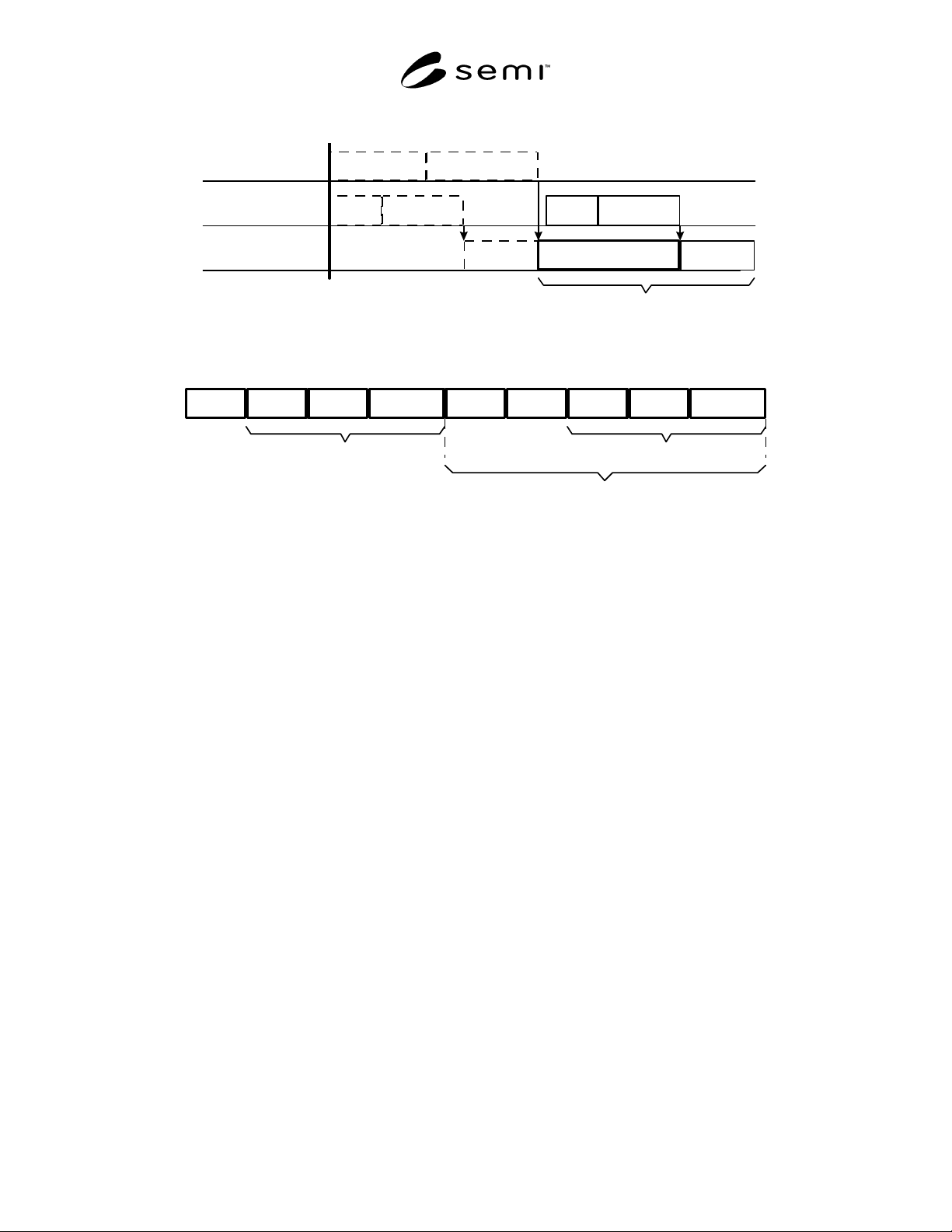
Figure R1-1
Example Resource Utilization Sequence
Step
Align Level Expose
x (# exposures)
Blade
Align
x (# exposures)
x (# images-1)
Step Level Expose
Figure R1-2
Example of Equipment Sub-Sequence
R1-2.10.3 The operations indicated by dashed boxes
represent the beginning phase of the main equipment
sequence. If the stepper is capable of processing wafers
of the same reticle indefinitely, then the beginning
phase is not included in theoretical production time. If,
however, there is a hardware and/or software limit to
the number of wafers that may be run consecutively,
then the beginning phase shall be counted in theoretical
production time.
R1-3 Modeling Theoretical Durations for
Operational Elements
R1-3.1 Once a theoretical equipment sequence is
defined, the next step is to measure and/or model
theoretical durations for each operational element in the
sequence. As a rule, it is preferable to acknowledge in
the model an elemental speed loss that can never be
recovered in lieu of inadvertently overlooking another
loss that could be reduced or eliminated.
R1-3.2 Legitimate Observations — Each theoretical
element duration should always be less than or equal to
any legitimate observation for that element, where a
legitimate observation is a traceable instance of an
operational element that does not result in a loss of
quality. The time for any legitimate observation that is
less than the existing theoretical element duration
should become the new theoretical element duration.
For legitimate instances of the same operational
element on different instances of identically configured
equipment, the best time observed among all equipment
of that type should be used as the theoretical element
duration.
R1-3.3 Basis for Theoretical Element Durations —
Theoretical element durations may be based on time
studies, nominal parameters, and/or parametric
modeling.
R1-3.3.1 Time Studies Most mechanical operational
elements that have fixed execution times, like transport
and load lock operations, can be accurately determined
by time studies using either stopwatches, equipment
data acquisition systems, timing systems built into the
equipment, or stand-alone data acquisition systems that
use sensors to detect equipment events and/or state
changes.
R1-3.3.1.1 When it is difficult to directly measure
individual elements, collections of elements may be
observed and timed instead. On systems where a
number of consecutive identical elements occur too fast
to be measured individually, a set of elements should be
timed, and the time should be divided by the number of
elements in the set. For even more complicated
situations, element times may be derived algebraically
from observations of several linearly independent sets
of operational elements.
R1-3.3.2 Nominal Parameters — There are instances
where it is desirable to use nominal parameters to
represent theoretical conditions rather than using direct
observations, such as when:

SEMI E79-0304 © SEMI 1999, 2004 21
• Nominal parameters are more representative of the
physical systems being studied.
• Nominal parameters are more representative of the
desired system performance.
• It is not practical to obtain reliable data.
R1-3.3.3 Parametric Models — For cases where the
time for an operational element may have a range of
values that are dependent on recipe specifications,
theoretical time is best represented by a parametric
model. Parametric models for representing
semiconductor operations may be based on
mathematical formulas, e.g., implant time versus beam
current, and/or “lookup” tables, e.g., best observed etch
time vs. etch end point.
R1-3.3.3.1 For the photolithography example, one of
the recipe parameters is the exposure energy (EE).
Given the ideal or theoretical lamp intensity (LI) of the
stepper, the theoretical duration per exposure (THT
EX
)
for the recipe may be calculated as THT
EX
= EE / LI .

SEMI E79-0304 © SEMI 1999, 2004 22
RELATED INFORMATION 2
RAPID CHARACTERIZATION OF INTRINSIC EQUIPMENT EFFICIENCY
(IEE) AND THE PRODUCTIVITY EFFICIENCY PLANE
NOTICE: This related information is not an official part of SEMI E79. This related information was approved for
publication by vote of the responsible committee on December 15, 1999.
R2-1 Rapid Characterization of Intrinsic
Equipment Efficiency
R2-1.1 IEE may be rapidly characterized as follows
using a limited number of production experiments.
R2-1.2 Step 1: Design Production Experiments —
Select a limited number of scenarios to execute as
equipment experiments. It may be of interest to
characterize IEE according to either operating modes,
processing diversity, or a combination of operating
modes and process diversity.
R2-1.2.1 Determine the value-added in-process
theoretical production time per unit (VTHT) – (time per
unit) for all recipes involved. This information is
required for determining IEE. See Table A2-1.
R2-1.2.2 For assessment of operating modes,
experiments should examine only a single typical recipe
that is likely to be used most frequently. Each
experiment should examine a separate operating mode,
where examples of various equipment operational
modes may be as follows:
One wafer at a time mode (production monitor
wafer).
One batch is run, then the tool stops.
Two batches are run, then the tool stops.
Three batches are run, then the tool stops.
Continuous (cascade) mode. A larger number of
batches is run, then the tool stops.
R2-1.2.3 For assessment of process diversity, select a
limited number of representative recipes that will be
processed by a tool. This population should include at
least one recipe representing the minimum expected
processing duration and one representing the maximum.
R2-1.2.4 Each experiment should be designed and
executed to eliminate rate efficiency losses to the
greatest extent possible. It is further assumed that
quality efficiency losses are zero. Under this
approximation, (VA-OEE) = (OEE)
× (IEE).
R2-1.3 Step 2: Execute Process Experiments —
Perform process experiments recording all relevant
input variables including the configuration of lots and
wafers, and recipes. For each experiment, record the
elapsed production time using convenient means, e.g.,
stopwatch or existing data acquisition system.
R2-1.4 Step 3: Calculate Results — Calculate IEE and
throughput for each experiment. IEE may be used to
measure the effect of non-value-added overhead time
during equipment processing. Approximately:
Intrinsic Equipment Efficiency (IEE)
= (Value-Added In-Process Theoretical Time)
/(Non-Value-Added Overhead Time
+ Value-Added In-Process Theoretical Time)
R2-1.4.1 Hence, non-value-added overhead time for
each experiment may be calculated as:
Non-Value-Added Overhead Time
= [(Production Time)
- ( Value-Added In-Process Theoretical Time)]
R2-1.4.2 It should be the focus of efforts by the
equipment supplier and the end-user to reduce or
eliminate non-value-added overhead time through
improved equipment design, including scheduling
software, as well as hardware components (carrier and
wafer handling systems, valves, pumps, heaters,
coolers, etc.).
R2-1.4.3 Results may be shown in either tabular form
or plotted graphically on a Productivity Effectiveness
Plane. See Section R2-2.