semi合集-English.pdf - 第3341页
SEMI E130-1104 © SEMI 2003, 2004 55 Table R2-1 Self-Index ing State Trans ition Table #. Current State Trigger New State Action Comment 19 IDLE A process job has been dispatched. VERIFYING Actions taken correspond to pre…
SEMI E130-1104 © SEMI 2003, 2004 54
RELATED INFORMATION 2
NOTICE: This related information is not an official part of SEMI E130 and was derived from the work of the
originating task force. This related information was approved for publication by full letter ballot procedures on
September 3, 2003.
R2-1 Application for Self-Indexing Probing
R2-1.1 Following ideas for implementation of specific integrations are not a part of this specification but
applications for some regency solution to maximize compliance to this specification.
R2-1.2 Some wafer prober with combined specific IC testers may index dice automatically by itself synchronized
with such communication as GPIB or RS-232C between tester and prober. According state model in this
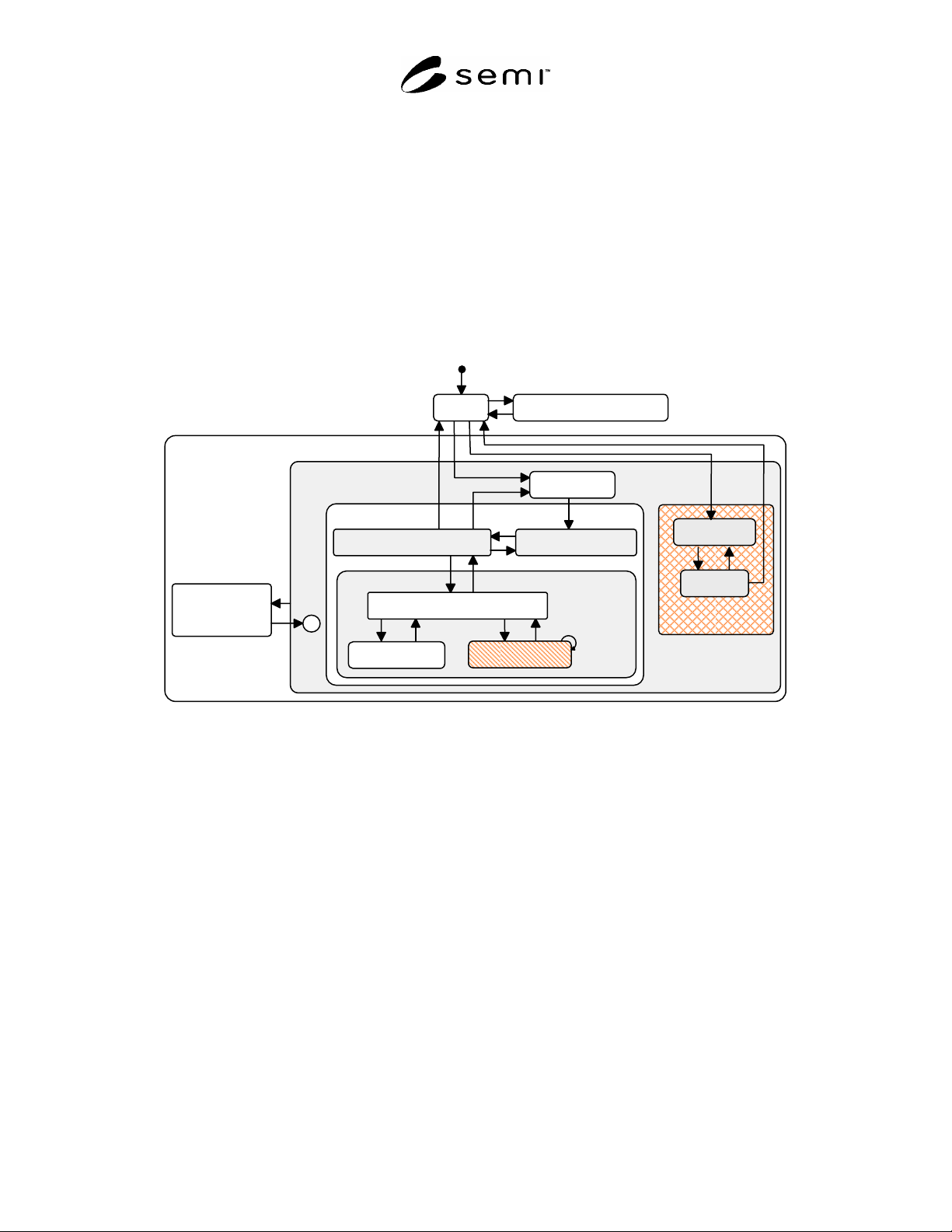
specification, a series of this automated indexing and testing could be execution of a service task (hatched area in
following diagram).
PROCESS
EXECUTING
PROCESSING
BLOCKED
3
C
16
15
4
5
SUBSTRATE
LOADED
6
8
10
9
11
12
13
2
IDLE
SETTING UP
AWAITING COMMAND
HANDLING MATERIAL
AWAITING LOAD
7
IDLE WITH ALARMS
PROCESSING ACTIVE
17
18
14
1
SERVICE TASK
MOVING XYZ
VERIFYING
SORTING
20
21
AUTOPROBING
19
22
Figure R2-1
Self-Indexing State Model
R2-1.2.1 For the other application to distinguish this normal probing task from such generic service tasks as
Cleaning Probes, adding substate “AUTOPROBING” in the state of “PROCESS” is one of ideas as an extension of
this specification. The diagram above illustrates the extension (cross-hatched substate) of a part of the state model
in this specification. This extension also eliminates loading/unloading remote commands and related states, and is
more close to processing state in SEMI E91 (PSEM).
R2-1.2.2
Above diagram illustrates the extension (cross-hatched substate) of a part of the state model in this
specification. Clarification of extended sub-states and transitions are given below.
R2-1.3 AUTOPROBING — Automatic processing state without instruction of host. Programmed such service
operations as inking cleaning are included in this states as well as probing sequence with automated self indexing
dice. Usually prober communicates with tester through serial or parallel cable in this state.
R2-1.4 VERIFYING — One of substates of AUTOPROBING. This states starts before loading the first wafer of PJ
and concludes when all set-up conditions and all alignments for the first wafer of PJ including needle-pad alignment
for the first dice on the first wafer is completed.
R2-1.5 SORTING — One of substates of AUTOPROBING. Prober executes processing automatically without
specific host instruction. The prober needs thecapability to index to the right dice by itself, communicate with the
tester, and execute programmed sequences including such service operation as cleaning and inking.

SEMI E130-1104 © SEMI 2003, 2004 55
Table R2-1 Self-Indexing State Transition Table
#. Current State Trigger New State Action Comment
19 IDLE A process job has been
dispatched.
VERIFYING Actions taken
correspond to
preconditioning
activities within the E40
Process Job including
loading the first wafer.
Check all alignment and
set-up conditions.
A part of verification may
be done by human operator.
Some prompt, usually
sound and/or light, to
instruct human verification
may be expected when
such operation is required.
20 VERIFYING All required alignment
for the first wafer of the
PJ is completed
including verification of
needle-pad alignment
for the first dice.
SORTING Start automated process.
21 SORTING Such processing
condition as recipe
parameter is updated.
VERIFYING Check all alignment and
set-up conditions.
An optional transition.
Same as transition 19.
22 SORTING The PJ is completed and
all materials of the PJ is
restored in carriers.
IDLE There are no active process
jobs at this time.
NOTICE: SEMI makes no warranties or representations as to the suitability of the standards set forth herein for any
particular application. The determination of the suitability of the standard is solely the responsibility of the user.
Users are cautioned to refer to manufacturer’s instructions, product labels, product data sheets, and other relevant
literature, respecting any materials or equipment mentioned herein. These standards are subject to change without
notice.
By publication of this standard, Semiconductor Equipment and Materials International (SEMI) takes no position
respecting the validity of any patent rights or copyrights asserted in connection with any items mentioned in this
standard. Users of this standard are expressly advised that determination of any such patent rights or copyrights, and
the risk of infringement of such rights are entirely their own responsibility.
Copyright by SEMI® (Semiconductor Equipment and Materials
International), 3081 Zanker Road, San Jose, CA 95134. Reproduction of
the contents in whole or in part is forbidden without express written
consent of SEMI.

SEMI E130.1-1104 © SEMI 2004 1
SEMI E130.1-1104
SPECIFICATION FOR SECS-II PROTOCOL FOR PROBER SPECIFIC
EQUIPMENT MODEL FOR 300 mm ENVIRONMENT (PSEM300)
This specification was technically approved by the Global Information & Control Committee and is the direct
responsibility of the North American Information & Control Committee. Current edition approved by the
North American Regional Standards Committee on July 11, 2004. Initially available at www.semi.org
September 2004; to be published November 2004.
1 Purpose
1.1 This document maps the services and data of SEMI
E130 to SECS-II streams and functions, and data
definitions.
2 Scope
2.1 This is a specification covering equipment
supporting automated communication of the prober
equipment.
2.2 This document applies to all implementations of
SEMI E130 that use the SECS-II message protocol
(SEMI E5). Compliance to this standard requires
compliance to both SEMI E130 and SEMI E5.
NOTICE: This standard does not purport to address
safety issues, if any, associated with its use. It is the
responsibility of the users of this standard to establish
appropriate safety and health practices and determine
the applicability of regulatory or other limitations prior
to use.
3 Limitations
3.1 This specification applies to semiconductor
equipment that also use SEMI E30 GEM standard.
3.2 PSEM300-compliant equipment must support High
Speed Messaging Service (SEMI E37) communication
standard for sending SEMI E5 messages over TCP/IP.
4 Referenced Standards
4.1 SEMI Standards
SEMI E5 SEMI Equipment Communications
Standard 2 Message Content (SECS-II)
SEMI E30 Generic Model for Communications and
Control of Manufacturing Equipment (GEM)
SEMI E37 High Speed SECS Message Services
(HSMS) Generic Services
SEMI E123 Handler Specific Equipment Model
(HSEM)
NOTICE: Unless otherwise indicated, all documents
cited shall be the latest published versions.
5 Service Message Mapping
5.1 This section shows the specific SECS-II streams
and functions that shall be used for SECS-II
implementation of the services or remote commands
defined in SEMI E130, as well as the parameter
mapping for data attached to services.
5.2 Services Message Mapping
5.2.1 Table 1 defines the relationships between SEMI
E130 services and SECS-II messages. Mapping of
service parameters to the SECS-II data items is
provided in a separate table. Conventions and
definitions of table fields are as described below.
5.2.2 Service Name — Name of the service or remote
command defined in SEMI E130.
5.2.3 Stream, Function — Specifies the SECS-II
stream and function (SxFx) mapped to the service
messages. Following convention of SECS-II, request
and notification messages are mapped to the odd-
numbered functions and response or acknowledgement
messages are mapped to the corresponding even-
numbered functions.
5.2.4 SECS-II Message Name — Name of the SECS-II
message.
Table 1 Services Message Mapping Table
Service Name Stream, Function SECS-II Message Name
CLEAN-PROBES S2,F49/F50 Enhanced Remote Command Send/Acknowledge
INDEX S2,F49/F50 Enhanced Remote Command Send/Acknowledge
INK-DEVICE S2,F49/F50 Enhanced Remote Command Send/Acknowledge
INK-DIE S2,F49/F50 Enhanced Remote Command Send/Acknowledge
INSPECT-INK-MARKS S2,F49/F50 Enhanced Remote Command Send/Acknowledge