semi合集-English.pdf - 第1667页
SEMI E39-0703 © SEMI 1995, 2003 9 9.3 Scope and Ownershi p — The hierarchical relationshi ps of aggre gations, containers, a nd supervisors may at times be required for pointing to a specific object. These relations hips…
SEMI E39-0703 © SEMI 1995, 2003 8
8.3 Object Definition — An object definition includes
an attribute definition table described in Section 5.3.
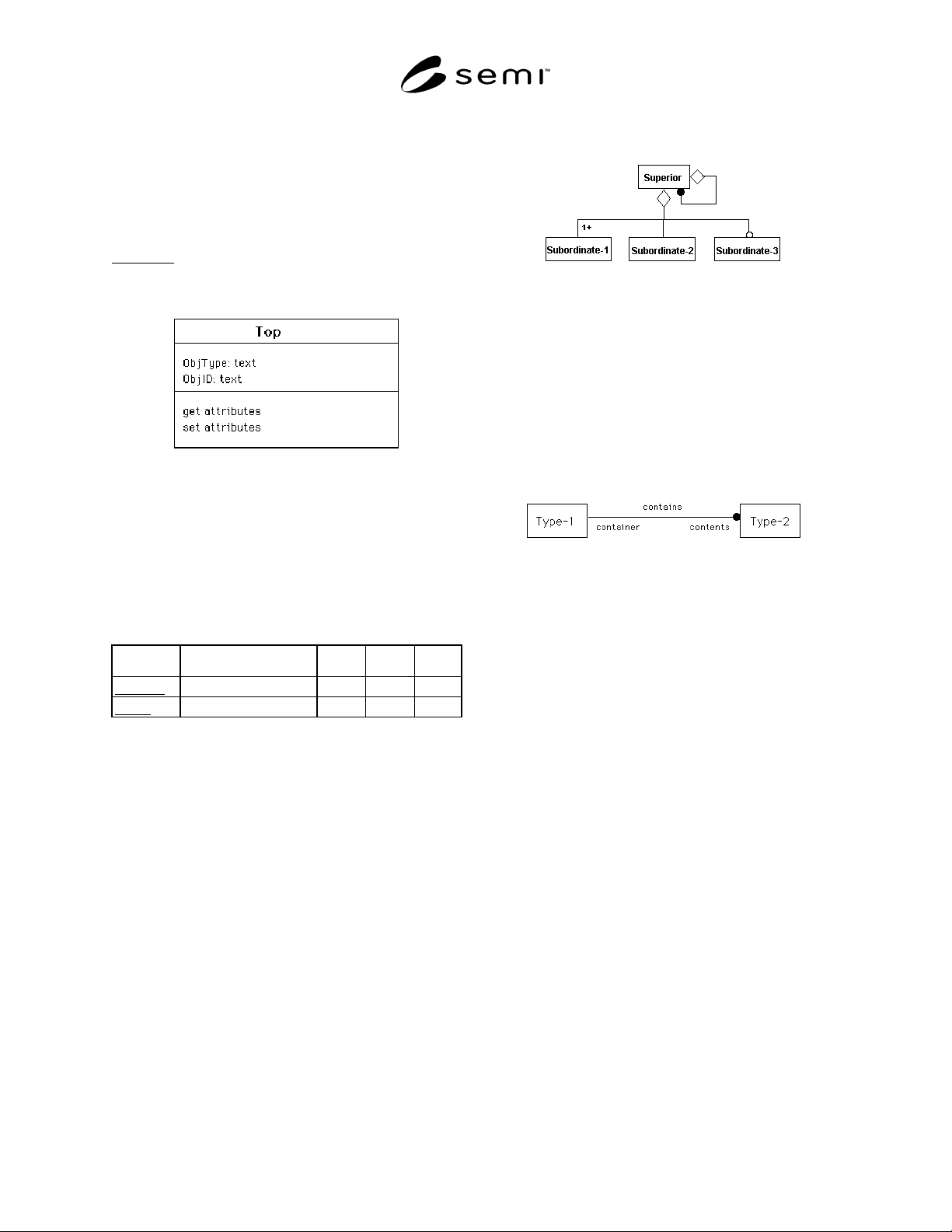
8.3.1 The object that is the super-type of all public
objects is called the top object. The attributes and
operations of the top object, shown in Figure 1, are
fundamental requirements for all public objects. That is,
all objects shall respond to the object attributes
ObjType
and text strings, and all public objects shall
recognize and respond to the operations get attributes
and set attributes.
Figure 1
Top Object
8.3.2 Formal definition of an object shall include a
table defining the object' s public attributes. The Object
Attribute Definition table for the top object is given in
Table 1 below. It contains the two fundamental
attributes required of all public objects.
Table 1 Top Object Attribute Definition
Name Definition Access Req Form
ObjType The object type. RO Y Text
ObjID The object' s identifier. RO Y Text
8.3.3 Access refers to the ability to read and write the
value of the attribute through OSS services. An
object’s type and identifier may not be changed through
OSS services. However, it may be possible for the
service user to assign a value for the object' s identifier
at the time the object (instance) is created. This depends
on the object and the services provided.
9 Object Relationships
9.1 This section addresses relationships between
objects that affect communications, either by restricting
communications or through information concerning
relationships.
9.2 Object Hierarchy — Certain objects may be
specified as aggregation objects or as container objects
when they are defined.
9.2.1 An aggregation object is composed of other
objects called the components of the aggregation. This
is illustrated in Figure 2. Components may be of one or
more different types, or they may be of the same type.
Figure 2
Aggregation with Two Component Types
9.2.2 Container objects contain other objects, of the
same or different types, but are not made up of them.
9.2.3 Figure 3 shows two object types that are
associated with a relationship called “contains.” The
solid circle indicates that Type-1 may contain zero or
more objects of Type-2 type. An example of a common
container type is a file directory.
Figure 3
Container and Contents
9.2.4 An aggregation loses some degree of integrity if
certain of its components are missing, while a container
retains full integrity even if it has no contents. An
automobile is an aggregation of many components,
some of which are themselves aggregations. An
automobile may also have contents (driver, passengers,
belongings) which are removable and not considered as
components. Other examples of container objects
include lists, dictionaries, and libraries. A container that
has no contents is said to be empty.
9.2.5 The aggregation or container is called the
superior object and its components or contents are
called subordinate objects.
9.2.6 In addition to the relationships of “is composed
of” (roles: aggregate/component) and “contains” (roles:
container/contents), the other hierarchical relationship
that occurs naturally in factories and in control systems
is that of “supervises” (roles: supervisor/supervised).
This denotes a control relationship where the
supervised object accepts part or all of its directions
from the supervisor. The supervisor, in turn, has
responsibilities that it delegates to the supervised. The
supervisor typically will also have a relationship of “is
composed of” or “contains” with its supervised
subordinates.
SEMI E39-0703 © SEMI 1995, 2003 9
9.3 Scope and Ownership — The hierarchical
relationships of aggregations, containers, and
supervisors may at times be required for pointing to a
specific object. These relationships may be shown with
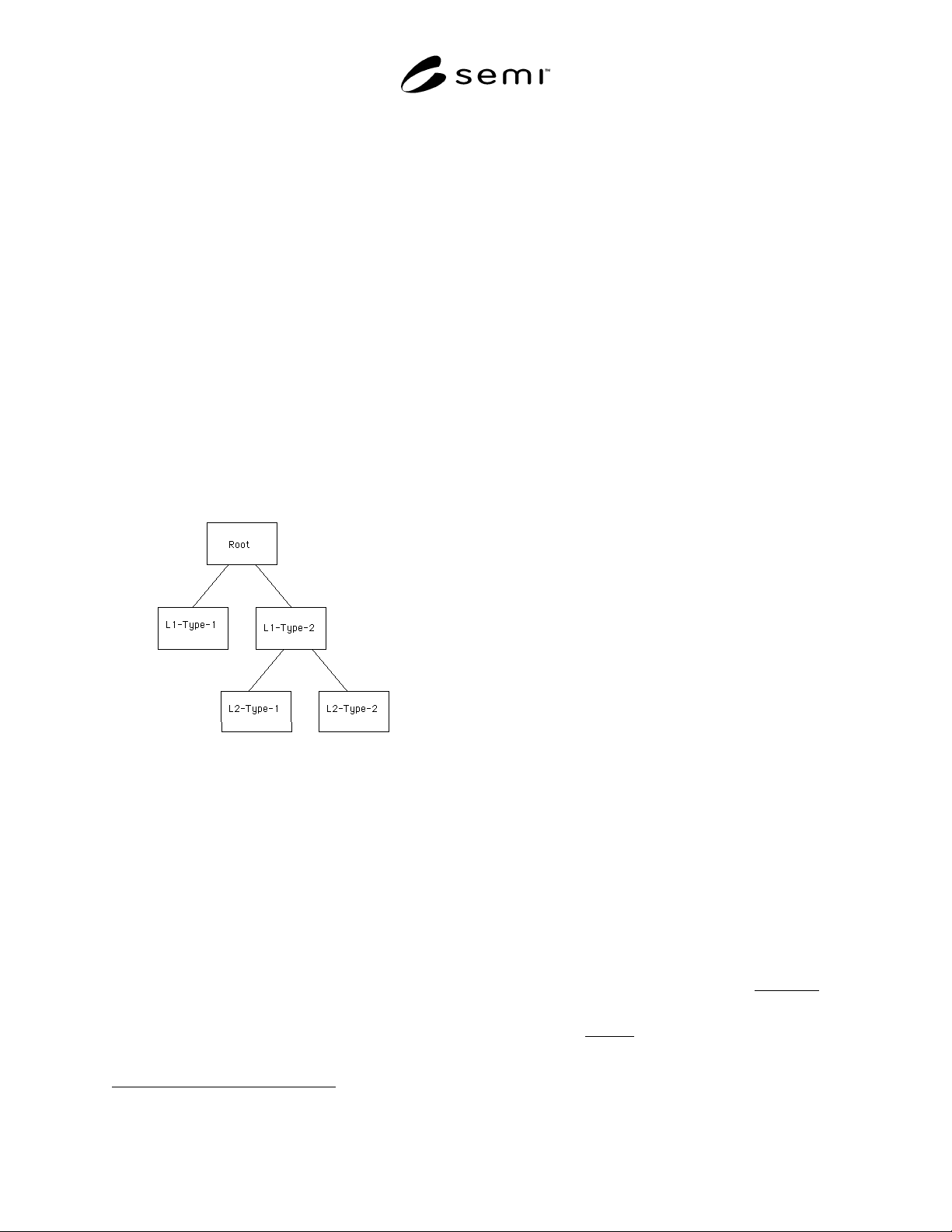
a multi-level tree structure, as shown in Figure 4.
Subordinate objects at one level may be the superior
objects at the next lower level. The superior object at
the highest level is called the root of the tree.
NOTE 1: Figure 4 is not drawn in OMT notation.
9.3.1 An owner object is an object that is an aggregate,
container, or supervisor. An owned object is an object
that is a component of, contained in, or supervised by,
an owner object.
9.3.2 Scope
7
is the concept and method of pointing to
a specific owned object through the use of sequence of
hierarchical relationships. Scope allows any particular
object (type or instance) within such a hierarchical tree
to be fully specified by providing a unique path down
this tree using a concatenation of object types and
identifiers.
Figure 4
Example of Owner Hierarchy
9.3.3 This path is used to create an object specifier that
is represented as a sequence of concatenated text strings
of the form “type:id>”, which may be repeated as
necessary to form the complete path. The character “>”
is used to terminate the object type field, and the colon
character “:” is used to terminate the identifier field.
The object specifier uniquely identifies an object within
the entire domain of objects and is able to extend the
domain within which a search for an object would
otherwise occur.
9.3.4 Formally, an object specifier is a formatted text
string of the form:
“type
1
:id
1
>...type
n
:id
n
>”
7 Scoping is used in material ISO 9595 (CMIS).
where “type
i
” and “id
i
” represent the object type and
object identifier, respectively, of the ith object instance
in the sequence, and where the ith object is owned by
the (i-1)th object and is the owner of the (i+ 1)th object.
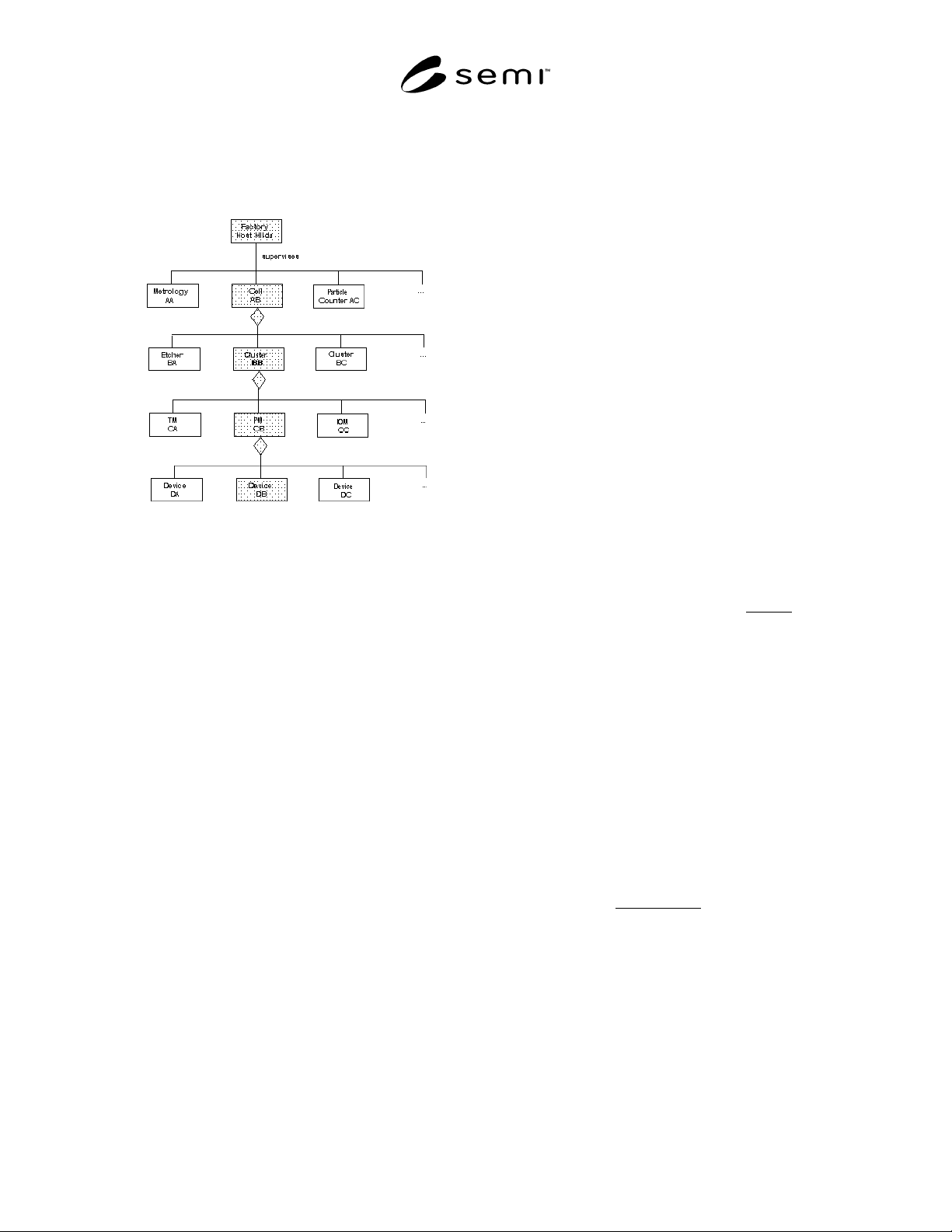
9.3.5 Figure 5 shows an example of a typical set of
hierarchical relationships in the factory. An application
of scope might be through Cell AB, Cluster BB,
Process Module (PM) CB, to Device DB. In this
example, the object specifier for Device DB would be:
“FactoryHost:Hilda>Cell:AB>Cluster:BB>PM:CB>
Device:DB>”
9.3.6 It is generally not necessary to start with the root
object. It is sufficient to start with an object that is
owned by the communications partner. However, it is
invalid to omit a level in the hierarchy that is between
the starting object and the final object in the path.
9.3.7 Some systems may be able to guarantee the
uniqueness of object identifiers for their owned objects.
For example, equipment may be able to guarantee that
all of its owned objects have unique identifiers
regardless of type. In this case, an object’s identifier is
sufficient to point to a specific object instance. Object
type may be omitted without ambiguity, as it may be
obtained as an attribute of the specified object. The
form of the path then becomes " id
1
>id
2
>.id
n
>" . In the
previous example, this might be " AB>BB>CB>DB>" .
9.3.8 Object type may also be omitted in applications
where it may be inferred without ambiguity within a
particular context. A service that is dedicated to a
specific object type X, for example, that is always
owned only by another specific object type Y, may
specify usage for object type X. Since object type may
then be inferred from the context, object types X and Y
need not be included in a specifier for an object of type
X.
9.3.9 The terminator of the final identifier is optional.
This allows a single object identifier to be used as a
simple object specifier. As a result, however, it may be
necessary to provide string delimiters to prevent
premature termination of string parsing in the event an
identifier contains one or more embedded spaces.
9.3.10 Scope can be applied to any set of hierarchical
relationships, given a minimum set of requirements for
public objects:
• an object always knows its own type (ObjType),
• an object always knows its own identifier(s)
(including ObjID),
• an owner object knows the types of objects that are
its components and/or contents, or that it otherwise
SEMI E39-0703 © SEMI 1995, 2003 10
supervises, and is able to determine their identifiers
(see GetType, Section 11.6),
• an owner object is able to determine the types and
identifiers of its owned objects.
Figure 5
Hierarchical Relationships in the Factory
9.4 Multiple Inheritance Hierarchy — Multiple
hierarchical inheritance may be required as an optional
capability for pointing to a specific object that provides
the same services from the inherited objects. Usually,
inherited services are implemented by the domain
object such that specifying “overrides” of attributes or
services from inherited objects is not required.
Sometimes the capability to override specified
attributes and services from inherited object is
necessary to resolve duplicated attribute names or
services or to allow duplicated names in user extended
objects.
9.4.1 If Andy an object TypeA inherits from object
TypeB and TypeC and a service requestor is focusing
services or attributes of the object TypeB rather than
those with the same name in the object TypeC, the
following text string form could specify the focused
part of the object Andy:
TypeA@TypeB:Andy
9.4.2 If any names of service and/or attribute that
TypeB provides are the same as those provided by
TypeA or TypeC, then, the object Andy will have to be
specified with the complete explanation from the
supplier as how the object handles the exception and
the differences from the original attribute or services.
So, the above expression is the same as “TypeA:Andy”
without notes to describe difference.
10 Additional Operations
10.1 This section defines operations that are common
to many types of public objects but are not required for
all types of public objects. These operations are not
required for OSS compliance. However, they may be
required for support of specific object types defined by
other standards that use OSS services.
10.2 Create and Delete — Creation and deletion are
optional services for object lifecycle management.
Object definitions may specify conditions under which
the services are supported. Objects may be created
and/or deleted in other ways. For example, the creation
and deletion of certain types of persistent objects may
be outside of the scope of OSS services, while transient
objects may be created and/or deleted automatically by
their owners as the result of other activities.
10.2.1 Create — The create operation creates an
instance of an object type.
10.2.1.1 Initial settings for one or more attributes may
be specified by the service user. Initial settings may be
required, prohibited, or optional, depending upon the
specific object type. The ability to set attribute values
through the create operation shall be clearly identified
as part of the object definition for those objects
supporting the create operation. For example, the ability
to set the value of the object identifier ObjID
may be
required, optional, or prohibited, depending upon the
type of object.
10.2.1.2 The object definition may also specify
attributes of the new object instantiation that are
returned to the service user by the service provider.
10.2.1.3 A request to create an object is invalid if it
does not provide all required attribute settings, if it
attempts to set prohibited attributes, or if it provides
values invalid for a given attribute.
10.2.1.4 The definitions of certain objects may specify
that the delete service only be provided to, or under the
authority of, the service user that requested the original
create operation. In this case, a private attribute (that is,
an attribute not accessible through services defined in
Section 11) named Delete Token
shall return a unique
integer as an attribute of the new object. This attribute
is then used in a subsequent request to delete the object.
The service user may delegate this token at its own
discretion.
10.2.1.5 The create operation is invoked by the service
Create sent to the owner that is to instantiate the
specified object. In order for the Create service to be
accepted if no owner for the object to be created is
defined in the target entity or if it is physically outside
of the domain of the entity; the object specifier shall
define the owner as “ ” (an empty string). If the entity