semi合集-English.pdf - 第3677页
SEMI PR8-0703 © SEMI 2003 7 Table 2 Messa geHeader XML Definit ion Tag Name Description XML Datatype Behavior mustUnderstand MessageHeader Container element for From/To/CorrelationId. complex Required 1 From Identifies t…
SEMI PR8-0703 © SEMI 2003 6
7.1.5 SOAP Binding — The SOAP binding specified in
this document shall be HTTP 1.1 in accordance with the
SOAP 1.1 W3C Note.
7.1.6 SOAP Message Style — Message encoding will
be XML document-style and not Remote Procedure
Call style. In document-style message exchange, XML
documents conforming to some application-defined
schema are exchanged via SOAP messages.
7.1.7 SOAP Action — The SOAP action HTTP header
field is used to facilitate dispatching individual
messages defined by this specification. The field will
contain a URI that indicates the specific operation in
the message. The URI will be a URN of the form:
“urn:semi-org:ws:eda_ps_v0.0:<OperationName>”.
Where OperationName corresponds to the name of the
root tag for each message.
7.1.8 SOAP Headers — This document specifies the
required use of a SOAP header element to describe the
source and destination of all messages between the
equipment and EDA clients (see Section 7.3.2 and to
correlate responses with requests (see Section 7.3.3).
The specification does not prohibit the use of additional
SOAP header elements, should an implementation of
this specification find them necessary.
7.1.9 SOAP encodingStyle — The SOAP
encodingStyle attribute is not used (i.e., not present on
any XML element information item) for the messages
defined in this specification.
7.1.10 SOAP Body — The SOAP body will contain an
XML fragment as defined in the Data Management and
XML Data Formats sections below.
7.2 SOAP Message Structure
7.2.1 Figure 3 shows the organization of each SOAP
message exchanged between the equipment and EDA
clients. This specification defines the value of the
SOAPAction HTTP header to use for each message
(see Sections 7.6.2.1 through 7.6.2.5), the SOAP
headers to be used for each message (Section 7.3), and
the elements that are included in the body of the SOAP
envelope for each message (see Sections 7.6.2.7 and
7.7).
HTTP Headers
SOAPAction
SOAP Envelope
SOAP Headers
<MessageHeader>
<From />
<To />
<CorrelationId /> (optional)
</MessageHeader>
SOAP Body
<IsEdaEnabled />, or
<ActivatePlan />, or
<EdaData />, or
<GetDefinedPlanIdsResponse />,
Etc.
Figure 3
EDA Message Structure
7.3 SOAP Headers
7.3.1 This section describes a SOAP header element
(MessageHeader) that can be used to facilitate different
messaging implementations on both the equipment and
EDA client side of the interactions defined in this
specification. The SOAP header defined in this section
is provided to identify the sender and recipient of each
SOAP message included in this specification, and to
associate a specific message with other messages sent
by a given entity.
7.3.2 There are two elements specified for the purpose
of identifying the sender and intended recipient of a
SOAP message: a “From” element and a “To” element.
Both are required elements in the MessageHeader
element of each message exchanged in an
implementation of this specification. These elements
identify the sender or intended recipient of a given
SOAP message. These identifiers can be used to route
a message to an appropriate entity for processing, to
distinguish a specific message from other messages
received from other sources, or as a simple mechanism
for enforcing access controls.
7.3.3 This section also defines an optional element
(“CorrelationId”) within the MessageHeader element
that can be used to associate related messages (for
example, a request and its reply) among all messages
sent and received by a given entity. The entity in the
client role generates a value for the CorrelationId that
would be used by the server entity in its reply to
establish the correlation. Use of this element is
optional, and communicating entities are not required to
process it in order to exchange the messages in this
specification.
SEMI PR8-0703 © SEMI 2003 7
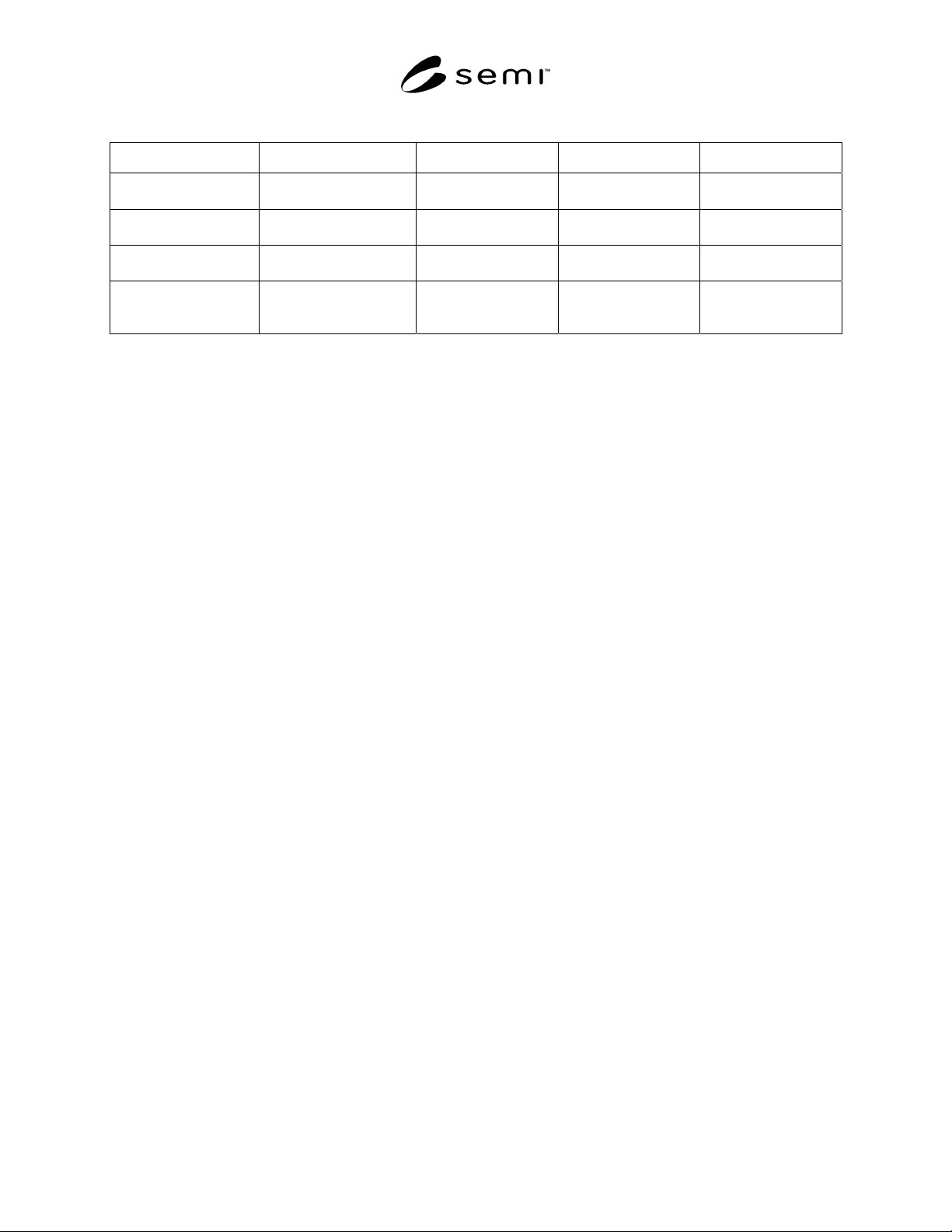
Table 2 MessageHeader XML Definition
Tag Name Description XML Datatype Behavior mustUnderstand
MessageHeader Container element for
From/To/CorrelationId.
complex Required 1
From Identifies the originator of
this message.
anyURI Required n/a
To Identifies the intended
recipient of this message.
anyURI Required n/a
CorrelationId Associates this message
with other messages in the
same message interaction.
string Optional (0 or 1) n/a
7.3.3.1 From Element — This element identifies the sender of a given SOAP message, whether the message is an
event, a request, or a response to a request. It is of XML type anyURI and can be any valid URL or URN. This
specification does not place any restriction on the format used to identify a sender, regardless of whether the sender
is the equipment or an EDA client. All messages originating from the same sender must provide the same value for
the From element so that the recipient may distinguish that sender from others.
7.3.3.1.1 Examples — Some examples of valid From elements are provided as follows:
• <From>urn:equipment-client:icm:utracking-01</From>
• <From>http://myfactory.com/furnace/KF011/EDA</From>
7.3.3.2 To Element — This element identifies the intended recipient of a given SOAP message. It is of XML type
anyURI and can be any valid URL or URN. This specification does not place any restriction on the form (URL or
URN) used to identify a recipient, regardless of whether the recipient is the equipment or an EDA client. All
messages intended for the same recipient must provide the same value for the To element so that the recipient may
distinguish that message from others intended for other recipients. If the message is a response to a request, the
value of the To element in the response must be equal to the value of the From element in the original request
message.
7.3.3.2.1 Examples — Some examples of valid To elements are provided as follows:
• <To>urn:equipment:robofurnace-inc:3JK9UI-02-99UI</To>
• <To>http://factory.icm.com/fdc/app-01</To>
7.3.3.3 CorrelationId Element — If used, the value of this element in the initial request message should be unique
for that client. Each request shall have a different CorrelationId value. For messages that are replies, the value shall
be equal to the value of the CorrelationId element provided in the original request message.
7.3.3.3.1 Examples — some examples of valid CorrelationId elements are provided as follows:
• <CorrelationId>5a389ad2-22dd-11d1-aa77-002035b29092</CorrelationId>
• <CorrelationId>4776</CorrelationId>
7.4 Equipment Configuration
7.4.1 Data Management Configuration — There shall be a persistent equipment configuration setting that controls
whether data management (see Section 7.6) is performed via SECS/GEM or via SOAP. The implementation and
behavior of this configuration setting is to be defined by the supplier, but shall not be implemented in such a way
that it is possible to perform data management via both SOAP and SECS/GEM concurrently. When the equipment
is configured to accept data management messages via SOAP, the equipment shall not accept these messages via
SECS/GEM. Likewise, when the equipment is configured to accept data management messages via SECS/GEM,
the equipment shall not accept these messages via SOAP. It must be possible for the factory to change this
configuration setting without requiring the involvement of the supplier.
SEMI PR8-0703 © SEMI 2003 8
7.4.2 EDA Client Configuration — There shall be a
persistent equipment configuration setting for each
EDA client that establishes the URL to which
equipment-initiated SOAP messages will be sent for
that client, and the value of the ‘From’ element of the
‘MessageHeader’ SOAP header that that client will use
in all client-initiated SOAP messages to the equipment.
If an EDA client will be performing data management
via SECS/GEM, it is not necessary to configure the
value of the ‘From’ element of the ‘MessageHeader’
SOAP header for that client, but the configuration must
indicate that the client can perform data management
via SECS/GEM. It must be possible for the factory to
change these configuration settings without requiring
the involvement of the supplier.
7.4.3 Equipment Identity Configuration — There shall
be a persistent equipment configuration setting that
establishes the value of the ‘From’ element of the
‘MessageHeader’ SOAP header that will be used for all
SOAP messages sent by the equipment. It must be
possible for the factory to change this configuration
setting without requiring the involvement of the
supplier.
7.4.4 Multi-Client Considerations — When the data
management interface configuration setting is set to
SECS/GEM, the equipment shall accept data
management messages only from the single configured
SECS/GEM client, and shall send all equipment-
initiated SOAP messages only to the single URL that
was configured for that client. When the data
management configuration setting is set to SOAP, the
EDA interface may be multi-client, if the equipment
supports this optional feature, and shall accept data
management messages from any valid configured EDA
SOAP client.
7.5 EDA State Models
7.5.1 EDA Communications State Diagram
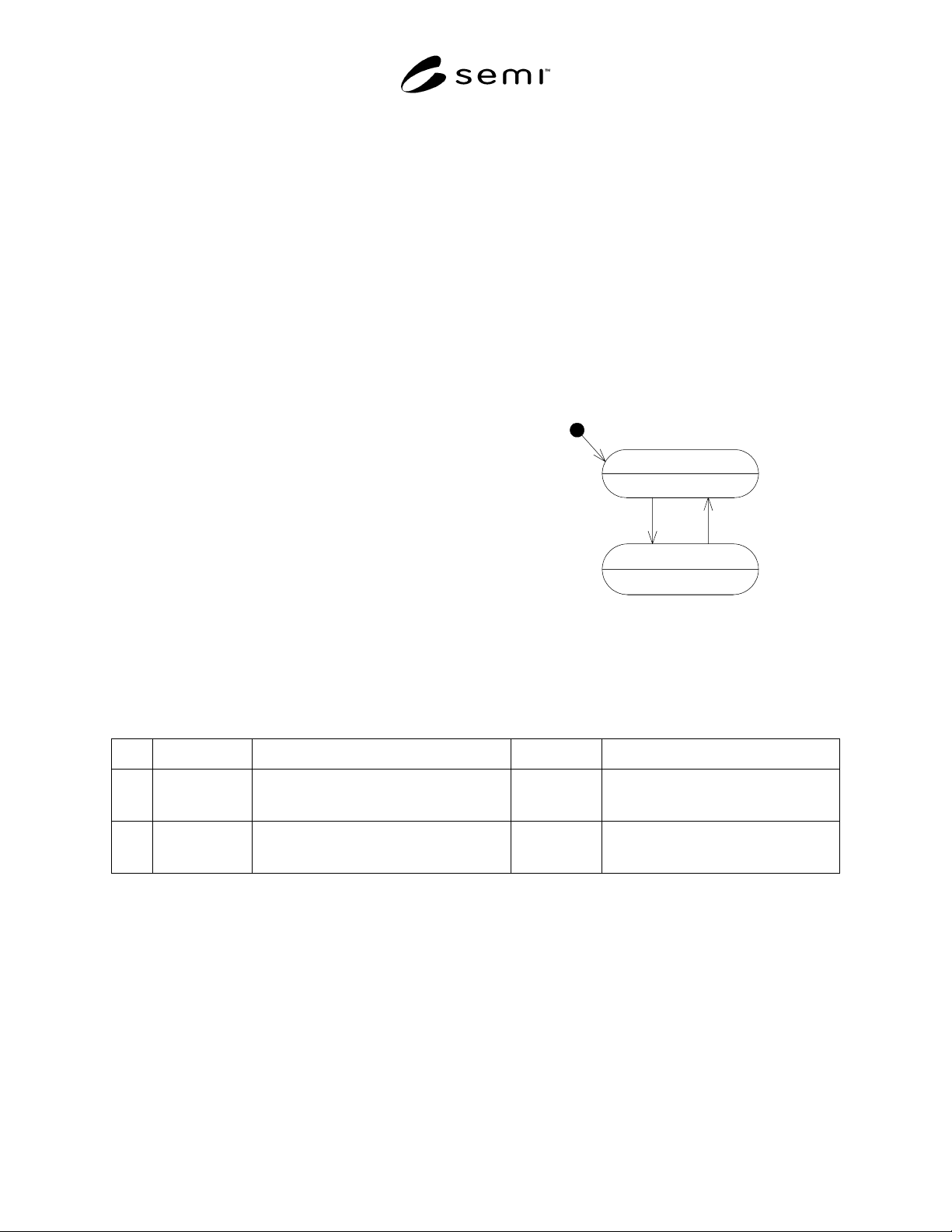
7.5.1.1 Figure 4 shows the state model for the
availability of the EDA interface to the factory. When
disabled, the equipment is not in a condition whereby it
can process data management messages, nor transmit
data to clients. When enabled, the equipment can both
process EDA data management messages, as well as
transmit data to clients.
EDADisabled
EDAEnabled
1 2
H
Figure 4
EDA Communications State Diagram
7.5.2 EDA Communications Transition Definition Table
Table 3 EDA Communications Transition Definition Table
Num Previous State Trigger New State Actions
1 EDADisabled Equipment powers up, achieves condition to
accept EDA data management requests and
transmit DCP data.
EDAEnabled For each configured client, equipment
begins sending EdaEnabled message, as
described in Section 7.7.4.1.
2 EDAEnabled Equipment is entering a state wherein it will
not be possible to perform EDA activities.
EDADisabled For each configured client, equipment
sends EdaDisabled message, as described
in Section 7.7.4.2.
7.5.3 Data Collection Plan State Diagram
7.5.3.1 Figure 5 shows the EDA client’s view of equipment behavior for each DCP defined on the equipment. Each
DCP for a given client follows this behavior model independently of every other DCP on the equipment. For
example, if client A activates “DCP1”, and client B does not, and client A subsequently requests the list of active
DCP’s from the equipment, “DCP1” will be returned in the list of active plans, because it is in the “Active” state for
client A. If client B requests a list of active DCP’s from the equipment, “DCP1” will not be returned in the list of
active plans, because client B did not activate “DCP1”, and it is still in the “Inactive” state for client B.