semi合集-English.pdf - 第4024页
SEMI F50-0200 © SEMI 2000 2 Utilit y Supplied Pow er Faciliti es Ele ctrical Distr ibution Sy stem Infrastructure Equi pment Process Equi pment Suppo rt Equipm ent Ut ilit y Services Facilities Sy stems Wafe r Processing…

SEMI F50-0200 © SEMI 20001
SEMI F50-0200
GUIDE FOR ELECTRIC UTILITY VOLTAGE SAG PERFORMANCE FOR
SEMICONDUCTOR FACTORIES
This guide was technically approved by the Global Facilities Committee and is the direct responsibility of the
North American Facilities Committee. Current edition approved by the North American Regional Standards
Committee on December 15, 1999. Initially available on www.semi.org February 2000; to be published
February 2000.
1 Purpose
1.1 This guide provides a framework for
semiconductor and flat panel display (FPD)
manufacturers and their electric utility service providers
to minimize the effect of voltage sag events on
semiconductor processing. In particular, this guide
focuses on electric utility power quality performance
goals that are complementary to voltage sag immunity
levels for semiconductor processing equipment and
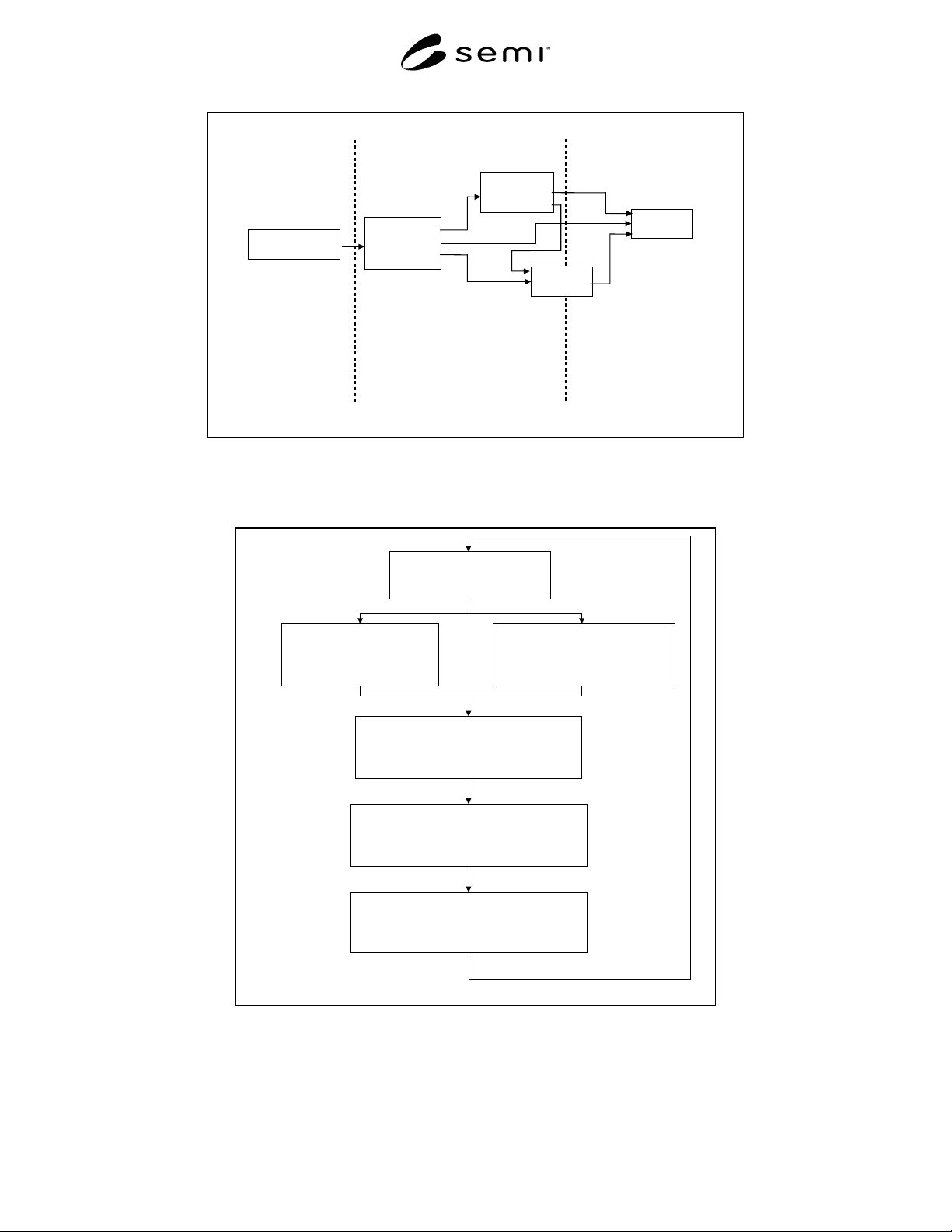
facilities infrastructure equipment (see Figure 1).
Recommendations for measuring and evaluating
voltage sag performance, evaluating utility system
enhancements, and implementation of a continuous
improvement process are included since no electric
utility industry standards exist.
1.2 Utility systems are designed, constructed, and
operated to meet utility industry regulations and
requirements. One important requirement for
semiconductor factories is power system reliability.
Utilities measure reliability in minutes of voltage
outages per customer per year. Semiconductor factories
require a high level of power system reliability, any
service outage is usually unacceptable. A second
important requirement is power quality. Power quality
relates to disturbed voltage waveforms, not outages.
When utilities implement measures to increase power
system reliability, power quality can be adversely
affected. The structured approach defined in this guide
can achieve high levels of power quality without
sacrificing power reliability.
1.3 The intent of this guide is to help semiconductor
manufacturers achieve both high levels of power
reliability and power quality from energy utility
providers. By becoming familiar with the cause and
effect relationships of voltage sag events on the utility’s
side of the electric meter, semiconductor manufacturers
and electric utilities can work together to pursue
efficient solutions for improved voltage sag ride-
through in semiconductor factories.
2 Scope
2.1 The scope of this guide extends beyond a
discussion of typical electric utility reliability and
quality improvement techniques to developing a
continuous improvement process for electric utility
voltage sag performance (depicted graphically in Figure
2). Factors in this process include the following:
• Define desired performance criteria by setting
goals for voltage sag event duration and magnitude
(see Section 6.1).
• Measure performance for both proposed and
existing semiconductor factory sites (see Section
6.2).
• Summarize voltage sag event data and identify the
impact on semiconductor processing and facilities
infrastructure equipment (see Section 6.3).
• Recommend improvements that include
consideration of cost, benefit, and risk.
Improvements can include corrective action to
eliminate system faults, changes to service
configurations, and power enhancements (see
Section 6.4).
• Select and implement improvements. Establish a
continuous improvement process (see Section 6.5).
2.2 For the purposes of this document, the term
Electric Utility refers to energy service providers (that
sell energy to semiconductor manufacturers) and/or
electric transmission and distribution providers (that
deliver energy through their power lines).
2.3 This guide does not purport to address safety
issues, if any, associated with its use. It is the
responsibility of the users of this guide to establish
appropriate safety and health practices and determine
the applicability of regulatory limitations prior to use.
SEMI F50-0200 © SEMI 2000 2
Utility Supplied
Power
Facilities
Electrical
Distribution
System
Infrastructure
Equipment
Process
Equipment
Support
Equipment
Utilit
y
Services
Facilities
Systems
Wafer
Processing
Systems
Power Monitoring
and Conditioning
Power Monitoring
and Conditioning
Ride-Through
Techniques
Covered in this
guide
for electric utility
voltage sag
performance
See industry guide for
semiconductor factory systems
voltage sag immunity.
See industry specification and
test method for semiconductor
processing equipment voltage
sag immunity.
Ride-Through
Techniques
Figure 1
Power Quality Interfaces
(See Related Documents section.)
Define Desired Performance
- Voltage Sag Magnitude/Duration
- Maximum Deviations per Year
Existing Sites
-
Define Monitor Protocol
- Monitor Performance
- Track and Report Events
Proposed Sites
- Define Site Selection Factor
- Monitor near Proposed Site
- Model Events
Summarize and Evaluate Dat
a
- Chart Data
- Correlate Events to Impact on Factory
- Categorize Events within Bins
Recommend Improvements
- Corrective Actions for System Faults
- Identify Service Configurations
- Review Enhancement Technologies
Select and Implement Improvements
-
Prioritize System Improvements
- Identify Action Plan and Define Expectations
- Implement Solutions
Figure 2
Continuous Improvement Process

SEMI F50-0200 © SEMI 20003
3 Limitations
3.1 This guide addresses electric utility power quality
monitoring and enhancement techniques primarily
related to semiconductor factory energy utility
providers. Process equipment and factory systems are
covered in other related standards.
3.2 This standard is not intended to address design or
materials issues related to safety which are addressed
elsewhere in the SEMI guidelines (see SEMI S2).
3.3 This document is not intended to supersede
international, national or local codes, regulations and
laws. Each should be consulted to ensure that the
equipment meets regulatory requirements in each
location.
4 Referenced Standards
4.1 SEMI Standards
SEMI S2 — Environmental, Health, and Safety
Guideline for Semiconductor Manufacturing Equipment
4.2 IEEE Standards
1
IEEE 1159 — IEEE Recommended Practice for
Monitoring Electric Power Quality
IEEE 1250 — IEEE Guide for Service to Equipment
Sensitive to Momentary Voltage Disturbances
IEEE 1346 — IEEE Recommended Practice for
Evaluating Electric Power System Compatibility with
Electronic Process Equipment
NOTE 1: As listed or revised, all documents cited shall be the
latest publications of adopted standards.
5 Terminology
5.1 electric utility — the company identified as the
contractual provider of electrical power and energy to
the customer point of delivery. Also known as the
electric service provider.
5.2 voltage sag — an rms reduction in the ac voltage
at power frequency for durations from half-cycle to a
few seconds (see IEEE 1250). Also known as voltage
dip.
6 Electric Utility Voltage Sag Performance
Recommendations
6.1 Define Voltage Sag Performance
6.1.1 Defining a goal for acceptable voltage sag
duration and magnitude is useful in establishing a
benchmark or reference point for monitoring
1 The Institute of Electrical and Electronic Engineers, Inc., 345 East
47th Street, New York, NY 10017-2394, USA
improvement. Events can be identified and categorized
within the realm of the electric utility or the
semiconductor manufacturer. Industry specifications
for semiconductor processing equipment voltage sag
immunity (which define the level of voltage sag
immunity required for semiconductor processing
equipment) are recommended as a performance goal.
Using this goal for the performance of electric utility
services will provide consistency with semiconductor
processing equipment capabilities. (See Related
Documents section.)
6.1.2 The goal for the maximum number of deviations
from specified performance per year is zero. However,
it is useful to recognize that utility generation,
transmission, and distribution systems are subject to
environmental and regulatory conditions that may
negatively influence the ability to provide zero
deviations on a continuous basis.
6.1.2.1 Document regulatory and environmental
requirements that will limit the electric utility’s choices
when implementing improvements, such as rate
structures or rights-of-way.
6.2 Measure Performance
6.2.1 Measuring Performance at Proposed Semi-
conductor Factory Sites
6.2.1.1 Factory site selection teams should consider
the importance of power and power quality when
evaluating potential sites. To insure that power quality
considerations are properly factored into the site
selection process, a selection factor should be assigned
to power quality and reliability criteria.
6.2.1.2 Utility electrical service configurations should
be considered when measuring and comparing
reliability and power quality performance at different
locations. The load profile for the proposed factory is
used to determine the standard utility electrical service
configuration. Usually, larger factories (> 10 MW)
exceed allowable loading for lower voltage distribution
systems (< 69 kV), therefore a high voltage service is
the typical configuration for larger semiconductor
factories. Selection of the highest available service
voltage is preferred for reliability due to two factors.
First, the area of exposure is greater for lower voltages
since they include both higher and lower voltage system
distribution lines and equipment. Second, higher
voltage systems can provide energy to lower voltage
system faults with little or no impact to high voltage
system voltages, whereas, lower voltage systems are
greatly impacted by faults not buffered by transformers.
6.2.1.3 The preferred method for comparing power
quality and reliability from different locations involves
creating a summary of the number of voltage sag events