semi合集-English.pdf - 第5058页
SEMI M21-0304 © SEMI 1992, 2004 3 6.2 Locate the Starting El em ent (0 ,0) as follows: 6.2.1 If the array center fa lls within an element, designate that element as the Starting Element (see Figure 3a). 6.2.2 If the arra…

SEMI M21-0304 © SEMI 1992, 2004 2
5.4 The array may have a tiled appearance, either with
one or more rows offset relative to the row containing
the Starting Element (row tiling) or with one or more
columns offset relative to the column containing the
Starting Element (column tiling).
5.4.1 For row tiling, the offset, t
r
, is a fraction (p
r
/q
r
) of
the horizontal element dimension, a, where p
r
and q
r
are
small whole numbers.
5.4.2 For column tiling, the offset, t
c
, is a fraction
(p
c
/q
c
) of the vertical element dimension, b, where p
c
and q
c
are small whole numbers.
5.4.3 In either case, the offset may be constant or it
may vary from row to row or column to column. When
the offset is constant, the array pattern is repeated every
q
r
rows or q
c
columns.
6 Element Addresses
6.1 Define the array center as the intersection of the
vertical and horizontal array centerlines, found as
follows:
6.1.1 If the array is regular (not tiled):
6.1.1.1 Count the number of elements, m, in the longest
row.
6.1.1.2 If m is even, start at the leftmost element, count
m/2 elements to the right, and construct a line along the
right vertical boundary of this element. This line is the
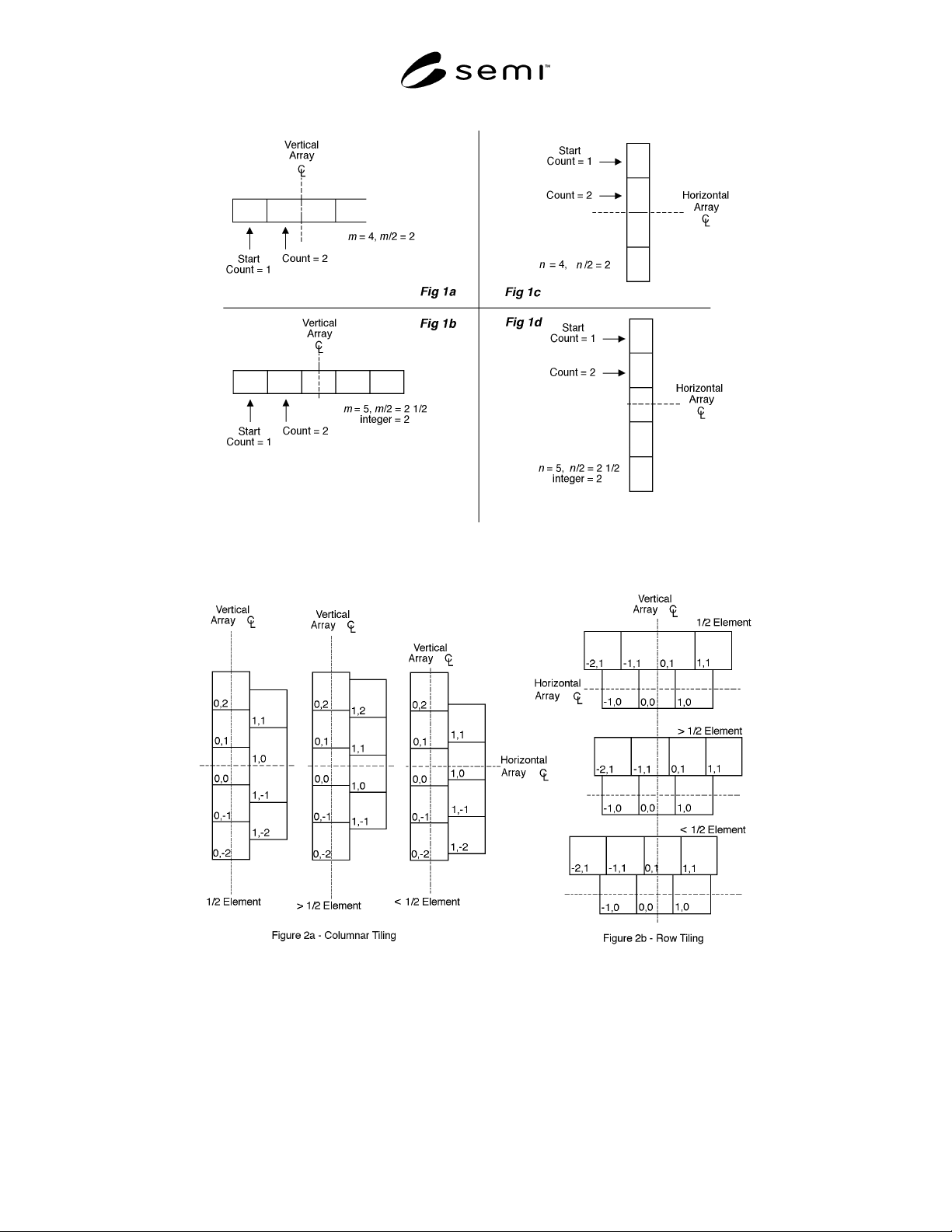
vertical array centerline (see Figure 1a).
6.1.1.3 If m is odd, start at the leftmost element, count
the integer of m/2 elements to the right, continue to the
next element to the right, and construct a line through
the center of this element. This line is the vertical array
centerline (see Figure 1b).
6.1.1.4 Count the number of elements, n, in the longest
column.
6.1.1.5 If n is even, start at the topmost element, count
down n/2 elements, and construct a line along the
bottom horizontal boundary of this element. This line is
the horizontal array centerline (see Figure 1c).
6.1.1.6 If n is odd, start at the topmost element, count
down the integer of n/2 elements, continue down to the
next element, and construct a line through the center of
this element. This line is the horizontal array centerline
(see Figure 1d).
6.1.2 If the columns of the array are tiled (see Figure
2a):
6.1.2.1 Count the number of columns, m, in the widest
part of the array from left to right.
6.1.2.2 If m is even, start at the leftmost column, count
m/2 columns to the right, and construct a line along the
right vertical boundary of this column. This line is the
vertical array centerline.
6.1.2.3 If m is odd, start at the leftmost column, count
the integer of m/2 columns to the right, continue to the
next column to the right, and construct a line through
the center of this column. This line is the vertical array
centerline.
6.1.2.4 Count the number of elements, n
′
, in the
column which contains or is immediately to the right of
the vertical array centerline, depending on whether m is
odd or even, respectively.
NOTE 1: The number, n
′
, is usually equal to but may be less
than n.
6.1.2.5 If n
′
is even, start at the topmost element, count
down n
′
/2 elements, and construct a line along the
bottom horizontal boundary of this element. This line is
the horizontal array centerline.
6.1.2.6 If n
′
is odd, start at the topmost element, count
down the integer of n
′
/2 elements, continue down to the
next element, and construct a line through the center of
this element. This line is the horizontal array centerline.
6.1.3 If the rows of the array are tiled (see Figure 2b):
6.1.3.1 Count the number of rows, n, in the widest part
of the array from top to bottom.
6.1.3.2 If n is even, start at the topmost row, count
down n/2 rows, and construct a line along the bottom
horizontal boundary of this row. This line is the
horizontal array centerline (see Figure 1c).
6.1.3.3 If n is odd, start at the topmost row, count down
the integer of n/2 rows, continue down to the next row,
and construct a line through the center of this row. This
line is the horizontal array centerline (see Figure 1d).
6.1.3.4 Count the number of elements, m
′
, in the row
which contains or is immediately above the vertical
array centerline, depending on whether n is odd or
even, respectively.
NOTE 2: The number, m
′
, is usually equal to but may be less
than m.
6.1.3.5 If m
′
is even, start at the leftmost element,
count m
′
/2 elements to the right, and construct a line
along the right vertical boundary of this element. This
line is the vertical array centerline.
6.1.3.6 If m
′
is odd, start at the leftmost element, count
the integer of m
′
/2 elements to the right, continue to the
next element to the right, and construct a line through
the center of this element. This line is the vertical array
centerline.

SEMI M21-0304 © SEMI 1992, 2004 3
6.2 Locate the Starting Element (0,0) as follows:
6.2.1 If the array center falls within an element,
designate that element as the Starting Element (see
Figure 3a).
6.2.2 If the array is regular and the array center lies at
an element corner, designate the element to the right
and immediately above the array center as the Starting
Element (see Figure 3b).
6.2.3 If the array is regular and the array center lies on
a vertical element boundary, designate as the Starting
Element that element which contains the horizontal
array centerline and is immediately to the right of the
vertical array centerline (see Figure 3c).
6.2.4 If the array is regular and the array center lies on
a horizontal element boundary, designate as the Starting
Element that element which contains the vertical array
centerline and is immediately above the horizontal
array centerline (see Figure 3d).
6.2.5 If columns of the array are tiled and the array
center lies on a vertical boundary between columns,
designate that element immediately to the right of the
vertical centerline and containing the horizontal array
centerline as the Starting Element. If the horizontal
array centerline also falls on an element boundary in the
column immediately to the right of the vertical array
centerline, designate the element in this column and
immediately above the horizontal array centerline as the
Starting Element (see Figure 4a).
6.2.6 If rows of the array are tiled and the array center
lies on a horizontal boundary between rows, designate
that element immediately above the horizontal array
centerline and containing the vertical array centerline as
the Starting Element. If the vertical array centerline also
falls on an element boundary in the row immediately
above the horizontal array centerline, designate the
element in this row and immediately to the right of the
vertical array centerline as the Starting Element (see
Figure 4b).
6.3 Assign addresses to the array elements as follows:
6.3.1 Elements along the horizontal array centerline:
6.3.1.1 If the horizontal array centerline passes through
an element, assign that element the address (i,0), where
i is the column number. The first column to the right of
the vertical array centerline is numbered 1, the next
column to the right is numbered 2, the next column to
the right is numbered 3, etc. Similarly, the first column
to the left of the vertical array centerline is numbered -
1, the next column to the left is numbered -2, the next
column to the left is numbered -3, etc. (see Figure 3a).
6.3.1.2 If the horizontal array centerline falls along an
element boundary in any column, i, assign the address
(i,0) to the element in that column which lies
immediately above the horizontal array centerline (see
Figure 3b).
6.3.2 Elements along the vertical array centerline:
6.3.2.1 If the vertical array centerline passes through an
element, assign that element the address (0,j), where j is
the row number. The first row above the horizontal
array centerline is numbered 1, the next row up is
numbered 2, the next row up is numbered 3, etc.
Similarly the first row below the horizontal array
centerline is numbered -1, the next row down is
numbered -2, the next row down is numbered -3, etc.
(see Figure 3a).
6.3.2.2 If the vertical array centerline falls along an
element boundary in any row, j, assign the address (0,j)
to the element in that row which lies immediately to the
right of the vertical array centerline (see Figure 3b).
6.3.3 Remaining elements:
6.3.3.1 Assign addresses (i,j) to the remaining elements
based on their position relative to the elements along
the horizontal and vertical array centerlines. For
example the address of the element immediately above
(1,0) is (1,1) and the element immediately below (1,0)
is (1,-1) (see Figure 5).
SEMI M21-0304 © SEMI 1992, 2004 4
Figure 1
Array Centerlines
Figure 2
Tiling