semi合集-English.pdf - 第3415页
SEMI E132.1-0305 © SEMI 2005 42 Table 79 XML Schema File Name E132-1-V0305-Schema.xsd Target Namespace urn:semi-org:xsd.E132-1.V0305.auth Imported/Referenced Namespaces http://www.w3.org/2001/XMLSchema urn:semi-org:xsd.C…
SEMI E132.1-0305 © SEMI 2005 41
8.3.9.3.1 See the portType operation definition for “CloseSession” in E132-1-V0305-SessionManager-
PortType.wsdl. Key information is shown for convenience in Table 77.
Table 77 CloseSession PortType Operation
Input Message Name
CloseSessionRequestMessage
Output Message Name CloseSessionResponseMessage
8.3.9.4 WSDL Operation Binding
8.3.9.4.1 See the operation binding for “CloseSession” in E132-1-V0305-SessionManager-Binding.wsdl. Key
information is shown for convenience in Table 78.
Table 78 CloseSession Operation Binding
SOAPAction
urn:semi-org:ws.E132-1.V0305.SessionManagerBinding:CloseSession
Input Headers (WSDL Message, Required) E132HeaderMessage, required
Output Headers (WSDL Message, Required) E132HeaderMessage, required
8.4 SessionClient Interface
8.4.1 Session Identifier
8.4.1.1 Equipment initiated SOAP messages such as equipment notifications are not required by SEMI E132 to be
send over an SSL channel, though equipment is still required to include the session identifier in all messages. Since
sending the session ID in plaintext is undesired, this specification defines a hashed session identifier to be included
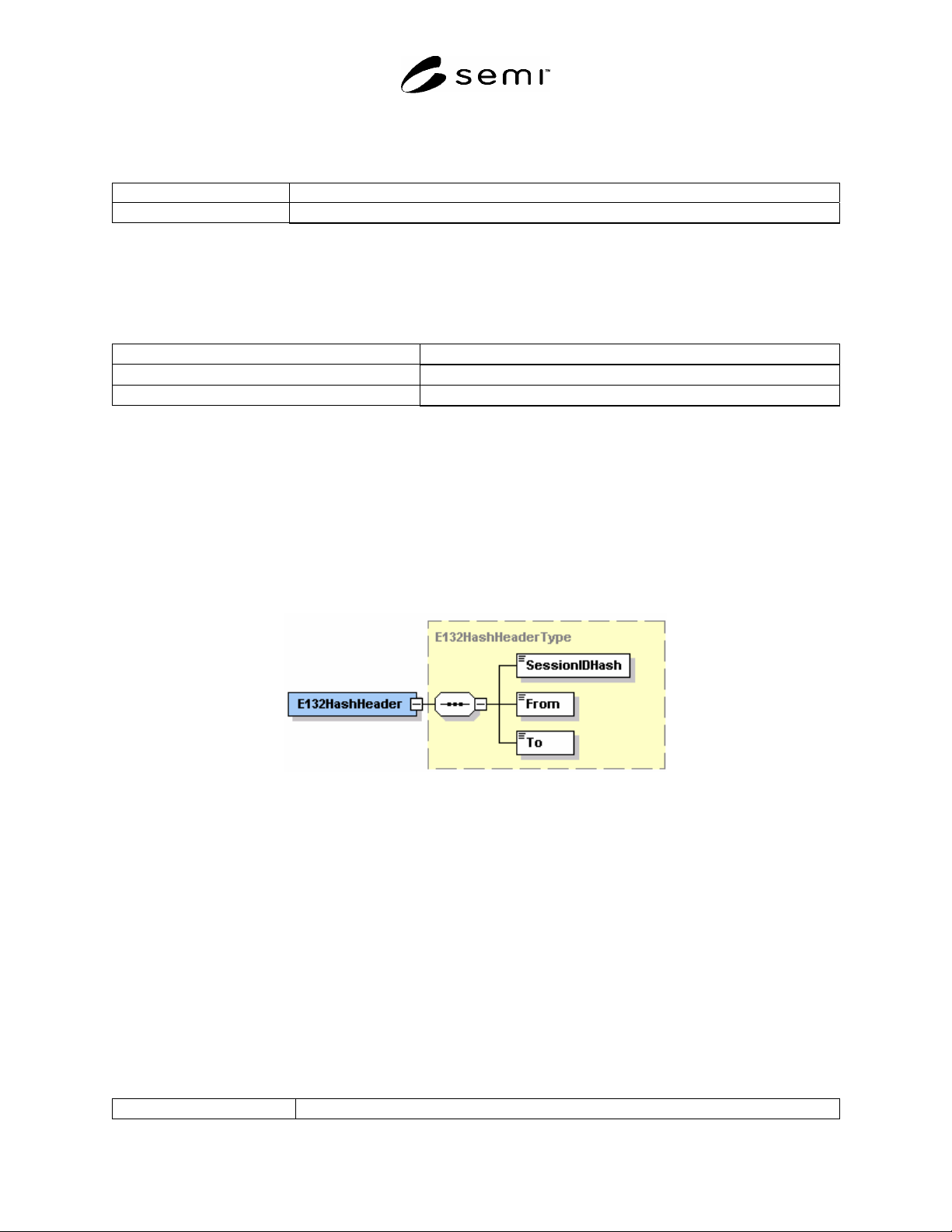
in the SOAP header. Figure 41 shows the XML Schema diagram for the E132HashHeader schema element. The
hashed session identifier is modeled as the XML element SessionIDHash of type xsd:base64Binary in the
E132HashHeader.
Figure 41
E132HashHeader Schema Element
8.4.1.2 The value of the SessionIDHash element is computed by first applying the SHA-1 hash function to the
session identifier, the resulting hashed output is then based 64 encoded. The session identifier must be converted to
a UTF-8 string prior to applying the hash. See SHA documentation reference in ¶4.4 for algorithm specification.
Base64Encoding is as specified in the XML Schema standard (part 2) referenced in ¶4.3.
8.4.1.3 All equipment initiated SOAP messages and corresponding responses over SEMI E132 authenticated
sessions shall include the E132HashHeader in the SOAP header.
8.4.2 The From/To fields are as described in ¶8.2.8.
8.4.3 XML Schema and WSDL Files
8.4.3.1 The XML Schema and WSDL defined by this specification for the SessionClient interface is contained in
the following documents:
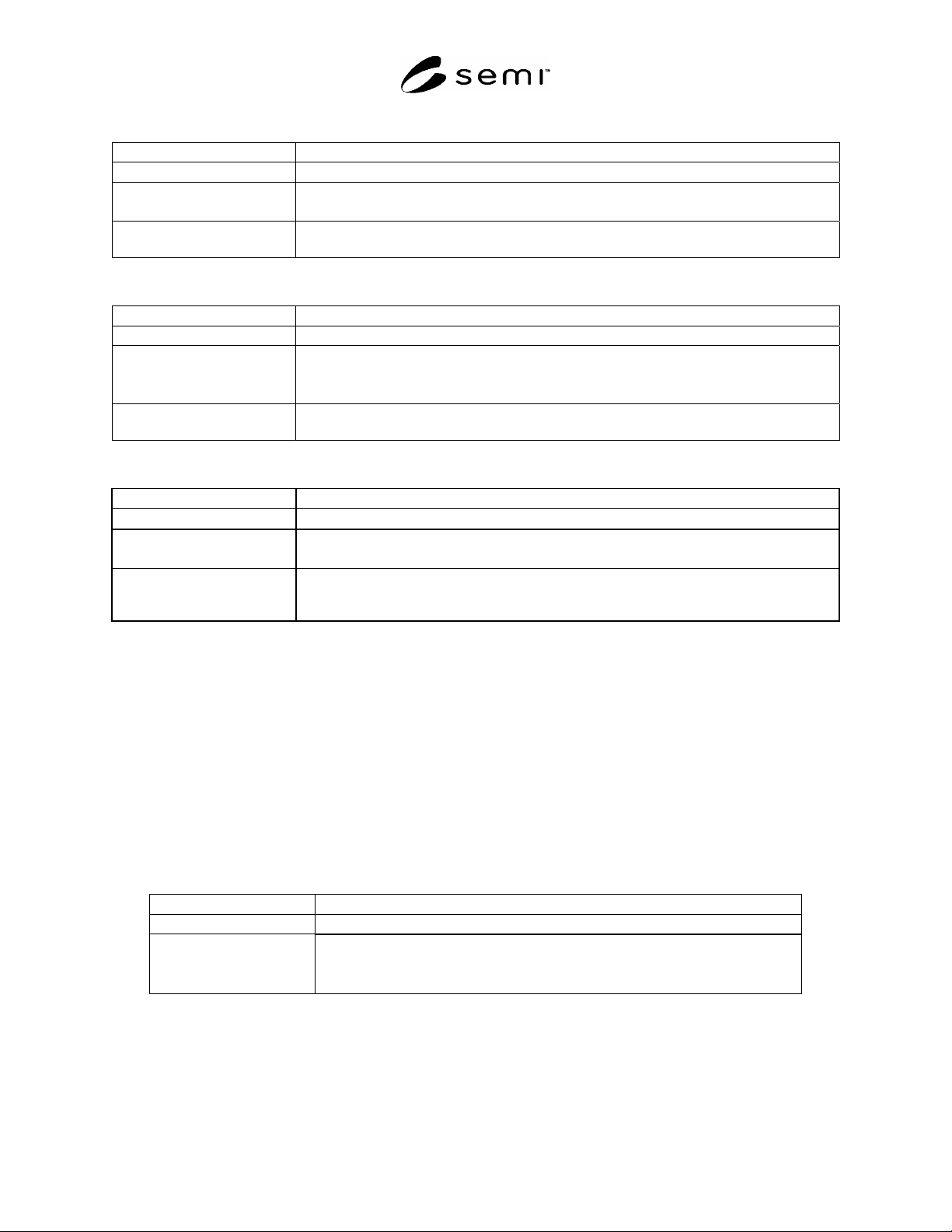
Table 79 XML Schema
File Name E132-1-V0305-Schema.xsd
SEMI E132.1-0305 © SEMI 2005 42
Table 79 XML Schema
File Name E132-1-V0305-Schema.xsd
Target Namespace urn:semi-org:xsd.E132-1.V0305.auth
Imported/Referenced
Namespaces
http://www.w3.org/2001/XMLSchema
urn:semi-org:xsd.CommonComponents.V0305.ccs
Description
This file defines all of the SEMI E132 data types and elements used by the SecurityAdmin,
SessionManager and SessionClient interfaces.
Table 80 SessionClient PortType Definitions
File Name E132-1-V0305-SessionClient-PortType.wsdl
Target Namespace urn:semi-org:ws.E132-1.V0305.sessClient-portType
Imported/Referenced
Namespaces
urn:semi-org:xsd.E132-1.V0305.auth
http://schemas.xmlsoap.org/wsdl/
http://www.w3.org/2001/XMLSchema
Description
This file defines all of the input/output messages and operations for the SessionClient interface,
based on the data types defined in the SEMI E132 XML Schema.
Table 81 SessionClient Binding Definitions
File Name E132-1-V0305-SessionClient-Binding.wsdl
Target Namespace urn:semi-org:ws.E132-1.V0305.sessClient-binding
Imported/Referenced
Namespaces
urn:semi-org:ws.E132-1.V0305.sessClient-portType http://schemas.xmlsoap.org/wsdl/soap/
http://schemas.xmlsoap.org/wsdl/
Description
This file binds the abstract portType definition to HTTP and SOAP, specifying required SOAP
and HTTP headers for each operation and the XML encoding style for the SessionClient
interface.
8.4.3.2 These documents are a part of this specification and should accompany this document. The contents of
these documents constitute the core part of this specification.
8.4.4 WSDL Port Type Overview
8.4.4.1 The SessionClient WSDL portType definition organizes the SEMI E132.1 XML Schema data types into a
collection of named operations with inputs and outputs that correspond to the UML operations that are defined for
the SessionClient interface in SEMI E132. The WSDL portType itself is named after the SEMI E132 interface, and
each WSDL portType operation is named after the corresponding UML operation defined for the interface. Each
WSDL operation consists of two WSDL message definitions corresponding to the input and output (request and
response) for the UML operation defined in SEMI E132. Table 82 describes the mapping between the UML
operations and WSDL operations. The WSDL message and operation definitions are described in more detail in
¶¶8.4.7 through 8.4.9 .
Table 82 SessionClient Port Type
SEMI E132 Class Name SessionClient
WSDL Port Type Name SessionClient
SEMI E132 Operation
WSDL Operation
SessionPing SessionPing
SessionFrozen SessionFrozen
SessionClosed SessionClosed
8.4.5 WSDL Binding Overview
8.4.5.1 The WSDL SessionClient binding definition specifies a message and transport protocol to use for a given
portType (SOAP and HTTP for SEMI E132.1), the interface style used (document style for SEMI E132.1). These
settings are shown in Table 83. For each WSDL portType operation, the binding defines any SOAP headers used
and whether or not they are required, the HTTP SOAPAction header value to use for that operation, and the XML
SEMI E132.1-0305 © SEMI 2005 43
encoding to use (literal for SEMI E132.1). The binding definitions for each portType operation are described in
¶¶8.4.7 through 8.4.9.
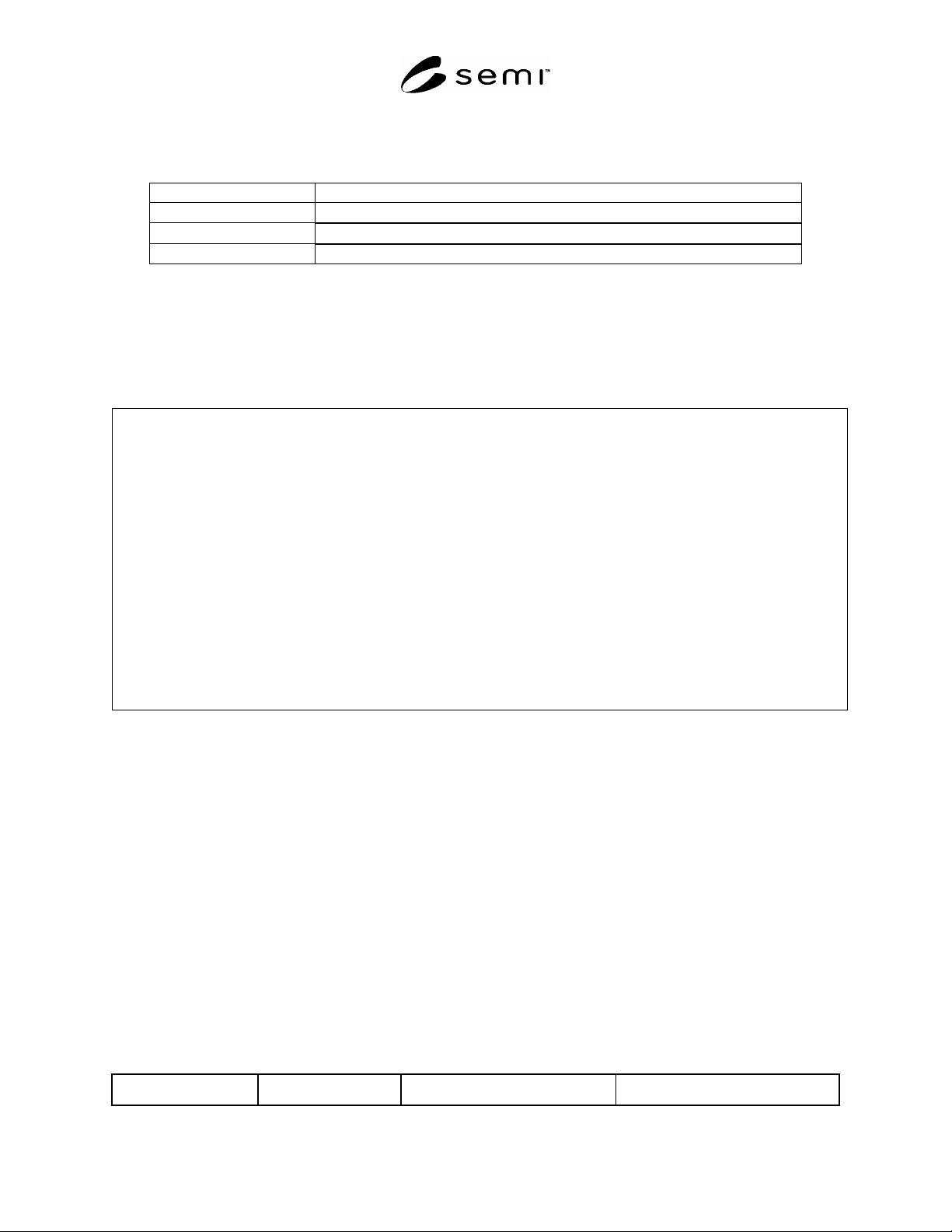
Table 83 SessionClient Binding
SEMI E132 Class Name SessionClient
WSDL Binding Name SessionClientBinding
SOAP Binding Style document
SOAP Transport http://schemas.xmlsoap.org/soap/http
8.4.6 WSDL Service Overview
8.4.6.1 This specification does not provide a WSDL service definition. WSDL service definitions provide one way
to define and locate the endpoint(s) at which a given interface can be accessed by a client. Such information cannot
be determined until the equipment has been installed on a factory network, and therefore is out of scope for this
specification. A sample SessionClient service definition is provided in Figure 42 for reference only.
<?xml version="1.0" encoding="utf-8"?>
<wsdl:definitions name="SessionClient"
xmlns="urn:semi-org:ws.E132-1.V0305.sessClient-service"
targetNamespace="urn:semi-org:ws.E132-1.V0305.sessClient-service"
xmlns:soap="http://schemas.xmlsoap.org/wsdl/soap/"
xmlns:wsdl="http://schemas.xmlsoap.org/wsdl/"
xmlns:SCBind="urn:semi-org:ws.E132-1.V0305.sessClient-binding">
<wsdl:import namespace="urn:semi-org:ws.E132-1.V0305.sessClient-binding"
location="E132-1-V0305-SessionClient-Binding.wsdl"/>
<wsdl:service name="SessionClient">
<wsdl:port name="SessionClientPort"
binding="SCBind:SessionClientBinding">
<soap:address location="http://www.someplace/SessionClient"/>
</wsdl:port>
</wsdl:service>
</wsdl:definitions>
Figure 42
Sample SessionClient WSDL Service definition
8.4.7 SessionPing Operation
8.4.7.1 XML Schema Types
8.4.7.1.1 This section describes the XML mappings for the classes defined in SEMI E132 for the SessionPing
operation.
8.4.7.1.2 SessionPing Request
8.4.7.1.2.1 The service request is mapped to the XML Schema element SessionPingRequest of type
SessionPingRequestType. There are no input parameters to this operation, so the schema element has no content.
See SessionPing operation of the SessionManager interface.
8.4.7.1.3 SessionPing Response
8.4.7.1.3.1 The service response is mapped to the XML Schema element SessionPingResponse of type
SessionPingResponseType. Table 84 shows how the output parameters are mapped to XML. See SessionPing
operation of the SessionManager interface for more details.
Table 84 Translation Table for SessionPing Output Parameters
Argument Name Format XML Element or Attribute XML Name/Type