semi合集-English.pdf - 第92页
SEMI E10-0304 E © SEMI 1986, 2004 6 the equipment to a condition where it can perform its intended function is includ ed in facilities-related downtim e. 5.10 NON-SCHEDULED STATE — The time (non - scheduled t i me) whe n…

SEMI E10-0304
E
© SEMI 1986, 2004 5
• Communications links with other equipment or
host computers.
5.8.6.1 Any downtime created by the items listed
above shall be included in facilities-related downtime.
For example, if, as a result of a scheduled 15-minute
power outage an otherwise unnecessary cryo pump
regeneration is needed, all time required to return the
equipment to a condition where it can perform its
intended function is included in facilities-related
downtime.
5.9 UNSCHEDULED DOWNTIME STATE — The
time (unscheduled downtime) when the equipment is
not in a condition to perform its intended function due
to unplanned downtime events:
• Maintenance delay (maint-delay)
• Repair
• Change of consumables/chemicals
• Out-of-spec input
• Facilities related (fac-rel)
5.9.1 Maintenance Delay — The time (maint-delay
downtime) during which the equipment cannot perform
its intended function because it is waiting for either user
or supplier personnel or parts (including
consumables/chemicals) associated with maintenance.
Maintenance delay may also be due to an administrative
decision to leave the equipment down and postpone
maintenance.
5.9.1.1 Maintenance delays may occur at any point in
the maintenance process. These maintenance delay
downtimes should be tracked separately from
maintenance time. Delay downtime is included in time
off-line, but not in maintenance time (see Sections 6.3
and 6.4 Equipment Availability and Maintainability).
5.9.2 Repair — The sum of the times (repair
downtimes) for:
• Diagnosis: The procedure of identifying the source
of an equipment problem or failure.
• Corrective action: The maintenance procedure
(including equipment ramp-down and ramp-up, re-
booting, resetting, recycling, restarting, reverting to
a previous software version, etc.) employed to
address an equipment failure and return the
equipment to a condition where it can perform its
intended function.
• Equipment test: The operation of equipment to
demonstrate equipment functionality (e.g., system
reaches base pressure, wafers transfer without
problem, gas flow is correct, plasma ignites, source
reaches specified power).
• Verification run: The processing and evaluation of
units after corrective action to establish that the
equipment is performing its intended function
within specifications.
5.9.3 Change of Consumables/Chemicals — The time
(change of consumables/chemicals downtime) for the
unscheduled interruption of operation to replenish the
raw materials of semiconductor processing. It includes
changes of gas bottles, acids, targets, sources, etc., and
any purging, cleaning, or flushing normally associated
with those changes. It does not include delays in
obtaining these consumables/chemicals.
5.9.4 Out-of-Spec Input — The time (out-of-spec input
downtime) when the equipment cannot perform its
intended function solely as a result of problems created
by out-of-specification or faulty inputs. Those inputs
include:
• Support tools (e.g., warped cassettes or wafer
carriers, faulty probe cards, reticles),
• Unit (e.g., upstream process problems, warped
wafers, contaminated wafers, warped lead frames),
• Test data (e.g., metrology tool out of calibration,
misread charts, erroneous data interpre-
tation/entry), and
• Consumables/chemicals (e.g., contaminated acid,
leaky target bond, degraded photo resist, degraded
mold compound).
5.9.4.1 Any downtime created by the items listed
above shall be included in out-of-specification input
downtime. For example, if, as a result of an
intermittent probe card short, a prober/tester system is
put down for repair, all downtime incurred prior to
identifying the problem is re-categorized as out-of-
specification input downtime.
5.9.5 Facilities Related — The time (facilities-related
downtime) when the equipment cannot perform its
intended function solely as a result of out-of-
specification facilities. Those facilities include:
• Environmental (e.g., temperature, humidity,
vibration, particle count),
• House hookups (e.g., power, cooling water, house
gases, exhaust, LN2), and
• Communications links with other equipment or
host computers.
5.9.5.1 Any downtime created by the items listed
above shall be included in facilities-related downtime.
For example, if, as a result of an unscheduled 15-
minute power outage, an otherwise unnecessary cryo
pump regeneration is needed, all time required to return
SEMI E10-0304
E
© SEMI 1986, 2004 6
the equipment to a condition where it can perform its
intended function is included in facilities-related
downtime.
5.10 NON-SCHEDULED STATE — The time (non-
scheduled time) when the equipment is not scheduled to
be utilized in production, such as unworked shifts,
weekends, and holidays (including shutdown and start-
up).
5.10.1 If equipment is out of the production plan due to
off-line training or an installation, modification,
rebuild, or upgrade (hardware or software) that cannot
be accommodated by the regular preventive
maintenance schedule, its status is the non-scheduled
state. This includes any qualification time required to
bring the equipment to a condition where it can perform
its intended function from one of these states.
5.10.2 Any maintenance done to equipment during
these periods cannot be counted in the non-scheduled
state, since all maintenance must fall into either
scheduled or unscheduled downtime (this includes
automatic maintenance routines such as a programmed
cryo pump regeneration).
5.10.3 By the same convention, any production or
engineering work done during these periods must fall
into either productive or engineering time (this includes
an unattended operation that may shut itself off “after
hours”).
6 RAM Measurement
6.1 Reliability, availability, and maintainability are
measures of equipment performance which have been
used widely in industry for decades. This section
defines them for the semiconductor industry in a
manner that is consistent with existing industrial
standards. Along with the definitions for RAM are
given indicators by which these measures can be
quantified.
6.2 EQUIPMENT RELIABILITY — The probability
that the equipment will perform its intended function,
within stated conditions, for a specified period of time.
NOTE 4: Two different methods of measuring this are
presented, productive time (Sections 6.2.1 and 6.2.2) and
equipment cycles (Sections 6.2.3 and 6.2.4):
• Productive time only considers what happens while
making units (useful for manufacturing operation
purposes).
• Equipment cycles take into account the wear and tear
created by every machine cycle during all equipment
states (useful for equipment reliability purposes).
6.2.1 MTBF
p
— Mean (productive) time between
failures; the average time the equipment performed its
intended function between failures; productive time
divided by the number of failures during that time.
Only productive time is included in this calculation.
Failures that occur when an attempt is made to change
from any state to a productive state are included in this
calculation. Using MTBF
p
, therefore, requires that the
user not only have the capability of capturing failure
information, but also tracking and categorizing total
time accurately.
time productive during occur that failures of #
time productive
MTBF
p
=
6.2.2 E-MTBF
p
— Mean (productive) time between
equipment-related failures; the average time the
equipment performed its intended function between
these equipment-related failures; productive time
divided by the number of equipment-related failures
during that time. Only productive time is included in
this calculation. Equipment-related failures that occur
when an attempt is made to change from any state to a
productive state are included in this calculation. Using
E-MTBF
p
, therefore, requires that the user not only
have the capability of capturing failure information, but
also tracking and categorizing total time and the root
causes of failures accurately.
productive time
# of equipment-related failures that
occur during productive time
E
–MTB
F
p
=
6.2.3 MCBF — Mean cycles between failures; the
average number of equipment cycles between failures;
total equipment cycles divided by the number of
failures during those cycles. This calculation
transcends equipment states to include all cycles that
the system, or subsystem, being considered
experiences. It does not require tracking equipment
states, only equipment cycles and equipment failures.
failures of #
cycles equipment total
MCBF =
6.2.4 E-MCBF — Mean cycles between equipment-
related failures; the average number of equipment
cycles between these equipment-related failures; total
equipment cycles divided by the number of equipment-
related failures during those cycles. This calculation
transcends equipment states to include all cycles that
the system, or subsystem, being considered
experiences. It does not require tracking equipment
states, only equipment cycles and equipment-related
failures and their root causes.
total equipment cycles
# of equipment-related failures
E
–MCB
F
=
SEMI E10-0304
E
© SEMI 1986, 2004 7
• Unworked shifts, days
•
Installation, modification
rebuild or upgrade
•
Off-line training
• Shutdown/Start-up
Non-Scheduled
Time
Total Time
Operations
Time
Uptime
•
Process experiments
• Equipment experiments
•
Software qualification
Engineering
Time
Manufacturing
Time
Productive
Time
• Regular production
• Work for 3rd party
•
Rework
• Engineering runs
Standby
Time
•
No operator
• No product
• No support tool
Downtime
•
Maintenance delay
•
Repair
•
Change of
consumables/chemicals
•
Out-of-spec input
•
Facilities related
Unscheduled
Downtime
Scheduled
Downtime
•
Maintenance delay
• Production test
• Preventive maintenance
•
Change of
consumables/chemicals
•
Setup
•
Facilities related
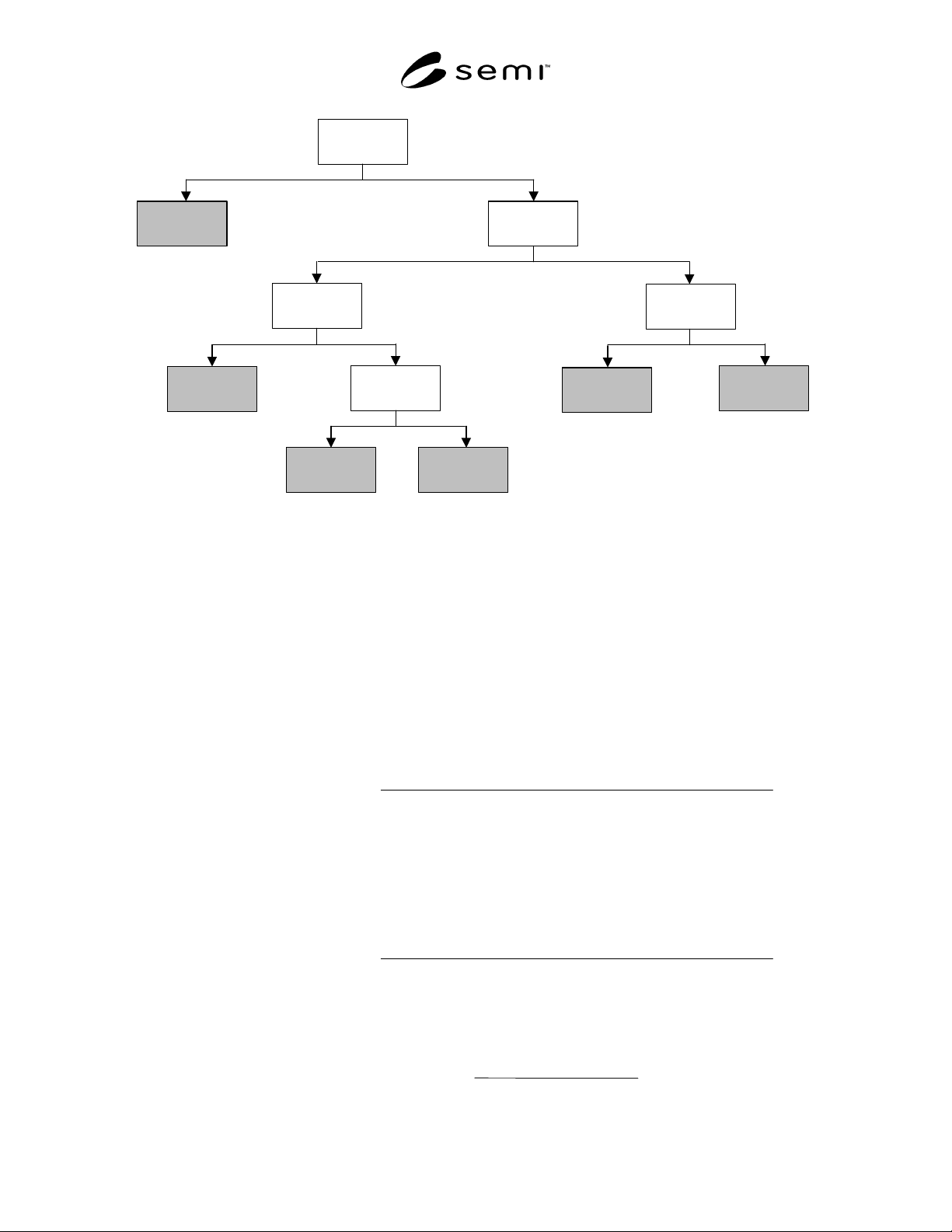
Figure 2
SEMI E10 Summary of Time
6.3 EQUIPMENT AVAILABILITY — The probability that the equipment will be in a condition to perform its
intended function when required.
6.3.1 Equipment Dependent Uptime — The percent of time the equipment is in a condition to perform its intended
function during the period of operations time minus the sum of all maintenance delay downtime, out-of-spec input
downtime, and facilities-related downtime. This calculation is intended to reflect equipment reliability and
maintainability based solely on equipment merit.
equipment dependent uptime (%) =
equipment uptime × 100
(oper-time – (all maint-delay DT + out-of-spec input DT + fac-rel DT))
6.3.2 Supplier Dependent Uptime — The percent of time the equipment is in a condition to perform its intended
function during the period of operations time minus the sum of user maintenance delay downtime, out-of-spec input
downtime, and facilities-related downtime. This calculation subtracts only user maintenance delay downtime from
the period, thereby taking into account supplier delays for parts and service. The intention is to provide an effective
performance measurement for use in supplier service contracts.
supplier dependent uptime (%) =
equipment uptime × 100
(oper-time – (user maint-delay DT + out-of-spec input DT + fac-rel DT))
6.3.3 Operational Uptime — The percent of time the equipment is in a condition to perform its intended function
during the period of operations time. This calculation is intended to reflect overall operational performance for a
piece of equipment.
operational uptime
(%)
=
equipment uptime
×
100
operations time